
You may be searching for social dance lessons after watching a couple move easily across a Philadelphia dance floor, or after realizing that your wedding dance, first class, or next night out would feel better with a little preparation. Perhaps you're also wondering whether you need a partner, natural rhythm, or any previous experience. You don't. Social dance is a learnable system of movement, listening, timing, and connection, and a good instructor gives you a clear way into it.
Social dancing also has a substantial recreational foundation. In England, 16.0% of adults engaged in dance in 2016/17, compared with 16.9% in 2010/11, while 11.6% attended a dance event and 6.7% took part in dance activities in 2016/17, according to a report summarized in Frontiers in Sports and Active Living. Those figures reflect a simple truth: people dance for many reasons, including recreation, exercise, friendship, celebration, and self-expression.
What Social Dance Lessons Feel Like for First Timers
You arrive a few minutes early, check your shoes, and notice that everyone else seems to know exactly where to stand. Then an instructor smiles, introduces themselves, and asks you to begin with something much simpler than a full routine: walking to the beat, shifting your weight, and finding the rhythm in the music.
That first moment often surprises nervous beginners. A social dance lesson isn't an audition, and you won't be expected to perform a polished routine immediately. The class usually develops in small pieces, beginning with posture and timing before adding a basic pattern, a turn, or a change of direction.
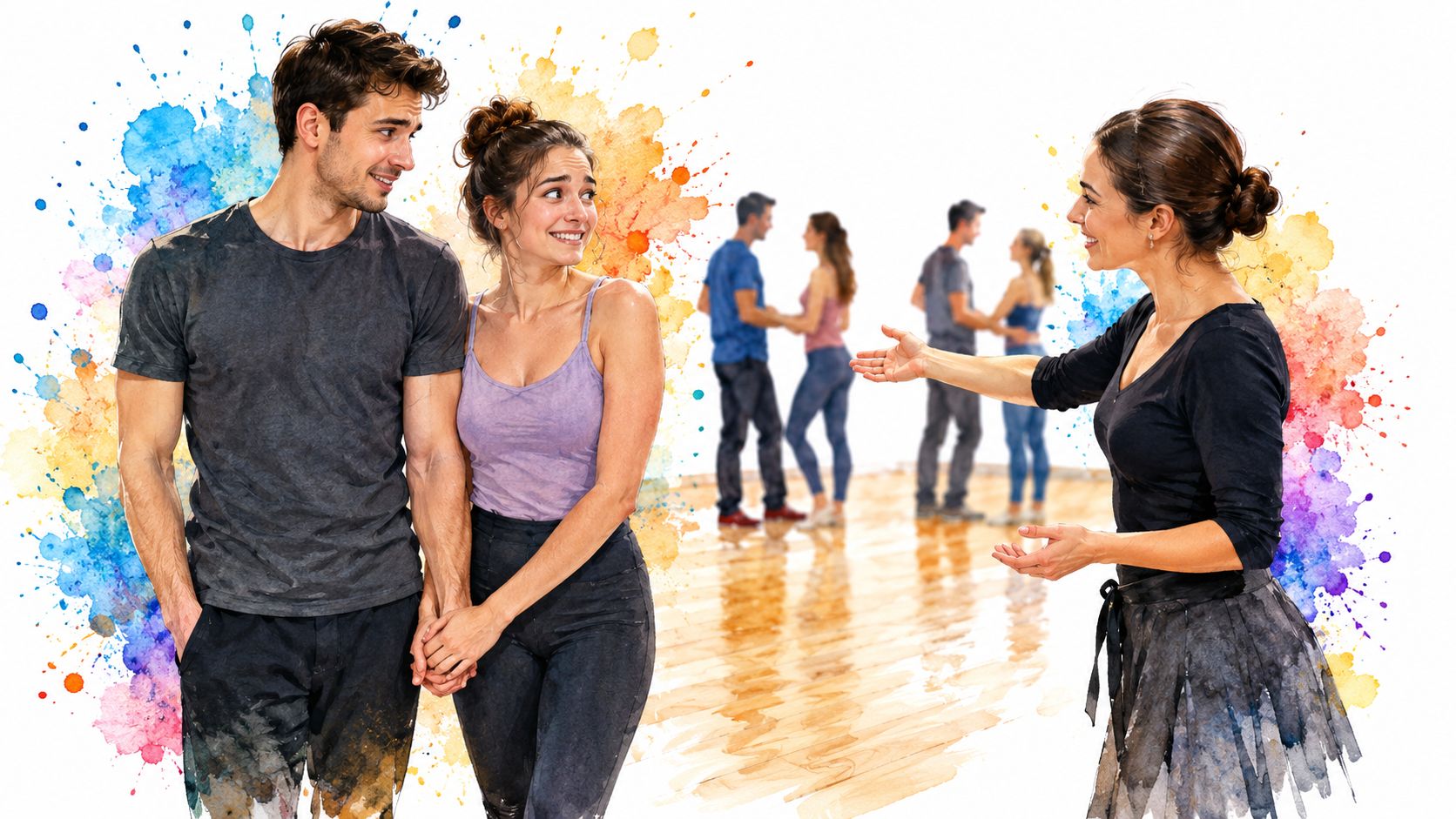
You won't need to arrive with a partner
Many studios rotate partners during group classes. That arrangement gives you practice adjusting to different heights, rhythms, and communication styles, while keeping the class active and welcoming. If you arrive with a spouse, friend, or fiancé, you can still dance together, but you won't be isolated if your partner misses a class.
The instructor may first demonstrate a pattern with another teacher or student. You'll then try it slowly, receive a correction, and repeat it with music. Mistakes are expected because they give the instructor useful information about what to explain next.
A useful first-class rule: Your job isn't to look experienced. Your job is to notice the beat, listen to your partner, and stay curious.
Social dance lessons teach more than steps. You learn how to begin and end a dance politely, share space, respond to another person, and recover when a pattern goes wrong. That combination is why social dancing feels different from memorizing choreography alone.
If public dancing makes you tense, practical preparation can help. Danza Academy's guide to overcoming fear of dancing in public offers another way to think about the nerves that appear before your first class.
The atmosphere matters, too. At a welcoming Philadelphia studio, encouragement should be part of the instruction, not an extra reserved for advanced dancers. By the end of a first lesson, you may not know every step, but you should understand what you're practicing and feel that improvement is within reach.
How Social Dance Lessons Work and What You Actually Learn
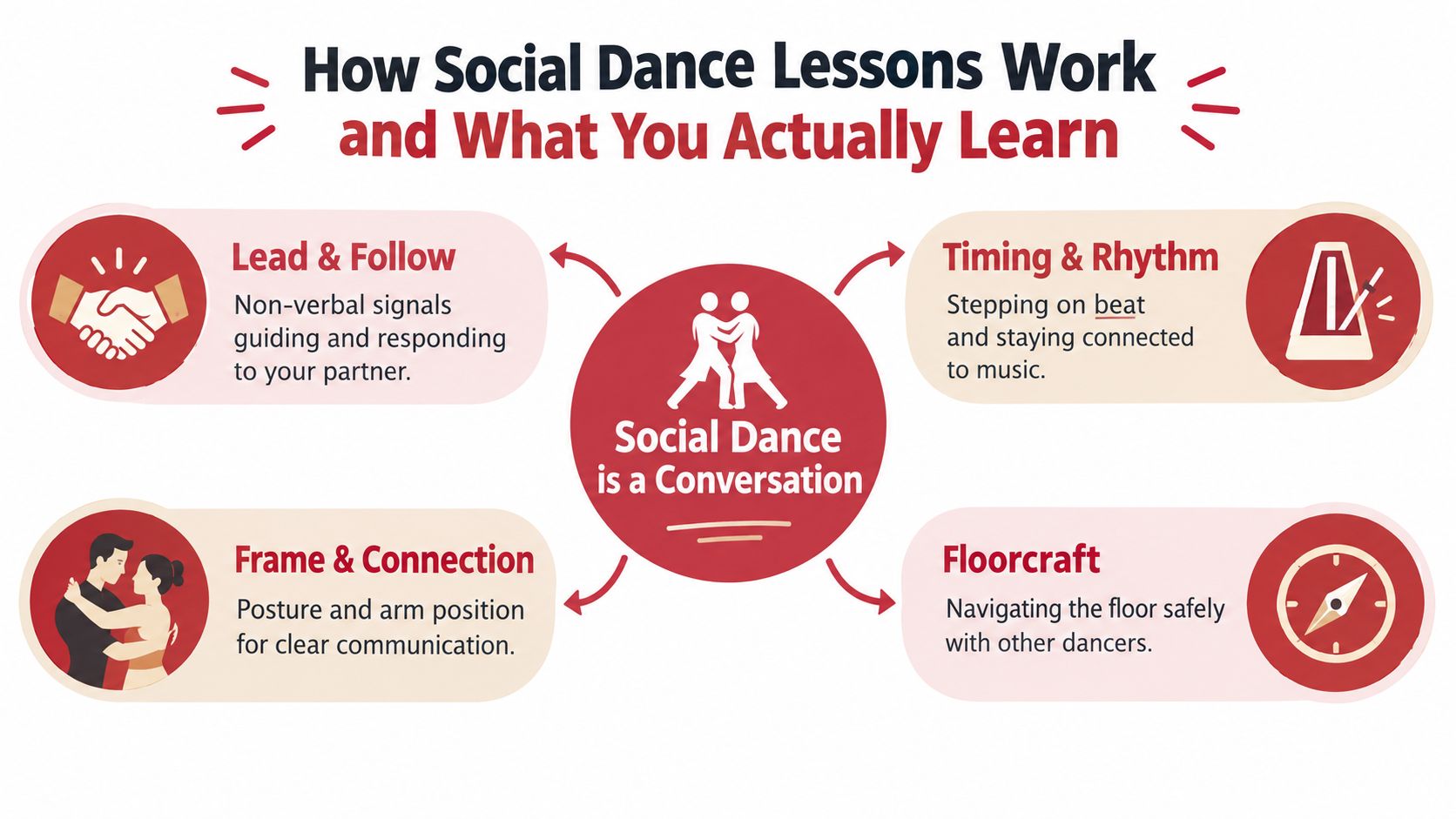
Social dance is best understood as a conversation. One partner suggests a direction through body movement, and the other responds. Both dancers listen to the music, maintain balance, and adjust to what happens in the room.
This doesn't mean one person controls everything while the other passively follows. In lead and follow, each role requires attention, timing, and responsibility. The lead communicates clearly without forcing, while the follow stays receptive without guessing every movement in advance.
The foundation builds in layers
Most beginners benefit from learning these ideas in a practical order:
- Rhythm comes first. You identify the pulse, transfer weight cleanly, and step in time.
- Posture creates options. A balanced body makes turns, changes of direction, and partner communication easier.
- Connection carries information. Your hands, arms, torso, and movement direction help communicate what comes next.
- Patterns organize the conversation. A basic box, rock step, chasse, or walking sequence gives you material to use socially.
- Musicality adds choice. You learn to recognize accents, phrasing, tempo, and the character of a song.
Frame is the comfortable structure created by posture and arm position. It shouldn't feel stiff or heavy. A clear frame lets partners exchange information while keeping their own balance.
Floorcraft is another essential skill. You learn to watch the space around you, avoid collisions, adapt a pattern when another couple enters your path, and keep dancing when the room becomes crowded. That's one reason social dance lessons differ from practicing alone in front of a mirror.
Practice turns information into instinct
An instructor may explain a pattern verbally, demonstrate it visually, and then guide you through it slowly. Repetition helps your body recognize the movement so you have more attention available for music and your partner.
Talent isn't the main dividing line between beginners who progress and those who stop. Consistent attendance, focused repetition, and asking clear questions usually matter more. To explore the musical side in greater depth, read this explanation of what musicality in dance means.
The goal isn't to execute every step perfectly before you enjoy yourself. It's to build enough understanding that you can make a mistake, recover, and continue the conversation.
Popular Social Dance Styles You Can Explore
Choosing a style becomes easier when you compare the experience rather than memorizing labels. Ask yourself what kind of music makes you want to move, whether you prefer a close or open connection, and whether you enjoy smooth travel, dramatic pauses, playful rhythm, or energetic turns.
The history of social dance also explains why studios offer such a broad menu. The Metropolitan Museum of Art's overview of social dancing frames social dance as an evolving tradition, while a popular dance timeline places major milestones across different periods. Polka, Mazurka, Galop, and Waltz Cotilon spread in the late nineteenth century, followed by waves including the 1920 Charleston, 1930s Lindy Hop and dance marathons, 1940s Rumba and Swing, and 1950s Mambo.
Match the style to the experience
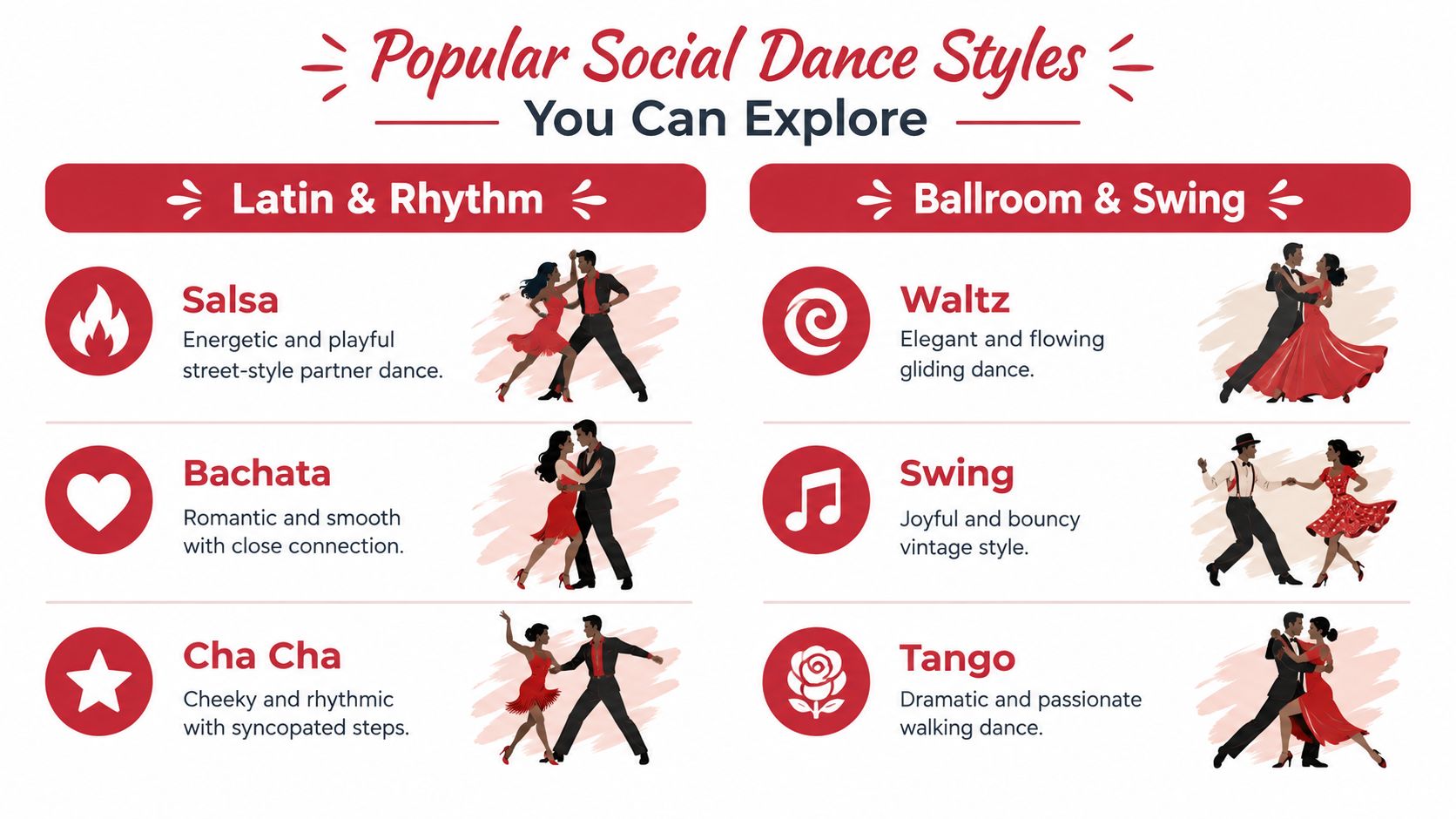
- Salsa feels energetic, social, and playful, with clear rhythmic changes and opportunities for turns.
- Bachata uses a smoother, closer connection and often appeals to beginners who enjoy romantic music and grounded movement.
- Cha-Cha has a cheeky character, syncopated steps, and a lively rhythmic identity.
- Waltz offers gliding movement, graceful rise and fall, and a spacious feeling.
- Swing brings bounce, musical play, and a joyful vintage atmosphere.
- Tango emphasizes walking, direction, pauses, and dramatic musical interpretation.
- Rumba rewards patience, controlled weight changes, and expressive timing.
- Foxtrot develops smooth walking and elegant phrasing.
- Samba brings rhythmic energy and a strong connection to musical accents.
- Hustle, West Coast Swing, and Country Two-Step each offer distinct social settings, from disco-inspired movement to elastic contemporary patterns and traveling country-floor combinations.
This Latin and ballroom dancing lesson guide can help you compare two broad families before choosing a first class.
| Style Family | Example Dances | Music and Vibe | Best For Beginners Who Want |
|---|---|---|---|
| Latin and Rhythm | Salsa, Bachata, Cha-Cha, Rumba, Samba, Hustle | Energetic, expressive, rhythmic, and often playful | Turns, musical accents, and lively partner interaction |
| Ballroom and Smooth | Waltz, Foxtrot, Tango, Quickstep | Elegant, flowing, structured, or dramatic | Poise, traveling movement, and classic partner dancing |
| Swing and American Social | Swing, West Coast Swing, Country Two-Step | Bouncy, relaxed, adaptable, and social | Improvisation, groove, and casual floor confidence |
Watch a short visual example before your first class, but don't assume you must reproduce everything immediately.
A good starting shortlist is Salsa, Waltz, and Swing if you're unsure. Try more than one when possible, then choose the style that makes you want to return.
Class Formats That Match Your Goals and Schedule
The right class format depends less on your current ability than on what you want the lessons to accomplish. A weekly group class can make dancing part of your routine, while a private lesson can address a specific challenge with focused feedback.
Group classes create repetition and community
Group lessons suit adults who want a structured weekly activity, social exposure, and the energy of learning alongside other beginners. Partner rotation gives you varied practice, and the instructor can introduce a progression that builds from fundamentals into usable patterns.
Private lessons work differently. The instructor can slow down a difficult movement, adjust your posture, tailor the material to your body, or focus on a goal such as wedding choreography, confidence, or competition preparation. Couples may choose private instruction when they want dedicated time together, while solo students may use it to correct a technical habit before returning to group classes.
Workshops and specialty tracks serve milestones
Workshops concentrate on a theme, style, or skill. They're useful when you want an intensive experience, a new challenge, or extra practice with musicality and styling. Showcases add a performance objective, which can motivate dancers who enjoy preparation and presentation.
Specialty tracks need a clear outcome:
- Wedding preparation turns a first dance into a manageable sequence with music choices, transitions, and practice goals.
- Kids' programs use structured movement to develop coordination, confidence, listening, and participation.
- Competitive training adds detailed technical coaching, performance quality, conditioning, and strategic preparation.
A simple decision matrix can clarify your first step:
| Your Goal | Useful Starting Format | Why It Fits |
|---|---|---|
| Meet people and learn social basics | Group class | Builds repetition and comfort with different partners |
| Prepare a wedding dance | Private lessons | Keeps instruction centered on your music and timeline |
| Explore a new style | Workshop or introductory group class | Offers focused exposure before a longer commitment |
| Support a child's confidence and coordination | Kids' program | Provides age-appropriate structure and encouragement |
| Prepare for performance or competition | Private coaching plus specialty training | Allows detailed correction and milestone planning |
You can combine formats without trying to do everything at once. For many dancers, group lessons provide the social foundation, while occasional private instruction resolves specific questions.
Why Social Dance Lessons Are Good for Body Mind and Connection
Dance gives you a reason to coordinate your body, make decisions in real time, and stay engaged with another person. That combination helps explain why people often experience social dance as more sustainable than exercise that feels repetitive or isolated.
A partner-dance study reported that 84% of participants perceived improved physical fitness and 92% perceived improved coordination, with gains also reported in cognitive functioning, social functioning, mood, and self-confidence. The study found that benefits increased as participants danced more frequently and for longer periods. Read the partner-dance research in full.
Your body learns control, not just exertion
Stepping, turning, balancing, and changing direction ask your body to coordinate several actions at once. Lessons can improve awareness of weight placement, posture, timing, and lower-limb stability. These qualities matter when you dance, but they also influence how confidently you move through ordinary activities.
Structured conditioning deserves attention, especially when dancers add volume or pursue demanding technique. In a randomized controlled investigation of professional ballet dancers, the intervention group had an 82% lower injury rate, with a hazard ratio of 0.18, a 95% confidence interval of 0.04 to 0.78, and p=.022. The time between injuries was 45% longer than in the control group, and the authors connected the benefit with reduced muscular fatigue, improved balance, and correction of muscular imbalances, as reported in this professional ballet injury-prevention study.
The mental benefit comes from active participation
A systematic review reported that structured dance programs lasting at least six weeks can improve psychological and cognitive outcomes, including emotional well-being, depression, motivation, social cognition, and some aspects of memory. The review also found dance generally comparable with other structured physical activity interventions for many mental-health measures, according to this summary of the systematic review.
Another review of dance and health describes benefits across cognitive function, physical health, stress reduction, self-perception, mental health, and community connection. These findings don't mean one class solves every problem. They do support treating regular dance as a meaningful practice rather than a novelty.
Connection also has a specific, nuanced role. A study of adult romantic couples found a significant increase in intimacy after partnership dance classes, but no significant increase in trust and only limited change in attachment style, as described in this study of couples and partnership dance. Dance may help couples feel closer without functioning as automatic relationship repair.
How to Choose a Studio and Prepare for Your First Lesson
Start with the teaching environment, not the most impressive-looking class description. A strong studio should explain who teaches the class, what beginners can expect, how students progress, and whether the lesson fits your goal.
Use a practical studio checklist
- Teaching approach: Look for instructors who explain technique, musicality, partner communication, and floor safety rather than showing combinations without context.
- Class calendar: A varied schedule gives you room to find a sustainable day, style, and level.
- Location: Philadelphia students may compare a Center City studio with an option in Exton, PA, based on commute and long-term consistency.
- Culture: Ask whether solo students are welcome, whether partners rotate, and how instructors support mistakes.
- Format: Confirm whether the studio offers group classes, private lessons, workshops, practice parties, wedding preparation, kids' programs, or competitive coaching.
- First visit: A complimentary introductory lesson can show you more about the teaching style than a website description can.
Pricing varies by format, instructor, and goal, so ask for the full structure before enrolling. Find out what's included, whether practice opportunities are available, and which schedule the studio recommends for your objective.
Make lesson one comfortable
Wear clothes that let your shoulders, hips, and knees move without restriction. Choose clean shoes that stay securely on your feet and avoid soles that grip the floor excessively. Bring water, arrive with enough time to check in, and tell the instructor if you have an injury, mobility concern, or strong preference about partner rotation.
Trend-based formats can be exciting. Afro House requests, heels workshops, bachata variations, and short-form dance challenges may help people discover movement through social media and current culture, but a viral routine isn't automatically the same as transferable social-dance skill. Foundational lessons teach timing, balance, connection, and floor awareness that help you adapt across settings.
Practice between classes by reviewing one rhythm, one pattern, and one connection idea. Short, focused repetition is more useful than trying to recreate an entire lesson from memory.
Start Dancing Today With Your Complimentary Lesson at Danza Academy
Social dance lessons can begin with a simple goal: feel less awkward at a party, move comfortably with a partner, prepare a wedding dance, or find an activity that keeps you engaged. You don't need to decide on a lifelong style before your first visit. Start by identifying the experience you want, choose a format that supports it, and give yourself enough repetition to notice progress.
A group class may be the right doorway if you want community and regular practice. Private instruction may make more sense for a wedding, a specific technical challenge, or a highly personal schedule. Workshops, showcases, kids' programs, and competitive coaching provide additional paths when your goal becomes more focused.
Danza Academy of Social Dance offers instruction in Ballroom, Latin, and social styles, with studios in Center City Philadelphia and Exton, PA. The academy has over 40 years of teaching experience, offers private and group instruction, and welcomes significant others, solo beginners, families, and dancers pursuing advanced training.
The most useful next step is not another hour of comparing styles online. Book a complimentary lesson and let an instructor help you test the rhythm, connection, and pace in person. You can arrive without a partner and without previous experience, explain what you hope to learn, and leave with a clearer recommendation for your next class.
Visit the Danza Academy contact page to reserve your free complimentary lesson.
Danza Academy of Social Dance offers welcoming social dance lessons in Ballroom, Latin, and popular partner styles, with private lessons, group classes, workshops, and goal-based training in Philadelphia and Exton. Visit Danza Academy of Social Dance to choose your starting point and book a complimentary lesson with an instructor who can help you feel comfortable from the first step.