
Rumba is the dance of love, known for its slow, romantic rhythm in 4/4 time and its sensual slow-quick-quick timing. In the ballroom world, it's danced with flowing movement and signature Cuban Motion, while the word “rumba” also refers to a distinct Cuban folk tradition with different roots, music, and purpose.
You're probably here because you've heard the word rumba in a class listing, a wedding dance conversation, or a ballroom video, and you want a straight answer before you step onto the floor. That's smart, because rumba is one of the most misunderstood dances for beginners.
Some people expect a dramatic Latin performance. Others expect a simple date-night dance. Many are surprised to learn that both instincts are partly right, depending on which Rumba they mean.
What is rumba dancing, then? At its heart, it's a partner dance built on connection, timing, control, and expressive body movement. It looks gentle from the outside, but once you understand how the music, weight transfer, and hip action work together, you start to see why dancers fall in love with it. It's romantic, yes. It's also precise, musical, and very satisfying to learn.
An Introduction to the Dance of Love
Rumba has earned its nickname for a reason. When you watch two people dance it well, it feels less like a series of memorized steps and more like a quiet conversation set to music.
In ballroom, Rumba is often called the dance of love because its rhythm is unhurried, its movement is intimate, and its energy is about connection rather than speed. The dancers don't rush. They listen, settle their weight, and let each step breathe.
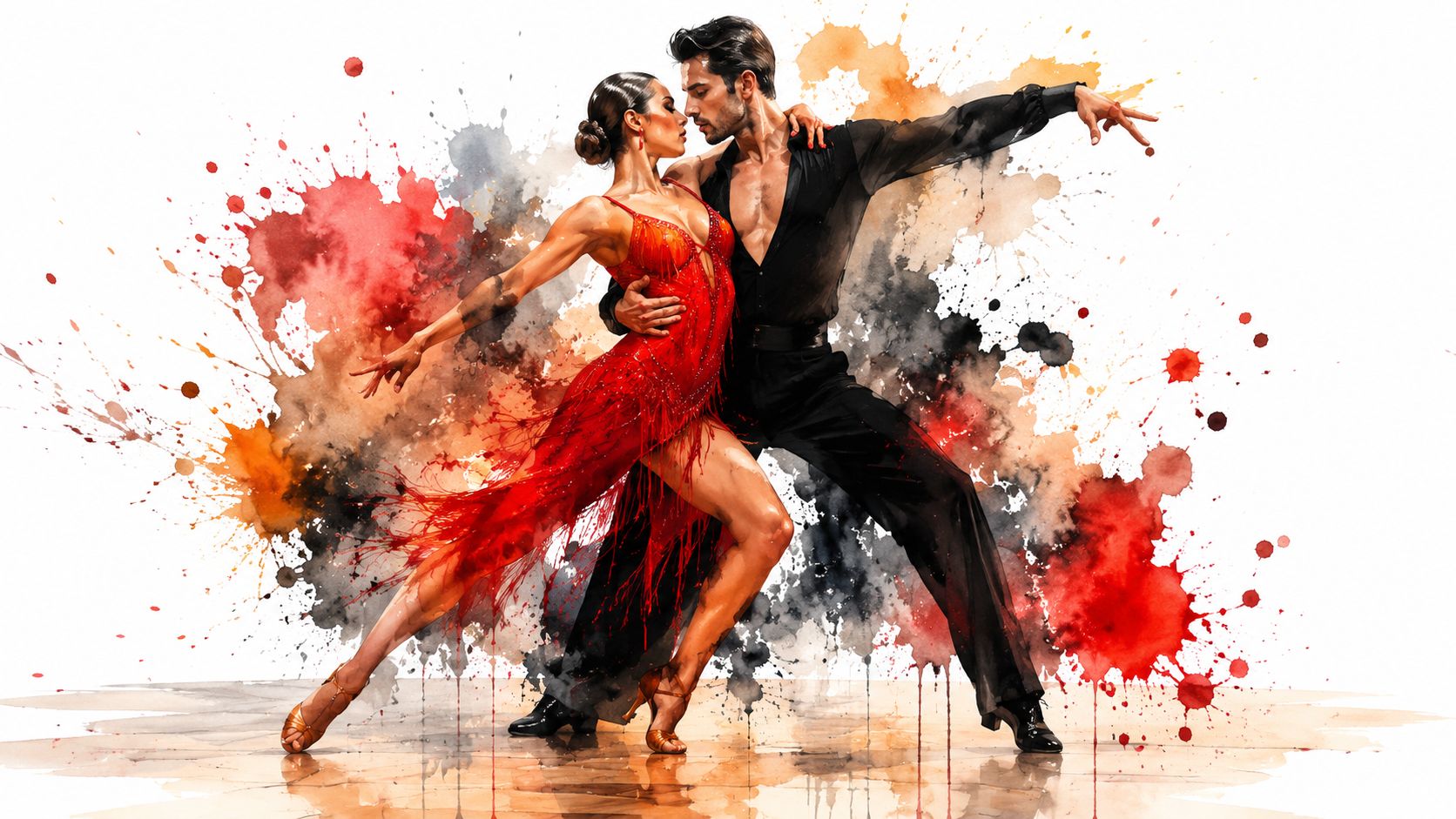
What makes Rumba stand out
A few things make rumba immediately recognizable:
- Its musical feel: The rhythm stretches time in a way that feels calm and expressive.
- Its body action: The hips move, but not as a separate wiggle. Good rumba starts from the feet and legs.
- Its emotional quality: This dance asks partners to pay attention to each other.
Rumba rewards patience. The dancers who look the smoothest are usually the ones who aren't hurrying anything.
For beginners, that's good news. You don't need flashy tricks to begin. You need a steady count, a willingness to slow down, and permission to let the dance feel human.
Why beginners get confused
The biggest point of confusion is simple. The word rumba doesn't refer to only one thing. It can point to a traditional Cuban form with deep cultural roots, or to the ballroom version taught in many studios.
If you've been searching “what is rumba dancing,” that's likely why the answers online can feel mismatched. One video shows a folkloric street dance with drums. Another shows a polished couple moving slowly in a ballroom hold. Both use the same word, but they are not the same dance.
The Two Worlds of Rumba From Cuban Streets to the Ballroom
You hear the word rumba, sign up for a class, and then discover two very different dances living under the same name. That mix-up confuses plenty of beginners.
One rumba grew in Cuban communities as a living social and musical tradition. The other was shaped for the ballroom, where technique, partner structure, and studio teaching gave it a different look and feel. If you understand that split early, the whole subject gets much easier to follow.
Cuban Rumba was born in Cuba in urban courtyards and community spaces, where Afro-Cuban drumming, singing, movement, and social exchange developed together. It includes yambú, guaguancó, and columbia, each with its own character. UNESCO's description of rumba in Cuba clarifies this is not the same as the ballroom rumba many studio students learn. It is a percussion-led, improvised tradition tied to everyday community life, not a standardized partner syllabus.
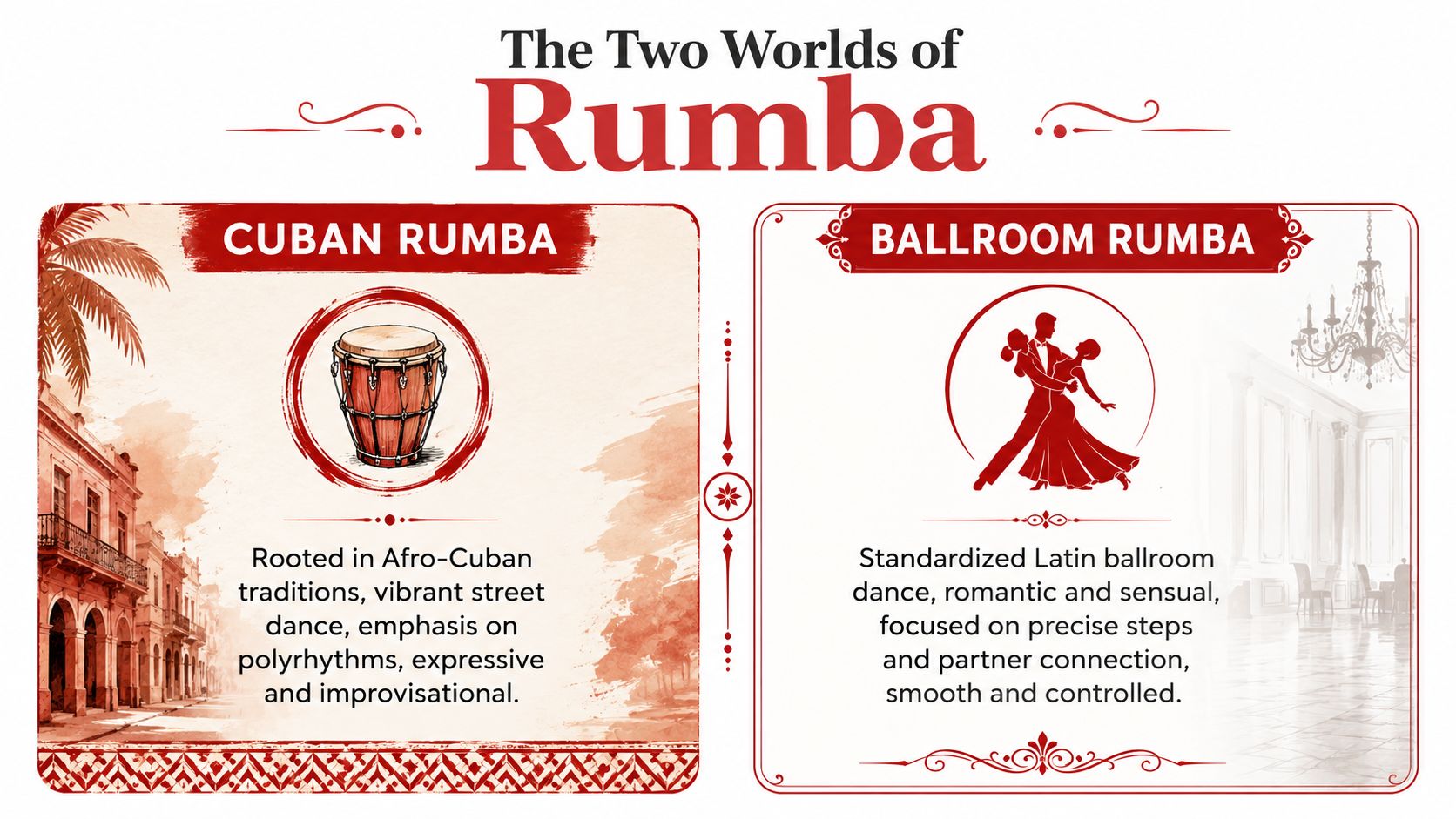
Cuban Rumba and Ballroom Rumba side by side
| Form | Feel | Setting | What defines it |
|---|---|---|---|
| Cuban Rumba | Earthy, rhythmic, improvisational | Courtyards, streets, community spaces | Drumming, social expression, Afro-Cuban roots |
| Ballroom Rumba | Romantic, controlled, stylized | Studios, socials, competitions | Partner connection, codified technique, smooth body action |
A simple way to sort them out is to ask one question: Is this a cultural rumba tradition, or a studio partner dance? Cuban Rumba answers with drums, call-and-response energy, and improvisation. Ballroom Rumba answers with frame, timing, and a carefully shaped conversation between two partners.
That difference also explains why ballroom rumba is often called the dance of love. In studios, the focus is not on fast footwork or flashy tricks. It is on tension, softness, eye contact, and the slow, deliberate way two people move in relation to each other. The feeling is intimate and romantic, which is why so many beginners connect with it right away.
What most studio students are learning
If you join Latin ballroom dancing lessons, you will usually be learning Ballroom Rumba, not authentic Cuban Rumba. That is the version commonly taught in beginner programs because it introduces Latin technique in a clear, structured way.
Older American usage sometimes spelled it Rhumba. Over time, this ballroom form developed its own teaching system, its own competitive role, and its own identity. So when someone asks, “What is rumba dancing?” the honest answer is, “Which rumba do you mean?”
Cuban Rumba is a folk tradition with deep Afro-Cuban roots. Ballroom Rumba is the romantic partner dance many studio students learn first.
Feeling the Rhythm Rumba Music and Timing
You step onto the floor, the song begins, and suddenly rumba feels less mysterious once you know what to listen for.
For studio dancers learning Ballroom Rumba, the music is counted in 4/4 time and usually danced with slow, quick, quick timing. That pattern is one reason ballroom rumba feels tender and unhurried. It gives each movement time to breathe, which fits the romantic character that made this version of rumba famous as the dance of love.
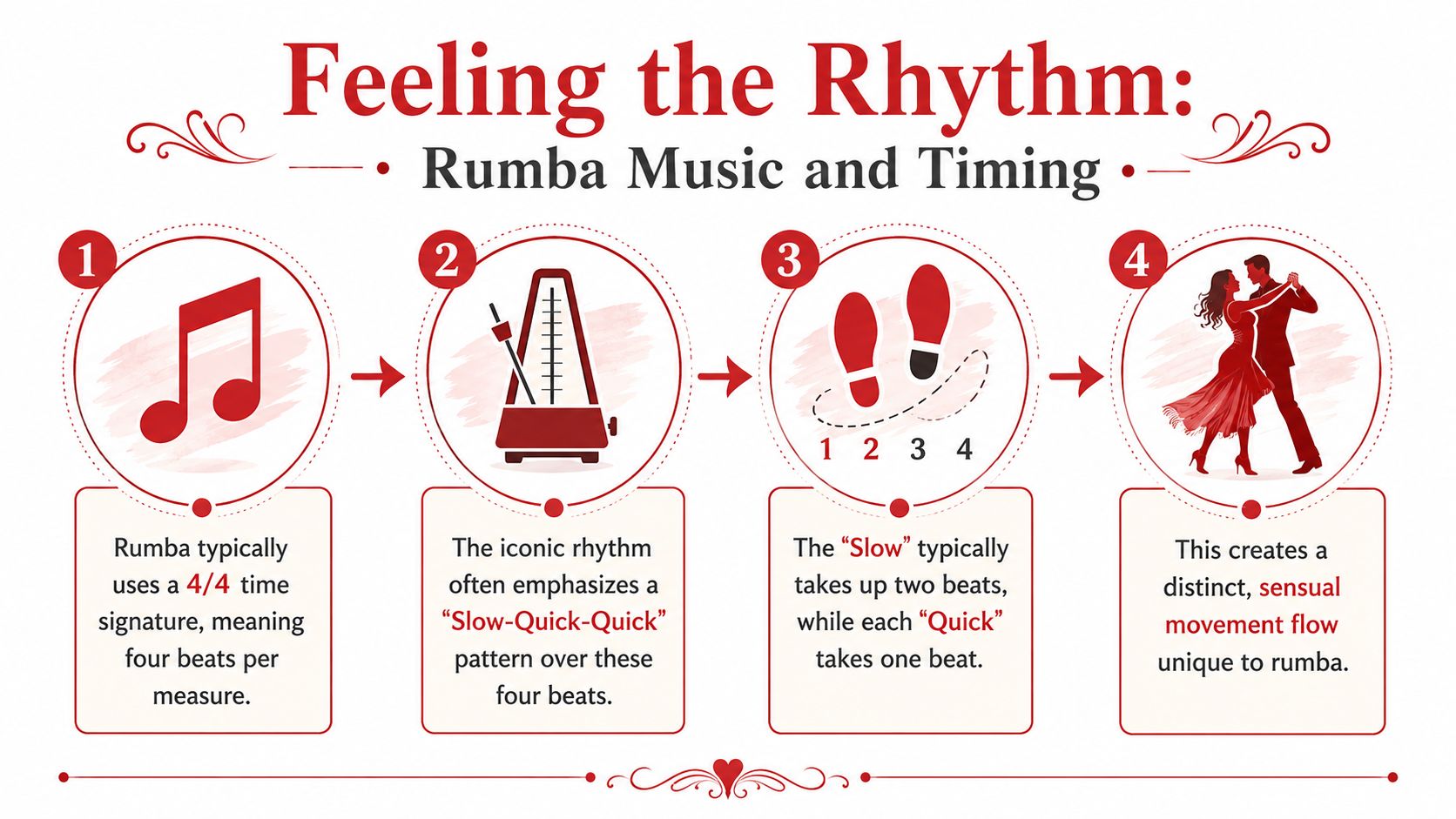
How to count it without getting lost
Start with the music before you worry about your feet.
A bar of rumba music has four steady beats. In the beginner ballroom version, dancers often spread three weight changes across those four beats:
- Slow uses two beats
- Quick uses one beat
- Quick uses one beat
Say it out loud as you walk: slow… quick, quick.
That spoken rhythm works like a set of training wheels. It helps you feel that the first action takes longer, then the next two arrive more quickly. Once that pattern settles into your body, the dance starts to feel natural instead of mathematical.
Why beginners sometimes get confused
Part of the confusion comes from the word Rumba itself. Authentic Cuban Rumba and studio Ballroom Rumba do not use music in the same way or create the same feeling on the floor. In a dance studio, you are usually learning the ballroom version, where the count is organized clearly so partners can move with control, balance, and expression.
That structure is helpful. It gives beginners a reliable map.
Why the music feels romantic
Ballroom rumba does not rush to place a new step on every beat. The held quality of the slow creates a sense of suspension, almost like a sentence with a meaningful pause in the middle. That pause gives dancers room for eye contact, breath, and shape.
This is where the “dance of love” feeling really comes from. Not from speed. From restraint.
A simple practice method
Use this sequence while listening to a rumba song:
- Find the pulse: Count 1, 2, 3, 4 evenly.
- Match the rhythm: Let slow cover beats 1 and 2, then place quick on 3 and quick on 4.
- Walk it first: Practice the rhythm with plain steps before adding arm styling or hip action.
- Repeat calmly: Your ear learns through repetition.
For more help hearing this pattern clearly, see our guide on how to find the beat in music.
Simple rule: If you can hear the pulse and say the rhythm, your body can learn to dance it.
Mastering the Signature Moves Cuban Motion and Basic Steps
What makes rumba look like rumba? Two things. The first is Cuban Motion. The second is a simple foundational pattern many beginners start with in American Rumba: the box step.
Cuban Motion is a result, not a trick
Many beginners think they need to move their hips first. That usually creates a forced look. In good rumba, the hips respond to what the legs and weight are doing.
A technical breakdown of Cuban Motion describes it as rhythmic hip rotation created by weight transfer, knee action, and the straightening of the supporting leg. The figure-eight feeling comes from leg mechanics, not from twisting the hips independently. Dancers keep both feet connected to the floor, gather the ankles between steps, and let the body action emerge naturally from the way weight passes from one side to the other (technical explanation of Cuban Motion).
That may sound complicated, but the sensation is simple. Stand with your weight on one leg. Let that leg support you fully. As the other knee softens and the weight changes, the hip settles. That's the beginning of rumba action.
A simple analogy that helps
Think of rumba like carrying a tray of water across the room. Your upper body stays composed. Underneath, your legs and feet do the quiet work of keeping everything balanced.
If you try to wiggle the tray, the whole thing looks unstable. If your legs move cleanly and your weight arrives fully, the motion underneath looks elegant.
The American Rumba box step
The foundational American Rumba basic is a box pattern with six foot movements. The leader steps forward with the left foot (slow), side with the right (quick), and closes the left to the right (quick), then steps back with the right foot (slow), side with the left (quick), and closes the right to the left (quick). That six-step sequence creates the familiar box shape on the floor (American Rumba box step breakdown).
Here it is in a beginner-friendly format:
Step forward left on slow
Don't lunge. Place the foot and transfer weight with control.Step side right on quick
Keep the movement compact.Close left to right on quick
Finish the weight cleanly.Step back right on slow
Stay tall through your torso.Step side left on quick
Let the body continue smoothly.Close right to left on quick
Return to balance and repeat.
What new dancers should focus on first
Don't try to master everything at once. Start with these priorities:
- Weight transfer before styling: If your weight never fully arrives, the dance will always feel unstable.
- Small steps: Rumba usually looks better when beginners take less space, not more.
- A calm upper body: Let the lower body create the action.
- Clear timing: Count out loud until the rhythm feels natural.
Most rumba problems aren't step problems. They're timing and weight-transfer problems.
The Benefits of Rumba More Than Just a Dance
Rumba looks soft. It doesn't feel soft when you're learning it well.
Its challenge comes from controlled tension and precise weight transfer, not speed. The slow-quick-quick rhythm asks dancers to sustain hip rotation through bent-knee support, which places real demand on the core and legs. That's why rumba can feel more physically taxing than faster dances, even though the music seems gentler on the surface (why rumba feels physically demanding).
What your body learns from Rumba
Rumba teaches control in a very honest way. You can't fake balance for long, and you can't rush through the slow count without feeling it.
Here's what students often notice as they improve:
- Better posture: You learn to stay lifted without becoming stiff.
- Stronger balance: Clean weight transfer makes everyday movement feel more coordinated.
- More grounded legs and core: The dance asks your lower body to stay active the whole time.
- Sharper body awareness: You start noticing exactly where your weight is, and where it should be.
What it does for confidence and connection
Rumba also changes how people relate to movement. Because it's slower, it exposes habits quickly. That can feel humbling at first, but it also makes progress very satisfying.
You learn to be present. You learn to listen to music instead of chasing it. If you dance with a partner, you also learn nonverbal communication in a very direct way. Pressure, timing, eye contact, and trust all matter.
For engaged couples, that quality is one reason rumba often enters the conversation around a first dance. If you're also planning your wedding entertainment, it helps to think about how the atmosphere of your music and dancing will shape the room, not just the schedule.
Why people stay with it
Some dances hook you with speed. Rumba hooks you with depth.
It asks for patience, but it gives a lot back. Students who stick with it often discover that the very things that made it hard at first, slowing down, finishing weight, moving with intention, become the reason they love it most.
Your First Rumba Lesson How to Get Started Today
Your first rumba lesson doesn't need to be dramatic. It just needs to be comfortable enough for you to start.
The best beginner mindset is simple: show up ready to listen, count, and move more slowly than you think you should. Rumba rewards that immediately.

What to expect in a first lesson
A beginner lesson usually starts with rhythm, posture, and a basic step pattern. You won't be expected to dance like an advanced competitor. You'll be learning where to place your feet, when to change weight, and how to connect movement to the music.
A few practical expectations help:
- Wear comfortable clothes: You want freedom to move, not a performance outfit.
- Choose shoes that let you glide: Avoid heavy athletic shoes if possible.
- Expect repetition: Repeating the basic is how your body learns calm timing.
- Don't worry if it feels unfamiliar: Rumba often feels more natural after a little guided practice.
If you want a clearer picture of what stepping into class is like, take a look at a beginner dance lesson overview.
What beginners often worry about
People usually ask the same questions.
Do I need experience? No.
Do I need a partner? No.
Do I need to “have rhythm”? Also no.
You need willingness. That's the true starting point.
A short demo can help you connect the ideas on the page to movement on the floor:
The fastest way to improve
Private instruction shortens the learning curve because a teacher can fix small issues early. A tiny adjustment in timing or weight placement can make rumba feel completely different.
That's why trying one lesson is so useful. You stop guessing. You get immediate feedback, a welcoming place to begin, and a much clearer sense of what rumba can feel like in your own body.
If you're ready to stop wondering what is rumba dancing and feel it for yourself, book a free complimentary lesson with Danza Academy of Social Dance. It's a warm, beginner-friendly way to start, and you can reserve your spot through the contact page.