
You've probably felt this already. You take social dance classes, you're getting more confident, and then you watch a competition video or attend an event and hear a flood of labels like Novice, Intermediate, Open, Pro-Am, Junior, Senior, solo, duet, syllabus. It sounds organized, but from the outside it can feel like everyone else got the handbook except you.
That confusion is normal, especially for adult dancers. Most explanations of dance competition levels are written for studio families with children who've been in the system for years. Adult ballroom and social dancers often come in through a different door. You may have started with Salsa for fun, Waltz for a wedding, or Cha-Cha because you wanted a new challenge. Competition can still be for you. You just need the structure translated into plain language.
There's also a mental hurdle. Social dancing asks, “Can I enjoy this with another person?” Competition asks, “Can I show control, consistency, timing, and presentation under pressure?” Those are related skills, but they aren't identical. If public performance still makes you nervous, this guide on how to overcome fear of dancing in public can help you settle the emotional side while you learn the technical side.
Stepping onto the Competitive Dance Floor
The first thing to know is that competition labels aren't there to intimidate you. They exist to create a fair field. A dancer who is still learning posture, rhythm, and partner connection shouldn't be judged against someone training many more hours and performing much harder material.
That's why competitions use categories and levels. Once you understand the logic, the system stops feeling mysterious and starts feeling useful. You can look at a competition form and tell where you belong, what judges will expect, and what you should work on next.
Why the language feels confusing at first
Adult students often bring a social-dance mindset into a competitive setting. In social dancing, success might mean staying on time, leading or following clearly, and enjoying the music. In competition, people sort dancers by training, age, role, and often by the structure of the material they're allowed to dance.
A ballroom student may also hear terms borrowed from other dance worlds. Some competitions use labels tied to training hours. Others use style-specific systems. Some are highly structured. Others give more creative freedom.
Competition terms are less about status and more about placement. They tell the organizer where your dancing belongs so judges can compare you with the right peer group.
Environment matters too. Stage lighting, floor visibility, and sightlines can change how a performance feels to both dancer and audience. If you're curious how presentation changes in event spaces, these expert tips for event lighting offer a practical look at what makes movement read clearly in a room.
A simple way to think about it
Start with three questions:
- What system am I entering? Ballroom often separates structured material from freer choreography.
- What level fits my current training? Your weekly practice and lesson volume usually matter.
- What division am I in? Age and entry type still shape who you compete against.
Once those pieces click, the map gets much easier to read.
Syllabus vs Open The Two Competition Systems
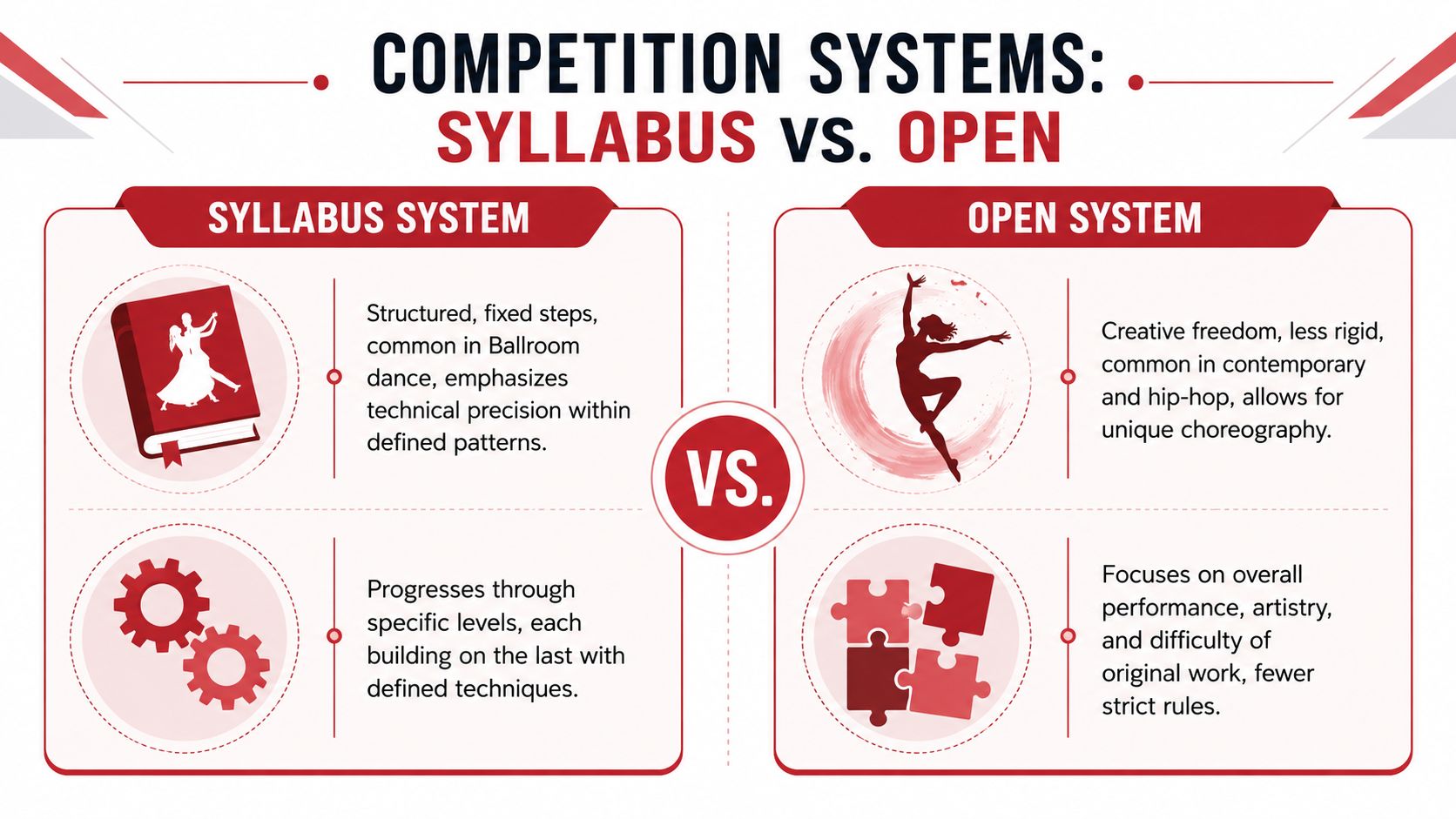
Some of the biggest confusion in dance competition levels comes from mixing up level with system. They're not the same thing. A level tells you where you fit compared with other dancers. A system tells you how the competition expects material to be built and presented.
What syllabus means in practice
In Syllabus competition, dancers work from a defined curriculum. This approach is akin to classical music training. You don't begin by doing anything you want. You learn specific material, in a specific order, with specific technical expectations.
For ballroom dancers, this can feel reassuring. You know what belongs at a given stage. You can focus on clean foot placement, posture, timing, rise and fall, frame, lead and follow, and precision inside a limited vocabulary of figures.
That structure is useful for adults because it answers a question many social dancers ask: “What should I learn next?” In syllabus, the path is built in.
What open means in practice
In Open competition, the rules are looser. Think of it more like jazz improvisation or original choreography. The dancer or teacher has more freedom to shape the routine, vary the movement, and show artistry beyond a fixed list of figures.
This doesn't mean “anything goes.” Judges still care about control, musicality, quality of movement, and whether the material suits the dancer. Open work gives more room for personal style, more difficulty, and more creative choices.
For a social or adult dancer, Open often becomes attractive later, after the basics are reliable. If your foundation is shaky, extra freedom can expose weaknesses instead of highlighting artistry.
Which path fits an adult ballroom student
A practical comparison helps:
| System | Best for | Main strength | Common challenge |
|---|---|---|---|
| Syllabus | Dancers building fundamentals | Clear progression | Can feel restrictive if you love creative variation |
| Open | Dancers with stronger technical base | Greater artistic freedom | Requires better control and decision-making |
Practical rule: If you still need to think hard about timing, posture, and basic patterns, syllabus usually gives you a better return than jumping into open work too early.
One fairness rule matters in partnered entries. In duet or trio routines, the competition level is determined by the highest level of any single registered dancer in the routine, rather than an average of the partners' skill levels. That keeps a stronger dancer from lowering the category by pairing with a beginner, as explained in the Believe Talent rules.
Decoding the Levels From Newcomer to Champion
When adult dancers ask about dance competition levels, they usually want a practical answer to one question. “Where would I start?” The clearest way to answer that is to connect level names with training habits and visible skills.
A lot of competitions sort dancers by weekly training volume. One published framework defines Recreational as 3 hours or less per week, Intermediate or Advanced as 3 to 5 hours per week, and Competitive or Elite as 6 or more hours per week in Elite Performance Challenge category guidance. That doesn't tell the whole story, but it gives adult students a tangible benchmark.
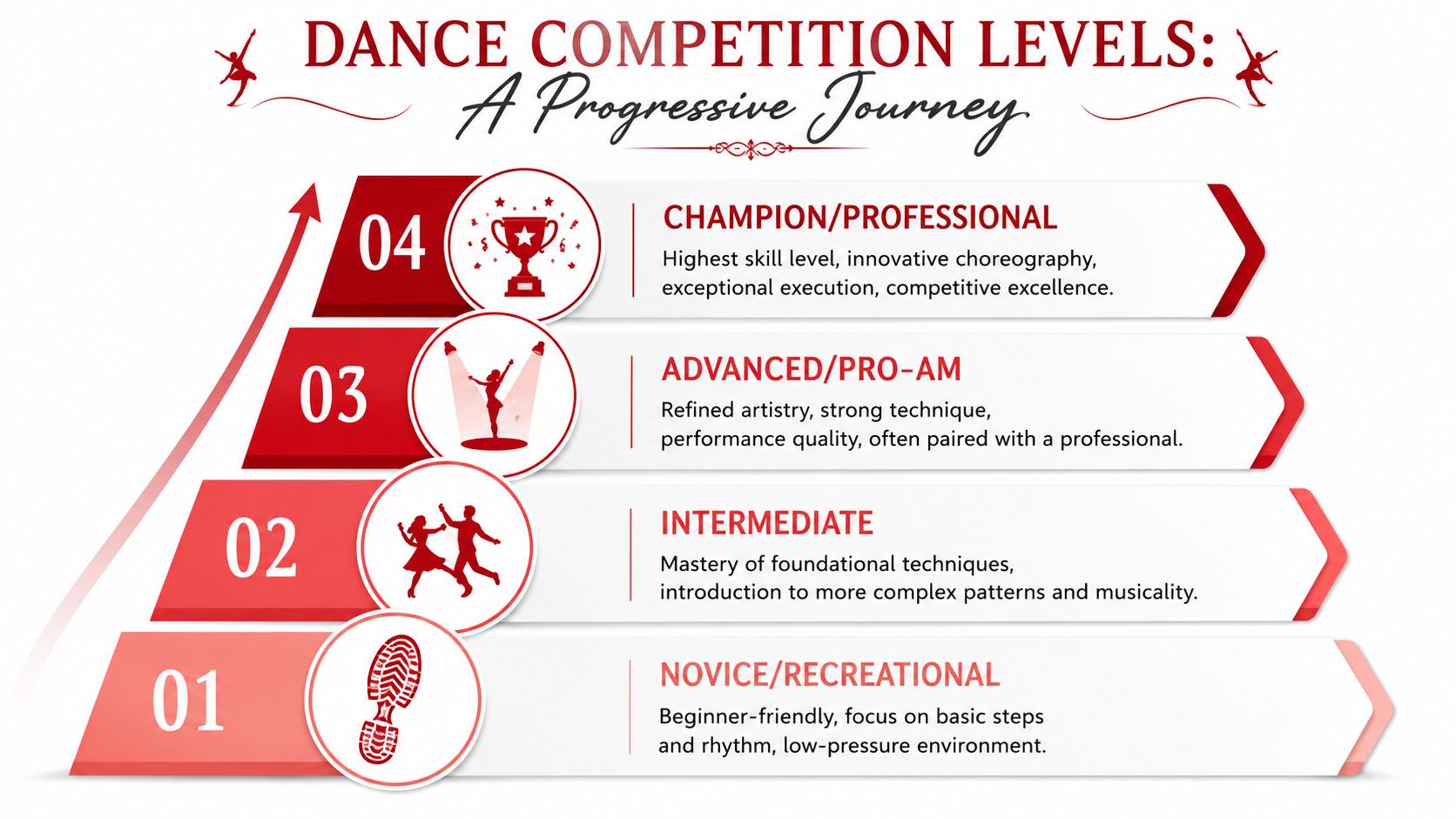
Novice or recreational
Many adult competitors often commence at this point, even if they've social danced for a while. The issue isn't whether you can enjoy a dance socially. The issue is whether you can produce the same quality consistently when someone is judging details.
At this level, dancers are usually working on:
- Reliable posture and balance so movement looks organized instead of rushed
- Basic rhythm and timing that holds up under nerves
- Simple patterns danced cleanly rather than complicated figures danced unevenly
- Partner connection that stays steady through entrances, exits, and turns
A social dancer often underestimates how valuable this level is. There's no shame in starting where your fundamentals can settle.
Intermediate
Intermediate is where dancing starts to look less survival-based and more intentional. You're no longer just trying to remember the routine. You're shaping it.
Common signs of intermediate development include:
- Cleaner transitions between figures instead of stopping and restarting energy.
- Better musical response so accents and phrasing start to show.
- More controlled turns and directional changes without losing frame or timing.
- Greater stamina so the last section of a round still looks composed.
Some competitions also add rule details at this level. For example, one ruleset states that Intermediate dancers may compete in no more than 9 routines total, a cap described in the Journey Competition rules and awards page. Even if your event doesn't use that exact rule, the idea is sensible. Intermediate dancers usually progress faster with focused entries than with overloaded schedules.
Here's a useful self-check for adult ballroom dancers at this stage:
| If this sounds like you | Your likely need |
|---|---|
| “I know the steps, but I lose quality when I speed up.” | More repetition under tempo |
| “My routine works in lessons, then falls apart under pressure.” | More mock rounds and stamina work |
| “I can dance the material, but it still looks flat.” | Better phrasing, projection, and contrast |
Advanced and competitive
Advanced dancers don't just execute more difficult material. They execute it with fewer visible compromises. The routine may include sharper dynamics, stronger shaping, more difficult coordination, and clearer interpretation of the music.
An adult Pro-Am student often reaches this category when they can maintain:
- polished basics even in harder choreography
- stronger body awareness
- steadier emotional projection
- better recovery when something goes wrong
This video can help you start noticing the difference between “knowing steps” and “performing a level”:
Champion and professional
At the top end, the gap is rarely about memorization. It's about depth. Movement looks more effortless, more deliberate, and more complete. The dancer can handle pressure, complexity, and interpretation at the same time.
A higher level doesn't mean you know more names for steps. It means your body can deliver more quality, more often, with less breakdown.
For adult students, that should feel encouraging. Progress isn't reserved for people who started young. It comes from matching your current training to the right competitive level and building from there.
Finding Your Division Age and Role Categories
Your level is only one part of your competition identity. The second part is your division, which usually combines age grouping and entry type. This aspect often confuses many newcomers. They assume “I'm Intermediate” tells the whole story, but a competition form usually wants more than that.
Age divisions keep the field fair
Published competition structures commonly organize dancers by both age and skill experience. Recognized age brackets include Petites ages 7 to 10, Junior ages 11 to 12, Teen ages 13 to 15, and Senior ages 16 to 18 in the framework described by LA Dance Academy's competition scoring overview.
Adult ballroom events often use different adult-specific labels, but the same principle applies. You compete against dancers in an age-relevant division, not against every person at the event. That matters because technical expectation and life stage affect how categories are built.
For adult dancers entering from the social world, this should be reassuring. You aren't stepping into one giant undifferentiated pool. Organizers separate fields so judging is more meaningful.
Role categories change how you enter
Entry type also matters. Most dancers will see some version of these categories:
- Solo means one dancer is judged on their own performance.
- Duet or Trio means a small partnership or small team entry.
- Group means a larger ensemble routine.
- Pro-Am usually means a student dances with a professional instructor.
- Amateur partnership means two non-professional dancers compete together.
Adult ballroom students often start with Pro-Am because it gives them structure. Your instructor handles partnering at a high level while you focus on your own technique, timing, and confidence. Amateur partnership can be rewarding too, but it asks both dancers to develop together.
A ballroom example
If you're an adult student dancing Smooth or Rhythm with your teacher, your “address” in competition might sound something like this:
- adult age division
- syllabus or open system
- beginner, intermediate, or advanced level
- Pro-Am role category
- specific style and dance
That may sound like a lot, but each part answers a different fairness question.
Two dancers can share the same skill level and still belong in different competitive categories because age group and role category aren't the same thing.
If you enter with another student in a small partnered routine, the higher-skilled dancer affects the category. That rule protects fairness and stops a more advanced entry from slipping into a lower bracket through partnership.
How Your Performance Is Scored
Judging feels mysterious until you know what the panel is watching. Most dancers think judges are reacting to a general impression, but competitions often use a structured framework. One published model uses a 100-point scale across five domains: technique 25%, performance 20%, presentation 15%, choreography 15%, and overall impression 5%, with three judges providing independent scores per category, as outlined by Queen City Dance.
Before you read the breakdown, notice one key point. The judges aren't only asking whether your routine was enjoyable. They're also asking whether it was technically sound and appropriate for the level.
What each score area means on the floor
Here's how those categories translate into plain language:
- Technique is your body organization. Judges look for posture, alignment, foot placement, timing, balance, and control.
- Performance is how you communicate. Do you connect to the music, your partner, and the audience?
- Presentation includes polish. Grooming, costuming, and overall visual readiness live here.
- Choreography considers whether the material makes sense for your ability and showcases strengths.
- Overall impression is the final effect after all the pieces come together.
A social dancer often scores lower than expected in technique, even when they look expressive. That's because “fun to watch” and “cleanly executed” aren't always the same thing.
How judges' expectations shift by level
The same category can mean different expectations depending on level. A beginner may be rewarded for stable timing and clean basics. An advanced dancer may be judged more harshly for the same visible mistake because the standard is higher.
That's one reason adults shouldn't rush upward. If your current level expects strong basics and you skip straight into material your body can't yet support, your scores often reveal the gap quickly.
Strong scoring usually comes from appropriate difficulty. A simpler routine danced well often lands better than ambitious choreography danced with visible breakdowns.
A practical scoring lens for ballroom and social dancers
If you come from Salsa nights, wedding dance prep, or casual group classes, use this lens when preparing a competitive routine:
| Judge sees | Common adult-student issue | Better focus |
|---|---|---|
| Timing slips | Nerves speed everything up | Practice with music under pressure |
| Frame changes | Social hold isn't stable enough | Rebuild posture and connection |
| Flat performance | Student is concentrating too hard | Rehearse expression after technique settles |
When you know what's being measured, practice becomes more efficient. You stop asking, “Did that feel good?” and start asking, “Would a judge see control, clarity, and intention?”
Choosing Your Level and Planning Your Progress
The smartest competitive dancers don't ask, “How fast can I move up?” They ask, “What level lets me build well?” That shift matters because progression in dance isn't always a straight line.
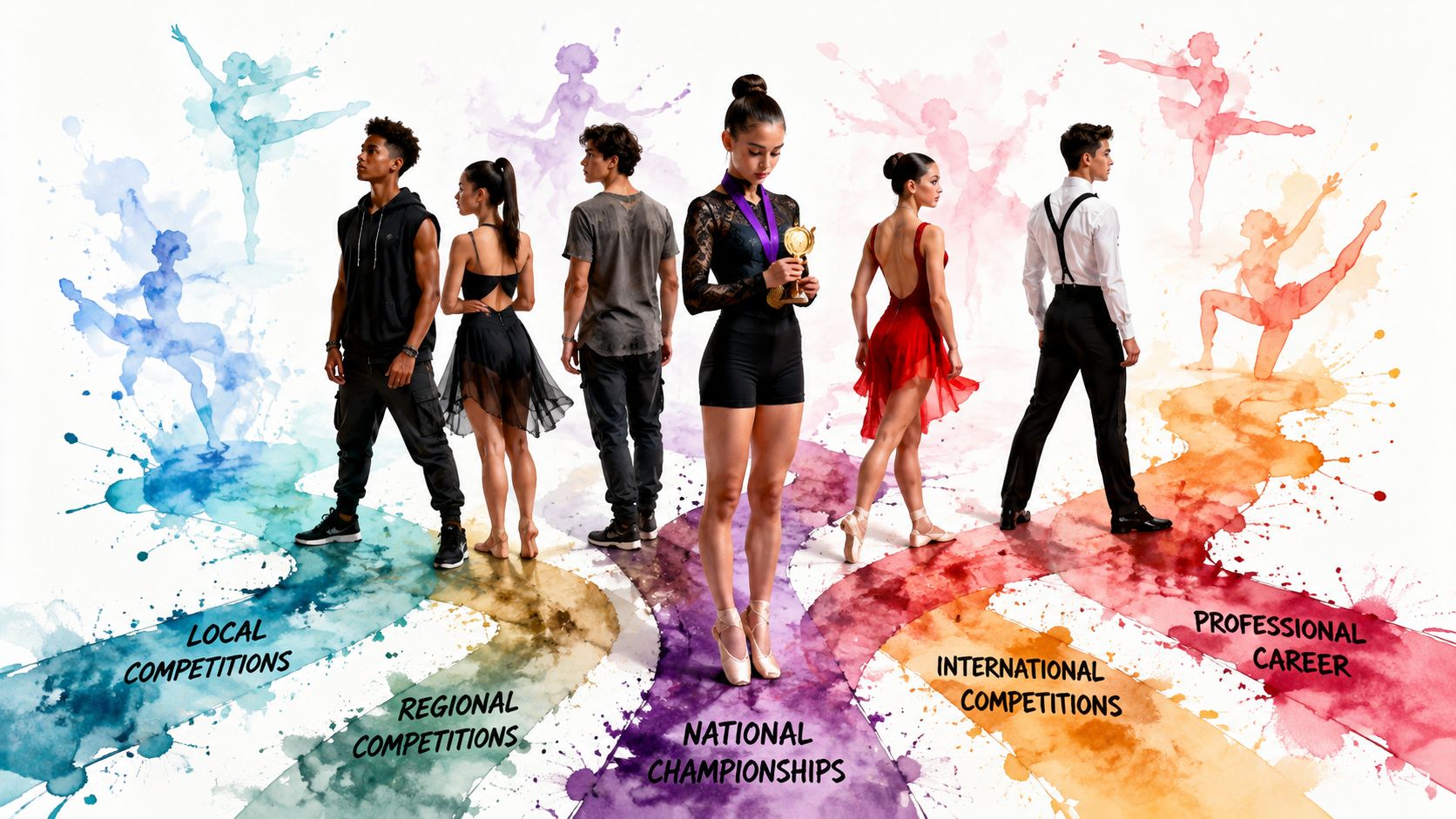
One important reality often gets ignored. Many rule systems assume dancers only move forward. Yet one published summary notes that most competition rules assume linear progression and lack clauses for downward mobility, despite industry surveys showing 18% of competitive dancers experience skill stagnation or regression due to injury or burnout within 12 months, as discussed in the Starpower rules context. Adult dancers feel this too, especially when life, work, stress, or physical setbacks interrupt training.
Pick the level that supports growth
A useful way to choose is to look at evidence, not ego.
Ask yourself:
- Can I repeat my basics under pressure? If not, a lower level may be the right place.
- Does my training volume match the category? Entering above your preparation usually shows.
- Can I recover calmly from mistakes? Competition rewards composure, not perfection.
- Am I building technique or hiding weak spots with harder choreography?
An instructor's eye matters. Adult students often judge themselves by social success. Competition requires a different standard.
Why moving down can sometimes be wise
In many sports and performance settings, a reset phase protects long-term progress. The same logic appears in broader coaching conversations, including these strategies for developing young athletes, which emphasize matching challenge to readiness instead of forcing advancement before the foundation is secure.
That principle applies well to dance. If you plateau, get injured, or start compensating with bad habits, rebuilding at a simpler level can be smart training, not failure.
The goal isn't to collect harder labels. The goal is to become a stronger dancer.
A technical reset can help you regain:
- cleaner timing
- better body mechanics
- stronger confidence
- healthier training habits
For dancers who want a structured place to work on those fundamentals, technique dance classes can support that process without the pressure of rushing into the next category.
A simple planning model
Think in seasons, not in status.
One season might focus on:
- consistent rhythm
- stronger frame
- better stamina
Another might focus on:
- performance quality
- style-specific technique
- competition simulation
That approach keeps your progress honest. It also makes competition more enjoyable because you know why you're entering and what success should look like for you.
Start Your Competitive Journey with Us
Competition becomes much less intimidating once you can name the moving parts. You need to know the system you're entering, the level your current training supports, the division that fits your age and role, and the standards judges will use when you step onto the floor.
For adult dancers, that clarity matters even more. You're often balancing work, family, fitness, confidence, and personal goals all at once. A good plan should fit your actual life, not just an ideal training schedule. Some students want one Pro-Am event. Others want a longer competitive path with private coaching, group practice, and performance development.
If you want guidance on where you fit and how to prepare, one practical option is private dance lessons. Danza Academy of Social Dance also offers competitive training for students preparing for events, along with group classes that help build stamina, musicality, and floor confidence.
You don't need to have everything figured out before you begin. You just need an honest starting point and a plan that makes sense for your current level. That's how confident competitors are built.
If you're ready to turn curiosity into a real next step, book a free complimentary lesson with Danza Academy of Social Dance. You'll get a chance to talk through your goals, assess where you fit within dance competition levels, and see whether a social-to-competitive path makes sense for you. It's a simple, no-pressure way to start.