You hear tango music, and something in it catches you before you understand a single step. The rhythm feels grounded and dramatic. The dancers seem calm and intense at the same time. You might be thinking, “I'd love to try that, but it looks impossible.”
It isn't impossible. It is different.
When people first look up how to dance the tango, they usually expect a list of steps. Steps matter, but tango works better when you learn it as a conversation. One partner suggests movement. The other partner receives, interprets, and answers. The beauty comes from that exchange, not from memorizing a pattern and forcing it through the music.
That's the shift that helps beginners most. If you start by chasing fancy figures, tango feels stiff. If you start by learning connection, posture, timing, and social awareness, the dance begins to make sense much faster.
Embracing the Tango Dialogue
Tango has always carried a strong human story. It originated in the late 19th century in the working-class port neighborhoods of Buenos Aires, Argentina, and Montevideo, Uruguay, initially danced exclusively by male workers, as noted in this history of tango. That origin matters because tango was never just decoration. It grew out of people meeting, adapting, listening, and expressing themselves with the body.
Why beginners struggle with tango
Many new dancers try to “do the move” before they know what the move is saying. That's like learning a phrase in a new language without understanding tone or timing. The result usually looks tense. You can see the effort, but you can't feel the conversation.
A better starting point is to ask:
- What is the lead communicating
- How is the follower responding
- What does the music invite right now
- Where is the shared balance between both partners
Those questions keep you focused on the engine of tango.
Tango looks dramatic from the outside, but from the inside it should feel organized, grounded, and clear.
What tango should feel like
In a good beginner tango, you don't need big movements. You need a steady center, clean weight changes, and attention to your partner. A simple walk can feel more authentic than an ambitious sequence done with poor balance.
That's one reason so many dancers fall in love with tango and stay with it. There's always more depth to discover. A pause can say as much as a turn. A slow step can carry more feeling than speed.
If you're drawn to the emotional side of the dance, this short read on reasons to love the tango captures that appeal well.
Here's the mindset that works: don't treat tango as a performance you must pull off. Treat it as a skill you can build. You're learning how to listen with your body, how to share balance, and how to move with intention. That makes the first class much less intimidating, and it leads to better dancing from the start.
Finding Your Foundation in Posture and Connection
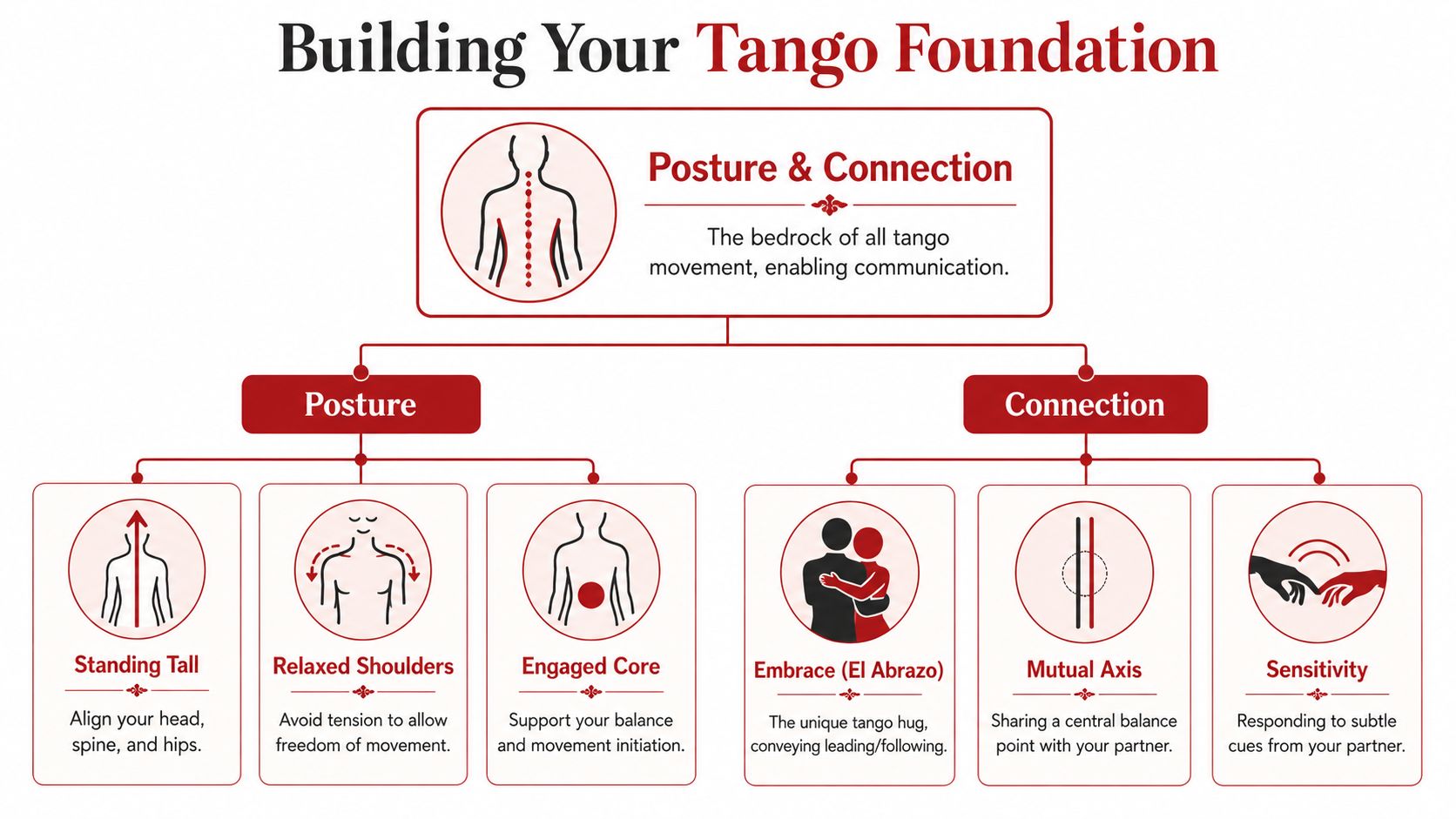
Before you worry about ochos, crosses, or turns, fix your foundation. In tango, the quality of your posture and connection decides whether the dance feels easy or confusing. Most beginner problems don't come from “not knowing enough steps.” They come from unstable balance, tight shoulders, and unclear communication.
Build your own axis first
Your axis is your personal balance. If you can't stand and transfer weight cleanly on your own, the embrace will feel heavy or unstable. Tango doesn't ask you to lean randomly into your partner. It asks you to become more responsible for your own body.
Use this checklist when you stand still:
- Head over spine: Keep your head lifted without pushing your chin up.
- Ribs quiet: Don't flare the chest or over-arch the back.
- Core awake: Support your center enough to move without wobbling.
- Knees soft: Locked knees make you slow and rigid.
- Feet grounded: Feel the floor before you try to travel across it.
Try standing on one foot for a moment, then changing weight to the other without lifting your shoulders. That small exercise reveals a lot. If the upper body tenses every time you shift weight, the walk will be hard to lead or follow smoothly.
Create an embrace, not a frame fight
In tango, the embrace is called the abrazo. Think of it less as a frame you hold and more as a shared listening system. Your arms don't drag your partner around. They complete the connection that starts through the torso.
A useful beginner rule is simple:
Practical rule: If your partner feels your hands more than your center, you're probably overusing your arms.
The lead should begin from the chest and body direction. The follower should stay available and responsive without collapsing into the leader. Both people need tone, but not stiffness.
Here's what usually works well in the first months:
| Element | What works | What doesn't |
|---|---|---|
| Posture | Upright, grounded, calm | Leaning from the shoulders |
| Arms | Supportive and responsive | Pushing or hanging |
| Shoulders | Relaxed and broad | Lifted and tight |
| Balance | Each dancer keeps their own axis | Using the partner as a crutch |
Close embrace and open embrace
Beginners often ask which embrace is “correct.” The honest answer is that both are useful.
Close embrace places the partners nearer through the upper body. It encourages compact, musical dancing and often makes the connection feel immediate.
Open embrace allows a little more space. It can help when learning turns, pivots, and directional changes because each dancer has more room to organize their movement.
Neither option fixes poor technique. If posture is weak, close embrace will feel crowded. If connection is vague, open embrace will feel disconnected. Start with whichever allows you to maintain comfort, clarity, and independent balance.
A strong tango foundation doesn't look flashy. It feels trustworthy. When your partner can sense where you are, where you're going, and how your weight is changing, the dance starts to become enjoyable.
Mastering the Essential Tango Vocabulary
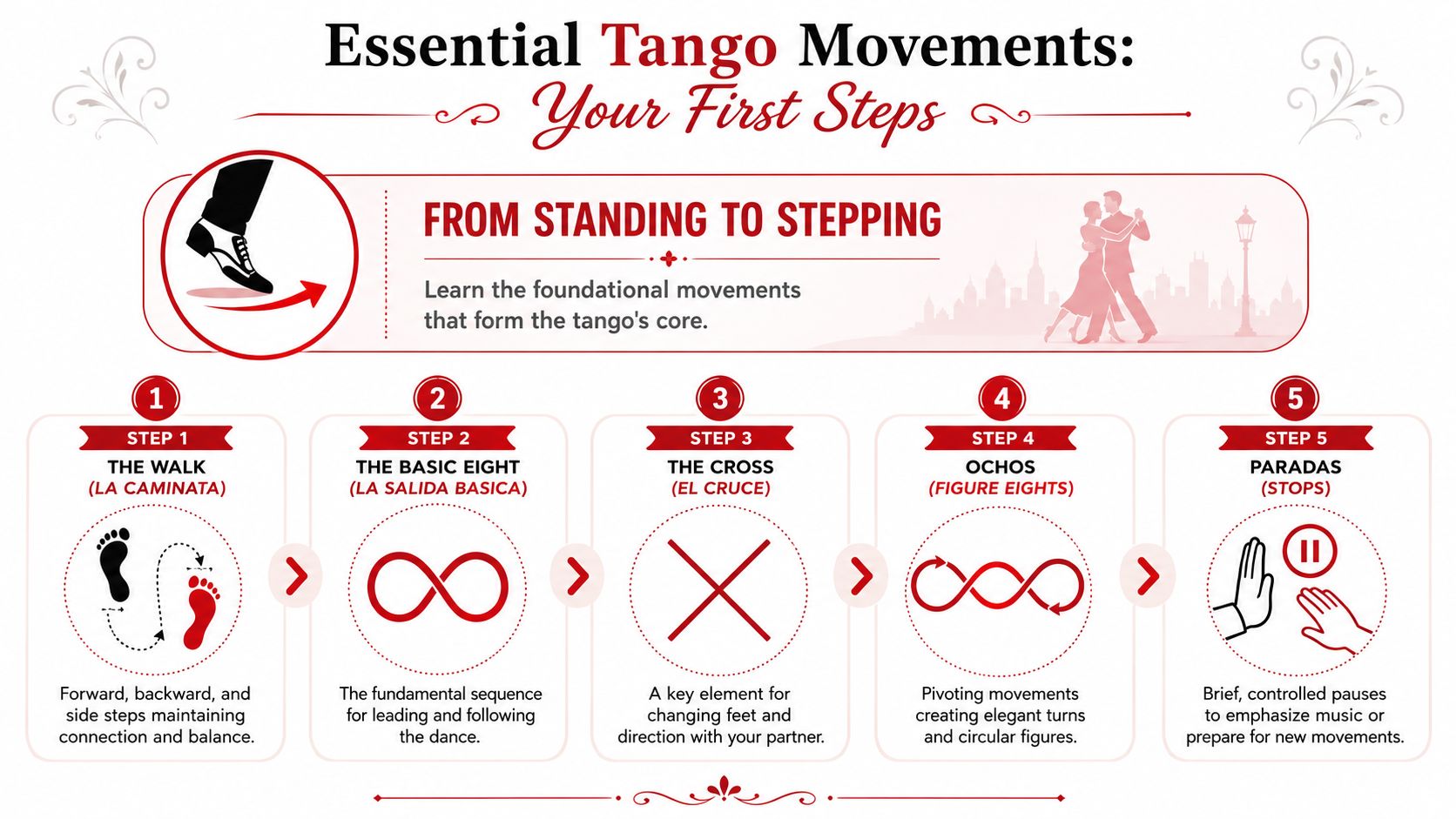
Once the body is organized, you can start building the movement vocabulary. I call these elements vocabulary because they're not meant to be recited in one fixed order. They combine and recombine, depending on the music, the space, and the partnership.
Start with the walk
The tango walk is everything. If the walk is unstable, every larger figure will feel forced. If the walk is clean, even a very simple dance can feel elegant.
A solid training method for the tango walk uses four speeds, with a very specific starting point. A foundational tango walking method recommends beginning at the very slow pace and giving exactly 4 counts for each step so you can complete weight transfer and control your balance.
That sounds almost too simple, but it works. Slow practice exposes all the places where dancers rush, tip forward, skip the standing leg, or move before they've fully arrived.
Try practicing in this order:
- Very slow: Take one full step over 4 counts. Finish the weight change completely.
- Slow: Keep the same precision, but reduce the delay.
- Regular: Match a natural walking rhythm.
- Fast: Stay organized without shortening your posture.
The same method also includes corrida, or fast-walking practice, using a quick-quick-slow rhythm. That helps you respond to the music without losing smoothness.
Your first useful patterns
This short demo gives you a visual sense of how the movement language fits together.
The most useful beginner elements are these:
- The walk: Forward, backward, and side steps. This is the base of nearly everything.
- The cross: A classic tango action where the follower collects and crosses neatly. It depends on clear lead, timing, and alignment.
- Ochos: Figure-eight actions built from pivots. They teach dissociation and help dancers feel rotation through the torso.
- Paradas: Stops or checks that create a pause. These are musical and conversational when used with control.
- Simple turns: Often taught before large giros, these help you learn how to move around a shared center without pulling.
What to focus on inside each movement
Beginners often get overwhelmed because every figure seems like a lot at once. Strip it down.
For the lead, ask:
- Where is my weight?
- Is my torso communicating direction clearly?
- Am I asking for one thing at a time?
For the follow, ask:
- Have I completed my previous step?
- Am I listening with my center, not guessing with my feet?
- Am I pivoting because I received information, or because I'm anticipating?
The body should finish one idea before starting the next. Most tango confusion comes from stacking instructions too early.
If you want to improve the musical side of your dancing while learning these basics, it helps to study what musicality in dance means. Tango gets easier when you stop treating music as background and start using it to shape pauses, walking speed, and intention.
A practical beginner session
A productive practice session doesn't need a huge syllabus. Keep it compact.
| Practice block | Focus |
|---|---|
| Standing and weight changes | Stability, relaxed shoulders, clear arrival |
| Very slow walk | Full transfer, grounded movement |
| Side steps and collection | Neat feet, quiet upper body |
| Ochos or pivots | Rotation without force |
| Short improvised walk | Connection over complexity |
That's how to dance the tango in a way that builds skill. You don't win by collecting more figures. You improve by making a small set of actions more accurate, musical, and connected.
The Art of Leading and Following
Leading and following aren't separate skills glued together at the end. They're the dance itself.
A lead is not pushing, dragging, or steering with the hands. A clear lead comes from intention in the center of the body, supported by timing and direction. When that signal is organized, the follower can respond without guessing. When it's vague, the follower has to choose between anticipation and confusion, and neither feels good.
What good leading feels like
A useful lead feels early enough to understand, small enough to stay comfortable, and steady enough to trust. The chest initiates. The arms transmit, but they don't dominate.
Try this partner drill without taking a single step:
- Stand face to face: Connect lightly in tango hold.
- Change weight only: One partner initiates weight changes. The other matches.
- Add pauses: Don't move continuously. Let stillness be part of the exercise.
- Test clarity: If the follower has to look down or guess, make the lead smaller and clearer, not bigger.
This drill teaches a lot because it removes the distraction of traveling steps.
What strong following actually means
Following is active. It isn't passive waiting.
A skilled follower maintains their own balance, notices subtle changes in the lead's center, and completes each movement with precision. That requires attention, timing, and body control. The follower isn't “doing nothing” until a command arrives. They're continuously reading and organizing.
A follower who stays balanced helps the lead. A lead who gives clear information helps the follower. Tango improves fastest when both partners own their job.
Why leads and followers learn at different speeds
This is one of the most important expectation resets for beginners. According to the Tango Integral FAQ, male leads take about a year to reach semi-competence in Argentine Tango, while female followers often take about half that time, with leads taking “three times longer” to reach the same milestone.
That doesn't mean one role is “better” or “harder” in every way. It means the jobs are different. Leads usually have to manage navigation, timing, initiation, and choice-making earlier. Followers often develop responsiveness more quickly because they can focus on receiving and executing with clarity.
If you're leading and feel slow, that's normal. If you're following and progressing faster, that's also normal. The wrong response is frustration. The right response is empathy.
A balanced class and social practice mix works better than relying only on social dancing. Without basics, people rehearse mistakes. With guidance, they build habits that transfer to the dance floor.
Navigating the Milonga with Confidence
A milonga is a social tango event, and it has its own culture. You can know a few steps and still feel nervous if nobody explains how the room works. Once you understand the etiquette, the whole experience becomes calmer.
How invitations work
The most important custom to learn is the cabeceo. The traditional tango invitation method uses eye contact across the room, called mirada, followed by a nod of the head, called cabeceo. It's subtle, and it helps ensure that both people are willing partners before they step onto the floor.
This matters for more than manners. It also supports a more relaxed start to the embrace. When both dancers have already agreed nonverbally, there's less awkwardness and less physical tension.
What to do once you're on the floor
At a milonga, floorcraft matters as much as vocabulary. Keep your steps appropriate to the space. Don't launch big figures in a crowded lane. Don't stop unpredictably in the line of dance.
A few beginner rules help:
- Enter carefully: Wait for a clean moment before stepping into the lane.
- Dance for the room you have: Smaller, clear movement beats ambitious movement in traffic.
- Protect your partner: Awareness is part of good dancing.
- Finish graciously: A social dance includes the entrance, the dance itself, and the exit.
If tango travel is on your mind, exploring personalized Buenos Aires trip ideas can help you understand the city context that shaped the dance and its social culture.
Your first milonga doesn't need to be perfect
What's often needed isn't more bravery, but a clearer first step. Taking a beginner-focused class before attending a social event usually makes the experience much smoother, especially when the class covers etiquette along with movement. A practical starting point is this page for tango lessons for beginners.
Go to watch, listen, and learn the rhythm of the room. Dance when it feels appropriate. Sit out when you need to. That's part of learning too.
Take Your First Real Steps on the Dance Floor
You step onto the floor for your first tango lesson. The room is quiet for a moment, the music starts, and suddenly the question is not “What pattern comes first?” It is “Can I feel the beat, stay balanced, and connect clearly with another person?” That is the true beginning of tango.

Why guided instruction matters
A beginner usually improves faster with direct feedback than with solo practice alone. Tango asks for control, listening, timing, and partner awareness at the same time. You can read about posture and watch videos of the walk, but it is hard to feel whether your chest is leading, whether your weight is fully over one leg, or whether your partner can understand your intention without a teacher in the room.
That learning curve is normal. As Brisbane House of Tango's overview of advanced development explains, tango develops over years, not days.
In class, we correct small things before they become habits. A lifted shoulder, a rushed step, or a grip that feels secure to you can make the dance feel heavy or confusing to your partner. Early guidance saves time, and it makes the dance more enjoyable from the start.
The next step that makes sense
If you want to learn how to dance the tango, get your body involved as soon as possible. A teacher can adjust your stance, help you hear the phrasing in the music, and show you how the walk becomes a conversation instead of a set of isolated steps. That is the part many beginners miss when they try to memorize figures first.
At Danza Academy of Social Dance, tango instruction is part of a broader social dance program, so the focus stays practical. You learn how to stand, how to move with another person, and how to make simple movement feel clear and musical.
Start before you feel ready.
A complimentary first lesson gives you a low-pressure way to test the experience for yourself. You can feel the embrace, practice walking with guidance, ask questions about leading or following, and leave with one or two corrections that effectively change your dancing.
If this article helped you understand tango more clearly, book the complimentary lesson on the contact page and take your first real steps with guidance.