
You might be standing in your kitchen right now, playing a song you love, thinking, “I wish I knew what to do with this music.” Or maybe you've watched other people dance at weddings, parties, or social events and felt that mix of curiosity and hesitation. You want in, but you don't want to look awkward, start in the wrong class, or walk into a room where everyone seems ahead of you.
That feeling is normal. Most beginners don't struggle because they lack potential. They struggle because dancing looks mysterious from the outside.
It isn't mysterious. It's learnable.
To begin dancing, the most useful approach is simple. Pick a style that matches the experience you want, choose a class format that fits your personality, expect your first lesson to feel new rather than polished, and give yourself enough repetitions to settle in. Confidence comes after contact with the floor, not before it.
Finding the Right Dance Style for You
The first decision isn't “Am I talented enough?” It's “What kind of dancing do I want to feel?”
A lot of people freeze at the starting line because they think they need to pick the perfect style on the first try. You don't. You need a style that makes you want to come back next week. Motivation matters more than getting overly technical too early.
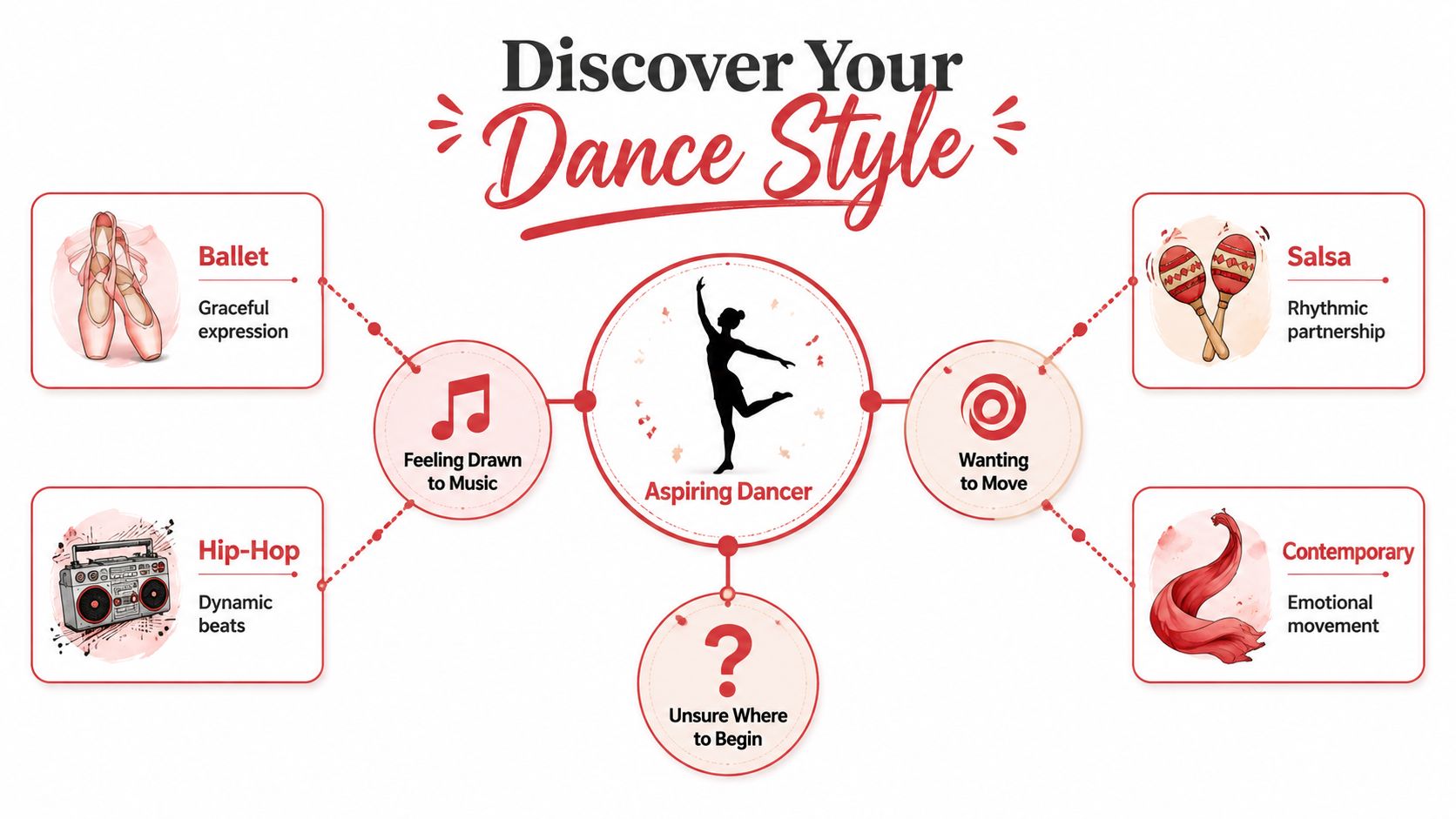
Start with the feeling, not the label
Some beginners are drawn to smooth, elegant movement. Others want rhythm, playfulness, and more visible energy. Others just want a social skill they can use at parties, weddings, or nights out.
Here's a practical way to sort it out:
| Dance family | What it feels like | Good fit if you want |
|---|---|---|
| Ballroom | Graceful, structured, classic | Posture, poise, partnership, formal social dancing |
| Latin | Rhythmic, lively, expressive | Energy, hip action, strong musical connection |
| Social styles | Relaxed, fun, versatile | Confidence at events and a more casual dance floor experience |
Ballroom usually appeals to people who like clean lines and a calm sense of control. Waltz and Foxtrot feel spacious. Tango feels sharper and more dramatic. If you want to move with elegance and learn a strong frame, ballroom often gives beginners a satisfying structure.
Latin tends to hook people who respond fast to rhythm. Salsa, Cha-Cha, and Rumba ask you to connect movement to the beat in a more immediate way. If a song makes you want to step, sway, and engage your body more fully, Latin may be the right door.
Social dances such as Swing and Hustle often work well for adults who want something practical and enjoyable without feeling formal. They can be playful, interactive, and easier to picture yourself using in real life.
Watch your own reaction to music. Your body usually answers the style question before your brain does.
Match the style to your real goal
A beginner who wants a wedding first dance may choose very differently from someone looking for a weekly hobby. The style should serve the life you have.
- For social confidence: Salsa, Swing, Hustle, and other partner-friendly social dances make sense.
- For elegance and polish: Waltz, Foxtrot, and other ballroom styles usually feel rewarding.
- For connection with a partner: Rumba and smooth ballroom are often appealing.
- For a fun fitness outlet: Latin styles often keep people engaged because the music pulls them forward.
If you're still undecided, read through this overview of social dancing styles and what they involve. It can help you narrow your first step without overthinking it.
A simple rule for choosing well
Pick the dance that makes you say, “I want to try that again.”
That's the right beginner style. Not because it's objectively perfect, but because it gets you moving. Starting matters more than optimizing.
How to Find the Best Dance Class
Once you've chosen a direction, the next real question is where beginners usually get stuck. Should you start with group classes or private lessons?
Both work. They just solve different problems.
Group classes and private lessons do different jobs
A group class gives you shared energy. You walk in and immediately see that other people are learning too. That's useful if your biggest barrier is nerves. Group learning also helps you get used to rhythm, class flow, and basic patterns without feeling like all attention is on you.
A private lesson gives you precision. An instructor can correct your posture, foot placement, timing, and partner connection in real time. If you're preparing for a wedding, want faster feedback, or feel overwhelmed in a crowd, private instruction often shortens the confusion phase.
Here's the trade-off:
| Format | Works well for | Less ideal if |
|---|---|---|
| Group class | Social learners, beginners wanting variety, people who like shared momentum | You want highly personalized correction |
| Private lesson | Targeted progress, individual goals, faster troubleshooting | You prefer to blend into a room and observe first |
Neither format is more legitimate. The better question is what helps you keep showing up.
What reduces beginner anxiety
The early hurdle isn't only skill. It's commitment anxiety. A lot of adults want to test the environment before they sign up for anything. That's smart.
Offering a free trial lesson is a proven way to ease beginner anxiety. Studios that offer specific, scheduled trial classes can see a 3.2x improvement in monthly inquiries, demonstrating that a structured introduction is highly effective.
That makes sense from a teacher's perspective. Beginners do better when they know where to go, what the room is like, and who will guide them. A vague “drop in anytime” approach sounds flexible, but it can feel harder emotionally than a clearly scheduled introduction.

A practical way to test a studio
When you're comparing studios, don't just look at the class list. Look for signs that the studio understands beginners.
- Clear beginner entry points: You should know which class is meant for someone brand new.
- A welcoming first visit: New dancers need orientation, not guesswork.
- Instructors who explain, not just demonstrate: Fast demos alone don't teach beginners much.
- A path forward: Good studios can tell you what to do after lesson one.
If you want a checklist for evaluating options, this guide on how to choose a dance studio is useful.
One practical option is Danza Academy of Social Dance, which offers a complimentary first lesson through its contact page so new students can experience the studio, meet an instructor, and get a starting recommendation without committing upfront. For many beginners, that kind of first contact removes the biggest obstacle, which is taking that first step.
What to Expect at Your First Dance Lesson
A first dance lesson is usually much gentler than people imagine. Beginners often picture themselves being thrown into a fast-moving room, surrounded by experienced dancers, with everyone noticing every mistake. That's rarely how a well-run beginner lesson feels.
Most first lessons begin with orientation. You arrive, get settled, meet the instructor, and learn the basic stance or frame for the style you're trying. Then you work on a simple foundational step. After that, the teacher may add one small variation such as a change of direction, a turn, or a timing cue.
What to wear and how to prepare
You don't need a costume. Wear clothes you can move in comfortably and shoes that let you stay balanced. The goal is not to look like a dancer. The goal is to move without distraction.
Leave a little early so you aren't rushing into your first class already tense. If you're calm when you walk in, you'll absorb more. That matters more than having the perfect outfit.
Going alone is common
One of the biggest emotional blocks is showing up solo. People worry they'll stand out, or that partner dancing is only for couples.
The question “Do I need a partner?” is one of the biggest hurdles for beginners. While most studios confirm no partner is required, they often fail to address the social anxiety of starting alone. Professional instructors are skilled at integrating solo dancers and fostering confidence in both leader and follower roles through practice (more on that beginner concern here).
That last part matters. “No partner required” is a technical answer. It doesn't always soothe the actual fear, which is, “Will I feel out of place?” In a welcoming studio, you won't. Solo beginners are common, and watching others for a few minutes before joining in is also normal.
If you come alone, you're not behind. You're simply arriving the way many adults start.
What awkward actually looks like
Most new dancers feel awkward because they're trying to think about feet, rhythm, posture, hands, and direction at the same time. That's not failure. That's the first stage of learning coordination.
A good first lesson doesn't ask you to perform. It asks you to notice.
- Notice the beat
- Notice where your weight is
- Notice which foot starts
- Notice when you tense up
Those are useful beginner wins.
If you'd like a clearer picture of the first experience, this page on a beginner dance lesson gives a helpful overview of what new students can expect. The first class isn't about impressing anyone. It's about leaving the room knowing that dancing now feels possible.
Building a Foundation with At-Home Practice
Class time matters, but the fastest beginners usually do one thing outside the studio. They build rhythm at home.
A lot of new dancers assume home practice means drilling choreography in front of a mirror. That can help later, but it's not the most important place to start. Early on, your main job is to internalize the beat so movement lands on the music instead of floating around it.
Rhythm first, shape second
Beginners often rely too much on what they see. They copy limbs without understanding timing. That's why some people can mimic a move once but can't repeat it when the music changes.
A stronger approach is to build rhythm before complexity. Guidance for beginners has emphasized mastering the beat through clapping at half speed, normal speed, and double speed before adding full-body movement, rather than depending too early on mirrors or visual appearance (discussion here).
Try these drills at home:
Clap the pulse
Pick one song and clap steadily through it. Then clap half speed. Then double speed. Don't dance yet. Train your ears first.March and transfer weight
March in place and pay attention to when your weight fully changes from one foot to the other. Clean weight transfer is the base of almost every partner dance.Start with one leading leg
Before any pattern, say to yourself which foot starts and which direction you're traveling. That small habit prevents a lot of confusion later.
Give yourself a real beginner target
Research and teaching experience indicate that a minimum of 10 hours is a critical threshold for beginner success. One instructor with 20 years of teaching experience advises beginners to commit to at least 10 group and private lessons to log those 10 hours before worrying about complex technique, because beginner success rates “skyrocket” once students persist past that mark (teaching perspective and timeline).
That's one of the healthiest ways to frame how to start dancing. Don't ask, “Am I good yet?” Ask, “Have I given this ten honest hours?”
Practical rule: Your first milestone is not looking smooth. It's reaching 10 hours without quitting.
To support your home practice, short visual breakdowns can help once you've established the beat. This kind of follow-along video works best when you pause, repeat, and stay focused on timing rather than trying to make every movement big right away.
Keep practice small and repeatable
You don't need marathon sessions. You need consistency.
Ten focused minutes spent clapping, stepping, and transferring weight with attention will usually help more than a distracted hour of random movement. Small repetitions calm the body down. That's when dancing starts to feel less foreign.
Common Mistakes New Dancers Make
The most common beginner mistake isn't having two left feet. It's learning dance as if it were a math problem.
People count steps mechanically, memorize shapes, and then wonder why they get lost the moment the music shifts. That approach creates dancers who know a sequence in silence but fall apart in motion.
Counting isn't the same as hearing rhythm
A primary pitfall for beginners is learning choreography by counting steps rather than synchronizing with the music's bars and beats. Successful dancers learn the count and rhythm first, then physically “stomp” the steps to build muscle memory that aligns with the music (demonstrated here).
That doesn't mean counting is bad. Counting is useful. But counting without hearing where the movement sits in the music creates a fragile result. The fix is to connect your feet to the beat, not just to numbers in your head.
What to correct right away
A few early habits are worth catching before they settle in:
- Looking at your feet constantly: This pulls your posture down and disconnects you from the room. Glance if needed, then return your focus outward.
- Starting without identifying the lead foot: If you don't know which leg begins, the rest of the pattern gets messy quickly.
- Trying to dance full-out too soon: Beginners often go for style before timing. Timing has to come first.
- Holding the upper body stiff: Tension blocks movement. Stay organized, but don't lock yourself up.
One practical correction is to stomp or mark the rhythm before trying to dance it smoothly. That helps your body feel the pulse in a grounded way.
Use tools that support, not distract
For beginners learning short combinations at home, it helps to break movement into 15 to 20 second chunks and practice at 0.5x speed with a mirroring tool such as MirrorTube before gradually increasing speed (breakdown method described here). That method improves choreography retention because it keeps your attention on timing and key movements instead of rushing toward fluidity.
If your feet get tired during repetitive drills, supportive training gear can help make practice more comfortable. Options like the Insoles.com aerobic collection are worth a look for dancers doing regular step work on hard floors.
The bigger shift is mental. Stop asking, “How many steps is this?” Start asking, “Where does this land in the music?” That question produces better dancers.
Your Dance Journey Next Steps
The first class is only the doorway. After that, dancing starts to branch into different lives.
For some adults, it becomes a social skill they use on weekends. For engaged couples, it turns into a first dance that feels natural instead of stressful. For parents, it becomes a structured activity that helps kids build confidence and coordination. For a smaller group, it grows into performance, competition, or advanced training.
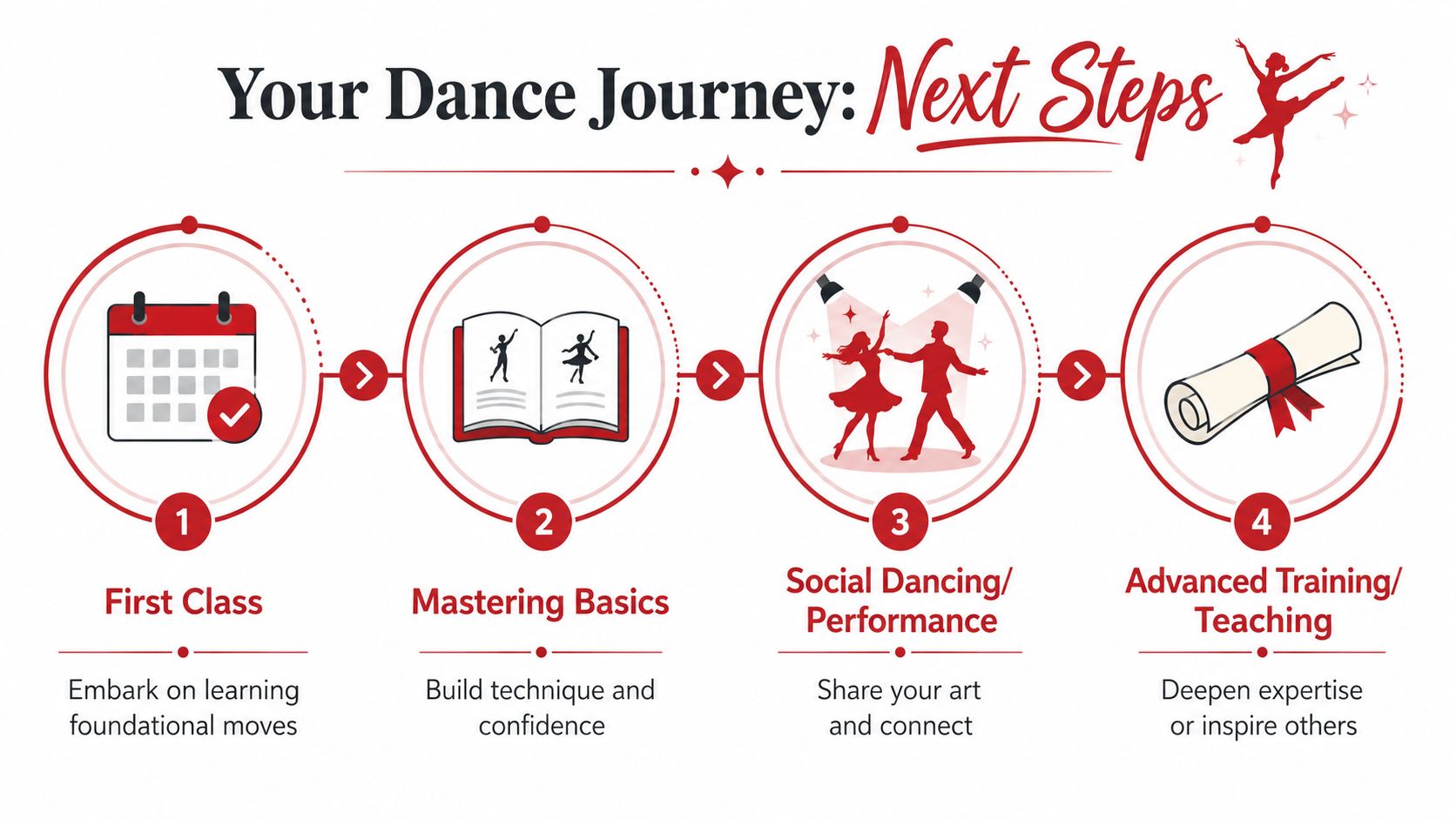
Think in pathways, not one finish line
A lot of beginners assume they need to know exactly where they're headed. You don't. You only need a next step that fits your current life.
Here are common paths people discover after starting:
| Path | What matters most early |
|---|---|
| Social dancing | Comfort with rhythm, partner awareness, repetition |
| Wedding dance | Simplicity, confidence, music choice, clean basics |
| Kids' training | Coordination, consistency, enjoyment, structure |
| Competitive growth | Technique, coaching, discipline, detailed feedback |
Basic competency takes time. While beginners can feel comfortable on the dance floor after a few lessons, gaining basic competency typically requires around 100 hours of instruction. That's a healthy expectation because it takes pressure off those first imperfect classes.
Progress usually looks like this
At first, everything feels busy. Then one day the beat becomes easier to hear. Your feet stop arguing with each other. You begin anticipating direction changes. You recover faster when you make a mistake. That's how real progress shows up.
Advanced dancing takes much longer, and mastery is its own road. But beginners don't need to think in years on day one. They need one clear action, one consistent practice rhythm, and an environment where they can learn without feeling judged.
The dancers who improve aren't the ones who never feel awkward. They're the ones who keep showing up long enough for awkwardness to turn into familiarity.
If you've been waiting to feel ready, take that pressure off. Readiness often arrives after the first lesson, not before it.
Starting is easier when the first step is simple. Danza Academy of Social Dance offers a free complimentary lesson you can book through the contact page. If you're ready to stop wondering how to start dancing and begin, book that first visit, walk in as you are, and let the process start with one song, one step, and one clear introduction.