You're probably closer than you think to taking your first salsa class.
Maybe you've been out in Nob Hill, walking through Old Town, or meeting friends for dinner when a salsa track came on and the whole room seemed to change. Someone caught the beat, stepped onto the floor, and suddenly it looked like they knew a language you didn't. That feeling is common. So is the next thought: “I'd love to do that, but I'd probably be terrible at it.”
You won't be the only beginner in the room. You won't need perfect rhythm on day one. And in Albuquerque, getting started is much more approachable than many people expect.
Feel the Rhythm Your Albuquerque Salsa Journey Begins Here
You hear a salsa song at a Friday night spot in Albuquerque, your foot starts tapping, and for a second you can see yourself out on the floor. Then the beginner nerves show up. What if you miss the beat, forget the steps, or walk in alone?
That moment is the true starting line for a lot of new dancers.
Salsa does not begin with natural talent. It begins with a first class, a little patience, and a room where beginners are expected. Albuquerque has that kind of salsa community. People show up by themselves, feel a little stiff at first, laugh, reset, and get better one song at a time. The process is normal here, which makes the whole idea feel much less intimidating.
A lot of beginners assume the goal is to look good right away. A first lesson works more like your first day learning to drive. You are not trying to impress anybody. You are getting familiar with the basics so your body can stop panicking and start listening. In salsa, that usually means hearing the beat, shifting weight cleanly, and learning how to connect with a partner without overthinking every count.
That is why this guide is not just a list of studios. Albuquerque beginners usually need more than an address. They need a clear path from "I am curious but nervous" to "I know what to wear, what class to choose, and how to enjoy my first social." If that sounds like you, you are in the right place.
What beginners usually misunderstand
New dancers rarely struggle because they are "bad at dancing." They struggle because they treat the first class like a test instead of practice.
The room is there to help you build rhythm in layers. First comes the basic step. Then timing starts to click. Then partner work feels less awkward. Salsa grows the same way red and green chile builds flavor in a good Albuquerque meal. One ingredient at a time, then suddenly everything comes together.
You become a dancer by dancing, not by waiting until you feel ready.
That shift in mindset helps adults stick with it. Salsa gives you movement, music, and a way to connect with people face to face. If you want a fuller picture of why so many people keep coming back, this article on the benefits of social dancing for confidence and connection lays it out well.
What this journey can become
At the beginning, salsa can feel like numbers and foot placement. Before long, it starts to feel like conversation. You hear the music sooner. Your body responds with less hesitation. A turn that felt impossible in week one starts to feel natural.
That is the fun of learning salsa in Albuquerque. You are not only signing up for a class. You are learning a skill that can carry you from a beginner lesson to a local social dance floor with real confidence.
Finding Your First Salsa Class in Albuquerque
You're sitting in your car outside a studio on a Tuesday evening, wondering two things at once. Did I pick the right class, and am I about to walk into a room full of people who already know what they're doing?
That moment is normal. Your first salsa class in Albuquerque starts before the music does. It starts with choosing a learning setup that makes it easy to show up, relax, and come back next week.
Group classes versus private lessons
For many beginners, group classes are the easiest starting point. The energy in the room helps. You can follow the instructor, watch other new dancers, and realize very quickly that nobody expects perfection on day one. A private lesson gives you a different kind of comfort. You get personal feedback, a slower or faster pace if needed, and more space to ask questions without feeling rushed.
Here's the practical difference:
| Feature | Group Classes | Private Lessons |
|---|---|---|
| Learning environment | Social, shared energy, common beginner experience | One-on-one, focused, customized |
| Pace | Set by the class and instructor | Set around your learning speed |
| Practice style | Rotating partners and shared drills | Repetition built around your needs |
| Best for | New dancers who want structure and community | Students who want personal feedback or faster troubleshooting |
| Commitment feel | Easier for many people to try first | Better for targeted goals |
The best choice is the one you will keep attending.
If you enjoy learning with other people, start with a beginner group class. If crowds make you tense, or you know you learn best with direct correction, a private lesson can give you a calmer runway. Salsa works a lot like learning conversational Spanish. Some people like the buzz of a classroom. Others do better with one teacher first, then join the group once the basics feel familiar.
Why level structure matters
A good beginner program builds skills in layers. You should not have to guess whether you belong in the room.
Many Albuquerque salsa programs sort classes by level, which helps new dancers avoid the common mistake of joining a class that moves too fast. The point is not to hold you back. The point is to give you a steady base. Basic timing, weight changes, posture, and partner connection are the steps under every turn pattern you will learn later.
If a class skips those foundations, beginners often end up memorizing shapes without understanding how the dance works. That feels shaky fast. A well-structured Level I class gives you repetition, then adds complexity once the rhythm starts to settle in.
One simple clue helps here. If the class description clearly says beginner, intro, fundamentals, or Level I, the studio is usually doing a better job of guiding new students into the right room.
What to look for before you enroll
Studios have different personalities. Some feel social and chatty. Some feel methodical and technique-focused. Neither is wrong, but one may fit you better.
Check for these signs before you sign up:
- Clear beginner labeling: The class should plainly say who it is for.
- A path to progress: The studio should show how students move from beginner material into higher levels.
- A welcoming room culture: New faces should feel expected, not like they walked into a rehearsal.
- A schedule you can keep: A class only helps if it fits real life in Albuquerque traffic, work hours, and family routines.
If you want a sharper way to compare your options, this guide on how to choose a dance studio gives a useful checklist.
A simple way to decide
Pick the class that feels easy to attend three times in a row.
That standard helps more than chasing the “perfect” studio. Your first goal is not finding the fanciest room or the most advanced teacher. Your first goal is building enough repetition for the music to stop feeling foreign. Once that happens, salsa gets a lot more fun.
What to Expect in Your First Salsa Lesson
You walk into the room a few minutes early, hear the music, and wonder if everyone else already knows what they're doing.
That feeling is normal in Albuquerque beginner salsa classes. The good news is that a well-taught first lesson is built for people who are new, a little unsure, and still learning how the rhythm fits in their body. You are not expected to perform. You are there to get familiar.
Many local beginner classes start with solo work before any partner rotation begins, so coming alone is completely fine. That matters more than new students realize, because it lets you focus on the beat, your footing, and your posture before adding another person to the mix.
The first few minutes
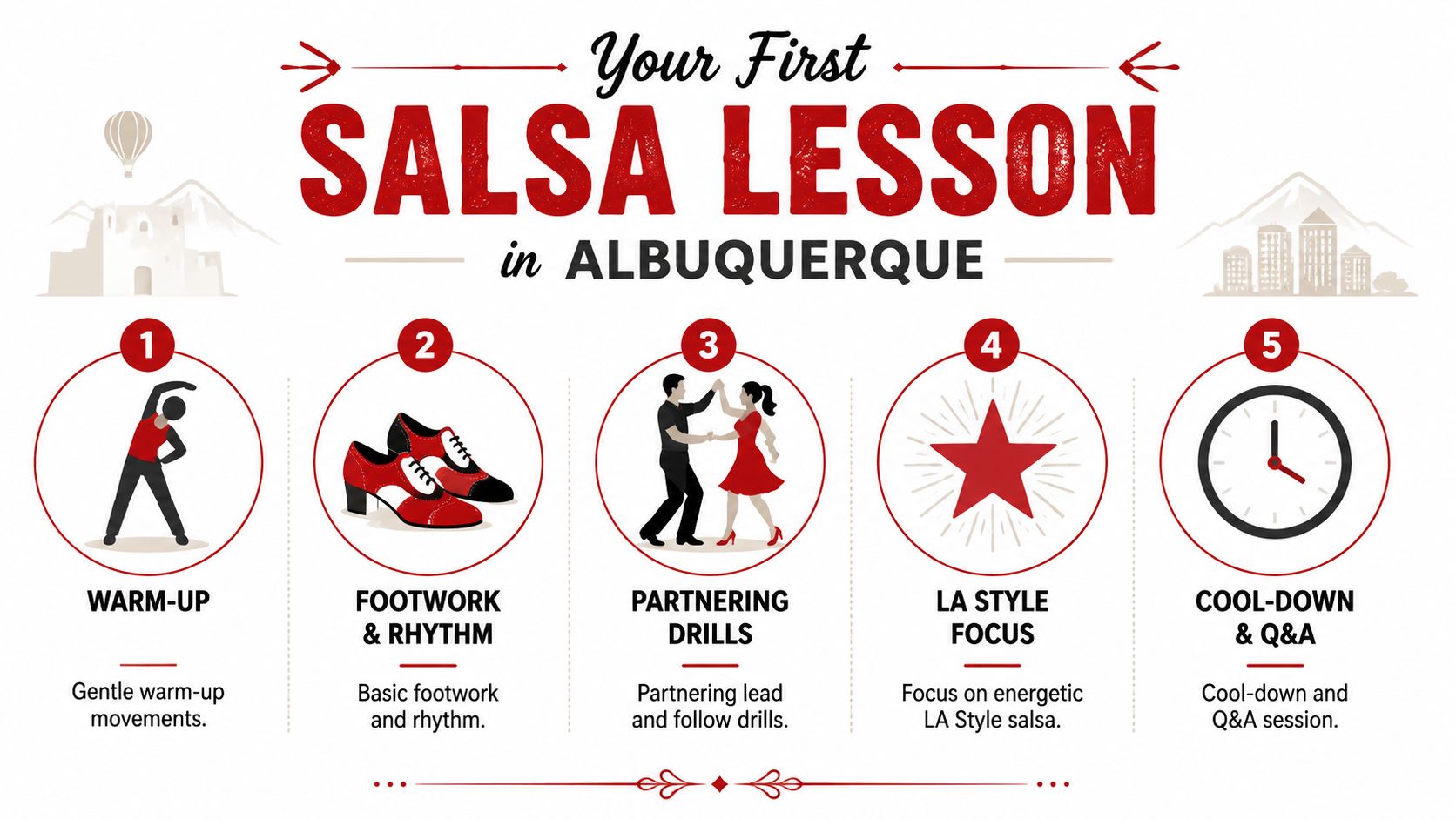
The opening of class is usually calm and structured. You check in, find your spot, and listen while the instructor explains the goal for the day. A good teacher gives you a simple target, such as the basic step, timing, or one easy partner pattern, instead of flooding you with too much at once.
Then comes the warm-up. It is less about exercise and more about getting your body awake. Your shoulders soften, your knees loosen, and the music starts to feel less like background noise and more like something you can follow.
What you'll probably practice
Your first lesson usually stays focused on a handful of building blocks. Salsa works like learning a new language. You do not start with a speech. You start with a few words you can use right away.
Basic footwork
You learn where the feet go, when to shift weight, and how to keep your steps small enough to stay balanced.Timing
Timing often causes adults to tense up. Try not to. Timing gets better by hearing the count again and again, then matching your body to it.Partner connection
If the class includes partnering, you learn how to give clear signals and respond to them. Good connection feels more like a conversation than a tug-of-war.A simple turn or pattern
Usually this is one small application of the basic step, just enough to show how salsa becomes social dancing.A final review
Strong instructors revisit the main idea before class ends so you leave remembering one or two things clearly.
What confuses beginners most
The hardest part for many first-timers is not the footwork. It is trying to remember everything at full speed.
You do not need to.
Your first class is about recognition. The rhythm starts to sound less mysterious. The basic step starts to feel less awkward. Your body may sort out the lesson later that evening or even the next day, the same way a new route across town makes more sense after you have driven it once.
If you leave thinking, “I can't do it perfectly yet, but I understand the shape of it,” that is a strong start.
What to wear and bring
Keep your setup simple so your attention stays on the lesson.
- Clothes: Wear something comfortable that lets you move and turn without fussing with it.
- Shoes: Pick shoes that can pivot. Very sticky soles can make turning harder on many dance floors.
- Water: Bring some, even if the class looks low-key from the outside.
- Mindset: Expect repetition. Salsa is learned in layers, not all at once.
If you want a clearer preview before you go, this guide to a beginner dance lesson shows the kind of first-day experience many new students find helpful.
One practical note. Some beginners feel nervous because they associate dancing with polished performances or ticketed events. Class is different. It is a practice room, not a show. If you are curious how organizers structure public events, this article on how to optimize event ticket pricing explains that side of the dance world, but your first lesson is much simpler. You show up, learn the pattern, laugh a little, and try again.
Treat that first class like your first lap around a quiet neighborhood street. You are building control, rhythm, and comfort. Once those pieces start settling in, stepping onto a local salsa floor in Albuquerque feels far more doable than it did at the door.
Understanding Costs and Class Schedules
You do not need to spend a fortune to get started. You need a plan you can stick with.
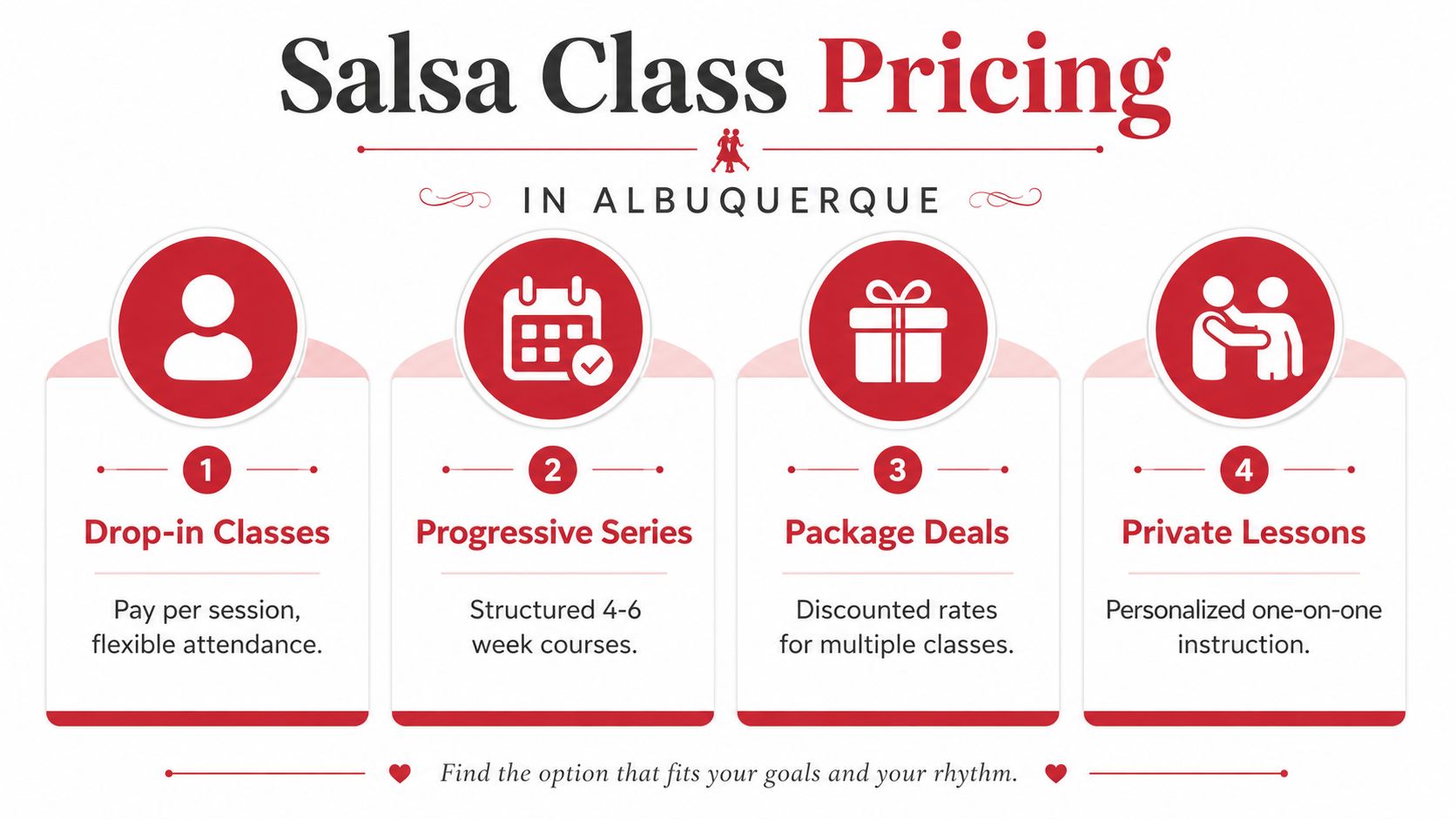
In Albuquerque, beginner salsa classes usually show up in a few common formats. Some studios offer single drop-in classes. Others teach in a short series where each week builds on the last. You may also see class packs or private lessons. For a brand-new dancer, those options can feel like standing in front of a menu written in another language. Once you know what each format is for, the choice gets much easier.
How to think about pricing
A drop-in class works like buying one practice session at a time. It gives you flexibility, which is helpful if your work schedule changes or you are still testing whether salsa fits your week.
A progressive series works more like a short course. Week one lays the foundation, week two adds to it, and so on. That structure often helps beginners because you are not guessing what to practice next.
Class packages sit in the middle. They can save money if you know you will attend regularly, but they still give you room to choose different dates. Private lessons are the most personalized option. They can speed up learning, especially if you want extra help with timing, turning, or confidence, but they usually cost more than group classes.
If you are organizing socials, workshops, or studio events yourself, it also helps to understand how organizers optimize event ticket pricing so class fees and event entry feel reasonable from the student side.
How to choose a schedule you will actually keep
Pick the class that fits your real life in Albuquerque, not your ideal week.
That matters more than beginners expect. Salsa is physical learning. Your feet, ears, and timing improve through repeated exposure, the same way a familiar route across town starts to feel automatic after a few drives.
One class a week is enough to build momentum if you attend regularly. Two can help if your schedule and budget allow it. Random attendance makes progress feel choppy, even when the teaching is good.
A class you attend regularly will help you more than a class that looks perfect on paper but keeps getting skipped.
Evening classes are often easiest for working adults, but the best time is the one you can protect. If Tuesday at 7:00 keeps opening up for errands, meetings, or family plans, another night may serve you better.
A realistic beginner budget
Start with a home base. One weekly group class is usually the smartest first expense.
After that, you can decide whether to add a social, a workshop, or an occasional private lesson. That order matters because classes give you a place to build habits. Then your first social feels like practice in public, not a test.
Give yourself a month or two before judging whether the cost feels worthwhile. Salsa rarely clicks all at once. It grows class by class, week by week, until one night you notice you are hearing the beat faster, turning with less effort, and walking into the room like you belong there.
From the Studio to the Social Dance Floor
Friday night arrives, the music starts, and you are standing at the edge of the room with the basic step you learned in class running through your head. That moment can feel big. It is also completely normal.
Group classes teach patterns in a calm setting. Social dancing teaches you how those patterns work with real music, different partners, and the natural energy of a room. That shift is where many Albuquerque beginners stop feeling like they are memorizing and start feeling like they are actually dancing.

What a salsa social is really like
A social is part practice, part community, part night out. You will usually see a mix of people. Some have danced for years. Some are on week two and concentrating hard on staying on beat. Both belong there.
Many Albuquerque socials begin with a short beginner lesson before open dancing. That helps in a very practical way. You get to hear the rhythm, loosen up, and meet a few people before the room fills. It works like arriving early to a potluck where you only know one person. The setting feels much easier once you have had a minute to settle in.
You also do not need a full bag of moves. At a beginner social, a clean basic step, a right turn, and the ability to keep time will carry you farther than trying to remember six patterns at once.
How to make your first social feel manageable
Keep the goal small. A first social goes well when you leave thinking, “I can do that again.”
A few habits help:
- Show up for the pre-social lesson: It gives you an easy entry into the room and a few familiar faces.
- Start with one simple dance: One song with clear timing is better than five tense ones.
- Use your basics on purpose: Basics are your home base. If something gets messy, return there.
- Watch the floor between dances: Observation trains your ear and your timing.
- Ask a teacher or classmate which socials feel beginner-friendly: Local guidance matters because every event has its own personality.
Beginners usually enjoy socials more when they aim for comfort and connection instead of trying to impress anyone.
A quick visual can also help you see the kind of musical energy and partner flow people work toward over time.
Signs you are ready to go
You are ready once you can hear the beat most of the time, keep a basic step going without panicking, and recover if a turn or lead gets off track. That is enough.
New dancers often assume they should wait until they feel confident first. Social dancing usually builds that confidence, not the other way around. The floor gives you feedback that class alone cannot give. You learn how songs change, how different partners feel, and how to stay relaxed when something unexpected happens.
That is what makes salsa dance lessons in Albuquerque feel like a real journey instead of a series of classes. You prepare in the studio, test things in a social, come back with better questions, and grow faster each week.
Your First Step Starts with a Single Click
Hesitation is normal. Nearly every new dancer has that moment where they hover over the sign-up button and wonder if they should wait until they feel more confident.
Waiting usually doesn't create confidence. Experience does.
By this point, you know what beginner classes tend to look like, how the local learning structure supports new dancers, what class formats cost, and how lessons connect to actual social dancing in Albuquerque. That's enough to begin. You do not need to solve every future question before taking one first lesson.
One practical option is Danza Academy of Social Dance, which offers salsa through both private lessons and group classes. If you learn best with a welcoming introduction and clear instruction, a complimentary first lesson gives you a low-pressure way to test the experience for yourself.
Start before you feel polished. Salsa rewards people who participate.
If salsa has been sitting in the back of your mind for a while, take that seriously. The people you see dancing comfortably now were beginners too. They walked in uncertain, learned the basics one layer at a time, and kept showing up. That same path is open to you.
Book your free complimentary lesson through the Danza Academy of Social Dance contact page and give yourself a real starting point. One lesson can turn “I've always wanted to try salsa” into “I'm finally doing it.”