
You're probably here because merengue looks fun, but you're not sure how to start without feeling awkward. That's a normal place to begin. Most adults who try their first Latin dance aren't worried about the step itself. They're worried about looking stiff, missing the beat, or freezing when someone asks them to dance.
The good news is that merengue is one of the friendliest dances for a first timer. The movement is compact, the rhythm is steady, and the basic action is simple enough that you can start feeling successful quickly. If you want a practical introduction to social dancing in general, this guide to what social dancing is and how it works gives useful context for what happens on a real dance floor.
From the Sidelines to the Center of the Floor
At weddings, birthday parties, and Latin nights, merengue is often the dance that gets hesitant people moving. That's because the basic action doesn't ask you to memorize a long routine. You change weight from foot to foot, stay with the beat, and keep your movement small and relaxed.
Historically, merengue developed in the Dominican Republic in the mid-1800s as a social dance, and that social history shaped it into a dance built on compact partner movement and repeatable basics rather than complicated choreography, as described in this merengue dance history overview. For beginners, that matters. A dance made for social settings tends to be easier to join than a dance built around performance.
What beginners usually get wrong
Many new dancers assume they need to “look Latin” right away. They try to add hip action, arm styling, or dramatic turns before they can comfortably hear the beat. That usually creates tension.
Start with a simpler goal:
- Hear the beat clearly: If you can count along, you're already making progress.
- Shift weight fully: One foot holds you. Then the other foot holds you.
- Keep the body easy: Merengue works better when it feels grounded and calm.
A helpful mindset: Your first job isn't to impress anyone. Your first job is to stay moving without panic.
That's why merengue dance steps for beginners should start with feel before flair. If your rhythm feels steady and your body feels loose, the dance already looks better.
What success looks like tonight
A strong beginner version of merengue isn't fancy. It looks like this:
| Focus | What it should feel like |
|---|---|
| Timing | Steady and even |
| Footwork | Small, simple, close to the floor |
| Body motion | Natural, not forced |
| Confidence | Calm enough to keep going |
If you can stay on the beat and keep stepping, you're dancing merengue.
Finding the Beat The Heart of Merengue
Merengue starts in your ears before it reaches your feet. The rhythm is commonly written in 4/4 time, and beginner-friendly merengue music typically sits at 28–32 measures per minute, which gives new dancers a steady pace to practice the basic weight change on each beat, according to this round dancing merengue reference.
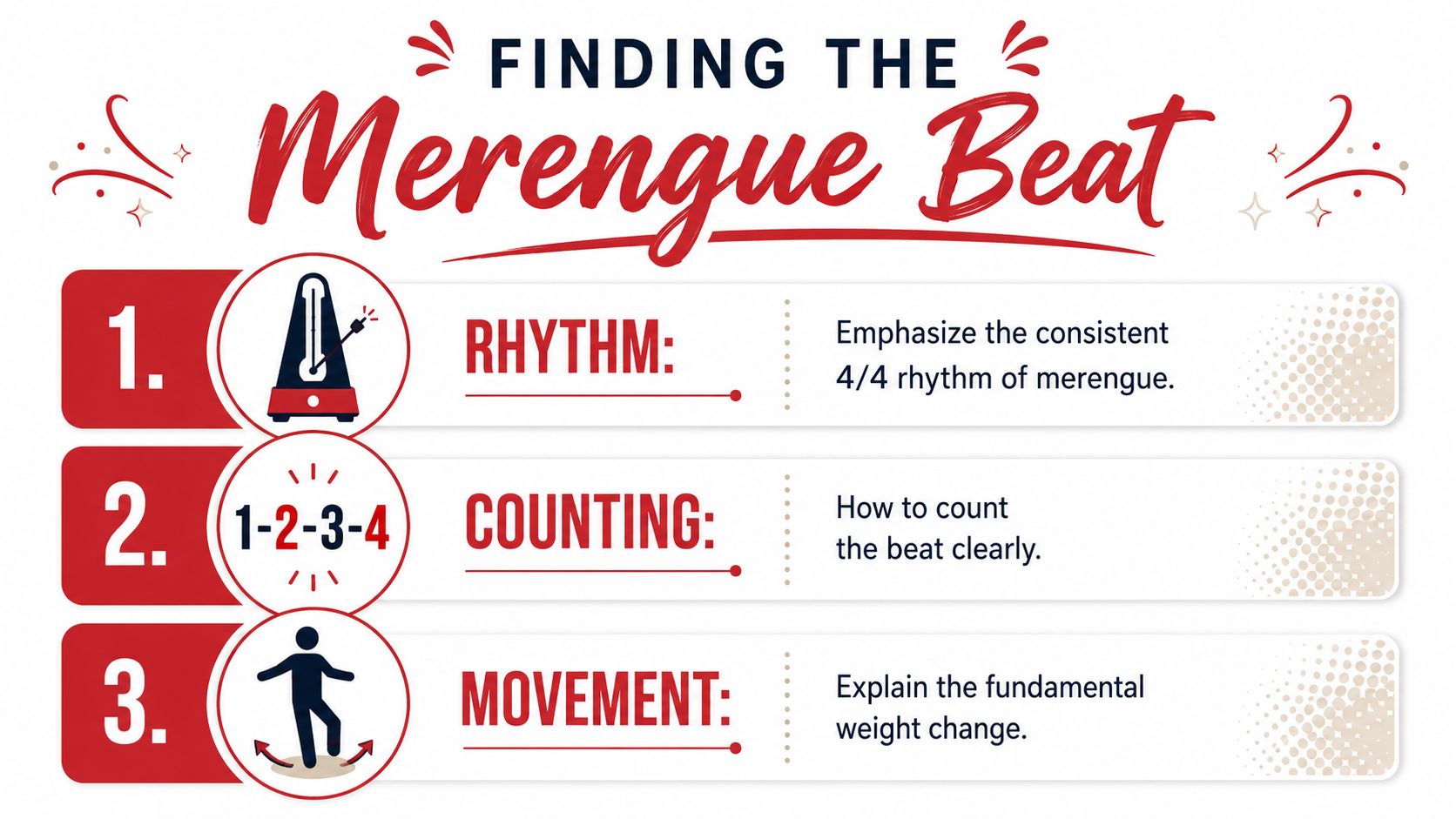
If music timing has always felt slippery to you, don't start by dancing with a partner. Start alone and simplify it down to a march. This article on how to find the beat in music can help if counting music feels unfamiliar.
Use the marching drill
Stand tall, let your arms rest, and march in place.
Count like this:
- Step left on 1
- Step right on 2
- Step left on 3
- Step right on 4
Then repeat. No rush. No styling.
This is the core of merengue dance steps for beginners. Not a pattern. Not a trick. Just a clean weight transfer on every beat.
Where the hip motion really comes from
Many people often tense up here. They think the hips need to be added manually, like a separate dance move. They don't.
Your hips start moving when you do two things well:
- Keep the knees soft: Bent knees help the weight settle naturally.
- Transfer weight completely: When one side of the body takes your weight, the hips respond.
Don't try to wiggle your hips. Let your weight shift create the motion.
If you force the sway, your upper body stiffens and your timing often gets worse. Natural hip motion always looks better than exaggerated hip motion.
A practical way to hear it in real life
School dances, parties, and community events often use songs with clear pulse because people need something easy to move to. If you ever help with planning school dance entertainment, you'll notice how much easier dancing becomes when the music has an obvious beat and predictable structure.
Try this home drill for one song:
- First pass: Clap only.
- Second pass: March in place.
- Third pass: Add a slight side movement.
- Fourth pass: Smile and keep going, even if you make a mistake.
That last part matters. Rhythm gets stronger when you continue, not when you stop every time something feels off.
Building Your First Merengue Dance Steps
You hear the music start, you know the beat is there, and then your body asks one nervous question: “What do I do with my feet?” That moment is normal. Beginner merengue gets much easier once you treat the basic step like walking to music, with a little more rhythm and a lot less tension.
The goal is not to look flashy. The goal is to make the beat feel dependable in your body so your movement starts to look natural instead of stiff. A good beginner progression is simple: march in place through an eight-count phrase, add a side basic, then try a forward-and-back basic. Save turns for later, after your steps feel steady, as shown in this beginner merengue tutorial.
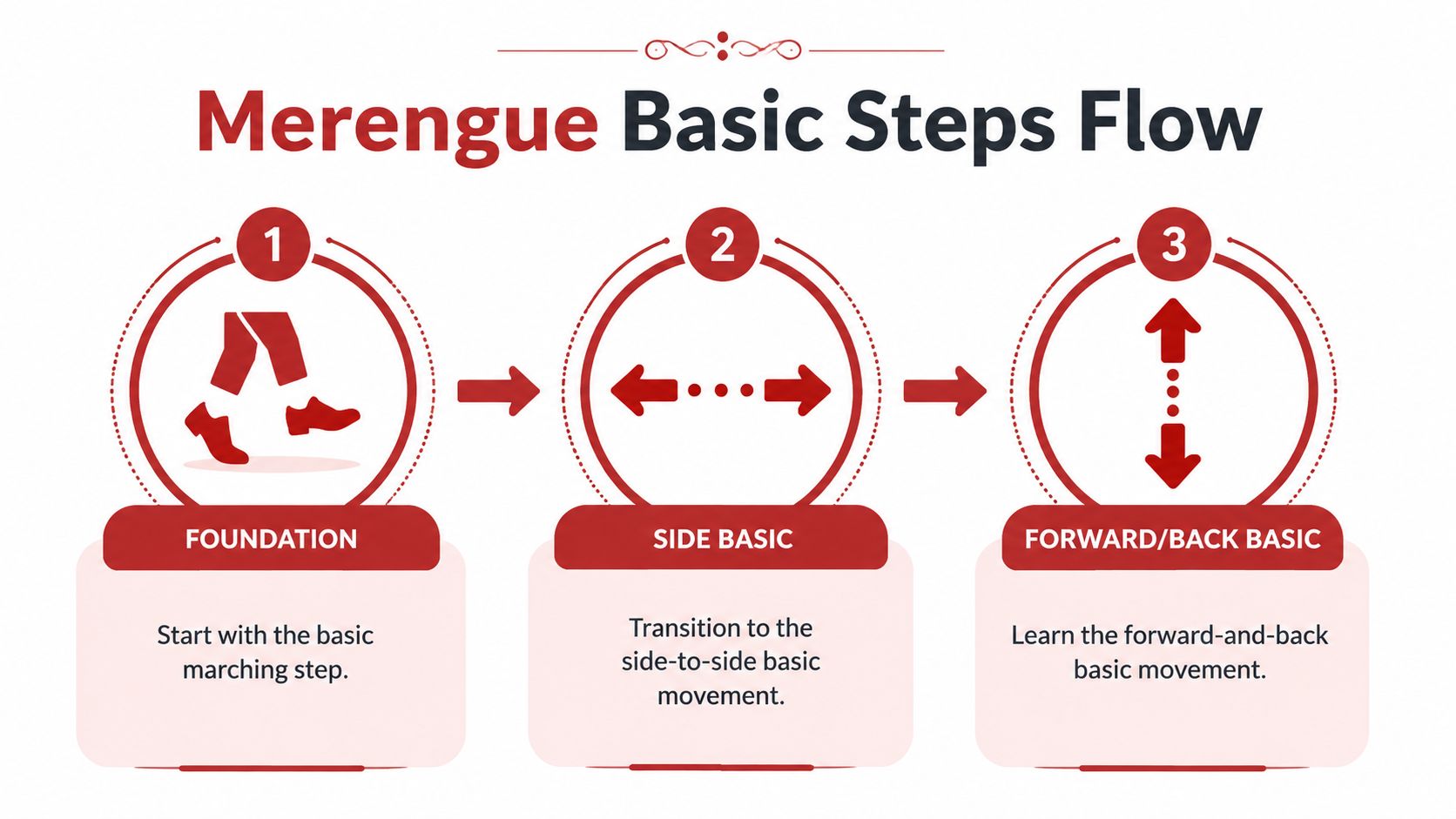
Many beginners learn faster when they stop treating merengue as a special, mysterious foot pattern. It works a lot like controlled walking with rhythm. If balance or foot placement feels awkward, this guidance on walking patterns can help you understand weight transfer in a simple, non-dance way.
The side basic
The side basic is often the first pattern that makes beginners feel like they are really dancing with someone.
For leaders:
- Count 1: Step left with the left foot.
- Count 2: Bring the right foot in and change weight.
- Count 3: Step right with the right foot.
- Count 4: Bring the left foot in and change weight.
For followers:
- Count 1: Step right with the right foot.
- Count 2: Bring the left foot in and change weight.
- Count 3: Step left with the left foot.
- Count 4: Bring the right foot in and change weight.
Keep each step small. Your feet are sketching the rhythm, not trying to cover distance. If you step too wide, your body has to work hard to catch up, and that is when beginners start to feel clumsy.
Here's a visual example to study before you practice:
The forward and back basic
This basic adds direction without adding much difficulty. It also teaches control, which helps you stop looking rushed.
For leaders:
- Step forward.
- Replace weight.
- Step back.
- Replace weight.
For followers, it's the opposite:
- Step back.
- Replace weight.
- Step forward.
- Replace weight.
The usual mistake is stepping too far. Merengue does not need a big reach. Keep the step short enough that you still feel stacked over your feet. If your partner can tell the direction changed but you still look balanced, you are in the right range.
Practice rule: Small steps help your timing stay clear. Big steps create extra recovery work.
A clean solo practice plan
Try this for a few songs, and stay relaxed if one round feels messy. Progress in merengue often sounds better before it looks better.
| Drill | What you do |
|---|---|
| Round 1 | March in place for a full song |
| Round 2 | Practice the side basic for several phrases |
| Round 3 | Alternate side basic and forward-and-back basic |
| Round 4 | Pause, reset your posture, and repeat |
One more reminder that helps nervous beginners: you do not need to force style into these steps. When the weight changes cleanly on each beat, the body starts to soften, the hips begin to respond naturally, and the dance stops feeling mechanical. That is the feeling you want to build first.
How to Lead and Follow a Simple Turn
A simple underarm turn feels exciting because it looks like a “real dance move,” but it only works if the basic step stays alive underneath it. Beginners often stop their feet the moment the turn starts. That's the mistake to avoid.
A sound beginner method is to keep the feet low, lifting only about 2 to 3 inches, and let the knees stay softly bent so the movement remains fluid. The natural hip action should come from the weight shift, not from conscious swaying, as explained in this step-by-step merengue guide.
What the leader does
The leader's job isn't to spin the follower. The leader creates a clear path.
Use this order:
- Keep the basic going: Don't freeze your own feet.
- Prepare early: Lift the joined hand slightly before the turn begins.
- Guide, don't yank: The hand invites the circle. It shouldn't drag your partner through it.
- Stay calm in the body: If your shoulders rise, the lead gets muddy.
Think of the turn as opening a doorway, not pushing someone through a revolving door.
What the follower does
Followers often worry they're supposed to “guess right.” You're not guessing. You're responding to direction while continuing your steps.
A simple approach works well:
- Keep your feet walking to the beat.
- Feel the hand lift.
- Walk a small circle under the arm.
- Finish the turn without rushing the last step.
The cleaner your basic is, the easier the turn feels.
If the turn feels wild, make the circle smaller and slow your upper body down.
What makes the turn look smooth
A beginner turn usually looks awkward for one of three reasons:
- The feet stop
- The step gets too big
- Both dancers try to hurry
Smooth turns look almost ordinary from the waist down. That's the secret. Your feet keep doing the same simple job while the arms create the shape.
Perfecting Your Posture and Partner Connection
A beginner couple can know the steps and still look unsure. Usually, the problem is not the feet. It is posture, tension, and the way the two bodies communicate.
Merengue works best when the connection feels easy and clear. On a crowded social floor, you do not need a dramatic frame. You need a posture that helps both partners feel the beat, stay balanced, and understand each other without force.
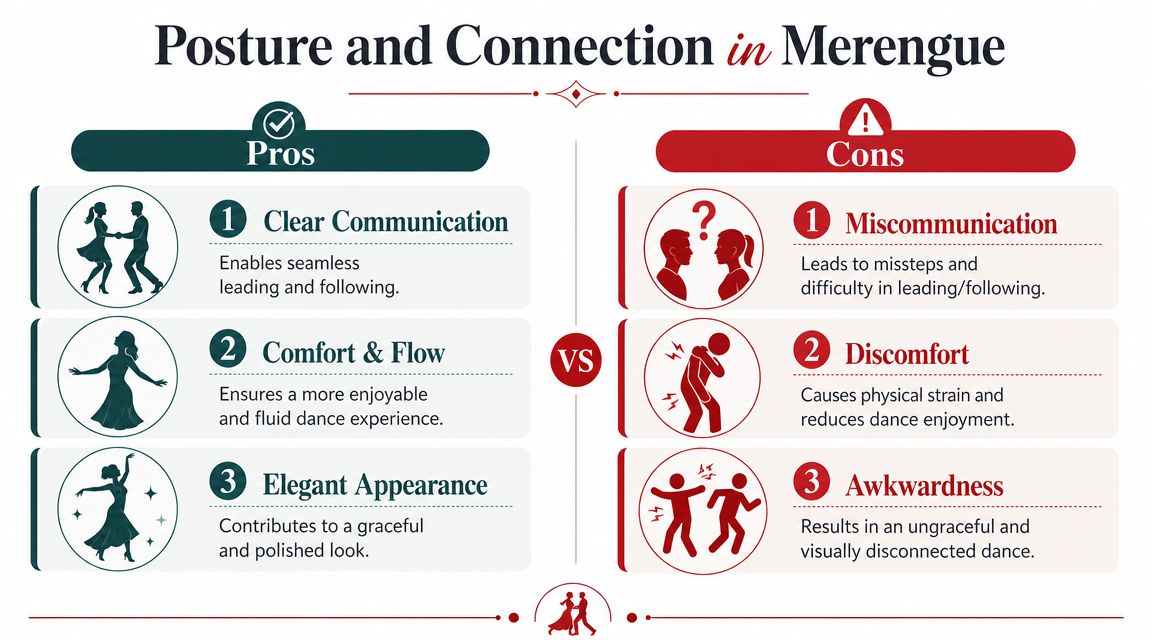
What a good connection feels like
In a common beginner hold, the leader places the right hand on the follower's shoulder blade area, and the other hands meet lightly in front. The goal is gentle tone in the arms and hands. Enough energy to send information. Enough softness to stay comfortable.
A good comparison is holding a shopping bag with something breakable inside. Your hand stays awake, but it does not squeeze.
If your partner cannot tell whether you are leading a change, the connection is too loose. If either of you feels pulled, pressed, or trapped, it is too strong.
How to stand without looking stiff
Many new dancers hear “good posture” and respond by standing like statues. That makes merengue look formal and frozen, even though the dance should feel grounded and alive.
Start with this setup:
- Stand tall through the top of your head.
- Keep the chest open so breathing stays easy.
- Let the shoulders rest down.
- Keep the knees soft.
- Hold your core gently, like you are ready to walk.
That last point matters. Merengue posture is walking posture with better awareness. You are organized, not rigid.
Small fixes that change the whole dance
These habits make partner dancing feel better fast:
- Keep your hands light: Your hands pass information. They should not clamp down.
- Keep your elbows slightly active: This helps signals travel from one partner to the other.
- Keep your weight over your own feet: Each partner should carry their own balance.
- Keep your gaze up: Looking at the floor often pulls the chest down and breaks the connection.
And watch for these common beginner mistakes:
- Locked knees
- Raised shoulders
- Leaning forward into the partner
- Arms with no tone at all
Good connection feels supportive, clear, and easy to read.
Why beginners feel awkward here
Nervous dancers often try to control every detail at once. They tighten the shoulders, grip with the fingers, and brace the hips because they are afraid of looking sloppy. Ironically, that effort is what creates the stiff look.
A better goal is responsiveness. Let the rhythm travel through a relaxed body. Let the weight shift create the natural motion. Let the connection carry simple messages between you and your partner.
Use this quick self-check during practice:
| Body area | What to aim for |
|---|---|
| Head and chest | Tall and open |
| Shoulders | Resting down |
| Hands | Light and clear |
| Knees | Soft |
| Partner contact | Close enough to communicate, never heavy |
If you focus on those five areas, merengue starts to feel less like memorizing steps and more like having a conversation. That is the point. Beginners do not need to look perfect. They need to look connected, comfortable, and in time.
Take Your First Steps with an Expert Guide
You know that moment when the music starts, other couples step onto the floor, and you tell yourself, “I'll try once I feel less awkward”? That feeling is common. Merengue gets easier much faster when a teacher can show you that you do not need bigger moves or more force. You need clearer timing, a calmer body, and trust in the beat.
Reading about merengue helps you understand the map. A lesson helps you feel the road under your feet. An experienced instructor can spot the small habits beginners often miss on their own, such as stepping without fully changing weight, hurrying the count, or freezing the hips because they are trying too hard to “do it right.”
That outside feedback matters in many kinds of coaching. Even tools built for optimizing personal training operations focus on the same basic idea: clear guidance, steady practice, and adjustments based on what the student is doing.
If you want support that is specific to your body, your timing, and your confidence level, private dance lessons can be a very helpful next step. At Danza Academy, beginners often relax once they realize they are allowed to ask simple questions, repeat a movement slowly, and learn the feel of merengue before worrying about looking polished.

A first lesson also gives you something a blog post cannot. Reassurance in real time.
Maybe your steps are correct, but your body still feels stiff. Maybe the rhythm makes sense when you read it, but disappears when the song starts. A teacher can slow everything down, count with you, and help you connect the step to the music so the dance starts to feel natural instead of mechanical.
Book your free complimentary lesson with Danza Academy of Social Dance through the contact page. It's a simple next step if you want personal guidance, clearer timing, and the confidence to use your merengue dance steps for beginners on a real social floor.