
A lot of couples start this search at the same moment. Dinner out feels repetitive, movie night is passive, and you want something that gets you off the couch and into a shared experience you'll remember. That's usually when the search bar gets a very specific question: salsa classes for couples near me.
That's a smart search. Salsa gives you movement, music, teamwork, and just enough challenge to feel exciting. You don't need dance experience, perfect rhythm, or the “right” personality for it. You just need a willingness to laugh, try, and learn a few basics together.
Tired of the Same Old Date Night

You're probably not just looking for a class. You're looking for a better way to spend time together.
A good date night gives you something to do, but a great one gives you something to build. Salsa does that. You learn a skill side by side, you move to music, and you share those small wins that make an evening feel fresh again. One clean turn, one moment of catching the beat together, one laugh after stepping on the wrong foot. That's the fun of it.
If you've already looked through lists like these top creative date spots in NYC, you've probably noticed a pattern. The most memorable dates are interactive. They ask both people to participate, not just show up. Salsa fits that idea perfectly.
Why this search makes sense
Many people worry they need to be “dance people” before they try a salsa class. You don't. In major dance markets, salsa is commonly taught as a group social dance with beginner-friendly formats, flexible schedules, and options that make it approachable for couples. One Phoenix-area listing shows weekly classes on Monday, Thursday, Saturday, and Sunday, with prices from $10 to $20 per class, and another downtown venue offers a $15 class followed by social dancing from 9:30 PM to 11:30 PM. Those listings also note that no partner is needed, which helps couples attend together without worrying about strict registration rules or balance requirements. You can see that pattern in these Phoenix salsa meetup listings.
That matters because it changes the feeling of the whole experience. Salsa isn't locked behind a private club door. It's designed to welcome beginners in.
For many couples, that's the breakthrough. You're not signing up for pressure. You're signing up for a shared activity that's social, practical, and easy to test out. If you want a fuller picture of how social dancing supports connection and confidence, this guide on the benefits of social dancing is worth reading.
Salsa works well for couples because it gives you structure without making the night feel scripted.
Why Salsa is the Perfect Hobby for Couples
Salsa works for couples because it teaches two people how to pay attention to each other. That sounds simple, but it's rare. Most hobbies happen next to your partner. Salsa happens with your partner.
You listen to music together. You notice timing together. You learn how to send and receive information without saying much at all. One person suggests direction, the other responds, and both people keep adjusting. That process builds a kind of teamwork you can feel right away.
It teaches connection without making it heavy
Beginner couples often think dance is about flashy moves. It isn't. At first, it's about clear signals, balance, posture, and trust.
That's why salsa feels surprisingly personal. You start noticing how much communication happens through your hands, your frame, and the way you shift weight. When something clicks, it feels less like memorizing and more like speaking a new language together.
A few things couples often discover early:
- You don't have to be naturally coordinated. You only need patience and repetition.
- Mistakes become part of the fun. Most first classes include plenty of laughing.
- Progress feels shared. When one person improves, the partnership improves too.
It gives you a reason to keep showing up
Some hobbies fade because there's no momentum. Salsa has built-in momentum. There's always another basic to clean up, another turn to understand, another song where things feel smoother than last time.
That steady progress is one reason couples stick with it. You can make it a weekly ritual, a social outlet, or a focused project before an event. Some couples want a casual date-night hobby. Others want to feel comfortable at parties, weddings, or Latin nights. Both approaches work.
If you're curious how partner-focused instruction can support that process, take a look at these couples dance lessons.
Dancing together gives couples a repeatable moment of cooperation. You're solving one small challenge at a time, in rhythm.
It feels romantic without being forced
A lot of “couples activities” try too hard. Salsa doesn't need to. The music does some of the work. The movement does the rest.
You hold each other's attention. You move in sync. You get better over time. That creates a natural sense of closeness. Not because anyone told you it should, but because shared effort usually does.
That's the appeal. Salsa can be lively, playful, and social, but underneath all of that, it gives couples a simple gift. It helps you practice being a team.
Group Classes vs Private Lessons What's Right for You
This is usually the first big decision. Should you start in a group class, book private lessons, or mix both?
The short answer is that both formats work. The better choice depends on what you want most right now. Some couples want a low-pressure weekly activity. Others want focused instruction and faster correction. A mixed path often gives the clearest progress because each format develops a different part of the skill set.
Studios that offer both weekly group classes and private coaching create two distinct learning loops. Group classes build pattern recognition and social adaptability, while private lessons allow rapid correction of posture, frame, and synchronization errors that are hard to fix in a crowded room, as described in this overview of salsa lesson formats.
Group Classes vs. Private Lessons for Couples
| Factor | Group Classes | Private Lessons |
|---|---|---|
| Learning environment | Social, energetic, shared with other beginners | Quiet, focused, tailored to your pair |
| Feedback | General corrections for the room | Direct feedback on your exact habits |
| Pace | Set by the class and curriculum | Set by your goals and comfort level |
| Scheduling | Usually tied to a studio calendar | Usually more flexible |
| Best for | Couples who want fun, routine, and community | Couples who want personalized coaching |
| Common challenge | Less individual attention | More intense because all attention is on you |
When group classes make the most sense
Group classes are often the easiest starting point. You get structure, music, repetition, and the energy of learning with other people. If you're nervous, that shared beginner atmosphere helps.
They also prepare you for real social dancing. You learn to stay on time, recover from mistakes, and keep moving even when everything isn't perfect. That's valuable.
Choose group first if this sounds like you:
- You want a date-night habit. You're looking for consistency more than speed.
- You enjoy social settings. Learning around others makes you relax.
- You want to test the waters. A class lets you try salsa before committing to deeper coaching.
When private lessons are the better fit
Private lessons help when you want concentrated progress. The instructor can stop, adjust, repeat, and explain exactly what's happening between the two of you. That's hard to get in a busy room.
They're especially useful if one partner learns faster, one feels shy, or you're preparing for something specific such as a wedding dance, party, or vacation where you want to feel more ready.
For couples who want more targeted support, these private dance lessons for adults show how one-on-one coaching can be structured.
Practical rule: Start with the format that removes your biggest obstacle. If your obstacle is nervousness, try group. If your obstacle is confusion, try private.
Your First Salsa Class What to Actually Expect
Most first-timers are worried about the wrong thing. They worry about looking awkward, but that's normal. The actual job of a first class is much simpler. You're there to understand the basic rhythm, learn where your feet go, and get comfortable moving with another person.
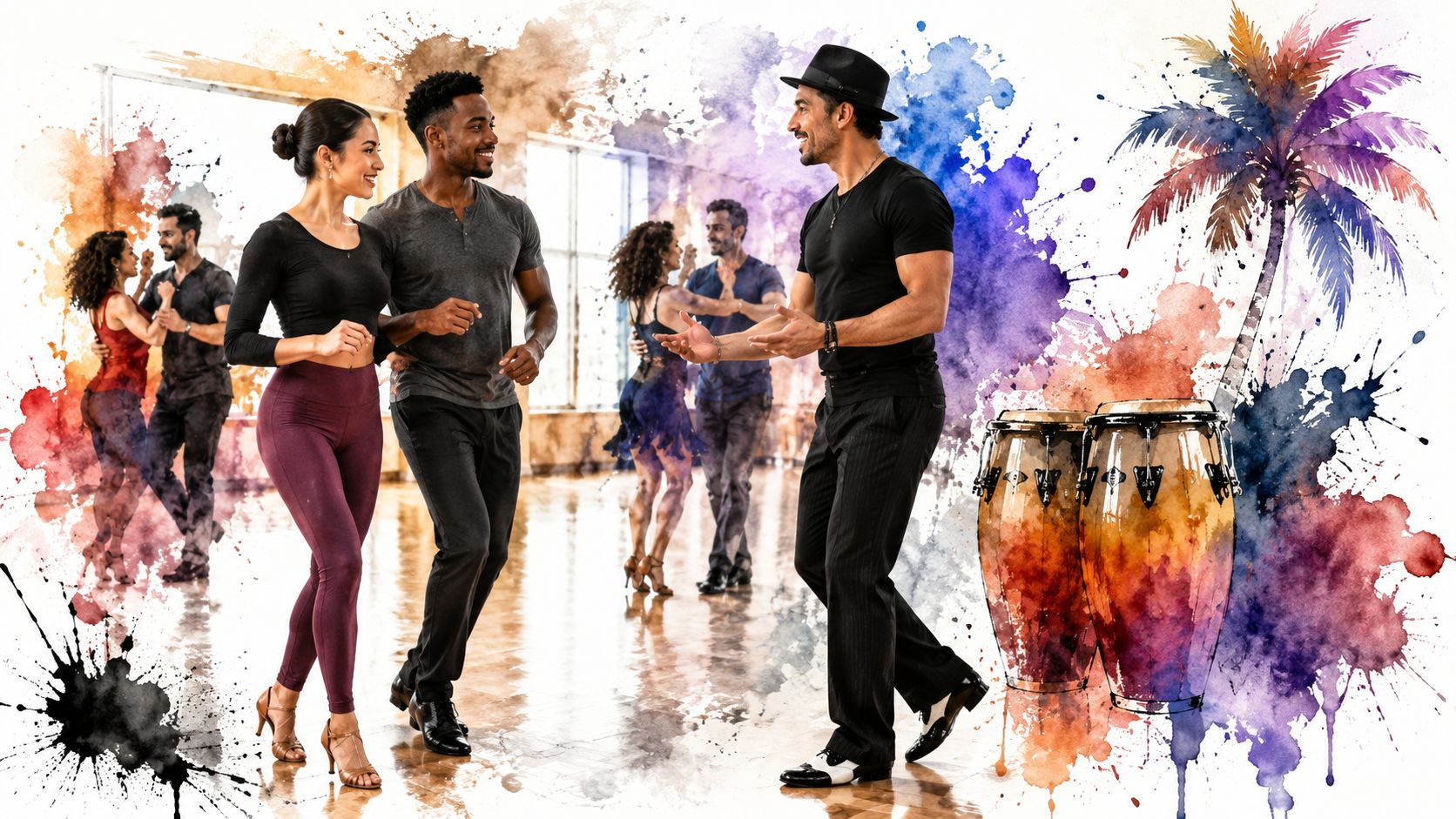
A beginner class usually feels less intimidating than people expect. The instructor greets everyone, explains the level, and starts with something basic. You won't be thrown into advanced spins. You'll build from the ground up.
The first twenty minutes
Many beginner lessons begin with a short warm-up and basic footwork. Often, couples practice the rhythm without touching first. That helps each person find their own timing before adding partner connection.
Then the instructor usually introduces a simple partner hold and one easy pattern. Expect to repeat it several times. Repetition is a good sign. It means the teacher is giving your body time to learn.
A typical progression looks like this:
- Warm up and settle in. You loosen up and start listening to the beat.
- Learn the basic step. Usually without pressure to get it perfect right away.
- Add partner connection. Lead and follow starts to make sense.
- Try a simple pattern. Often a basic turn or change of places.
- Repeat with coaching. Improvement happens.
What beginners often misunderstand
Many couples think they need to stay graceful the whole time. You don't. Beginner salsa is full of pauses, resets, and tiny corrections.
You also don't need to memorize everything instantly. Good instructors expect some hesitation. They're watching for effort, listening, and willingness to try again.
If you miss the step, keep the beat. If you lose the beat, smile and rejoin on the next count.
That mindset helps more than people realize.
Why the class-plus-social format helps
A long-standing salsa format in many communities is a formal lesson followed by immediate practice. One Phoenix guide describes venues where a beginner salsa lesson runs from 7:00 PM to 8:00 PM and social dancing begins around 8:15 PM. The same guide also lists broader Latin offerings such as mambo, bachata, merengue, rumba, cha-cha, and Afro-Cuban dance, showing how salsa often sits inside a wider social dance scene. You can see that class-and-social model in this Phoenix salsa guide.
That setup is useful for couples because you don't have to wait a week to try what you learned. You get instruction, then a low-pressure chance to practice while the material is still fresh.
Here's a quick visual to make that first class feel more familiar:
What to wear and how to think about it
Keep it simple. Wear clothes you can move in and shoes that stay secure on your feet. You don't need a costume, special dancewear, or a dramatic look for your first night.
The most useful thing to bring is a cooperative attitude. If one of you gets it faster, help by staying patient. If both of you feel clumsy, that's fine too. Beginner salsa isn't a performance. It's a practice.
Finding the Best Salsa Studio for Your Goals
Choosing a studio is a little like choosing a gym, a teacher, and a date-night atmosphere all at once. The best fit depends on what the two of you want your salsa life to look like a month from now.
Some couples want a fun weekly class that gets them out of the house. Others want careful instruction so they can feel steady on the floor before dancing in public. Some care most about meeting people. Others want a shared skill they can build together. A good decision starts there.
Questions worth asking before you commit
One question matters more than many beginners realize. Do couples stay together, or do partners rotate?
That single detail changes the feel of the class. Rotation helps students adjust to different leads and follows, which can build social confidence. Staying with one partner can feel more comfortable for couples who want to practice as a team and grow at the same pace. A local studio listing highlights that partner structure is something students should check before enrolling in these dance class details from a local studio listing.
A few other questions can save you from signing up for a class that looks good online but feels wrong in person:
- Do beginners stay with their partner or rotate? Pick the format that matches your goal as a couple.
- How is the class paced? Some studios move quickly and assume you will practice outside class. Others build in more repetition.
- What do instructors correct first? Good beginner teaching often starts with rhythm, posture, frame, and connection.
- Can we add a private lesson later if we need one? That gives you a clear next step if one or both of you want extra help.
What to notice when you walk in
The room tells you a lot before class even starts.
Look at faces, not just decor. Are beginners smiling between mistakes, or do they look tense and lost? Listen to the instructor. A welcoming teacher usually breaks patterns into small pieces, then repeats them without making anyone feel behind. Salsa should feel like learning a new language with a patient guide, not like being dropped into the middle of a conversation.
You can also watch how the studio handles common beginner friction. Does the teacher give simple corrections people can use right away? Is there enough floor space for couples to move without bumping into each other? Do staff members greet new students clearly, or are newcomers left guessing where to stand?
The right studio is the one that helps both of you feel comfortable enough to keep showing up.
Match the studio to the reason you started
If salsa is replacing the usual dinner-and-a-movie routine, a warm social atmosphere may matter more than a highly technical syllabus. If you have a wedding, vacation, or party coming up, structure and private coaching may matter more. If your goal is to join socials, look for a studio that teaches patterns and the social skills around them, like how to enter a dance, recover from mistakes, and keep moving when things are not perfect.
One local option couples may consider is Danza Academy of Social Dance, which offers social dance instruction in Philadelphia and Exton, including Salsa among its dance styles, with private lessons and group classes available.
Start Your Salsa Journey at Danza Academy
If you've read this far, you probably don't need more convincing that salsa could be a great fit. You need a first step that feels easy enough to take this week.
That's where a complimentary lesson helps. Instead of guessing whether salsa will feel awkward, fun, too hard, or surprisingly natural, you get to experience it directly. For couples, that's often the moment things become real. You stop researching and start moving.
Danza Academy has studios in Center City Philadelphia and Exton, PA, and the school brings 40+ years of teaching experience to ballroom, Latin, and social dance instruction. For a couple starting fresh, that combination matters. You want a place that can meet you where you are, whether you want a playful date-night hobby, stronger partner technique, or a confident path into social dancing.
Why a complimentary first lesson is a smart start
A first lesson removes a lot of friction. You can ask questions, feel the teaching style, and get a sense of whether the environment fits the two of you.
That's especially helpful if one of you is eager and the other is hesitant. Once both people have tried a lesson, the uncertainty usually gets much smaller.

Make your next date night easier to choose
You don't have to wait until you feel “ready.” Beginners rarely do. The better move is to pick a lesson, show up together, and let the process begin.
If you've been searching for salsa classes for couples near me because you want something fun, social, and shared, this is a simple way to test it without overthinking every detail. Book the complimentary first lesson through the contact page at Danza Academy and see how it feels to take the floor together.
A complimentary first lesson is a low-pressure way to find out if dancing fits your style as a couple. If you're ready to try something more engaging than the usual routine, book with Danza Academy of Social Dance and take that first step together.