
You've probably seen it before without knowing its name. Two people are dancing to a song that doesn't sound like old-school swing at all, and yet the movement clearly isn't salsa, ballroom, or nightclub two-step. It looks smooth. Grounded. A little playful. One partner glides down a narrow track, then both settle into a moment that feels almost like a pause in conversation before the next phrase begins.
That dance is West Coast Swing.
If you've been asking what is West Coast Swing, the short answer is this: it's a partner dance built on connection, improvisation, and musical interpretation. It feels less like memorizing a routine and more like having a conversation with music and another person. That's why it often looks modern even though its roots go back much further.
A lot of beginners get confused because the word “swing” makes them expect something bouncy, fast, and vintage. West Coast Swing can include that energy, but its signature feel is different. It's smoother, more elastic, and more adaptable to different kinds of music. For many adults trying social dance for the first time, that makes it easier to imagine themselves doing it.
Welcome to the Smoothest Dance on the Floor
You are at a wedding or a studio social, and one couple catches your eye. They are not trying to fill every beat with motion. They let the music breathe. One partner travels, the other shapes the moment, and both seem to agree on tiny changes in timing without needing to say a word.
That is the first thing many people notice about West Coast Swing. It feels less like a rehearsed routine and more like a conversation you can watch.
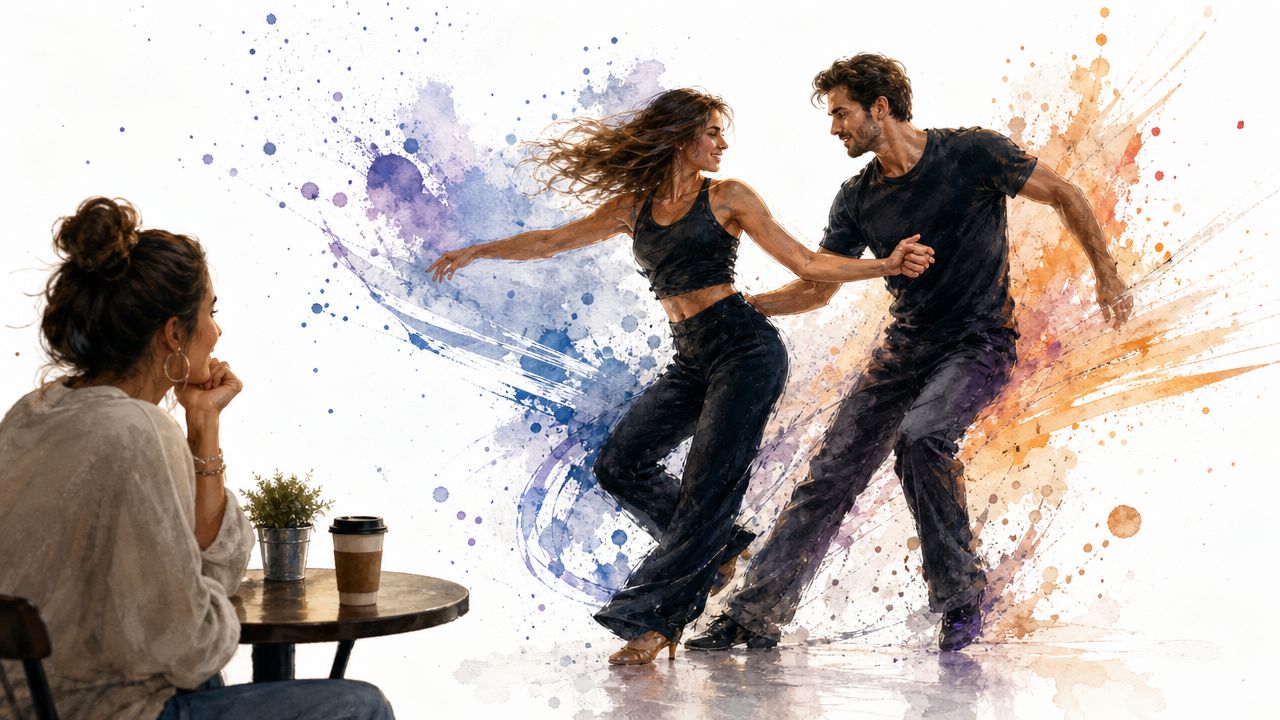
Part of its appeal is the contrast inside the dance. It can look relaxed and grounded, then suddenly crisp and playful. Two couples can dance the same song with the same basic patterns and still look completely different, because West Coast Swing gives dancers room to answer the music in their own way.
Why it feels so current
West Coast Swing often looks modern before a beginner knows anything about the mechanics. That is because the dance is built around listening and response. The partners are not just repeating shapes. They are adjusting to each other, stretching a beat here, settling into a lyric there, and choosing how much energy to send back and forth.
A good social dance in this style works like a real conversation. Sometimes one person speaks clearly. Sometimes the other adds a playful reply. Sometimes both pause for half a second because the music created the perfect opening.
West Coast Swing often looks like two people sharing an idea, not performing a script.
That matters if you are new. You do not need flashy tricks to start enjoying it. You need a few basics, a willingness to listen, and permission to be curious.
What makes people stay with it
People usually stay with West Coast Swing because the dance keeps feeling new.
- It feels interactive. The connection asks you to notice your partner's timing, energy, and choices, then answer them. Even a simple pattern can feel different from one song to the next.
- It fits social dancing well. The style is organized in a way that helps couples share the floor without roaming wildly, which makes it comfortable at parties, weddings, and crowded dance nights.
- It leaves room for expression. One dancer might play with a lyric, another might settle into the groove, and another might keep things clean and understated. The structure holds all three.
West Coast Swing also carries a long history behind that modern feel. It grew in California during the 1930s from earlier swing forms such as Lindy Hop and Jitterbug. Decades later, California named it the official state dance. That mix of old roots and present-day expression is part of what makes the style so appealing.
Understanding the Slotted Feel and Elastic Connection
The fastest way to understand West Coast Swing is to stop thinking about “moves” first and think about path and connection.
Those two ideas explain why the dance looks so distinct.
The slot is the dance's lane
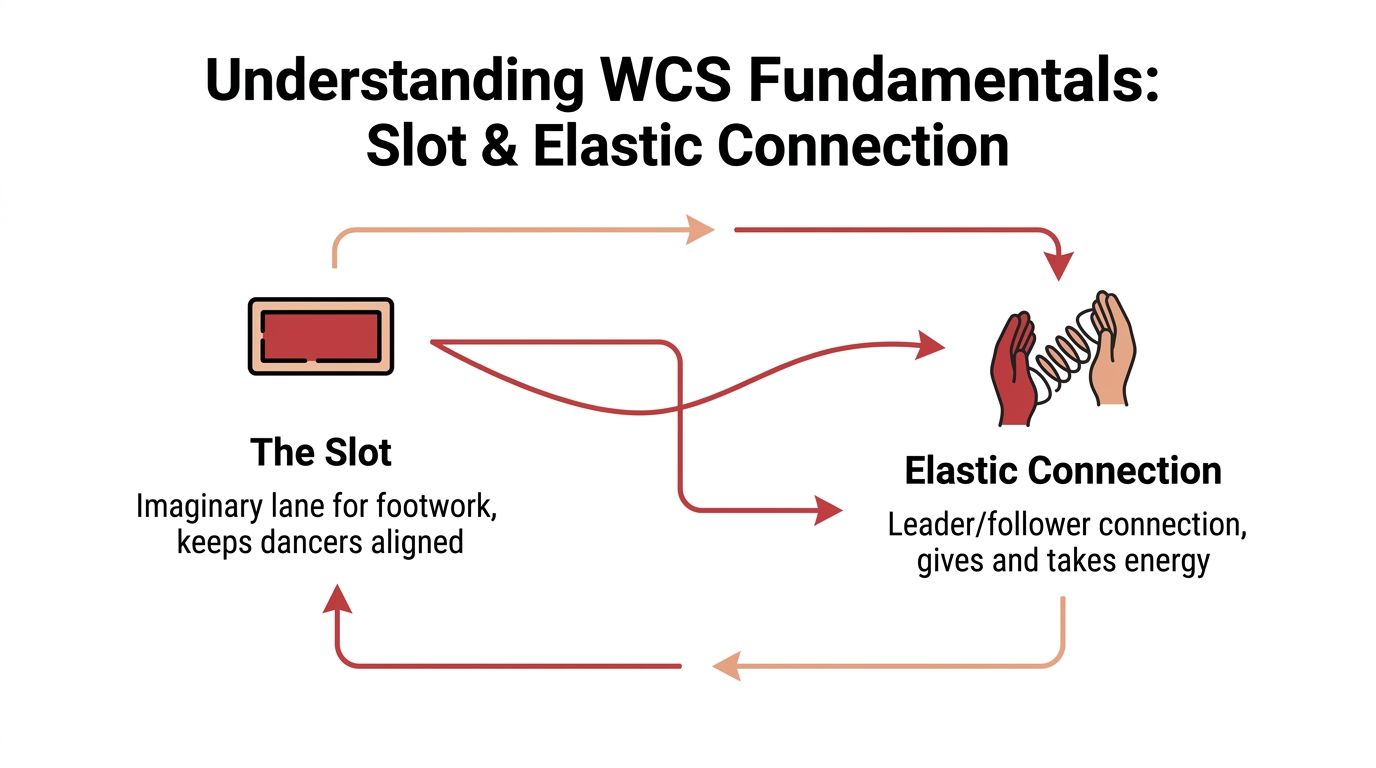
In West Coast Swing, the follower usually travels along an imaginary line, often called the slot. The leader tends to stay closer to the center of that lane and makes room when needed. This creates the clean, sleek look that people notice right away.
It resembles a hallway rather than a spinning circle. Instead of traveling all over the room, the couple organizes movement through one shared lane. According to Easton Swing's explanation of West Coast Swing fundamentals, this slotted structure helps reduce collision risk on crowded floors and makes body-led communication more important than using arm strength.
That's one reason social dancers love it. On a busy floor, a compact, organized shape is a gift.
The connection feels elastic
If the slot is the road, connection is the language.
West Coast Swing uses an extension-compression model. In plain language, that means the partners sometimes move slightly away from each other and create stretch, then come toward each other and create a gentle compression. It's not forceful. It's responsive.
A good analogy is a soft resistance band between two people. If both dancers maintain clear tone and timing, the dance feels alive. If one person goes limp or yanks with the arms, the conversation gets muddy.
Practical rule: In West Coast Swing, your arms shouldn't drag your partner around. Your body movement should make your intention readable.
Why beginners sometimes get confused
New dancers often assume partner dancing works like this: leader decides, follower obeys. West Coast Swing is more nuanced. Yes, there is lead and follow. But the best dancing feels two-way.
Here's where many first-timers get stuck:
- They overuse the arms. That makes the dance feel heavy.
- They walk off the slot. Then the shape of the dance starts to disappear.
- They rush the connection. They move before they've felt the lead.
A beginner doesn't need perfect technique to start enjoying this. But it helps to know what you're aiming for. The goal isn't stiffness. The goal is a clear, relaxed frame that lets both people sense direction, timing, and energy.
What it feels like when it works
When the slot and connection start making sense, the dance gets easier almost immediately. You stop guessing. You begin to feel when to travel, when to settle, and when to wait.
That's why West Coast Swing can look calm even when it's highly skilled. The couple isn't fighting the structure. They're using it.
The Music and Moves That Define Modern Swing
You hear a song with a steady groove, your partner catches the beat with you, and suddenly the dance looks less like a rehearsed routine and more like two people trading ideas. That feeling is a big reason West Coast Swing reads as modern. It adapts to the music in front of you, so the dance can feel cool, playful, soulful, or sharp without losing its identity.
Its long, clean shape also helps. As noted earlier, the style developed a sleek visual quality that made it stand out from rounder, busier swing forms. That is part of why West Coast Swing often looks current even when the basics are simple.
It listens well to many kinds of music
Beginners often want one clear answer to the question, “What songs work?”
A better way to hear it is this: West Coast Swing works best with music that gives dancers room to respond. Blues can make the dance feel grounded. R&B can bring out texture and groove. Pop often invites clearer hits, lyrics, and playful timing choices. Acoustic tracks can slow everything down and make small moments matter more.
The dance follows phrasing as much as tempo. If you can hear where a verse settles, where a chorus opens up, or where a break creates space, your dancing starts to feel more intentional. This basic song structure guide can help you hear those parts of a song, which makes social dancing feel much less mysterious.
The basic patterns are the conversation starters
West Coast Swing uses a small group of common patterns, usually built in 6-count and 8-count timing and danced to music in 4/4. You will hear names like sugar push, side pass, and whip.
Those labels matter less than what each one lets the partnership say.
Sugar Push
This pattern feels like a short exchange. The couple stays more contained, and the rhythm often highlights a small moment of compression before sending energy back out.Side Pass
This is one of the clearest traveling actions in the dance. It gives one partner space to move through, which is why beginners often start understanding the flow of West Coast Swing here.Whip
The whip usually feels fuller and more dramatic. It creates time for momentum, redirection, and musical accents, so experienced dancers can stretch it, settle into it, or play with the timing.
If you want a visual breakdown of how those patterns work, this guide to West Coast Swing basic moves helps connect the names to the movement you will learn in class.
A helpful way to frame it is to treat these patterns like shared sentence structures. The structure stays familiar, but the tone changes with the song and with the person you are dancing with.
Why the dance rarely feels the same twice
A sugar push to a blues track can feel quiet and intimate. The same pattern to a pop chorus can feel cheeky and rhythmic. A whip can read smooth and floating in one song, then hit hard on accents in the next.
That is the appeal.
West Coast Swing gives you enough structure to stay connected and enough freedom to keep the dance alive. The result is a style that feels current not because it chases trends, but because it leaves room for real-time interpretation between two people.
West Coast Swing vs Other Swing Styles
You can spot the difference before you know a single pattern.
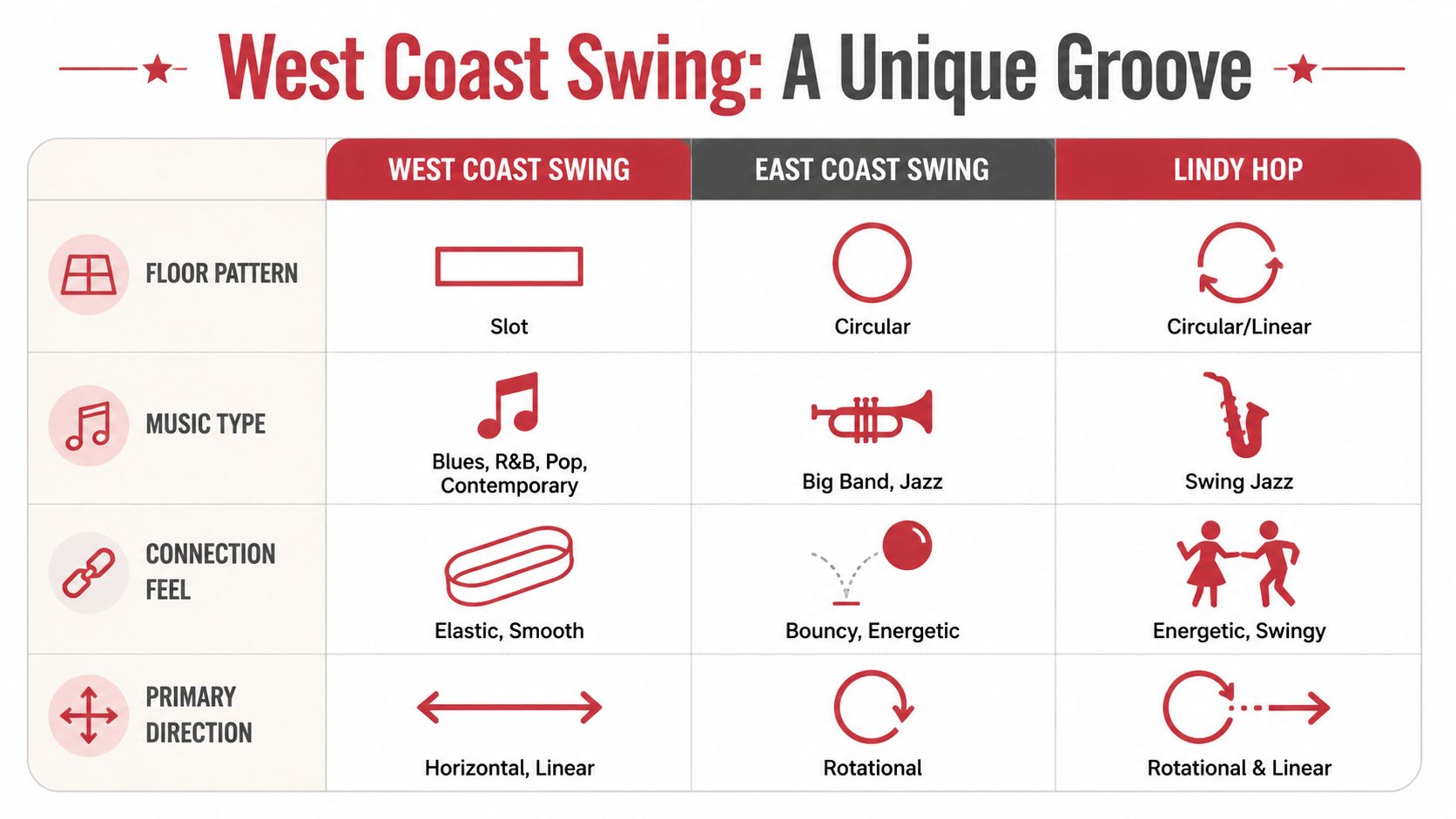
Watch three couples on the same floor. One looks like they are sharing a relaxed conversation, with space for pauses, changes of tone, and little moments of play. That is often West Coast Swing. Another couple may travel in a more circular way with a brighter, springier pulse. A third may fill more space with jazz energy and bigger shapes. That contrast helps beginners understand why West Coast Swing reads as more modern, even when all three belong to the swing family.
The fastest way to tell them apart
A beginner usually notices the shape and mood first.
| Style | Floor pattern | Typical feel | What you'll notice first |
|---|---|---|---|
| West Coast Swing | Linear, slotted | Smooth, elastic, conversational | One partner travels down a lane |
| East Coast Swing | More circular | Bouncy, energetic | The couple rotates more |
| Lindy Hop | Circular and sometimes more expansive | Swingy, athletic, rhythm-driven | Bigger movement and classic jazz energy |
West Coast Swing tends to look calmer on the surface, but it is not empty or restrained. The interest is in the exchange between partners. One person suggests. The other answers. Both react to the music in real time. East Coast Swing often feels more straightforward and upbeat, while Lindy Hop carries a stronger jazz character and a fuller, more buoyant attack.
Why West Coast Swing feels so different
The biggest difference is not just the slot. It is the timing of attention.
In West Coast Swing, dancers often stretch a moment, wait for a lyric, or change the texture of a basic pattern without losing the conversation. That gives the dance a current, social feel that works well with many kinds of music. Other swing styles can certainly improvise too, but West Coast Swing puts that partner-to-partner negotiation right in the foreground.
For beginners, that means the dance may feel less like memorizing a fixed routine and more like learning how to listen while moving.
Which one should you learn first
Start with the one that matches the experience you want.
- Choose West Coast Swing if you like musical freedom, smoother movement, and a dance that feels like a back-and-forth conversation.
- Choose East Coast Swing if you want an upbeat, accessible style that gets you moving quickly.
- Choose Lindy Hop if you love swing-era jazz, pulse, and a more vintage social atmosphere.
If you want a closer comparison, this guide on the difference between East Coast and West Coast Swing makes the distinctions easier to feel, not just memorize.
Beginners rarely choose a dance because one is objectively better. They stay with the one that feels good in their body and makes them want another song.
Your First Class What to Expect and How to Prepare
The biggest beginner question usually isn't technical. It's personal.
Will I feel awkward?
That's a fair question, especially because many descriptions of West Coast Swing focus on slot, anchor, and mechanics while giving very little detail about the actual beginner experience. That gap is noted in this overview of what West Coast Swing feels like for newcomers. People don't just want to know what the dance is. They want to know what walking into class will feel like.
What usually happens in a beginner class
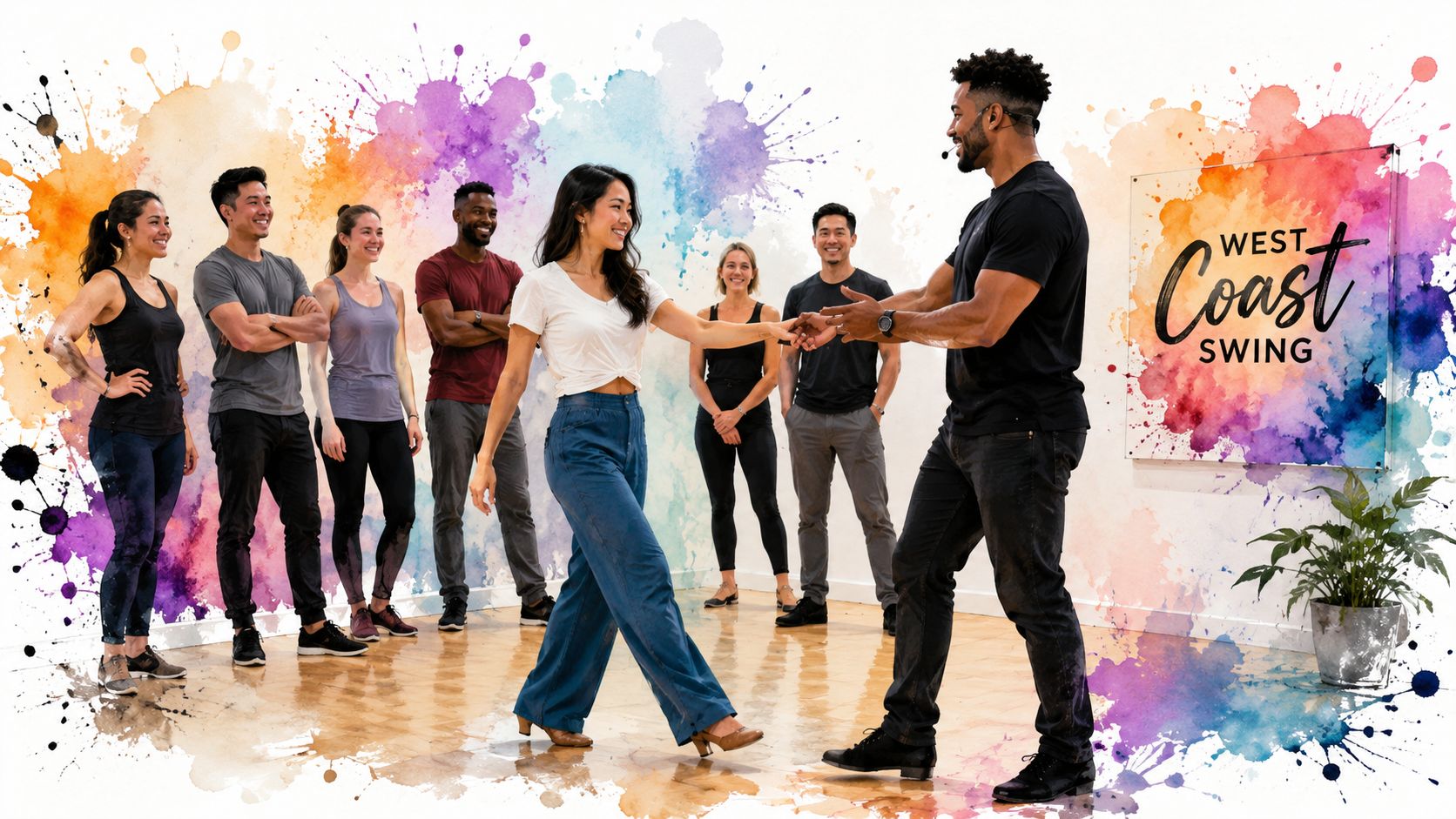
Most first classes are simpler than people expect. You won't be thrown into a fast routine. You'll usually start with rhythm, posture, connection, and one or two patterns that introduce the logic of the dance.
You also usually don't need to bring a partner. In many social dance programs, people rotate so everyone gets experience with different partners and different communication styles. That helps learning.
A first class often includes:
- A warm welcome and basic orientation so you know where to stand, when to rotate, and what the class flow looks like
- Foundational movement such as timing, walking the slot, and feeling basic connection
- A short pattern or two that lets you practice without trying to memorize a long sequence
- Social practice time where you try it in a lower-pressure setting
What to wear and bring
You don't need a costume, special outfit, or dance background.
A few practical choices make class easier:
- Comfortable clothes that let you move freely
- Shoes that let you pivot or glide a bit, rather than very sticky rubber soles
- A water bottle, especially if you're taking class after work
- A willingness to laugh at mistakes because everyone makes them
If you can walk to music and stay curious, you can start West Coast Swing.
What beginners worry about most
People often assume everyone else will already know what they're doing. That's rarely the case in a true beginner class. Many students are there for the same reason you are. They're trying something new and hoping they won't be the only one figuring it out in real time.
This short video gives a helpful feel for beginner-friendly learning in action:
How to make your first class go better
Don't aim to look advanced. Aim to understand the conversation.
Try these mindset shifts:
- Listen before you decorate. Clean basics beat fancy styling.
- Feel the partner, not just the count. Numbers help, but connection is what makes the dance work.
- Expect partial understanding. A full grasp of West Coast Swing doesn't happen instantly.
- Come back for a second class. The first class introduces the language. The second often makes it click.
If you want an in-person option for learning, Danza Academy of Social Dance offers West Coast Swing instruction with beginner-friendly class formats and private lessons that focus on practical social dancing.
Start Your West Coast Swing Journey Today
West Coast Swing gives you something many dances don't. It has structure, but it doesn't trap you inside choreography. It's social, but it still rewards artistry. It looks polished, yet beginners can start feeling the fun long before they feel “advanced.”
If you came here asking what is West Coast Swing, the clearest answer is this: it's a conversation you can feel. The slot organizes it. The connection powers it. The music gives it personality. And once those pieces start working together, the dance becomes satisfying.
For many adults, the hardest part isn't learning the first pattern. It's deciding to walk into the first class. That's why a low-pressure first step matters.
If you're ready to try it for yourself, take a look at these West Coast Swing classes near you. A real lesson will teach you more in one hour than weeks of guessing from videos. You'll feel the difference between watching the dance and doing it.
The best next step is the simplest one. Book a complimentary first lesson, meet an instructor, and find out how this dance feels in your own body. You don't need experience. You don't need a partner. You just need a starting point.
Take your first step with Danza Academy of Social Dance. You can book a free complimentary lesson through the contact page and try West Coast Swing in a welcoming, beginner-friendly setting. If you've been curious but unsure, this is the easiest way to feel the connection for yourself and start dancing with confidence.