You've probably felt this already. You watch a tango clip, or see a couple moving across a floor with that calm, connected look, and you think, “I'd love to try that.” Then the next thought lands just as fast: “But where would I even start?”
That's exactly where most beginners begin.
A search for tango lessons near me usually brings up a mix of ballroom studios, social dance schools, private coaches, and event calendars. For someone brand new, that can feel confusing fast. The good news is that tango is much easier to enter than many people expect. You don't need to arrive looking polished. You don't need fancy shoes. You usually don't even need a partner.
Your Guide to Finding Tango Lessons Nearby
The hardest part of starting tango is often not the dancing. It's sorting through options and figuring out which studio fits your goals. Some people want a relaxed social hobby. Some want focused one-on-one instruction. Some just want one lesson to see if they enjoy the music and movement.

Those seeking local information typically want answers to a few simple questions:
- Is this beginner-friendly
- Do I need a partner
- Should I take private or group classes
- Will I learn enough to feel comfortable dancing
There's also a practical side to choosing a studio. If you're comparing local options, visibility in search results can shape which places you find first. If you're curious why certain studios show up more prominently, this guide to Google Maps for service businesses gives useful context on how local discovery works.
Tango looks dramatic from the outside, but beginner instruction is usually much calmer and more methodical than people expect.
A good studio won't throw you into advanced patterns. It will help you build comfort step by step, so your first class feels manageable instead of intimidating. That's what you want to look for first.
What to Expect in Your First Tango Lessons
Most first lessons are much less theatrical than beginners imagine. You won't spend the class trying to perform. You'll work on a few core things that make tango feel stable and clear.
The first skills you'll usually learn
In a beginner class, instructors often start with posture, balance, and the tango walk. That may sound simple, but it matters. If your posture is comfortable and your walk is grounded, everything else becomes easier later.
You'll also begin learning how to connect with a partner without gripping, leaning, or guessing. In tango, that connection is the conversation. The goal isn't to memorize a long sequence. The goal is to move clearly, listen, and stay relaxed.
A practical benchmark is that beginner social-dance programs often run in 5-week sessions with classes lasting 30 to 90 minutes, and one current studio example includes a 5-week session starting 3/03/2026 with beginner-friendly Argentine Tango 101 and American Tango classes taught in 1-hour blocks, with no-partner-needed participation explicitly welcomed at Ballroom Dance STL's tango schedule.
If you're still deciding whether dance classes are a good fit at all, this overview of a beginner dance lesson experience can help you picture the pace and tone of a first visit.
What to wear and bring
Keep this part easy:
- Clothing that moves well: Wear something comfortable that lets you step, turn, and breathe easily.
- Shoes with a smoother sole: You don't need specialty tango shoes for day one. A comfortable shoe that doesn't stick to the floor too much is usually enough.
- An open mind: That sounds obvious, but it matters. Tango feels unfamiliar at first because it uses posture, timing, and attention in a new way.
Practical rule: Your first lesson is for learning, not impressing anyone.
What often surprises beginners
Many adults worry they'll fall behind, step on feet, or look awkward. That's normal. Everyone starts there. A strong teacher expects that and builds the class around it.
You may also notice that tango feels mentally engaging. You're not just copying shapes. You're learning how movement, rhythm, and partner communication work together. That's one reason many people find it so satisfying once they settle in.
Private Lessons vs Group Classes Which Is Right for You
This is one of the biggest decisions a beginner makes. Neither format is automatically better. They merely teach in different ways.
What private lessons do well
Private lessons are ideal when you want direct feedback on your own movement. An instructor can watch how you stand, walk, pivot, and connect, then correct problems right away. That kind of attention often helps beginners who feel shy, people preparing for a wedding, or students who want a faster start.
Available local-market examples show that private instruction may be offered by appointment on an exclusively private dance floor, while group formats support partner rotation and social adaptability, as described by The Dance Whisperer's lesson format overview.
If your main goal is individual coaching, scheduling flexibility, or accelerated correction, it's worth looking at private dance lessons for adults.
What group classes do well
Group classes give you something private lessons can't fully recreate. They expose you to different partners, different timing, and the social rhythm of a shared room. That helps many students become more adaptable and less dependent on one familiar person.
They also make the experience feel lighter. You learn with others, laugh at the same beginner mistakes, and get used to dancing in a real social setting rather than a perfectly controlled one.
Private vs. Group Tango Lessons at a Glance
| Feature | Private Lessons | Group Classes |
|---|---|---|
| Feedback | Direct, individualized correction | General instruction shared across the class |
| Pace | Adjusted to your learning speed | Set by the group and lesson plan |
| Environment | Quieter, more focused | Social, interactive, more varied |
| Partner experience | Usually with one instructor or partner setup | Often includes partner rotation |
| Best for | Fast progress, confidence-building, wedding prep | Social comfort, floor adaptability, community |
| Scheduling | Often by appointment | Fixed class times |
If you feel nervous about dancing in front of others, starting privately can remove a lot of pressure.
How to choose honestly
Ask yourself what would help you stick with it.
Choose private lessons if you want privacy, focused attention, or a custom pace. Choose group classes if you want a social atmosphere and practice with different people. Many dancers eventually use both, but you don't need to decide that on day one. You just need a starting point that feels doable.
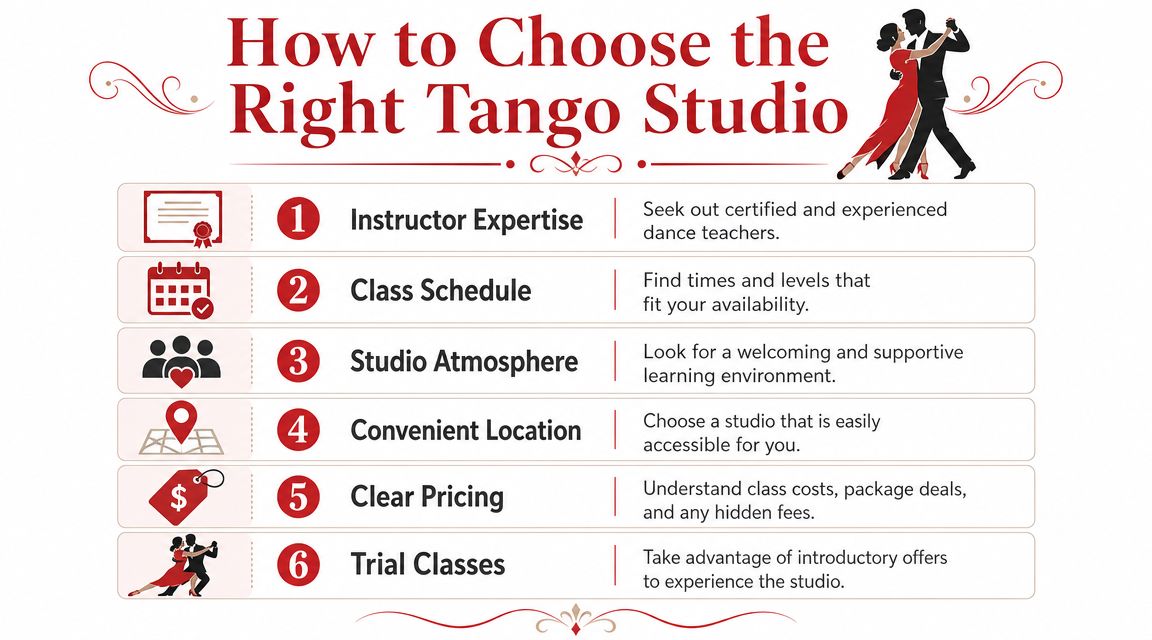
How to Choose the Right Tango Studio
A studio can teach the same dance in a completely different way. That's why choosing the right place matters as much as choosing the right style.
Look for signs of a beginner-aware teaching style
The first thing I'd check is whether the studio talks clearly to beginners. Do they explain what class levels mean? Do they say whether a partner is required? Do they make the first step feel accessible?
A welcoming studio doesn't assume you already know the culture or terminology. It explains things in plain language and helps you feel oriented from the start.
For a broader checklist, this article on how to choose a dance studio is a useful reference point when comparing local options.
Check the learning loop, not just the class listing
One of the smartest things a beginner can look for is whether the studio supports practice beyond the lesson itself.
A strong tango environment creates a loop: class introduces technique, practica gives you space to rehearse and solve problems, and milonga gives you a real social setting to apply what you know. That structure is described in a Houston tango example with a weekly Tuesday evening cadence and separate event types for class, milonga, and practica in this Houston tango program reference.
That matters because dancing doesn't settle into your body through explanation alone. You need guided repetition and a social setting where the skill becomes usable.
A quick studio checklist
- Teacher clarity: Can the instructor explain movement clearly, without making beginners feel lost?
- Schedule fit: A good class won't help much if the timing never matches your real life.
- Atmosphere: Look for a room where newcomers seem comfortable asking questions.
- Path forward: The best studio gives you a next step after your first lesson, not just a single class on a calendar.
- Trial option: An introductory lesson lowers the pressure and helps you feel the teaching style firsthand.
Begin Your Tango Journey at Danza Academy
You've compared lesson formats, looked at what a beginner-friendly studio should offer, and narrowed your options. Now the question becomes simple. Which local studio gives you a clear first step without making the process feel intimidating?
For many new dancers in the Philadelphia area, Danza Academy of Social Dance fits that test well. The studio teaches in Center City Philadelphia and Exton, offers both private lessons and group classes, welcomes students who come in without a partner, and brings long teaching experience to the beginner process, according to the publisher information provided for this article.
Why that matters for a beginner
A good tango studio should feel like a place where you can start at your actual level, not where you think you should be.
That matters because beginners rarely all need the same thing on day one. One student wants private instruction to slow everything down and ask questions freely. Another learns better in a room full of people, where repetition and shared energy make the steps feel less scary. A couple preparing for a wedding may want focused coaching. Someone exploring tango as a social hobby may prefer a class setting first. A studio that offers both formats gives you room to choose the path that matches your comfort level.
What makes the first step easier
The hardest part for many adults is not the walking pattern or the music. It is getting through the door the first time.
A complimentary first lesson helps lower that pressure. It gives you a chance to meet the instructor, see how the class is taught, and ask the practical questions beginners usually have. Will I feel out of place? Do I need special shoes yet? Is the pace too fast for me? One visit can answer those questions better than a long list of search results.
A first lesson should leave you feeling clearer and more at ease.
If you've been searching for tango lessons near me, Danza Academy gives you a practical way to test whether the fit feels right before making a bigger commitment.
Frequently Asked Questions About Learning Tango
Do I need to bring a partner
Usually, no. Many beginner-friendly tango classes are designed so that no partner is required, especially in social Argentine Tango settings where the long-term goal is to dance at milongas, as explained in this Argentine tango beginner overview.
What's the difference between Argentine Tango and Ballroom Tango
This confuses many beginners. Argentine Tango is commonly taught as a social dance focused on connection, navigation, and dancing with others in a social setting. Ballroom Tango is more structured in its presentation and is the version many people recognize from competitions and formal showcases.
If you're not sure which one you mean when you search for tango lessons near me, ask the studio directly. That single question can save a lot of confusion.
How long does it take to get good at social tango
That depends on how often you practice, how you learn best, and whether you spend time dancing socially as well as taking lessons. Most beginners feel some awkwardness at first. That's part of the process, not a sign that they're doing it wrong.
Aim for steady progress, not instant polish. The first milestone isn't “looking advanced.” It's feeling more balanced, more musical, and more comfortable dancing with another person.
Do I need special shoes right away
No. Start with comfortable clothing and shoes that let you move and turn without sticking to the floor. Specialized tango shoes can come later, after you know you want to keep going.
A complimentary first lesson at Danza Academy of Social Dance is the easiest way to turn curiosity into action. If you're ready to stop wondering and start moving, you can book your free introductory lesson on the contact page.