
Wedding planning has a way of making every decision feel bigger than it did at first. You choose a venue, lock in a date, compare outfits, answer family questions, and then the first dance suddenly starts to feel like a performance instead of a celebration.
That's where most couples get stuck. They aren't worried because they don't care. They're worried because they do. They want the moment to feel natural, connected, and like them, even if they've never taken a dance lesson before.
A strong couple wedding dance doesn't come from doing something flashy. It comes from making smart choices early, practicing the right things, and building a routine that fits your comfort level, your music, and your wedding day reality.
More Than Just a Dance Your First Moment as a Couple
The first dance still matters because it gives the two of you a pause inside a fast-moving day. It's one of the few reception moments where everyone's attention lands in one place, and for a short stretch, the room quiets down enough for you to feel what's happening.
That's also why couples put pressure on themselves. They know people will watch. They know cameras will be on. They know they can't fake comfort if they feel stiff, disconnected, or unsure.
A WeddingWire study found that 91% of couples choose to perform a first dance (University of Northern Colorado thesis citing WeddingWire). That matters for one reason. If you're thinking about your first dance a lot, you're not overthinking some random extra. You're planning one of the most common and recognized wedding traditions.
Why couples get nervous
Most nerves come from three places:
- Fear of looking awkward: Couples assume everyone else knows how to move naturally together. Most don't.
- Fear of forgetting steps: This usually happens when the routine is too long or too complicated.
- Fear of being watched: The spotlight feels bigger when you don't yet trust your body.
Practical rule: Your goal isn't to impress the room. Your goal is to look connected enough that the room relaxes with you.
That shift helps. Once you stop treating the dance like a talent test, preparation gets easier. You can make choices based on comfort, not ego.
Treat it like part of the wedding, not a side task
Couples often spend more time thinking about details like flowers, table layouts, and wedding band metals and styles than they do planning how they'll move together in front of everyone. But your first dance is one of the details guests will remember because it feels personal, not decorative.
A good first dance doesn't need ballroom perfection. It needs clear structure, calm energy, and one or two moments that feel intentional. If you can build that, you can walk onto the floor with confidence, even if right now you're convinced you have two left feet.
Finding Your Rhythm Choosing a Song and Dance Style
Song choice decides more than mood. It affects timing, movement quality, stamina, and how confident you feel from the first step. When couples struggle with a first dance, the problem often starts here. They pick a song they love emotionally, but it's hard to count, changes tempo unpredictably, or runs too long.
The fix is simple. Choose a song that means something to you, but make sure it also gives you a beat you can dance to.
What makes a song workable
A wedding song is easier to use when it has:
- A clear pulse: You should be able to clap along without guessing.
- Consistent phrasing: Repeating sections make choreography easier to remember.
- Room to breathe: Lyrics matter, but so does having space in the music for movement.
- A manageable emotional tone: Very meaningful is good. So dramatic that you tense up is not.
For many beginners, a slow romantic song pairs well with a simple sway, box step, or soft rumba-inspired motion. A smooth classic can support a Foxtrot feel. What matters most is not the label. It's whether the style matches your natural energy.
Keep it shorter than you think
While the average first dance song is 2 to 3 minutes, many wedding dance professionals recommend a target of 60 to 90 seconds to keep the moment concise and engaging for guests (wedding dance duration trends).
That recommendation makes practical sense in the studio. Most couples look strongest in the first part of the dance, when posture is fresh, smiles are real, and concentration is still high. After that, the risk of overthinking rises.
A shorter edit usually looks more polished than a longer song danced with filler movement.
If you need ideas before you commit, this list of best wedding dance songs is a useful place to compare tone, tempo, and overall feel.
Match the style to your real skill level
A few honest questions help narrow the choice:
| Question | If yes | Better direction |
|---|---|---|
| Do you want soft and intimate? | You'd rather feel close than perform | Slow dance or rumba-style basics |
| Do you like clean, classic movement? | You want elegance without tricks | Foxtrot-inspired walking patterns |
| Do you get nervous counting music? | Rhythm feels unfamiliar | Songs with obvious phrasing and fewer changes |
| Do you want one standout moment? | You don't want full choreography | Short edit with one turn or dip |
If you're also planning family dances, thinking ahead helps keep the reception flow cohesive. Couples choosing their own music often find it useful to look at guides on choosing father daughter dance music at the same time, so the emotional pacing of the evening feels intentional from one dance to the next.
Your First Steps Core Moves and Choreography
Most couples don't need more choreography. They need better structure.
When a routine feels shaky, it's usually because the couple started with “moves” instead of a base. Expert tutorials for beginners consistently recommend starting with a basic step-and-touch or box-step foundation, then adding only one or two controlled variations like a turn or a dip to keep the routine manageable and synchronized (The Knot first dance tips).
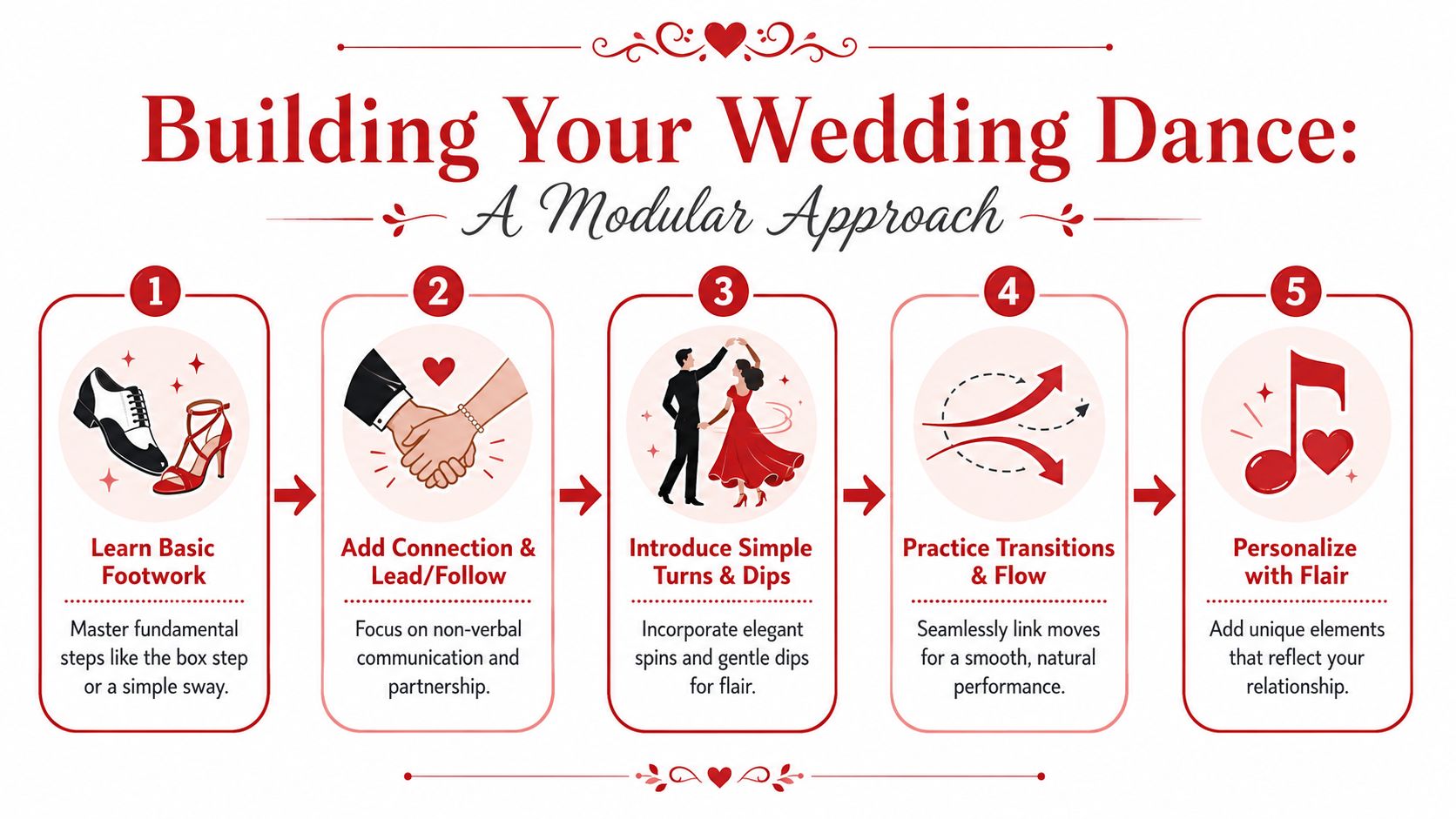
Start with the part you can repeat
Your base step should be boring in the best way. It should feel stable, easy to count, and repeatable under pressure.
Good beginner options include:
- Side-to-side step and touch: Great for couples who want something relaxed and romantic.
- Box step: Useful if you want a more traditional shape and cleaner directional movement.
- Sway with weight change: Best when the goal is softness and connection over visible footwork.
The reason these work is simple. Predictable weight transfer keeps both partners together. If one person gets nervous, the structure still holds.
Build the dance in sections
A polished couple wedding dance usually has four parts, even if the audience never names them that way.
Entrance
How you walk on and take hold matters. If you rush this, the whole dance starts tense.Foundation section
Settle into your base step. Let your breathing catch up. Show the room that you're comfortable together.Highlight moment
Add one visual change. This might be an underarm turn, a small traveling circle, or a gentle dip.Finish
End with a clear final pose. Don't let the song fade while you look unsure about whether you're done.
The audience reads confidence from transitions and endings more than from complicated footwork.
Here's a simple way to understand it:
| Section | What to do | What to avoid |
|---|---|---|
| Entrance | Walk calmly, connect, start on time | Jogging into place, adjusting hold mid-music |
| Middle | Repeat your strongest pattern | Constantly changing steps |
| Highlight | Choose one move you can land cleanly | Tricks that need perfect timing |
| Finish | Hold a final shape and smile | Drifting to a stop |
A visual walkthrough can help if you learn better by seeing movement in action.
Add only one or two highlights
Couples often make their wedding dance harder than necessary. They think a memorable dance needs several signature moments. It usually doesn't.
Choose from a short list:
- Underarm turn: Works well if one partner wants a graceful visual accent.
- Traveling circle: Helps the dance feel larger without adding technical difficulty.
- Dip: Effective only if both partners feel physically secure and have practiced the entry and exit.
- Open break and reconnect: Creates variety without much risk.
What doesn't work well for beginners? Fast spins, multiple directional changes, lifts, or anything that depends on perfect timing at high stress.
What looks best is often what feels calmest
A wedding audience doesn't judge the dance the way dancers do. Guests respond to chemistry, ease, and musical fit. If you stay balanced, keep your frame tidy, and move with intention, the dance reads as elegant even when the choreography is simple.
That's why the strongest routines for beginners are often the least crowded. Fewer decisions. Better timing. More connection.
Your Wedding Dance Rehearsal Timeline
The easiest way to avoid panic is to separate dance prep into phases. Couples who leave everything until late usually don't fail because they lack ability. They struggle because they try to make musical decisions, choreography decisions, and performance decisions all at once.
A layered workflow works better. A practical approach is to build the dance in stages and do a small-audience run-through before the event to expose memory errors and timing issues (wedding dance choreography workflow).
Sample Wedding Dance Rehearsal Timeline
| Timeframe | Key Goals |
|---|---|
| 3 months out | Choose the song, decide whether you want simple movement or a short routine, and begin learning your base step |
| 2 months out | Build the main sections of the dance, test hold positions, and start practicing transitions |
| 1 month out | Finalize the structure, practice with your actual song edit, and clean up entrances and ending pose |
| 2 weeks out | Rehearse in the shoes you plan to wear, check spacing, and smooth out any awkward turns or dips |
| Week of the wedding | Do full run-throughs, keep practice light, and perform once for a small audience of trusted friends or family |
| Day before | Mark the dance gently, don't overtrain, and review cues rather than drilling every detail |
How to practice without frustrating each other
Couples usually improve faster when practice stays short and specific. Long sessions create fatigue, and fatigue creates arguments about things that aren't the problem.
A better rhythm looks like this:
- Start with one goal: Maybe it's just the entrance and first phrase.
- Repeat the hard transition: Don't always run the full dance.
- Stop while it still feels good: End with a clean run if possible.
If remembering choreography is the part that worries you most, these tips on how to remember dance choreography can help you break the routine into pieces that are easier to recall under pressure.
Rehearsal should also match the wedding day schedule
Your dance doesn't happen in a vacuum. It happens after a ceremony, photos, greetings, vendor cues, and a lot of stimulation. That's why timeline coordination matters. The same planning mindset that helps couples avoid wedding transportation timeline mistakes also helps with dance prep. Small timing slips earlier in the day can affect how calm you feel walking onto the floor.
Rehearse like the dance is part of a real event, because it is. Practice starting after a pause, not only when you're fully ready.
Final Touches for a Flawless First Dance
The final layer isn't choreography. It's adaptation.
A key challenge for couples is adapting a dance to their specific bodies, confidence levels, and wedding format, and inclusive modifications can make the experience feel far more natural and authentic (inclusive first dance guidance). That means the best version of your dance may not look like the version you first imagined, and that's completely fine.
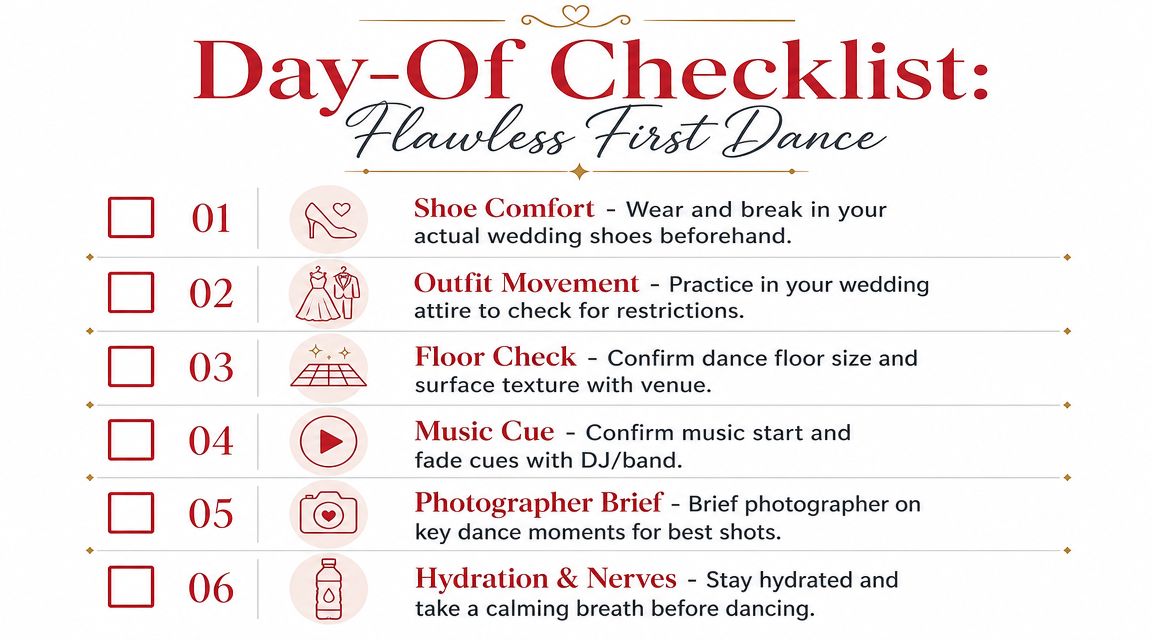
Adjust for clothes and floor space
A routine that feels easy in sneakers can feel different in heels, dress shoes, a long gown, or fitted formalwear. Practice in conditions that are close to real.
Pay attention to these points:
- Shoes: Try the actual wedding shoes before the big day. Slippery soles and unfamiliar heel height change balance.
- Clothing shape: A full skirt, train, or slim-cut pants can affect stride length and turns.
- Floor size: A small dance floor rewards compact movement. Large traveling patterns can become a problem fast.
If the venue space is tighter than expected, shrink the dance instead of forcing the original map. Side-to-side movement, small rotations, and a centered highlight usually read better than trying to cover distance you don't have.
Brief the people around you
Your DJ, photographer, videographer, and planner all affect how your dance feels in the moment.
Tell them:
- Where the dance begins
- Whether the song is edited
- If you have a dip, turn, or ending pose worth capturing
- Whether you want guests invited onto the floor at the end or kept back until you finish
That communication helps the moment look cleaner on camera and feel calmer in real time.
When vendors know your key cue points, you don't have to manage them from the dance floor.
Calm your nerves without trying to erase them
You probably won't remove every nerve before the dance. You don't need to. You just need to keep nerves from taking over your timing and connection.
A few useful habits:
- Take one full breath before the music starts
- Look at your partner, not the whole room
- Start slightly slower than you think you should
- If something goes wrong, keep moving
Most mistakes are far less visible than couples think. The audience doesn't know the plan. They only know how the moment feels.
Start Your Dance Journey with Confidence
Many couples feel pressure from short planning windows and limited experience, which is exactly why practical guidance matters more than complicated choreography (beginner-focused wedding dance guidance). The right process lowers stress. It gives you a dance you can enjoy instead of one you just hope to survive.
That's the big shift. Your first dance doesn't need to prove anything. It needs to fit your relationship, your music, and your comfort on the day. For some couples, that means a soft sway with one turn. For others, it means a more structured routine with a clean entrance and finish. Both can work beautifully.
If you want hands-on help, one option is working with the instructors listed at Danza Academy wedding dance teachers. Danza Academy of Social Dance offers private wedding dance instruction adapted for different experience levels, which can be useful if you want guidance on music choice, structure, and day-of practicalities without overbuilding the routine.
What usually works best for nervous beginners
The couples who end up happiest with their dance usually do a few things well:
- They choose comfort over complexity
- They practice in short, focused sessions
- They build one reliable structure instead of chasing many ideas
- They keep the emotional goal in view
You don't have to become dancers before your wedding. You just have to become confident in your version of this moment.
If you start early enough to make calm decisions, keep the routine honest, and rehearse with purpose, your couple wedding dance can become one of the most enjoyable parts of the lead-up to the wedding, not one more thing weighing on the checklist.
If you're ready to turn nerves into confidence, book a free complimentary lesson with Danza Academy of Social Dance. It's a simple, no-pressure way to meet an instructor, talk through your song and vision, and find out what kind of first dance fits you best.