
You might be there right now. You want a hobby that gets you off the couch, helps you meet people, and gives you something more memorable than another dinner out. But you also don't want a high-pressure activity that feels like training camp.
That's where the idea of a socialsport dance club makes sense. It gives you structure without stiffness, progress without pressure, and enough real technique to help you feel comfortable on an actual dance floor.
For adults and couples, that middle ground matters. A lot of beginners don't need a medal. They need confidence at weddings, ease on date night, and a fun reason to move their bodies with purpose.
What Is a Socialsport Dance Club
A socialsport dance club is a way of learning partner dancing that blends two things people usually think are separate. One side is social fun. The other is real skill-building.
If you've ever gone to a party and wished you knew what to do when music started, you already understand the need for the social part. If you've ever tried to copy steps from a video and felt lost two minutes later, you understand why the sport part matters too.
A socialsport approach sits between random dancing and formal competition. You learn posture, timing, lead and follow, and how to move with music. But the main goal isn't to perform under pressure. The goal is to enjoy dancing in real life.
Why this approach feels easier for beginners
Many adults feel restricted by the belief that only two options exist. One might dance casually without achieving significant progress, or choose to train rigorously and sacrifice weekends to perfection. A middle ground is often the preferred path.
A socialsport dance club offers a third path:
- You learn useful skills: not just flashy patterns, but how to start, stop, turn, and connect with a partner.
- You keep the atmosphere relaxed: lessons are structured, but the purpose is confidence and enjoyment.
- You can use what you learn anywhere: weddings, parties, date nights, studio socials, and community events.
If you're new to partner dancing, it helps to first understand the broader idea of social dancing for everyday life.
Dancing gets easier when you stop asking, "How do I look?" and start asking, "Can I hear the beat, stay balanced, and enjoy my partner?"
That shift changes everything. Instead of chasing perfection, you build comfort. And comfort is what lets dancing become fun.
The Best of Both Worlds A New Way to Learn
Think of a socialsport dance club the way you'd think of a recreational sports league. It isn't the same as showing up to a park and improvising with no guidance. It also isn't the same as trying out for an elite team. You still get coaching, repetition, and progression. You just use those things to become a capable, happy participant.
That balance is what makes the model so appealing to modern adults. You want enough structure to improve. You also want a setting that still feels welcoming after a long workday.
What the social part really means
The social side doesn't mean "anything goes." It means the end use of your dancing is human connection. You're learning how to move comfortably with another person, how to recognize musical cues, and how to handle different situations without freezing.
For example, at a wedding, the music might shift from a slow romantic song to swing or Latin pop. A socialsport student doesn't need to know every possible routine. They need adaptable basics that keep the moment flowing.
What the sport part really means
The sport side is about technique, but in a practical sense. You work on timing so you stop rushing. You improve your frame so your partner can understand your lead or feel your follow. You learn weight transfer so turns don't feel like guesswork.
That kind of training is why private instruction is useful for many adults. If you want a lesson format built around your pace and goals, adult private dance lessons can make the learning curve feel much smoother.
A strong socialsport-style studio also needs range. Socialsport Dance Club presents a broad but coherent group of dances, including progressive styles like Foxtrot and Waltz alongside slot-based dances like West Coast Swing on its how they teach page. That matters because students can build both wedding-dance skills and flexible social-dancing fundamentals in one place.
Why learning skills beats memorizing moves
Beginners often say, "Just teach me a few steps." I understand the instinct. Steps feel concrete. But steps alone fall apart when the music changes, the floor is crowded, or your partner moves differently than expected.
Skills travel. Moves don't always.
Here are the skills that carry from dance to dance:
- Rhythm awareness: hearing the beat and staying with it
- Partnership: sending and receiving clear physical information
- Balance: staying grounded during turns, side steps, and direction changes
- Floor awareness: moving safely around other couples
- Musical response: matching your energy to the song
Once those skills start to click, dancing stops feeling like memorization and starts feeling like communication.
Social Competitive or Social-Sport Dancing
People often use the same word, "dance," to describe very different experiences. That's why beginners get confused. A crowded nightclub, a ballroom competition, and a studio-based socialsport dance club may all involve partner movement, but the goals are not the same.
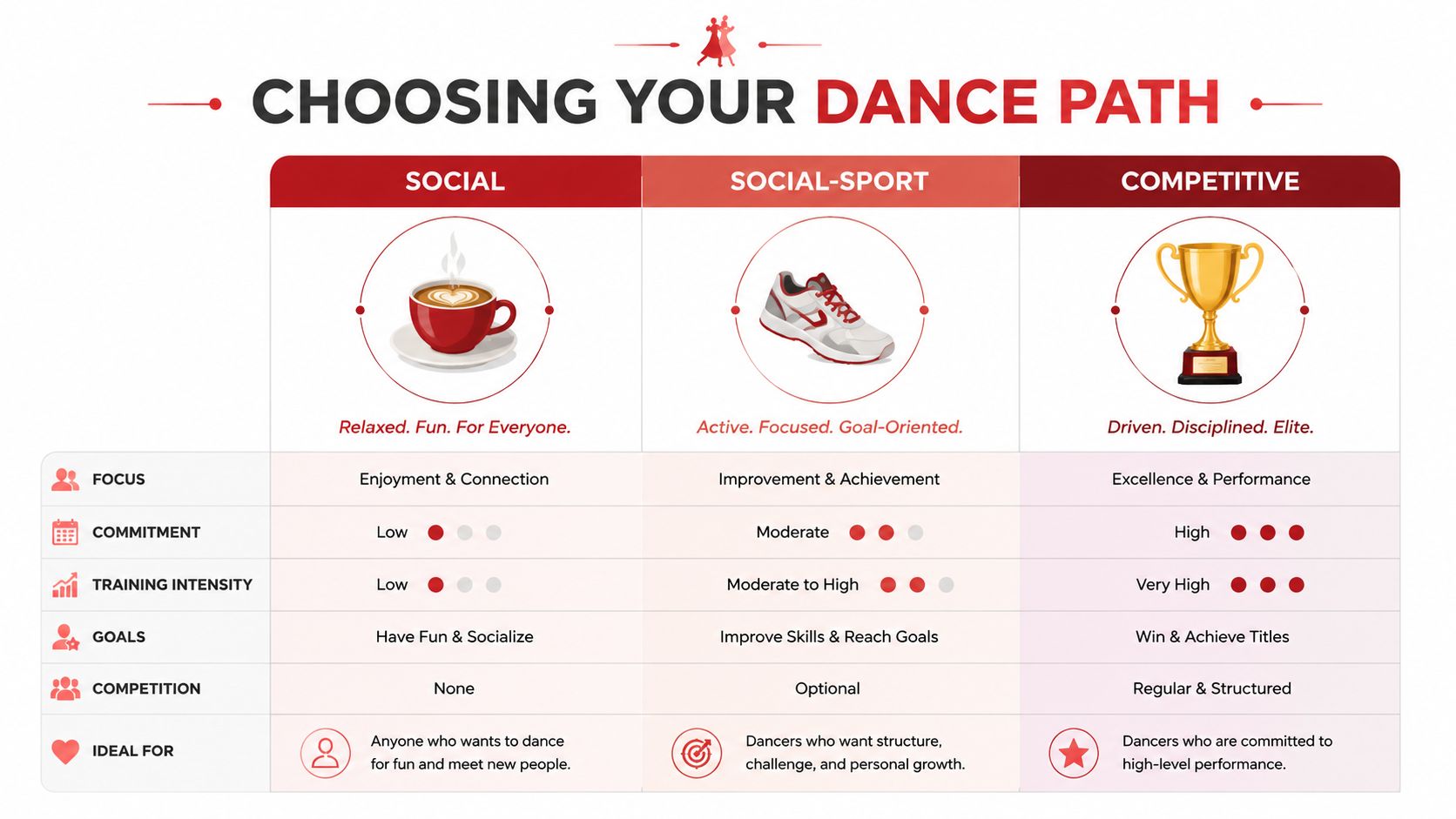
The easiest way to see the difference is to compare them side by side.
Choosing your dance path
| Attribute | Social Dancing (e.g., Nightclub) | Competitive Dancing (Dancesport) | Social-Sport Dancing (Studio-Based) |
|---|---|---|---|
| Primary goal | Have fun in the moment | Perform at a high level and be judged | Build real skill for enjoyable social dancing |
| Learning environment | Unstructured, informal | Rigorous, performance-focused | Structured, supportive, practical |
| Feedback level | Little or none | Detailed correction and refinement | Clear coaching aimed at confidence and competency |
| Partner connection | Often inconsistent | Highly trained and precise | Functional, comfortable, and improving |
| Music response | Instinctive or casual | Highly controlled and style-specific | Musical but accessible |
| Typical student mindset | "I just want to dance tonight" | "I want to compete well" | "I want to get good enough to enjoy this anywhere" |
| Outcome | Fun, but limited consistency | Strong performance ability | Confidence at parties, weddings, socials, and date nights |
Which one fits most adults
For most working adults and many couples, the social-sport lane is the sweet spot. It gives you enough instruction to stop feeling awkward, but not so much pressure that the hobby becomes stressful.
Simple test: If you want dancing to feel natural in real social settings, but you still want a teacher to guide your progress, you're probably looking for the social-sport model.
Competitive dancing has its place. It builds precision, discipline, and artistry. Casual social dancing has its place too. It can be spontaneous and fun. But a socialsport dance club is often the best fit for people who want both enjoyment and competence.
A real-world example
Let's say two engaged people want a first dance. They don't need competition-level shaping or a full showcase mindset. They also don't want to sway in place and hope for the best. They need enough training to feel connected, look comfortable, and move with intention in front of family and friends.
That is exactly where social-sport learning shines. It solves a real problem with a realistic level of commitment.
More Than Steps The Real Benefits of Dancing
The biggest change most beginners notice isn't technical. It's personal. They walk into a room differently. They stop shrinking away when music starts. They begin to trust their own movement.

That's why dancing matters beyond the steps. It gives you a practical skill, yes. But it also gives you a different relationship with your body, your confidence, and the people around you.
Confidence that shows up outside the studio
A lot of adults don't mind learning. What they mind is feeling clumsy in public. Dancing helps because it turns a vague fear into a trainable skill.
You learn how to enter a room, hear music, and respond instead of hiding. That confidence often spills into other areas too. People speak up more, laugh more, and stop overthinking every movement.
If you're curious about those broader effects, this guide on the benefits of social dancing is a helpful next read.
Connection for couples and singles
For couples, partner dancing creates a shared task that isn't about errands, bills, or schedules. One person leads an intention. The other responds. Then you switch your attention from daily noise to each other.
For singles, dancing offers a rare social setting with built-in interaction. You're not trying to invent conversation from scratch. The dance gives you a reason to connect.
Socialsport Dance Club's public wedding profile describes more than two decades of experience and says the team has taught hundreds of couples in the area on its The Knot listing. In the dance world, that kind of longevity usually points to trust, repeat referrals, and a teaching style people feel comfortable returning to.
Movement that doesn't feel like a chore
Some people hate the gym but love dancing because the focus is different. You're not staring at a clock. You're listening, adjusting, laughing, and working with music. The activity feels purposeful, not repetitive.
Studios that keep adults engaged usually pay attention to community as much as curriculum. If you're interested in how clubs build that kind of momentum, GroupOS shares useful ideas on effective member engagement strategies that apply well to dance communities too.
A short visual can help if you're still deciding whether partner dancing feels approachable:
Stress relief with a clear focus
Dancing asks for enough concentration to quiet mental clutter. You have to hear the beat, feel your steps, and respond to another person. That makes it hard to obsess over emails or unfinished tasks at the same time.
When students say, "I forgot everything else for an hour," that's not a small benefit. That's one reason they keep coming back.
Your First Steps onto the Dance Floor
Starting is usually much less intimidating than people expect. Most hesitation comes from unanswered questions, not from the dancing itself. Once you know what the first lesson looks like, the mystery disappears.

What to wear and what to bring
You don't need fancy ballroom clothing for your first lesson. Wear something comfortable that lets you move easily. Choose shoes that stay on securely and let you pivot without fighting the floor.
A few easy guidelines help:
- Pick comfortable clothing: You should be able to lift your arms, step side to side, and turn without adjusting your outfit every minute.
- Choose practical shoes: Avoid heavy tread if possible. Extremely sticky soles can make turning harder.
- Bring water and curiosity: That's enough for day one.
Do you need a partner
No. You don't need to arrive as part of a couple to start learning.
Many adults begin on their own. Some want a social hobby. Others want confidence before inviting a partner to try it too. In a studio setting, instructors can help you build the same core skills either way.
Good news for beginners: You can start alone, start with a spouse, or start with a friend. The important part is starting.
What happens in a first lesson
Most first lessons are simple and conversational. An instructor usually asks about your goals, your music tastes, and any event you're preparing for. Then you try a few basic movements to see what feels natural.
Socialsport Dance Club's dance menu includes styles ranging from Cha-Cha and Waltz to Argentine Tango and West Coast Swing, and its dance styles page notes that beginners benefit most when an instructor recommends a dance based on goals, natural movement, and music preference rather than asking the student to pick blindly from a list.
That matters because people often choose based on a name, not on fit. A slow romantic wedding song may call for one approach. A couple who wants playful energy may connect better with another.
Easy etiquette that makes dancing smoother
You don't need to memorize rules, but a few habits make the room more comfortable for everyone:
- Arrive ready to listen. You don't have to know anything yet.
- Ask questions early. Confusion gets smaller when you name it.
- Keep your grip gentle. Partner dancing uses connection, not squeezing.
- Expect repetition. Repeating basics isn't a sign you're behind. It's how coordination grows.
- Be patient with yourself. Your brain and body need time to work together.
If you're preparing for a wedding
Engaged couples often come in worried about three things: the song, the timeline, and looking awkward. All three can be handled with a clear plan.
Start with the song. Pick something you enjoy hearing, not just something you think you're supposed to use. Then think about the floor space, your clothing, and whether you want a simple elegant dance or a routine with a few memorable moments.
One studio option in the Philadelphia area is Danza Academy of Social Dance, which offers private lessons, wedding dance preparation, and instruction in ballroom, Latin, and social styles. If you want a low-pressure starting point, you can book a free complimentary lesson through the contact page.
The first lesson is not a test
This is the part I most want beginners to believe. You are not showing up to prove you can dance. You are showing up to learn how.
If you have rhythm concerns, two left feet, wedding nerves, or zero experience, that's normal. Those are starting points, not problems.
Find Your Rhythm in Center City and Exton
A socialsport dance club approach works because it respects real life. Adults want progress, but they also want fun. Couples want guidance, but they don't want the process to feel stiff. Beginners want to improve without feeling judged.
That's why this style of learning has such lasting appeal. It teaches enough technique to make dancing feel secure, while keeping the experience social, practical, and enjoyable.
If you're in the Philadelphia area, having options matters. Danza Academy serves students in Center City Philadelphia and Exton, PA, which makes it easier to fit lessons into an already busy schedule. For many people, convenience is what turns "I should try that someday" into an actual first lesson.
You don't need to wait until you feel ready. Readiness often comes after the first step, not before it. Once you try a lesson, the whole idea of partner dancing becomes more concrete, more welcoming, and much more fun than you expected.
A great next step is to book a complimentary lesson with Danza Academy of Social Dance. It's a simple, low-pressure way to meet an instructor, talk through your goals, and try dancing for yourself in either Center City or Exton. If you've been curious but hesitant, this is the easiest place to begin. Your dance journey starts with a single step. Book your free lesson today.