
You're probably here because Quickstep looks thrilling on the floor and slightly terrifying from the sidelines. It moves fast. The dancers seem to float. The feet look busy. And if you've ever thought, “I'd love to learn that, but I'd trip in the first eight counts,” you're in good company.
The good news is that Quickstep becomes much less intimidating once you stop treating it like a blur of speed and start treating it like a system. You need a clear rhythm, a reliable frame, a few core patterns, and a way to practice that works in real life. That means at home, at a wedding, in a group class, or on a crowded social floor where nobody has room for giant traveling steps.
This guide is about how to dance the quickstep in a way that feels musical, safe, and usable. Not just in theory. In your body.
What Makes the Quickstep So Electrifying
The first time viewers notice Quickstep, they don't notice the technique. They notice the feeling. The couple seems to skim across the floor with a kind of cheerful urgency, like the music is pulling them forward and they're happy to go with it.
That's what makes this dance so appealing. It has elegance, but it also has personality. It's lighter than Tango, brighter than Foxtrot, and less dreamy than Waltz. Quickstep smiles.
Historically, that energy makes sense. The dance was standardized in 1927, after evolving from the “Quick Time Foxtrot and Charleston” in the early 1920s as bands sped up tempos, and today it's danced in 4/4 time at 48 to 52 measures per minute, or about 200 to 208 beats per minute according to the Quickstep history and tempo overview on Wikipedia. That sounds fast because it is fast. But beginners often misunderstand what that means.
Fast music doesn't mean frantic dancing
Quickstep works when the body stays organized. The feet move quickly, but the upper body stays calm. The timing is lively, but the movement doesn't feel rushed. If you try to “keep up” by scrambling, the dance gets heavy and messy.
Quickstep should feel buoyant. If it feels panicked, you're using effort where you need timing.
In class, we often see the same shift happen. A student starts out bracing for impact, then learns a simple count and one traveling pattern, and suddenly the dance makes sense. The speed is still there, but now it has structure.
Why beginners can learn it sooner than they think
You don't need a big repertoire to start enjoying Quickstep. You need a few things done well:
- A steady rhythm: so you stop guessing where the next step lands.
- A connected frame: so you and your partner move as one unit.
- Compact footwork: so the dance feels light instead of lunging.
- Confidence with basics: because the simplest patterns often look the cleanest.
That's why Quickstep is so rewarding. When the foundation is right, even a small pattern can feel polished and fun.
Building Your Quickstep Frame and Rhythm
Before you think about fancy runs or dramatic turns, get your body organized. In Quickstep, posture, frame, and timing do most of the work. If those three pieces are stable, the steps get easier quickly.
Set your posture before you move
Stand tall without stiffening. Let your knees stay soft, your chest feel open, and your shoulders stay down instead of pulled back rigidly. Think “lifted” rather than “military.”
Your head should feel balanced over your spine, not pushed forward. Your center should feel engaged enough that you can move without wobbling, but not gripped so tightly that you stop breathing.
A common beginner mistake is trying to create elegance by freezing the body. That doesn't work. Quickstep needs tone, not tension.
Build a frame that can travel
In partnered dancing, your frame is the shape that lets information pass between two bodies. It needs to be present enough to guide and respond, but elastic enough to move.
For leaders, that usually means offering a clear left arm and a stable right side without clamping the partner in place. For followers, it means meeting that shape with your own tone rather than hanging on the leader's arms.
If your frame collapses, the couple gets late. If your frame hardens too much, the dance loses swing.
For beginners, it helps to practice this in front of a mirror or in structured dance technique classes where posture and connection are corrected early. Shoes matter here too. If your shoes pinch, slide, or throw off your balance, your frame will compensate for the problem. Consequently, expert shoe fitting advice can save you a lot of frustration.
Practical rule: If your shoulders get tired first, your frame is too tense. If your partner feels unpredictable, your frame is too loose.
Learn the basic Quickstep count
The foundational rhythm for beginners is:
Slow, Quick, Quick, Slow
A slow takes two beats. A quick takes one beat. Don't rush the slows. Most timing problems come from stepping too early on the first count and then chasing the music for the rest of the phrase.
Try this simple drill:
- Clap the rhythm while counting “slow, quick, quick, slow.”
- Walk it in place without turning.
- Add gentle rise and lowering only after the count feels easy.
- Repeat with music and keep the size of the steps modest.
If you can stand well and count clearly, you're already much closer than you think.
Learning the Core Quickstep Steps
This is where the dance starts to feel real. You don't need a huge vocabulary. You need a few dependable patterns that teach direction, movement, and control. For beginners, I like starting with three figures that each solve a different problem on the floor: the Quarter Turn to the Right, the Progressive Chassé, and the Natural Spin Turn.
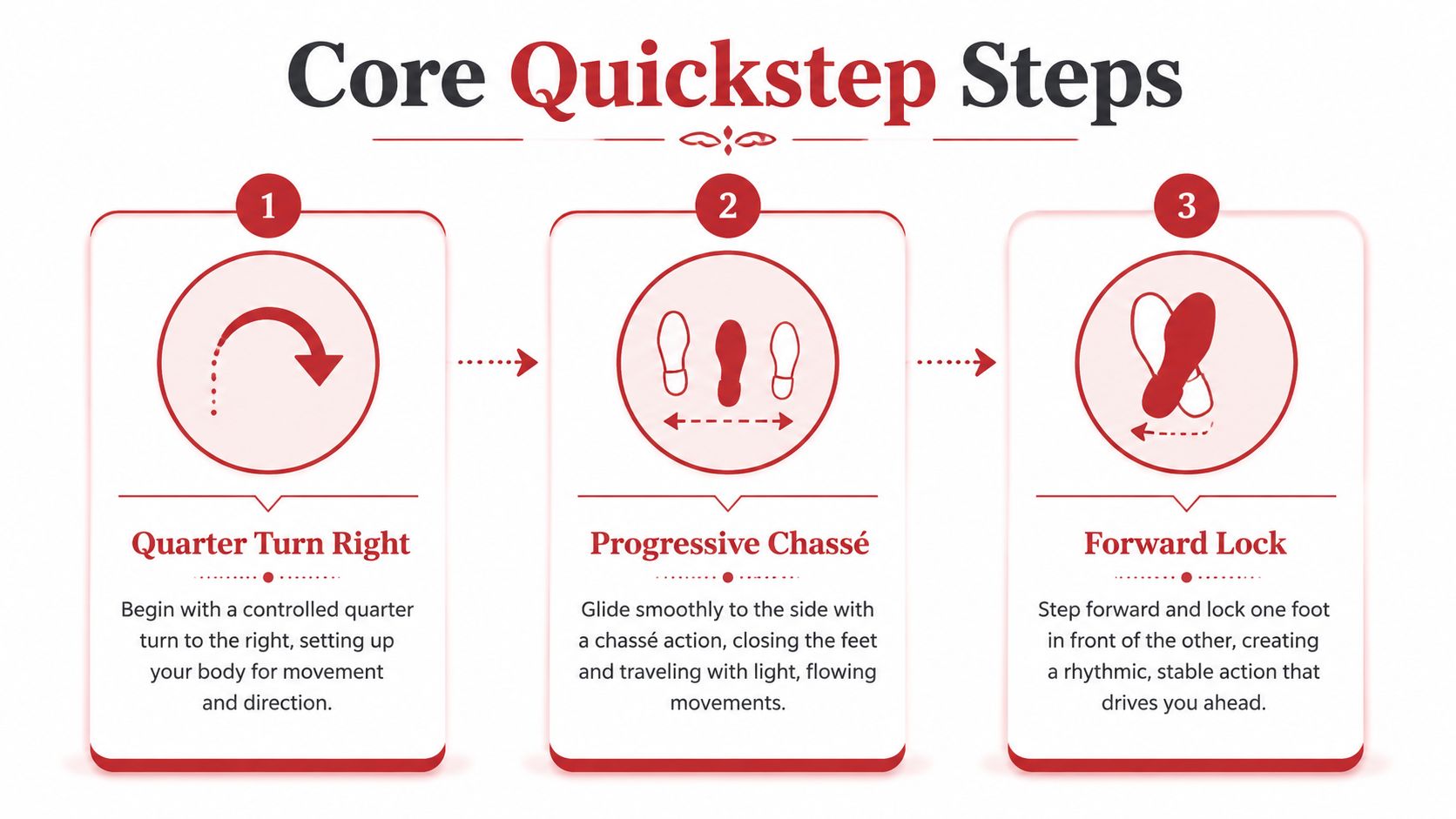
Quarter Turn to the Right
This figure helps you begin changing direction without overcomplicating the turn. It's one of the cleanest ways to learn how Quickstep travels around the room.
Leader
- Step 1 on Slow: Left foot forward.
- Step 2 on Quick: Right foot to the side, beginning to turn to the right.
- Step 3 on Quick: Close left foot to right foot.
- Step 4 on Slow: Right foot back, completing the quarter turn.
Keep the turn modest. Many beginners try to rotate too much too soon, and the shape of the dance falls apart.
Follower
- Step 1 on Slow: Right foot back.
- Step 2 on Quick: Left foot to the side, beginning to turn to the right from your perspective in partnership.
- Step 3 on Quick: Close right foot to left foot.
- Step 4 on Slow: Left foot forward.
What works is staying calm through the body and letting the feet do the work. What doesn't work is twisting the shoulders ahead of the turn.
Progressive Chassé
This is one of the figures that gives Quickstep its smooth, gliding brightness. The chassé is the little side-close-side action that makes the dance feel alive rather than trudging.
Leader
- Step 1 on Slow: Left foot forward.
- Step 2 on Quick: Right foot to side.
- Step 3 on Quick: Close left foot to right foot.
- Step 4 on Slow: Right foot to side or slightly forward, continuing travel.
Follower
- Step 1 on Slow: Right foot back.
- Step 2 on Quick: Left foot to side.
- Step 3 on Quick: Close right foot to left foot.
- Step 4 on Slow: Left foot to side or slightly back, continuing travel.
The key is that the feet close cleanly on the middle quick. Don't leave a gap. If you do, the chassé loses its crispness.
A short demonstration helps here before you try it yourself:
Natural Spin Turn
This pattern introduces more rotation and teaches you how to keep traveling while turning. It's often where dancers discover whether they're leading with the body or just throwing the feet around.
Leader
- Step 1 on Slow: Left foot forward, beginning a rightward turn.
- Step 2 on Quick: Right foot to side.
- Step 3 on Quick: Left foot closes or passes into the turn as the body continues rotating.
- Step 4 on Slow: Right foot back or around, finishing in balance and ready to continue.
Follower
- Step 1 on Slow: Right foot back, receiving the turn.
- Step 2 on Quick: Left foot to side.
- Step 3 on Quick: Right foot closes or passes through as the turn continues.
- Step 4 on Slow: Left foot forward or around to complete the figure in balance.
Balance matters more than ambition. If you lose your axis, make the turn smaller. The cleanest version is better than the biggest one.
Don't try to “perform” the turn. Finish each step under your body first, then let the next step happen.
Beginner Quickstep patterns at a glance
| Figure | Rhythm (Counts) | Description |
|---|---|---|
| Quarter Turn to the Right | Slow Quick Quick Slow | A basic turning figure that helps you change direction neatly |
| Progressive Chassé | Slow Quick Quick Slow | A traveling side-close-side action that creates glide and momentum |
| Natural Spin Turn | Slow Quick Quick Slow | A rotating figure that blends turn and progression |
Adding Bounce and Flow to Your Dancing
The steps alone won't make your Quickstep look like Quickstep. What gives the dance its character is the combination of rise and fall, light bounce, and body flow. This is also where beginners either start to feel airborne or start to feel battered.
Understand what bounce is and what it isn't
Quickstep bounce is not hopping up and down. It's not pumping the knees. It's not springing off the floor with uncontrolled energy.
The look comes from coordinated use of the ankles, knees, and feet so the body rises and lowers smoothly while continuing to travel. The upper body stays composed while the lower body absorbs and releases energy.
If you jump, you'll feel heavy. If you never lower, you'll feel flat.
Use rise and fall for lightness
A helpful image is to think of the body as skimming over the floor while the feet precisely manage the terrain underneath. On the slow, you organize and drive. On the quicks, you move through with a compact lift. Then you lower in time to set up the next phrase.
For many dancers, musicality enables this. If you want to develop that connection between what you hear and what your body does, studying musicality in dance can help you stop treating counts like math and start treating them like movement.
Protect your knees and ankles
Safety matters here. Quickstep has speed and energy, but it shouldn't leave your joints angry.
According to the Quickstep choreography guidance at DanceCentral, dancers can reduce strain by using “brake pad” ankles, leading with the heel on Slow counts and rising only partially on the balls of the feet for Quick counts. The same guidance notes that practicing controlled knee flexion can prevent up to 25% of beginner ballroom injuries.
That idea is excellent for beginners because it gives you a concrete cue. Don't rise as high as you can. Rise only as much as you can control.
Think of the ankle as a shock absorber. It softens the landing and meters the lift.
A simple safe-action drill
Try this without traveling first:
- On Slow: Step with a clear heel lead and keep the body low enough to feel grounded.
- On Quick Quick: Brush through the feet and rise only partially through the balls of the feet.
- On the next Slow: Lower with control instead of dropping.
What works is measured action. What doesn't work is forcing a dramatic bounce because you think more visible means more correct.
Flow comes from continuity
Once the rise and lowering feel controlled, your goal is continuity. Every figure should feed the next one. The body should never look like it stops and restarts.
That's the moment Quickstep stops feeling like a sequence of instructions and starts feeling like dancing.
From the Studio to the Social Dance Floor
Few Quickstep learners embark with immediate competition in mind. They want to enjoy it at a party, in a class, at a wedding, or during social dancing when space is limited and the floor is busy. That's where practical adaptation matters.
Practice drills that actually help
A lot of home practice fails because it's too vague. “Run the dance” isn't a useful assignment for a beginner. Specific drills are.
- Shadow dancing drill: Practice the basic rhythm and core patterns alone, facing a wall or mirror. This helps isolate foot placement and timing without partner variables.
- Frame walk drill: With a partner, take slow walks in frame without any turn. Keep the elbows stable and the shoulders quiet.
- Small chassé drill: Mark a narrow lane on the floor and fit your chassés inside it. This teaches compact travel and keeps the feet under the body.
If public dancing makes you self-conscious, it helps to work on confidence as a separate skill. This is why resources on overcoming fear of dancing in public can be as useful as technical drills.
How to adapt Quickstep in a crowded room
Social floors rarely give you the long runway you want. Competitive versions of the dance often need to be resized for real conditions.
According to the solo and crowded-floor Quickstep guidance in this YouTube lesson, a practical option is to shorten traveling figures into scatter chassés (QQQQ) or use more stationary tipsy turns (QQS) to keep the energy while avoiding collisions. The same guidance recommends shadow dancing as an effective solo practice method for building confidence and foot clarity.
That advice matches what works on busy floors. You don't need giant movement to look musical. You need clean timing and smart choices.
On a crowded floor, the best dancer isn't the one covering the most ground. It's the one who stays in control and keeps the partnership comfortable.
Shoes and social settings
If you're learning Quickstep for weddings or parties, your shoes deserve some thought. You need stability, a sole that lets you turn, and enough support to stay relaxed through the ankles and knees. If you're sorting through event footwear, this guide to best shoes for wedding guests is a useful starting point for balancing comfort and movement.
For structured in-person practice, one option is Danza Academy of Social Dance, which offers partner-friendly and no-partner-needed ballroom instruction. But whichever setting you choose, the principle is the same: practice the version of Quickstep you'll use.
Common Quickstep Questions and Fixes
Beginners usually don't struggle because they're incapable. They struggle because Quickstep exposes small technical habits quickly. That's normal. Here are the fixes that help most.
Why do I keep getting ahead of the music
You're probably rushing the first slow. When dancers feel nervous, they step too early and then spend the rest of the phrase trying to recover.
Try counting out loud while walking in place first. Then dance the pattern smaller than you think you need to. Smaller often means clearer.
Why does my frame fall apart when the dance speeds up
Because your arms are trying to do what your center should be doing. When the tempo increases, many dancers grip with the hands or let the elbows drift.
Reset with a simple exercise:
- Stand in frame without moving
- Breathe normally
- Take four walks forward and back
- Keep the sternum lifted and elbows quiet
If the shoulders rise, soften them. If the hands clamp, reduce pressure.
Why do I lose balance in turns
Most balance problems come from one of three things: steps that are too big, turning too early, or letting the head and shoulders whip around separately from the body.
Use this correction:
- Make the turn smaller
- Finish your weight transfer before increasing rotation
- Keep your spine vertical through the turn
A smaller clean turn always beats a larger unstable one.
What shoes should I wear for Quickstep
Wear something secure, flexible enough to move, and not sticky on the floor. You want traction, but not so much that turning twists the knee. Avoid floppy sandals, overly grippy sneakers, or shoes that slide off your heel.
If you're just starting at home, a comfortable practice shoe is better than forcing yourself into a shoe that looks formal but fights your balance.
What music should I practice with
Start with music where you can clearly hear the pulse and count the basic rhythm without guessing. Don't choose the most intense track you can find. Choose one that lets you stay relaxed and accurate.
When the rhythm is clear in your body, faster songs become much easier.
How long does it take to feel comfortable with the basics
That depends on how consistently you practice and whether you're working from good corrections. Most dancers start feeling more at ease once the rhythm becomes automatic and the first few patterns stop feeling like memorization.
The fastest path is usually simple, repeatable practice. Not more figures. Better basics.
Start Your Quickstep Journey at Danza Academy
Reading about Quickstep helps. Walking through the steps in your living room helps even more. But the fastest way to feel the dance is to learn it with a teacher who can adjust your timing, posture, and movement in real time.
That matters because Quickstep is a feel-based dance. A written guide can show you where the feet go. In-person instruction shows you how the dance should breathe, travel, and connect. It also helps you avoid the common beginner habits that make the dance feel harder than it is.
If you've been waiting until you feel “ready,” this is your sign that ready can start now. You don't need a partner. You don't need experience. You don't need to already look like a ballroom dancer.
You just need a first step.
A complimentary lesson is the easiest way to turn all of this into something physical and fun. You can ask questions, try the rhythm with guidance, and feel what Quickstep is supposed to feel like when it works. That first session often clears up more confusion than weeks of guessing on your own.
Ready to try it for real? Danza Academy of Social Dance offers a free complimentary lesson you can book through the contact page. If you want to learn how to dance the quickstep with clear instruction, supportive coaching, and a no-pressure start, book your lesson and get on the floor.