
Choosing a dance studio can feel harder than choosing the class itself. You search your area, open a dozen tabs, and every studio looks polished, friendly, and promising. One highlights trophies. Another emphasizes family atmosphere. Another says its teachers are highly trained. If you're new to dance, or choosing for your child, it can be difficult to tell what is important.
That confusion is normal. The dance world is large, and your decision has real weight. The U.S. dance studio market reached $4.7 billion with more than 75,000 studios, according to dance studio market statistics. At the same time, the same data notes a 30% annual student dropout rate, with 45% of dropouts tied to scheduling conflicts. In other words, plenty of people start. Fewer find the right fit and stay with it.
A good choice saves more than money. It protects motivation, confidence, and momentum. The best studio for a preschooler isn't the best studio for a nervous adult beginner. The right place for a wedding couple may be completely wrong for a serious competitor.
Starting Your Search For The Right Dance Studio
Start with this mindset. The best studio is not the one with the loudest marketing. It's the one that fits your life, your goals, and the way you learn. That sounds simple, but many people skip it and shop only by price, location, or a few social media clips.
Dance has become easier to access, but that creates a new problem. More options mean more noise. A polished website can tell you very little about how a class feels, whether the schedule is manageable, or whether the teaching style will help you improve week after week. If a studio makes attendance difficult, progress usually stalls long before enthusiasm does.
Practical rule: Choose for sustainability, not for first impressions alone.
That same principle applies in other service industries. A thoughtful local guide like Twizzlo's New Rochelle spa guide helps people compare options based on experience, fit, and real-world needs rather than surface-level branding. Dance deserves the same kind of careful selection.
When families or adults ask me how to choose a dance studio, I usually tell them to ignore the urge to crown a winner too early. First, identify your essential requirements. Then compare studios against those. If you want a helpful local starting point for evaluating nearby options, Danza Academy's article on how to find the perfect dance academy near me is a practical companion.
A studio should support the life you already have, not demand that you reorganize your entire week just to keep up. That's one of the most overlooked details, and it's often the difference between trying dance and staying with dance.
First Steps Define Your Personal Dance Goals
Before you ask about flooring, tuition, showcases, or dress code, ask yourself one question. Why are you doing this now?
People often say, "I just want to dance." That isn't wrong, but it isn't specific enough to help you choose well. Different studios serve different outcomes. Some are structured around technical progression. Some are social and community-driven. Some are ideal for children building confidence. Some are strong for wedding preparation because they understand deadlines, nerves, and choreography that fits a couple's actual ability.
Write down your real reason
Take two minutes and finish one of these sentences:
- I want dance to help me… feel more confident socially.
- I want lessons because… my wedding is coming up and I don't want to freeze during the first dance.
- I want my child to… gain coordination, discipline, and a positive activity after school.
- I want training that… challenges me seriously and pushes me toward performance or competition.
- I want a class environment where… I can start as a beginner without feeling behind.
That written answer becomes your filter. Without it, every studio starts to look equally attractive, and you end up comparing things that don't matter to your situation.
Match the goal to the kind of studio
A few examples make this easier.
If you're an adult beginner, you may need a studio that welcomes nervous first-timers, offers clear fundamentals, and doesn't make partner status a barrier.
If you're a parent, you may care most about safety, communication, age-appropriate instruction, and whether your child leaves class feeling proud rather than pressured.
If you're an engaged couple, your needs are usually practical. Can the instructor work with your song? Your schedule? Your comfort level? Can they build something that looks natural, not forced?
If you're a competitive dancer, you need a different lens entirely. You should look closely at training depth, coaching quality, feedback style, and whether the curriculum supports long-term development.
"A studio can be excellent and still be wrong for you."
Know your preferred learning environment
Goals matter, but so does learning style. Some students thrive in a lively room with lots of rotation and social energy. Others learn best in quieter classes with more repetition and individual correction. Some want a broad range of styles. Others want one discipline taught with precision.
Use these prompts before you start calling studios:
- How often can I realistically attend?
- Do I want private lessons, group classes, or both?
- Do I need evening or weekend availability?
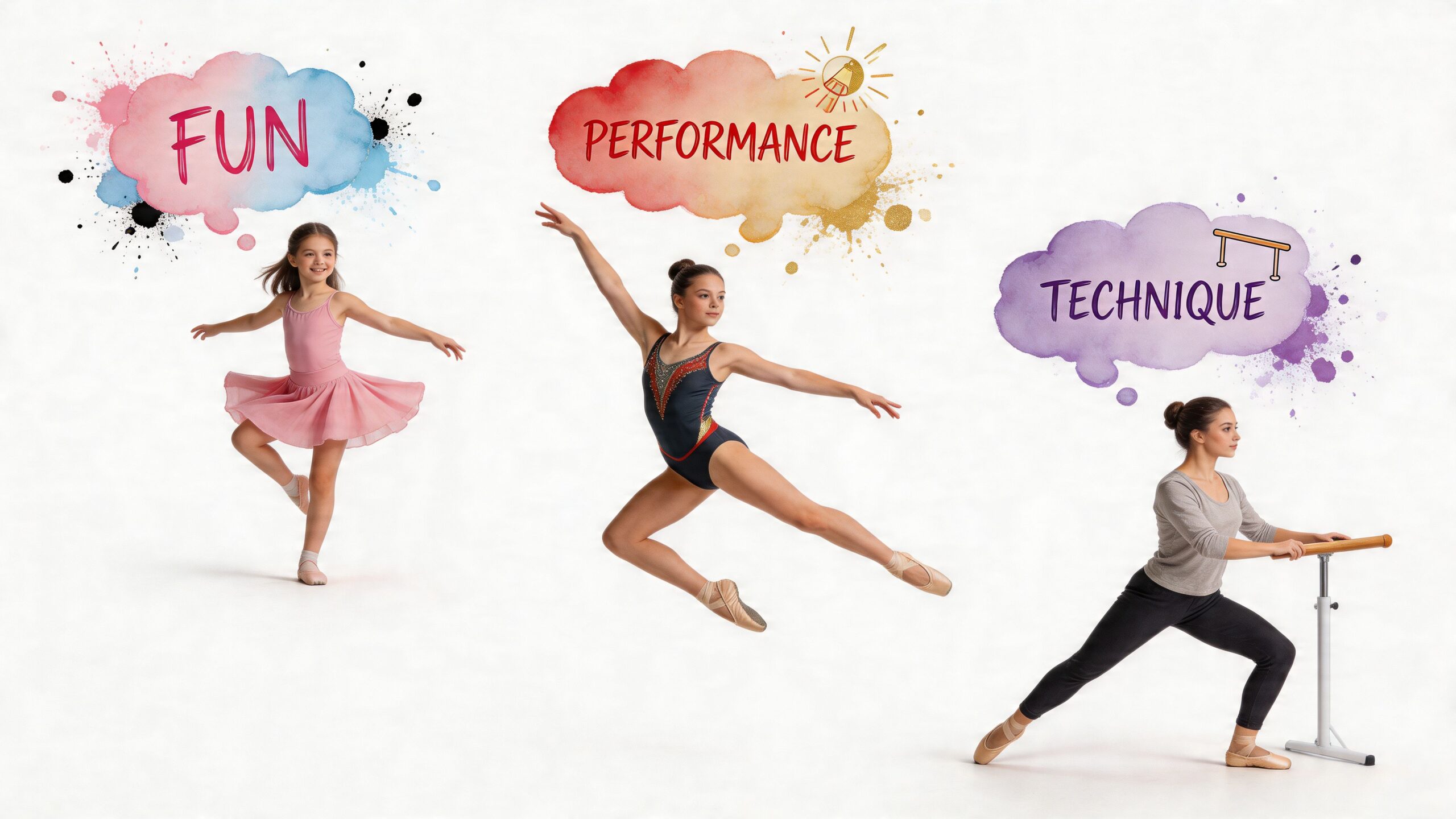
- Am I looking for fun first, or structured progress first?
- Will I stick with this if the studio feels intimidating?
Those answers keep you grounded when a studio's branding starts pulling you in directions that don't match your actual needs.
The Core Four What Every Great Studio Must Have
A studio can look polished online and still be a poor fit once class starts. After years of teaching, I keep coming back to four markers that hold up across styles and student types: teaching, safety, structure, and culture.
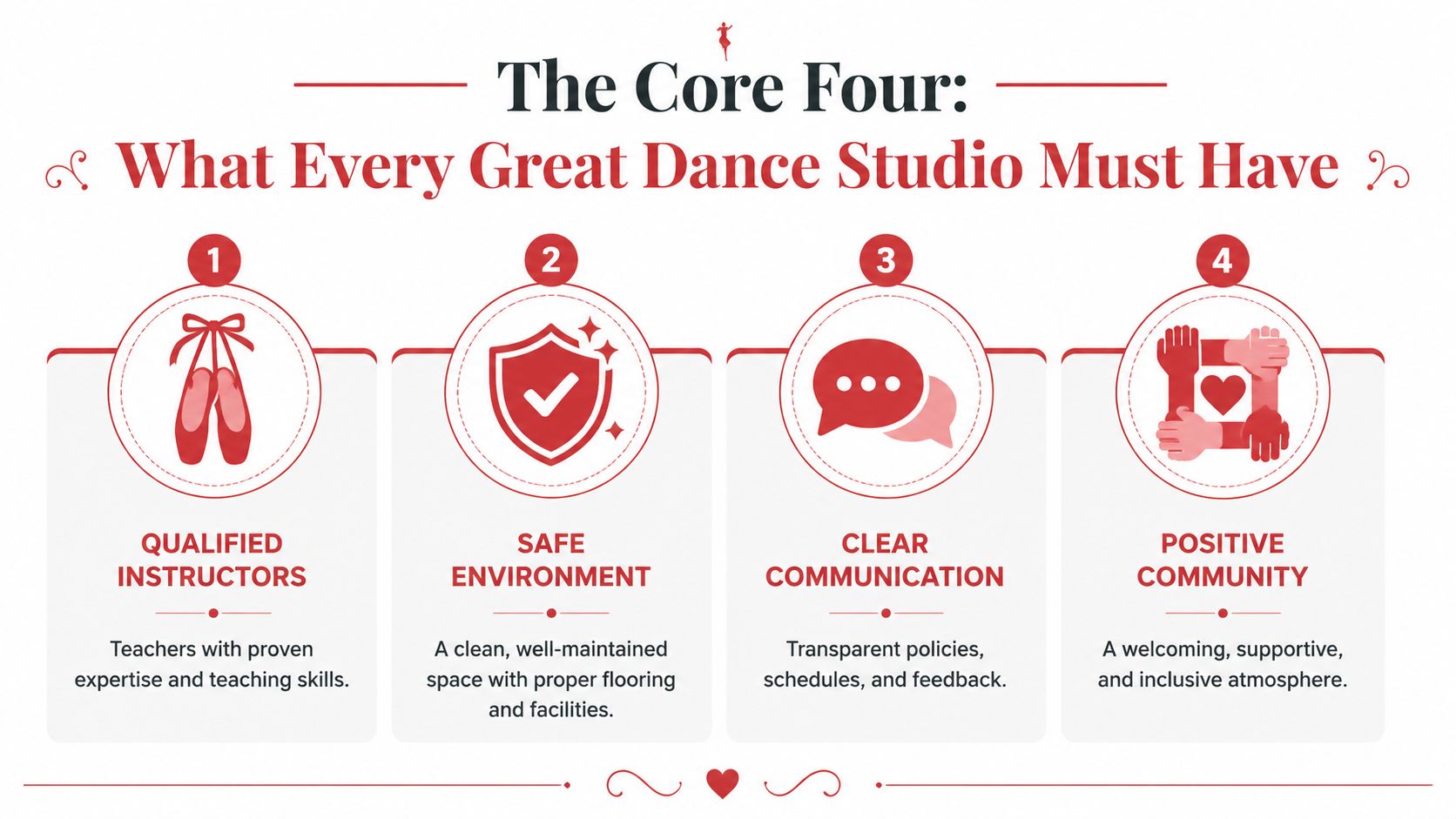
A parent may notice one first. An adult beginner may notice another. A wedding couple on a deadline may care most about whether the studio can teach clearly and keep lessons focused. All four matter because weaknesses tend to show up together.
Qualified instructors
Strong teachers do more than perform well. They watch carefully, give corrections a beginner can apply, and adjust their approach for the person in front of them.
That last part matters more than many new students realize. Teaching a shy seven-year-old, a nervous wedding couple, and an adult returning to movement after years away requires different pacing, different language, and different expectations. Good studios know that and staff accordingly.
Look for instructors whose background matches what they teach. Then look past the bio. Do students seem confused or supported? Are corrections specific? Does the teacher keep the room moving without rushing people? A beautiful demonstration means very little if the class cannot follow it.
Safe environment
The floor affects every class.
According to Greenville Ballet's guidance on choosing a dance studio, sprung wooden floors such as Rostan or Harlequin types can provide up to 70% shock absorption, reducing lower extremity injury risk by as much as 50% compared with concrete subfloors. That matters for children taking multiple classes a week, adults managing old injuries, and couples preparing for a wedding without time to recover from a preventable strain.
Safety also shows up in ordinary details that many people overlook:
- Cleanliness: Floors, restrooms, waiting areas, and corners should be consistently maintained.
- Ventilation: The room should feel fresh enough to support hard work.
- Space: Dancers need room to travel, turn, and partner without constant near-collisions.
- Upkeep: Mirrors, barres, entrances, and sound equipment should work and look cared for.
Facilities do not need to be luxurious. They do need to be well maintained.
Clear class structure
Students stay longer and improve faster when a studio runs on a system people can understand. Levels should be defined clearly. Policies should be easy to find. New students should know where to start, how attendance works, and what progress looks like.
This matters in different ways at different life stages. Parents need predictable calendars and prompt updates. Busy adults need class times they can keep. Wedding couples often need a short-term plan with a clear endpoint. Competitive dancers need a progression that is demanding but not chaotic.
Good administration supports good teaching. Registration, attendance, and makeup policies shape whether students show up consistently enough to improve. Even outside dance, the same principle shows up in tools built for how to schedule tutoring sessions efficiently. Clear scheduling reduces confusion and helps people stick with lessons.
For a studio-specific perspective on how professional space and organization support progress, Danza Academy offers a useful article on why a professional dance studio matters for training.
Positive community
Students feel the culture quickly. You can usually spot it before class even begins.
Watch how the front desk speaks to new people. Watch how teachers respond when someone forgets a combination. Watch whether advanced students make room for beginners or treat them like obstacles. Those small moments reveal far more than a mission statement.
A healthy studio community balances standards with warmth. Children should feel safe to try. Adult beginners should not feel embarrassed for being new. Wedding couples should not feel judged for wanting something simple and usable. Serious dancers should get honest feedback without constant tension in the room.
Here’s a quick comparison:
| Area | What works | What doesn't |
|---|---|---|
| Teaching | Specific corrections, patient explanations, visible student growth | Vague praise, confusion, no individual feedback |
| Environment | Clean floors, safe surfaces, organized traffic flow | Slippery floors, clutter, chaotic transitions |
| Structure | Clear levels, transparent policies, consistent scheduling | Unclear advancement, hidden rules, frequent confusion |
| Culture | Respectful, welcoming, focused | Cliques, intimidation, dismissive staff |
If one of these four is weak, students usually feel it fast. If all four are solid, the studio has a real chance of fitting into your life and helping you grow.
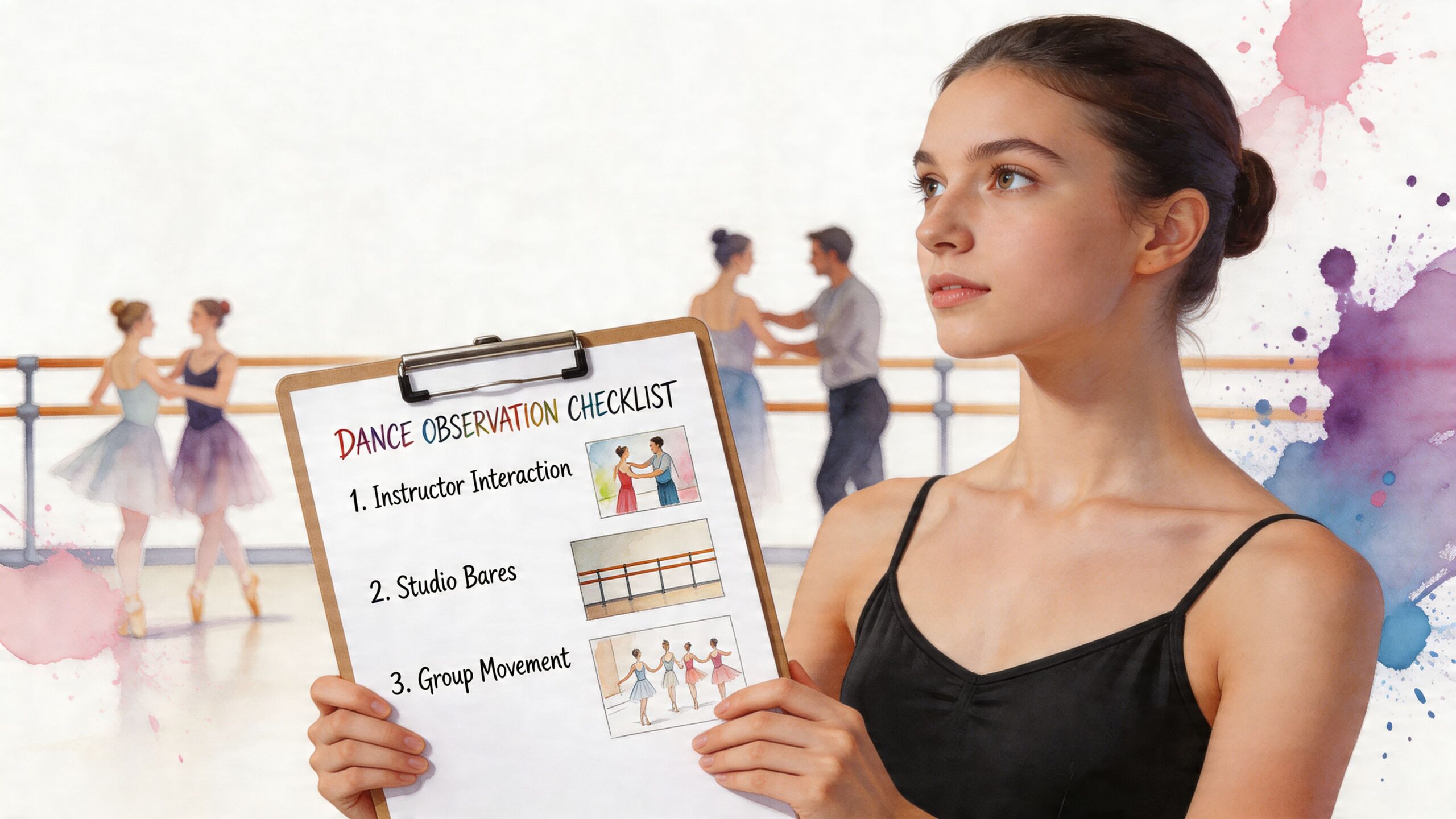
Your Personal Checklist Questions to Ask and What to Observe
Once you've narrowed the list, stop browsing and start investigating. This is the part many people rush, but it's where the decision gets easier. A good call, a studio visit, and one trial class will tell you more than an hour of scrolling.
Questions to ask before you visit
Start with direct questions. You don't need to apologize for asking them. A well-run studio should answer clearly and comfortably.
Ask about:
- Instructor fit: Who teaches beginners, children, wedding couples, or advanced students in the style you want?
- Class placement: How do they decide which level is right for a new student?
- Schedule flexibility: Are there makeup options, class swaps, or alternate times if your schedule changes?
- Commitment model: Is enrollment month-to-month, session-based, or long-term?
- Progression: How does a student move from one level to the next?
- Observation policy: Can you watch a class or take a trial lesson before enrolling?
- Partner policy: If you're coming solo, how does the studio handle rotation or partner changes?
- Communication: How are schedule changes, closures, or studio announcements shared?
Listen to the tone as much as the answer. Clarity matters. Evasion matters too.
What to notice during a visit
When you walk in, don't focus only on whether the space looks attractive. Watch how the place runs.
Notice whether people know where to go. Notice whether students seem tense or at ease. Notice whether the teacher starts on time, whether the room is prepared, and whether staff members speak to newcomers respectfully.
Then watch the class itself.
- Corrections: Does the teacher offer useful feedback, or mostly count and demonstrate?
- Attention spread: Do only the strongest students get noticed?
- Pacing: Is the class moving at a steady pace, or is it disorganized?
- Student engagement: Are dancers mentally present, or following along by rote?
- Respect: Are mistakes handled constructively?
Field note: The best classes feel focused, not frantic. Students should look challenged, but not lost.
A benchmark that matters
Class size isn't just a comfort issue. It affects learning.
When you're asking about structure, target a student-to-teacher ratio of 10 to 12 to 1, based on The Brainy Ballerina's studio evaluation benchmark. The same source notes that ratios above 20 to 1 can reduce individual attention and slow skill acquisition by an estimated 30 to 50%. In plain terms, crowded rooms often mean slower progress and more students falling behind.
That doesn't mean every small class is excellent. It does mean that if the room is packed, you should expect less personal correction and less room for adaptation.
What to observe in the waiting area and transitions
A lot of truth appears before and after class.
Parents can learn a great deal by watching how teachers dismiss children, how questions are answered, and whether staff appear rushed and reactive or calm and prepared. Adult students should watch transitions too. Do beginners seem embarrassed walking out, or energized? Do instructors linger for quick questions, or disappear immediately?
Try this simple observation checklist:
- Arrival: Is check-in smooth and welcoming?
- Before class: Are students standing around confused, or getting settled with purpose?
- During class: Does the teacher teach to the room, not just to one student?
- After class: Can students ask brief questions without feeling like a burden?
- Overall: Would you want to return next week?
Red flags worth taking seriously
Some problems are minor. Others usually predict a poor fit.
| Red flag | Why it matters |
|---|---|
| No clear answer about level placement | Students may end up in classes that are too hard or too easy |
| Policies are hard to explain | Confusion later usually means frustration later |
| Teacher talks far more than students move | You may be paying for lecture instead of training |
| Beginner questions are brushed aside | The culture may not support new dancers well |
| The studio feels socially closed off | Retention often depends on whether people feel they belong |
A visit should leave you with fewer doubts, not more.
Finding Your Fit Tailored Advice For Every Dancer
The same checklist doesn't carry equal weight for everyone. Parents, wedding couples, adult beginners, and competitive dancers need different things from the same studio. Given these varied needs, the actual decision-making becomes more personal.
For parents
Parents often start by looking at schedule and cost. Those matter, but they shouldn't come first.
Your child needs a studio that teaches with structure and care. That means age-appropriate expectations, instructors who can manage a room without harshness, and communication that keeps parents informed without making every week feel chaotic.
Look for these signs:
- Confidence-building instruction: The teacher corrects without shaming.
- Order in the room: Children know where to stand, when to move, and how class works.
- Healthy communication: Policies are clear, and staff answer parent questions directly.
A child doesn't need the fanciest studio. A child needs a place where discipline and joy live together. If you're evaluating programs for younger dancers, this guide on dance classes for kids near me and how to choose the right studio is a helpful next read.
For engaged couples
Wedding dance instruction is its own category. Couples don't just need dance lessons. They need planning, calm guidance, and choreography that fits real life.
One couple may want a polished classic first dance. Another wants a short routine that feels comfortable and fun. A strong wedding instructor asks practical questions early. What song are you using? How large is the floor? What shoes will you wear? Do you want something elegant, playful, or simple and natural?
Use this comparison lens:
| If you need… | Look for a studio that… |
|---|---|
| A relaxed first dance | teaches comfort, posture, and a few clean moments rather than over-choreographing |
| A custom routine | works with your song and builds around your timeline |
| Help with nerves | teaches patiently and understands non-dancers |
If an instructor seems more interested in showing how much they know than in creating a dance you can enjoy, keep looking.
For adult beginners
This group often has the most avoidable anxiety. Adults worry about looking awkward, falling behind, or showing up alone. A studio can remove that fear quickly, or reinforce it.
For social dance especially, partner policy matters. A guide focused on what adult social dancers should look for in a studio notes that 68% of adults dropped out due to inflexible partner matching or lack of social practice nights. That's a major warning sign. If you're learning Ballroom, Latin, Swing, Salsa, or other partner styles, ask directly whether a partner is required, how class rotations work, and whether the studio offers social events or practice opportunities.
A welcoming adult program usually has these qualities:
- No-partner-required options: Solo students can join without embarrassment.
- A true beginner pathway: New dancers aren't mixed into rooms where they're expected to keep up instantly.
- Community outside class: Practice nights, workshops, or social gatherings help people return.
If you want adults to stay, give them a place to belong, not just a syllabus to follow.
For readers comparing local options, one example in Philadelphia is Danza Academy of Social Dance, which offers Ballroom, Latin, and social styles, group and private instruction, wedding preparation, and classes where no partner is required. That's the kind of practical setup adult beginners should look for when evaluating any studio.
For competitive or goal-driven dancers
A serious dancer should be more demanding.
You need to know who is coaching advanced students, how corrections are delivered, and whether the studio's training habits support long-term progress. Some studios market to competitors but operate mostly as recreational schools. Others maintain high standards but don't communicate that clearly online.
Ask sharper questions here:
- Who teaches advanced technique and coaching sessions?
- How are goals set and reviewed?
- Can I observe stronger dancers in training?
- Does the feedback feel precise or generic?
For this category, culture matters in a different way. You want ambition without ego, rigor without chaos, and teachers who can push students while protecting fundamentals. Competitive students often improve fastest in environments where expectations are high and communication stays clear.
Making The Most Of Your Trial Lesson
You walk in ten minutes early for a trial class. A parent is trying to figure out where to wait, a couple is whispering about a first dance song, and two adult beginners are standing near the door wondering if they are underdressed. That moment tells you a lot before class even starts. A good studio knows how to receive people at different stages, not just how to teach combinations.
Use the trial lesson to judge fit, not just talent. New students often leave a first class asking, "Did I do well?" The better question is, "Did this studio teach in a way that makes me want to keep learning here?" That matters more than whether you picked up every step on day one.
Arrive early enough to watch the room settle. Notice whether the front desk knows who is expected. Notice whether the instructor starts on time, has a plan, and speaks to beginners like beginners, not like students who should already know the vocabulary. If you are a parent, look at how staff handle transitions and questions. If you are an adult beginner, pay attention to whether anyone helps you past the awkward first five minutes. If you are coming in for a wedding dance, listen for whether the teacher asks about your timeline, song, and comfort level rather than forcing a standard routine.
Corrections matter most during a trial. As noted earlier, many students first find studios through social media. That makes the in-person experience the real test. Strong teachers do not just demonstrate well. They spot what you need, explain it clearly, and adjust without making you feel behind. You should leave with one or two specific improvements you can name.
What a useful trial feels like
A useful trial has direction.
You understand what the teacher is asking for, even if you cannot do it yet. The feedback is specific enough to help. The pace stretches you without turning the class into a guessing game.
In a healthy class, the teacher also reads the room. Children need structure and encouragement. Adult beginners usually need clarity and permission to make mistakes. Couples often need practical coaching on connection, timing, and what will look comfortable at an event. Serious dancers need precise corrections and honest standards. One studio can serve several groups well, but the teaching has to shift with the student in front of them.
Watch the other students, too. Are they engaged, confused, relaxed, intimidated? Do they seem like a community people return to, or just a revolving door of trial sign-ups? Facilities matter, but retention often comes down to whether people feel seen.
Questions to ask yourself afterward
Give yourself a few quiet minutes after class and answer these truthfully:
- Did the teacher adjust to my level and goal?
- Did I get clear corrections I could use?
- Did the atmosphere feel welcoming for someone in my stage of life?
- Could this schedule and class format work in my real week?
- Did I leave encouraged to continue, not pressured to buy?
One imperfect moment does not disqualify a studio. Every class has occasional hiccups. What you are looking for is a pattern. Was the teaching organized? Were people treated with respect? Did the class make progress feel possible?
If you can, stay for a few minutes after your lesson. Watch how the teacher ends class, answers questions, and greets the next group. I have seen studios deliver a polished trial, then reveal their real habits in the ten minutes before and after it. Those edges tell the truth.
Take The First Step And Start Your Dance Journey
The right studio doesn't just teach steps. It gives you a place to grow. For some people, that means a child finding confidence. For others, it means a couple preparing for a meaningful wedding dance. For many adults, it means finally trying something they've put off for years because they were afraid they'd be too old, too stiff, or too inexperienced.
If you remember only a few things from this guide, remember these. Start with your own goal. Look for the core signs of quality. Ask direct questions. Watch closely during a visit. Then trust what the trial lesson tells you.
A studio should leave you feeling supported, capable, and interested in coming back. If it doesn't, keep looking. There are many studios. You do not need to force a fit.
If you're in the Philadelphia area and want to evaluate a studio the right way, the simplest next step is to try a lesson and pay attention to the details covered here. A complimentary first lesson gives you the chance to assess the teaching, the atmosphere, the scheduling fit, and your own comfort level without pressure.
A complimentary first lesson is one of the easiest ways to apply everything in this guide in real life. If you're ready to explore Ballroom, Latin, social dancing, wedding dance preparation, kids' classes, or more focused coaching, book your free lesson with Danza Academy of Social Dance and experience the studio for yourself before making a commitment.