You’re probably here because dance has been sitting in the back of your mind for a while.
Maybe you’ve watched a couple move across a floor and thought, “I’d love to do that,” then immediately followed it with, “But I’d be terrible.” Maybe you want a new hobby that gets you off your phone, out of the house, and around people. Maybe you need wedding dance help. Maybe you miss music being part of your week.
That hesitation is normal. Most adults don’t walk into their first class feeling polished. They walk in curious, a little guarded, and hoping no one asks them to perform anything on the spot. The good news is that philadelphia ballroom dance classes are built for exactly that kind of beginner. You don’t need rhythm on command. You don’t need a partner. You don’t need special shoes on day one.
Your First Step into Philadelphia's Dance Scene
Philadelphia has become a place where adult dance students have real choices. The city has over 50 dedicated dance studios, and adult enrollment in Philadelphia dance classes increased by 35% from 2020 to 2025, according to this overview of adult dance classes in Philadelphia. That matters because it tells you something simple. You are not the only adult starting now.

A lot of new students I meet sound similar. They say they’ve always liked music. They want confidence. They want something active that doesn’t feel like another workout app. Some come alone after a hard year and want a fresh routine. Some come as couples and realize very quickly that dance is less about “getting it right” and more about learning how to move together.
Philadelphia makes that easier because the local scene is broad. You can find classic ballroom, Latin, social dance, wedding instruction, and more. You can also find different entry points. Some people prefer a structured private lesson. Others want a group class where they can blend in, laugh a little, and learn by doing.
You don’t need to feel ready before you begin. Most people become ready by beginning.
There’s another reassuring detail in that same local picture. Studios with staying power have helped shape the scene for decades. Danza Academy, for example, has over 40 years of teaching experience in the Philadelphia market, which gives beginners a chance to learn in a setting where adult students are already part of the everyday rhythm.
What beginners usually want to know first
Before anyone asks about advanced technique, they usually ask these three things:
- Do I need a partner Not for most beginner programs. Many classes rotate partners, and many students come on their own.
- Will I hold the class back No. Beginner classes are designed for people who are learning basic timing, posture, and foot placement.
- Is this only for outgoing people Not at all. Some of the strongest dancers start out quiet and cautious.
That’s why this guide matters. If you’re interested but unsure, a little clarity removes a lot of fear.
A Guide to Ballroom Latin and Social Dance Styles
The biggest point of confusion for first-time students isn’t usually “Can I learn?” It’s “What am I supposed to try?”
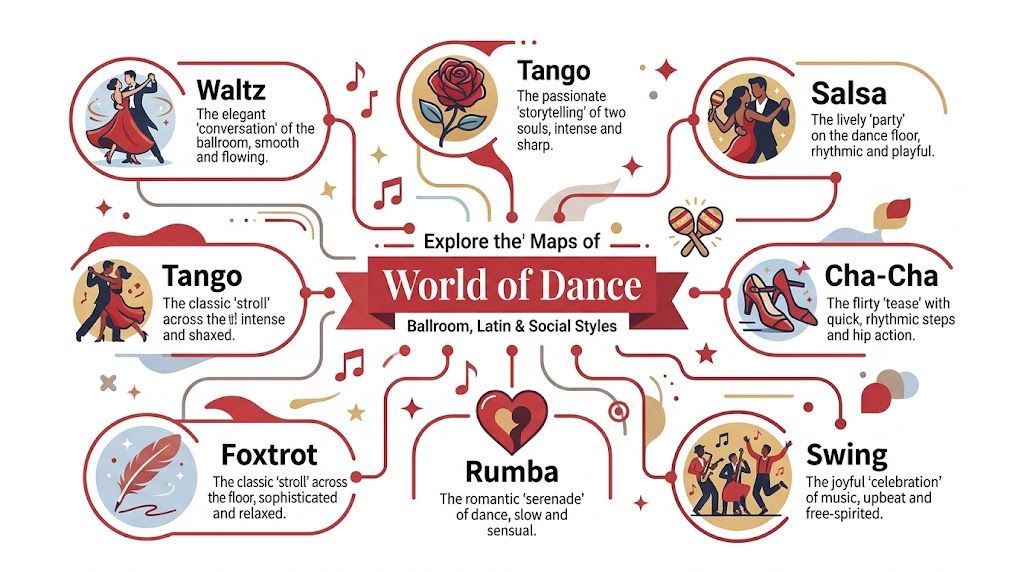
Ballroom studios often group dances into ballroom, Latin, and social styles. Those categories are useful, but they can sound abstract until you connect them to how each dance feels in your body. Start there. Choose the dance that matches your energy, your music taste, or the kind of experience you want on the floor.
Classic ballroom styles
When people hear “ballroom,” they often picture formality. In practice, beginner ballroom is about learning balance, direction, and connection.
Waltz feels smooth and floating. If you like music that rises and breathes, Waltz often feels natural. New dancers usually enjoy how it teaches traveling movement without rushing.
Foxtrot is calmer and more casual in mood. It has that “walking into the room with confidence” quality. If Waltz feels dreamy, Foxtrot feels grounded and polished.
Tango is sharper. The movement is more deliberate, and the pauses matter. Students who like drama, precision, and strong musical accents often connect with Tango quickly.
Latin styles
Latin dances tend to feel more rhythmic through the hips, feet, and torso. They’re expressive, playful, and often easier for beginners who enjoy a lively beat.
Salsa is social and energetic. It feels like a conversation with the music. Many people start here because they already know the music and want something upbeat.
Cha-Cha has a teasing quality to it. The rhythm is crisp, and the footwork teaches quick weight changes. It’s great for students who want personality and clear timing.
Rumba slows things down. That can make it look easier, but slow dances often ask for more control. Rumba helps beginners feel how weight transfer really works.
Social dances
Social dances are often the bridge between “I want to learn something fun” and “I think I’m becoming a dancer.”
Swing is joyful. It has bounce, energy, and a sense of play. Students who don’t want to feel stiff usually love it.
Some studios also teach styles like Hustle, West Coast Swing, and Country Two-Step. Those can be great if your main goal is going out dancing rather than focusing only on traditional ballroom patterns.
Practical rule: Pick your first dance by how it feels, not by what you think you “should” learn.
A simple way to choose your first style
If you’re still torn, use this quick matching guide:
- You want elegance and smooth movement Try Waltz or Foxtrot.
- You like bold character and dramatic music Try Tango.
- You want a fun social atmosphere Try Salsa or Swing.
- You enjoy detail and musical texture Try Cha-Cha or Rumba.
- You’re preparing for a wedding or event Start with the music you’ll dance to, then let an instructor guide the style choice.
For a broader look at how traditional partner dances fit together, this simple guide to the 10 traditional dances of ballroom dance can help you compare them in plain language.
Don’t overthink your first pick
Your first style isn’t a lifelong contract.
A beginner who starts in Salsa may later fall in love with Foxtrot. Someone who thinks they want Tango may discover they feel more natural in Swing. The first goal is not to choose perfectly. The first goal is to move, listen, and notice what makes you want to come back next week.
Finding Your Fit Private Lessons Group Classes and More
Choosing a dance style is one decision. Choosing how to learn is another.
Many adults frequently encounter a dilemma. They assume private lessons are only for advanced dancers, or they assume group classes are the only affordable route. In reality, different formats solve different problems. The right choice depends on your comfort level, your schedule, and what you want from philadelphia ballroom dance classes.
What private lessons are best for
Private lessons give you focused attention. If you’re shy, if you want to move at your own pace, or if you’re preparing for something specific like a wedding or a showcase, this format is often the cleanest starting point.
In a private lesson, the instructor can adjust everything in real time. That includes posture, timing, frame, foot placement, and even how much information you can absorb at once. If you have a mobility concern or need lower-impact options, a personalized setting also makes those conversations much easier. That matters because, in Philadelphia, there’s a clear information gap around accommodations for dancers with mobility challenges, and a welcoming studio should be ready to discuss modified steps and low-impact options, as noted in this piece on dance and community in Society Hill.
Why group classes work so well for many adults
Group classes do something private lessons can’t fully replicate. They normalize the beginner experience.
When you learn in a room full of other beginners, you stop assuming every mistake means you’re bad at dancing. You realize everyone is learning timing. Everyone occasionally turns the wrong way. Everyone needs repetition. Group classes also help you hear counts, feel rhythm with different partners, and get used to dancing with real-world variety.
They’re also useful if your goal is social comfort. If you want to go to dances, parties, or local events without freezing when someone asks you onto the floor, group classes are often the fastest way to build familiarity.
Class Format Comparison
| Feature | Private Lessons | Group Classes |
|---|---|---|
| Pace | Set to your learning speed | Set to the class as a whole |
| Feedback | Immediate and individualized | General, with some personal correction |
| Best for | Shy beginners, wedding couples, goal-specific training | Social learners, budget-conscious students, practice through repetition |
| Partner question | You can learn alone or as a couple | Often open to singles and couples |
| Flexibility | Easier to tailor around physical needs or specific music | Better for broad exposure and shared learning |
| Atmosphere | Quiet, focused, low-pressure | Social, lively, community-oriented |
If you want a deeper side-by-side breakdown, this article on group vs private dance classes is a practical next read.
Other formats worth considering
Most adults think only in terms of private versus group, but there are other useful paths too.
- Practice parties These help you use what you’ve learned in a relaxed setting. They’re especially good for building confidence between lessons.
- Wedding dance coaching This works well for couples who want a first dance that feels comfortable and personal rather than over-rehearsed.
- Kids and teen programs Parents often start by enrolling a child, then decide to try adult classes themselves.
- Performance or competition coaching This is for dancers who discover they want structure, polish, and measurable goals.
Some students need privacy first. Others need repetition. Neither choice is more serious than the other.
How to decide without getting overwhelmed
Use your actual obstacle as your guide.
If your obstacle is embarrassment, start private. If your obstacle is consistency, join a group that meets regularly. If your obstacle is “I don’t know if I’ll stick with this,” begin with the smallest commitment that gets you onto the floor.
One local option many adults consider is Danza Academy of Social Dance, which offers both private and group formats in Ballroom, Latin, and social styles. That matters because a mixed-format studio lets you start one way and switch as your confidence changes.
What to Expect in Your First Dance Lesson
Most first lessons start before you ever take a step. They start with that small moment at the door when you’re wondering if you’re underdressed, too old, too stiff, or too late to learn. Then someone greets you, shows you where to put your things, and the whole idea becomes less intimidating.
A first lesson usually begins with a short conversation. The instructor may ask what brought you in, whether you’ve danced before, what music you enjoy, and whether you’re learning for fun, fitness, confidence, a wedding, or something more ambitious. That conversation matters because it shapes the lesson. A good beginner lesson doesn’t dump technique on you all at once. It gives you a manageable first win.
What you’ll probably do in the room
For most beginners, the first physical tasks are simple.
You may learn how to stand in dance posture without stiffening your shoulders. You may practice shifting weight from one foot to the other. You may learn a basic pattern, then repeat it slowly enough to hear the count and feel where your balance belongs. If you come in saying you have “two left feet,” that usually just means your body hasn’t practiced these patterns yet.
Here’s a helpful example of what early ballroom instruction can look like in motion:
Common worries that fade quickly
A lot of adult beginners carry the same fears. Most of them disappear within the first lesson.
- What do I wear Comfortable clothes you can move in. Shoes should stay secure on your feet and let you step safely.
- Do I need a partner Usually no. Many beginners come solo.
- What if I mess up constantly You will make mistakes. That’s part of learning. Dance teachers expect that and build around it.
- Will it be awkward It might feel unfamiliar for a few minutes. Unfamiliar isn’t the same as bad.
What a good first lesson feels like
The best first lesson doesn’t leave you thinking, “I mastered dance today.”
It leaves you thinking, “I can do more than I expected.”
That might mean you heard the beat more clearly. It might mean you stopped looking at your feet for a few seconds. It might mean you smiled halfway through because the movement finally matched the music. Those are real beginner milestones.
If you leave your first lesson with one pattern, better posture, and less fear than when you arrived, it was a successful lesson.
That’s why a complimentary first lesson is so useful. It turns dance from a vague idea into a real experience, with no need to commit before you know how it feels in your own body.
Navigating Costs and Scheduling in Philadelphia
You get excited about dancing, then the practical questions show up fast. How much will this cost each month. How often should I go. Do I need private lessons right away. Those questions matter because a plan you can keep is what turns curiosity into progress.
In Philadelphia, pricing usually depends on the class format. Group classes are the lower-cost entry point, and private lessons cost more because the teacher’s attention stays on you for the full session. If you want a sense of the local range, this overview of affordable dance classes in Philadelphia compares common options and package structures.
What you are paying for in each format
A group class works like learning in a language classroom. You hear the same instruction as everyone else, you practice with repetition, and you benefit from the energy of the room. That makes group lessons a smart choice if your main goal is to get comfortable, build rhythm, and make dance part of your week.
A private lesson is closer to tutoring. The teacher can slow down one concept, clean up a habit before it sticks, and shape the lesson around your goals. According to this CBS Philadelphia roundup of ballroom studios, private lessons in the city often fall into a higher price range than group classes, which is why many adults use them selectively rather than exclusively.
That does not mean private lessons are only for advanced dancers. Beginners often use one to get clear on posture, timing, and partner connection, then use group classes to repeat what they learned.
A simple way to set a budget
Start with the schedule you can keep for three months, not the burst of motivation you feel this week.
Here is a practical way to choose:
- If you want the easiest starting point, begin with one weekly group class.
- If you have a short-term goal, such as a wedding dance or a strong preference for one style, add a private lesson.
- If you want steady progress without overspending, mix the two over time. Private lessons sharpen details. Group classes build comfort through repetition.
Many new students assume faster progress always means more classes. Usually, it means better consistency. One lesson a week for several months will teach you more than an ambitious plan you abandon after two weeks.
How to choose a schedule that fits real life
Pick one time slot that has a good chance of surviving your normal week. If your workday often runs late, a fixed evening class may create stress instead of momentum. If weekends are calmer, that may be your better starting point.
Commute matters too. A studio that is easier to reach often beats a perfect studio that requires too much planning. Dance improves through regular exposure, the same way learning an instrument improves through steady practice instead of occasional marathon sessions.
A useful question is not, “What is the ideal dance plan?” A better question is, “What plan will I still be following a month from now?”
If you are unsure where to begin, a complimentary introductory lesson gives you a concrete starting point. You can feel the pace, ask about scheduling, and see what kind of plan makes sense before committing to a larger package.
From Social Dancer to Competitor Your Path Forward
Some adults start dancing for fun and stay there happily. Others notice something else happening. They begin to care about clean timing, better posture, stronger partnering, and the satisfaction of doing a figure well. That’s often where interest in competition begins.
Philadelphia has a strong social dance culture, but one local gap is surprisingly consistent. Detailed public guidance on how an adult beginner moves toward competitive dancing is hard to find. As noted by Society Hill Dance Academy’s market context, many studios offer introductory classes, but clear benchmarks and timelines for the shift from social dancer to competitor are often missing.
What usually changes first
Competitive interest rarely starts with costumes or events. It starts with how you practice.
You stop asking only, “What step comes next?” and start asking, “Was my balance centered?” “Did I stay on time?” “Was that lead clear?” This shift matters because competition training is less about collecting patterns and more about refining movement quality.
A realistic progression for adults
While public benchmarks in the local market are limited, the learning path itself is fairly understandable.
- Build social comfort first Learn basic patterns, timing, floorcraft, and partner connection.
- Add private coaching This helps clean up habits that group classes can’t always catch.
- Study syllabus material Competitive training usually becomes more structured here.
- Practice with intention Video review, repeated drills, and coached rounds become more important.
- Try a low-pressure event Many adults benefit from experiencing performance nerves in a manageable setting before pursuing bigger goals.
What advanced training often includes
In competitive-focused studios, training may draw from the International Style syllabus, with emphasis on footwork, posture, frame alignment, and musical precision, as described in the earlier CBS-referenced local studio roundup. Students who move in this direction often use a mix of private lessons, group classes, and supervised practice because each format develops a different skill.
That combination matters. Group classes reinforce patterns under changing conditions. Private lessons sharpen detail. Practice sessions help you perform the material instead of merely recognizing it.
Competition isn’t a separate world for “natural” dancers. It’s a training choice for students who decide they like structure.
How to know if competition is for you
You don’t need to decide early.
If you enjoy repetition, feedback, and measurable improvement, you may eventually want that path. If you love dancing socially and have no interest in being judged, that’s equally valid. Good training supports both outcomes. In fact, many adults become better social dancers precisely because they borrowed some discipline from competitive methods.
Start Your Dance Journey in Philadelphia Today
You hear the music start at a studio open house in Philadelphia. For a second, you wonder if everyone else already knows what they’re doing. Then the instructor breaks the first pattern into small pieces, counts it out, and suddenly the room feels less intimidating. That first class often changes the question from “Can I dance?” to “Which style should I try next?”
That shift matters. Adults usually do not need more motivation. They need a clear path from curiosity to action. Philadelphia gives you that path because the city offers social dancing, ballroom and Latin training, beginner-friendly classes, and room to grow if you decide you want more structure later.
A good dance start works like learning a new neighborhood. First you find one street you can recognize. Then you learn how it connects to the next one. Dance works the same way. One lesson helps you recognize the rhythm, the class format, and the kind of instruction that makes you feel comfortable enough to continue.
If you want to keep learning between lessons, it helps to connect with the local dance community so you can find socials, events, and chances to practice in real settings.
The biggest turning point is often simple. Students stop treating dance as a test and start treating it as a skill they can build. Once that happens, progress feels much more possible.
If you are ready to try one class and see how it feels, Danza Academy offers a free introductory lesson. It gives you a practical way to meet an instructor, ask questions, and figure out which style and class format fit your goals.
Frequently Asked Questions About Dance Classes
Do I need a partner to start
No. Many adults begin alone, and that’s completely normal in philadelphia ballroom dance classes. In private lessons, you can learn directly with the instructor. In group classes, studios often have systems that make solo participation manageable.
What should I wear to a beginner class
Wear clothing you can move in comfortably. You don’t need formal dancewear to start. Choose shoes that stay on securely and let you move without feeling stuck or unstable. If you continue, an instructor can suggest footwear that matches your style and goals.
How long does it take to feel less awkward
Usually less time than people expect.
Most beginners feel a noticeable drop in anxiety once they’ve walked through the first lesson and realized no one expects perfection. Improvement in dance comes in layers. First you recognize the pattern, then you remember it, then you start moving with less hesitation, and only after that do things begin to feel smooth.
I’m shy. Should I avoid group classes
Not necessarily. Shy students often do well in groups because they see other adults learning in real time. That takes away the feeling of being singled out. If your anxiety is strong, start with a private lesson first, then move into a group once you know some basics.
Are classes suitable if I have mobility concerns or joint stiffness
This is an important question, and it’s one many studio websites don’t answer clearly enough. A good instructor should be willing to discuss lower-impact choices, modified movement, pacing, and what feels safe for your body. You don’t need to force yourself into a one-size-fits-all version of partner dance.
Should I begin with ballroom or Latin
Begin with the style that makes you want to move. That’s usually the best predictor of consistency. If you love smooth traveling movement, ballroom may feel more natural. If rhythm and energy pull you in, Latin may be the easier emotional starting point.
Can adults really become strong dancers if they start late
Yes. Adult beginners often learn very well because they bring patience, listening skills, and clear motivation. You may not learn the same way a child does, but adults often improve quickly once they understand the purpose behind each movement.
What’s the easiest next step if I’m interested but still unsure
Take one lesson. Not ten. Not an elaborate long-term plan. One lesson gives you a real answer to questions that reading alone can’t solve.
Book your free complimentary lesson with Danza Academy of Social Dance. If you’ve been curious about ballroom, Latin, or social dance, this is the easiest way to begin. You’ll get a clear, welcoming introduction and a better sense of which style fits you, without pressure to have everything figured out before you arrive.