
You walk into your first swing social and see a packed floor moving as one lively, turning crowd. The bass lands, shoes skim the floor, and suddenly the steps you practiced alone disappear. Your shoulders tighten, your feet rush, and you wonder whether you're supposed to remember a routine.
You aren't. Learning how to swing dance starts with learning how to listen, shift your weight, and communicate with another person. Footwork matters, but connection, timing, role clarity, and consent are the skills that let you use footwork comfortably in a real social dance.
What Swing Dancing Actually Feels Like
Swing dancing's modern foundation is usually traced to Harlem in the late 1920s, where Lindy Hop developed as a Black American social dance. Historical accounts place its birth around 1928, with the Savoy Ballroom, opened in Harlem on March 12, 1926, serving as a major incubator. The venue could serve about 5,000 people per night and drew roughly 700,000 visitors per year, according to this history of swing dance and the Savoy Ballroom.
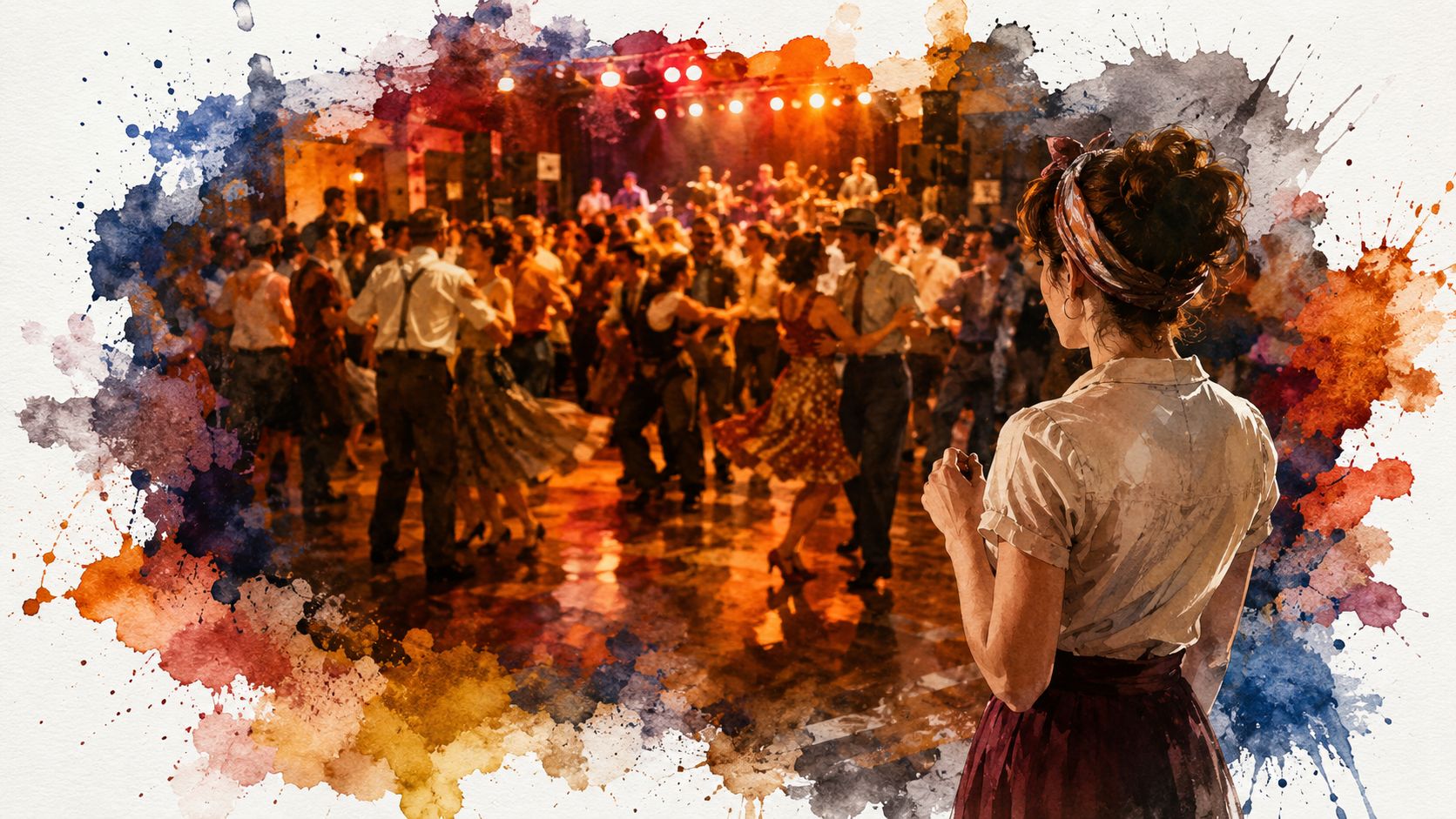
Swing is a family of partner jazz dances shaped by swing-era rhythms. Lindy Hop, East Coast Swing, and West Coast Swing look different, but they share a central idea: two people listen to the same music and answer each other through movement. One dancer usually takes the lead role, proposing direction and timing. The other takes the follow role, receiving information, responding, and adding interpretation. Either person can learn either role, and partners can switch.
That exchange is why connection comes before complicated steps. A perfect triple step with a rigid shoulder, locked elbow, or lifeless hand feels difficult to follow. A slightly untidy step with a relaxed, responsive frame can still feel enjoyable because both dancers remain present and adaptable. If you want a broader introduction to partner dancing, this guide to what social dancing means gives useful context.
Feel the connection before you dance
Stand alone with your feet beneath your hips. Bend your knees gently, keep your ribs stacked over your pelvis, and let your arms rest in front of you as if you're holding a large beach ball. Don't squeeze your hands or lift your shoulders.
Now shift your weight from one foot to the other without leaning your chest. Your feet should respond to your body, not drag it around. That quiet, grounded weight shift is the physical foundation of swing.
Practical rule: If your upper body is rushing ahead of your feet, make the movement smaller.
On a social floor, swing should feel elastic rather than forceful. You'll notice a pulse in your knees, a clear transfer of weight, and a light conversation through the hands and arms. You won't know every pattern at first, and you don't need to. Your first goal is to stay balanced, hear the music, and give your partner information they can comfortably answer.
The Timing That Holds Everything Together
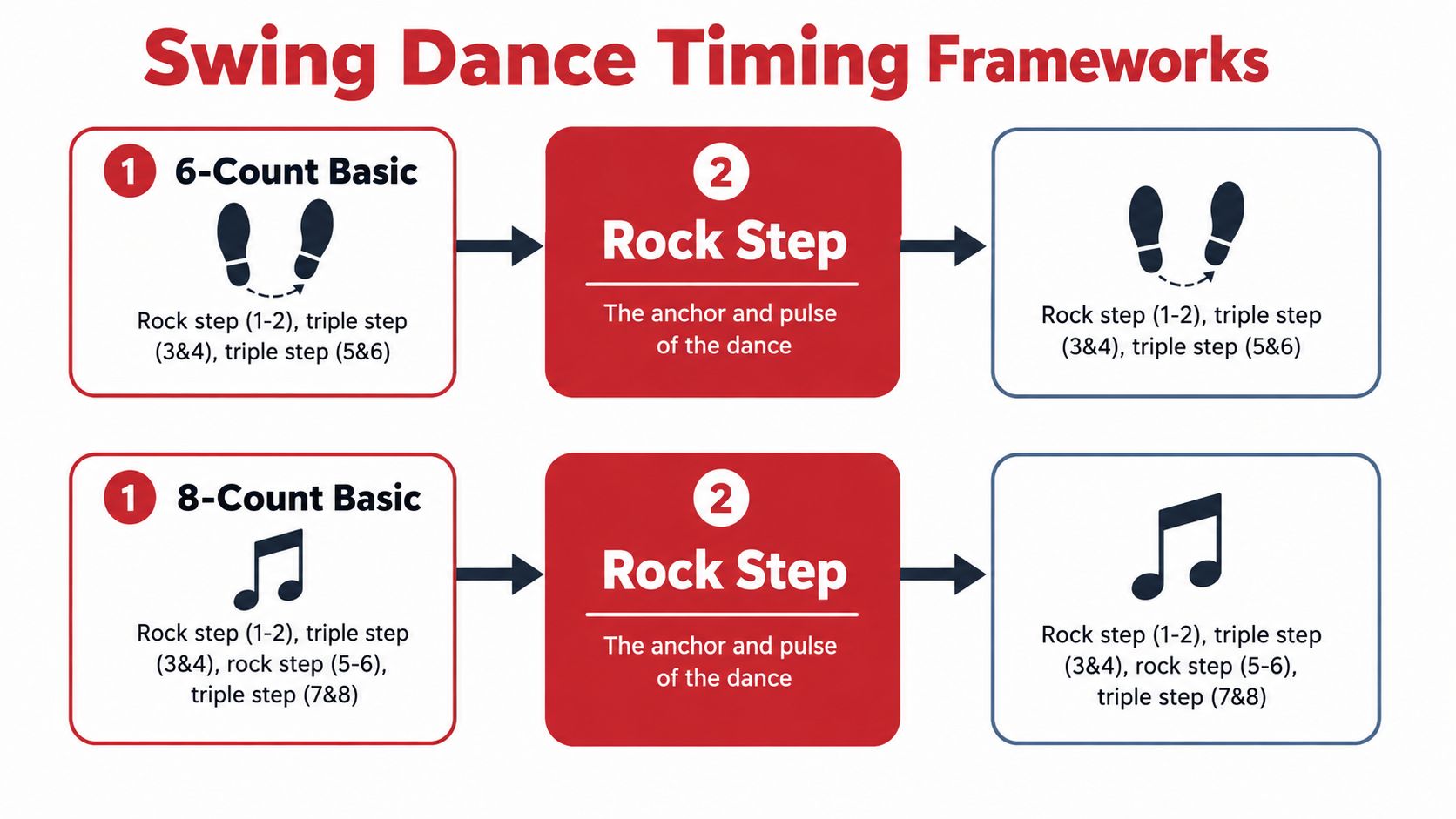
Beginners usually meet two timing frameworks first, 6-count swing and 8-count swing. These aren't two unrelated dances. They're different ways of organizing weight changes inside a musical phrase.
In a common 6-count basic, you'll use a rock step, a triple step, and another triple step. The rock step occupies counts 1-2, the first triple step fits 3-and-4, and the second fits 5-and-6. In an 8-count Lindy Hop basic, the rock step comes first, followed by a triple step, another weight-changing phrase, and a final triple step. A clear breakdown of Lindy timing describes the structure as 1-2, 3-and-4, 5-6, 7-and-8, with momentum and rotation developing through the pattern. You can see the framework in this Lindy Hop basic timing reference.
Make the rock step a weight shift
The rock step isn't a kick, hop, or dramatic lunge. Place one foot slightly behind you, transfer enough weight to feel that foot connect with the floor, then bring your weight back to the standing foot. Keep the step compact, with your chest upright and your knees soft.
In 6-count swing, you'll often hear the rock step on 1-2 or 5-6, depending on the pattern and teaching convention. In 8-count Lindy Hop, it commonly anchors 1-2 and returns on 5-6. Don't obsess over labels. Listen for the phrase, then feel where your weight changes.
The triple step gives swing its distinctive rhythmic texture. Think “step-step-step,” or “quick-and-quick,” rather than three equal stomps. Your feet stay close to the floor, and your body keeps moving through the rhythm. A snare accent, piano triplet, or walking bass line can help you hear why the middle step feels compressed.
Try this ear-training sequence:
- Clap the downbeats. Find the large pulse without moving your feet.
- Tap the rock step. Let your weight move back and return.
- Speak the triple step. Say “step-and-step” while keeping your knees relaxed.
- Combine the sounds. Use your voice first, then let your feet follow.
For a clearer explanation of musical meter, use this Isolate Audio rhythm guide. You can also practice finding the pulse with this guide to hearing the beat in music.
Style changes the timing and the way your body travels. Lindy Hop commonly adds an 8-count swing-out beginning on 1-2, while West Coast Swing often compresses the opening into a single weight change on count 1. Learn the rhythm as something you hear and feel, not as a rigid sequence detached from the song.
Holding Hands and Moving Together
Two first-time dancers stand facing each other in a studio. The person in the lead role raises a soft hand around shoulder height. The person in the follow role meets it without gripping. Their palms and fingers make contact, but neither dancer tries to pull the other into position.
The lead shifts weight and suggests a direction through the connected arm. The follow notices a change in tone, responds with their own weight transfer, and stays available for the next piece of information. The movement doesn't come from yanking. It comes from a shared frame that carries intention clearly.
Frame means stable, not stiff
Your frame is the gently braced shape of your upper body. Keep your elbows comfortably bent, your shoulders down, and your hands connected without squeezing. The frame should travel with your torso, so your partner can feel a change in direction while you remain balanced.
Think of tone as readiness, not tension. A spaghetti arm collapses when your partner offers information, so the message disappears. A rigid arm blocks movement and turns every suggestion into a shove. Keep enough engagement in the back, shoulders, and forearms to maintain shape, then soften the joints so the connection can breathe.
Roles describe skills and responsibilities, not gender. A lead proposes direction, timing, or rotation. A follow receives that proposal, maintains their own balance, and responds without guessing. A switch practices both roles. Role-fluid social dancing has become a visible part of many modern scenes because learning both sides improves empathy, musical understanding, and adaptability.
Social dancing includes clear choices
Ask with eye contact and a direct, friendly sentence: “Would you like to dance?” A partner may answer, “No thanks, I'm sitting this one out.” That response is normal and doesn't require a reason. Accept it with a smile and move on.
If a connection disappears during a turn, don't launch into an apology spiral. Stop safely, smile, and reset with a simple “Let's try that again.” A social dance isn't an examination. Both people are responsible for making the interaction comfortable, and either dancer can pause or decline.
Practice your frame alone, then with a partner who agrees to give slow, simple signals. These role drills will matter more than collecting patterns. You can also explore structured partner practice through couples dance lessons, even if you arrive without a regular partner.
Choosing Your First Swing Style
The best first style depends on the music you enjoy, the local classes available, and the kind of movement you want to practice. East Coast Swing usually feels bouncy and approachable. Lindy Hop offers more room for traveling momentum and improvisation. West Coast Swing uses a linear slot and often connects with R&B, blues, and contemporary music.
East Coast Swing is commonly treated as the 6-count swing basic and is often danced to music around 120-250 beats per minute, according to Princeton's swing music reference. Lindy Hop is commonly treated as the 8-count basic and is typically matched with slightly slower songs around 110-190 beats per minute. These are broad teaching ranges, not rules you must force onto every song. The Princeton swing music guide explains the practical difference.
| Style | Count & Tempo | Posture & Space | Best For |
|---|---|---|---|
| East Coast Swing | 6-count basic, commonly around 120-250 BPM | Compact, rounded, often closed or open | First-time social dancers and upbeat swing music |
| Lindy Hop | 8-count basic, commonly around 110-190 BPM | More traveling momentum, open and closed positions | Vintage jazz, improvisation, and larger movement |
| West Coast Swing | Timing varies by pattern and song | Linear slot, elastic connection, open shapes | R&B, blues, musical interpretation, and role flexibility |
Choose by your goal
If your priority is getting onto a social floor quickly, East Coast Swing is a sensible starting point because the compact basic gives you a manageable rhythm to repeat. If you want a stronger connection to vintage jazz culture and enjoy athletic momentum, Lindy Hop may hold your attention longer.
West Coast Swing suits dancers who like a slot-based pathway and want the follow role to have clear opportunities to shape the dance. It can also work well when you prefer contemporary music rather than a strictly swing-era sound.
Local availability matters more than theoretical perfection. A nearby class, welcoming social, and consistent practice partners will help you progress faster than a style you admire but rarely get to dance. Pick one entry point, then give yourself time to develop connection before judging whether it fits.
A Realistic Beginner Plan
A useful practice plan should make your next action obvious. Use this four-to-eight week roadmap at a studio, with a friend, or alone when a partner isn't available. Practice for a short, focused session each day rather than trying to exhaust yourself with random videos.
Weeks one through four
Week 1: Walk to swing music without adding patterns. Find the downbeat, relax your knees, and practice holding a frame in front of your body. Use “Sing, Sing, Sing” by Benny Goodman for its clear pulse, but keep your steps simple.
Week 2: Add the East Coast triple step in place. Practice the rock step in closed hold with a partner, focusing on weight transfer rather than arm movement. “It Don't Mean a Thing” by Duke Ellington can help you hear the recurring rhythmic texture.
Week 3: Introduce an underarm turn. The lead gives a clear, small invitation, while the follow keeps their own axis and walks beneath the raised connection. Practice slowly before adding speed.
Week 4: Learn a basic tuck turn and a starter step-out. Your milestone isn't styling. It's completing the pattern without losing the beat, grip, or partner connection.
Weeks five through eight
Week 5: Clap the swing pulse and accent beats 2 and 4. Dance to three songs that gradually increase in tempo, but choose music you can control rather than music that makes you panic.
Week 6: Attend your first social dance. Set a goal of three dances, not perfect execution. Introduce yourself as a beginner, ask clearly, and use the basic when you need a reset.
Weeks 7 and 8: Consolidate the Lindy eight-count if you chose Lindy Hop, or add your first West Coast Swing patterns if you chose that style. Keep one practice session devoted to connection and one devoted to musicality.
Progress check: You're ready to add complexity when you can stay on time, keep your steps compact, and recover from a missed connection without freezing.
At home, mark these milestones: you can identify the pulse, complete a basic without rushing, maintain a comfortable frame, accept and offer role changes, and finish a social dance with energy left for another song. Those are functional skills, not just memorized steps.
Fixing the Mistakes Everyone Makes
Most beginner problems come from trying to make the dance look bigger or faster than the body can currently control. Swing rewards grounded repetition. A kinetic analysis of recreational swing dancers found that the first and second triple-step actions produced different peak vertical forces, loading rates, and ankle and knee power absorption, with the second step showing especially high loading demands. The PubMed study on swing-dance kinetics supports a practical conclusion: keep the triple step compact and control the landing through aligned ankle and knee flexion.
Overstriding
A large rock step pulls your center away from your standing leg and makes the next weight change late. Shorten it to roughly one foot-length, keep your chest over your base, and let the rock foot brush back rather than launch backward.
If your knee collapses inward, reduce the distance again. Your ankle, knee, and hip should bend in the same general direction as you absorb the step.
Rushing the triple step
Rushing usually means your body has lost the relationship between the two quick steps and the next weight change. Practice “quick-quick-slow” at half speed with a metronome, then add music once your feet can repeat the rhythm cleanly.
Say the syllables aloud. Your voice can preserve the timing while your feet learn the pattern.
Spaghetti arms
A limp arm gives your partner no usable information. Rebuild tone by imagining that you're holding a large beach ball between your hands, with soft elbows and active shoulders.
Practice the basic in closed hold before adding turns. Your arms should maintain a readable shape while your torso and feet do the moving.
Role confusion
Collisions often happen when both dancers try to decide the direction at the same moment. The lead suggests direction through the connected hand and body movement. The follow offers a stable platform, keeps their own balance, and responds to information instead of guessing ahead.
Practice the basic in both roles. Biomechanical dance literature reports that skilled dancers use more consistent motor strategies than novices across repeated trials, which supports measuring progress through repeatable weight shifts and frame control rather than flashy movement. The research on motor strategies in dance gives useful background for that approach.
Before each social dance, run this self-check:
- Feet: Are your steps small enough to stay balanced?
- Knees: Can they bend without collapsing inward?
- Frame: Is there tone without gripping?
- Timing: Can you clap the beat and speak the triple step?
- Connection: Can you pause, reset, or decline comfortably?
Your First Night Out and Where to Start
Arrive early enough to learn the room before the music becomes busy. Wear clothing that lets your shoulders, hips, and knees move freely. Choose shoes that allow controlled pivoting without sticking, and avoid footwear that makes you feel unstable or trapped on the floor.
At the beginning of the evening, watch how dancers circulate. Social floors generally work best when partners keep traveling with awareness, avoid cutting directly through another couple, and leave space for dancers who are already moving. You don't need to know every local custom. Stay alert, protect your partner, and keep your patterns compact when the floor fills.
Ask, dance, and rotate
Approach someone with eye contact and ask, “Would you like to dance?” Accept a yes with a smile and introduce yourself. If they decline, answer “No problem” and let them return to their conversation or rest. A clear decline isn't an insult, and you don't owe an explanation when you need to sit out.
Many socials rotate partners through classes or encourage dancers to ask different people throughout the night. Rotation helps you discover how different connections feel, but you can also ask a friend for a practice dance. If you're new, say so briefly: “I'm learning, so I may need to reset.” Experienced dancers can then choose simpler patterns and give you room to respond.
When a step fails, protect the partnership before the pattern. Stop if you're off balance, release excess tension, smile, and restart from a basic. A calm reset communicates more skill than forcing your way through a turn.
Swing has a long social history and has repeatedly reached large audiences. A 1998 newspaper report estimated that about 3 million Americans practiced swing dancing, compared with about 1 million in the 1970s, citing the North American Swing Clubs Association. The Seattle Times account of swing's revival also described swing as an eight-step dance often fitting into six beats of music, a reminder that beginners encounter overlapping timing traditions rather than one universal formula.
Build a reliable learning routine
Solo video practice can help you see a pattern, but it can't fully reproduce the timing, tone, and adjustment required with another human. A class gives you immediate opportunities to test whether your frame communicates, whether your weight transfers, and whether you can recover when a partner responds differently than expected.
In Philadelphia, Danza Academy of Social Dance offers swing instruction, beginner swing lessons, West Coast Swing classes, and technique-focused training that includes musicality and partner connection. Its broader program includes group classes, private lessons, workshops, and socials, with no partner required for classes.
Choose one beginner class, bookmark the schedule, and attend a social within the following two weeks. Your first night doesn't need to look polished. It needs to happen, because consistent contact with music and partners turns isolated steps into a usable dance.
Danza Academy of Social Dance offers beginner-friendly swing and West Coast Swing instruction, group classes, private lessons, workshops, and socials for dancers building the timing and connection covered here. Book the free complimentary lesson through Danza Academy of Social Dance and take your first guided step onto the social floor.