
The music starts, you take hold, and you already know the pattern you want to lead. Then the turn arrives late, your partner hesitates, and both of you feel that awkward little break in the dance. Most beginners think the problem is the step itself.
Usually, it isn't.
Leading in ballroom is a conversation without words. If your posture collapses, your timing is late, or your frame changes shape mid-pattern, the message gets muddy. Your partner isn't ignoring you. She isn't getting a clear signal.
That's why learning how to lead in ballroom dancing has less to do with memorizing more figures and more to do with building a body language your partner can trust. A good lead feels calm, specific, and easy to follow. It doesn't yank. It doesn't argue. It doesn't panic when something goes off track.
The Art of Leading on the Dance Floor
A lot of dancers come in thinking the leader's job is to make things happen. They try to steer with the hands, rush through patterns, and force momentum when they get nervous. That creates the exact feeling nobody wants on a dance floor. Stiff, unclear, and disconnected.
A better lead feels quieter than is commonly expected.

What a follower actually feels
When a lead works, your partner doesn't feel shoved into a figure. She feels your intention early enough to move with you. That's the difference between commanding and communicating.
Think about a simple underarm turn. If you lift the hand first and hope the rest sorts itself out, the follower often gets mixed signals. If your center changes direction, your timing stays steady, and the arm only carries the information already created by your body, the turn feels natural.
Practical rule: The follower should feel where you're going before she sees what figure you chose.
What works and what fails
Here's the trade-off every leader learns. Big effort does not equal clear information. In fact, the harder you try with your arms, the less accurate the message usually becomes.
A useful way to separate strong leading from poor leading:
| Approach | What it feels like | Result |
|---|---|---|
| Leading with body intention | Stable, readable, calm | Smooth response |
| Leading with hands only | Sudden, disconnected, late | Hesitation and stumbles |
| Starting simple | Trust builds quickly | Better dancing with more partners |
| Showing off too early | Pressure and confusion | Broken flow |
Good leaders don't just know patterns. They make their partners feel safe enough to dance well.
Building Your Foundation with Posture and Frame
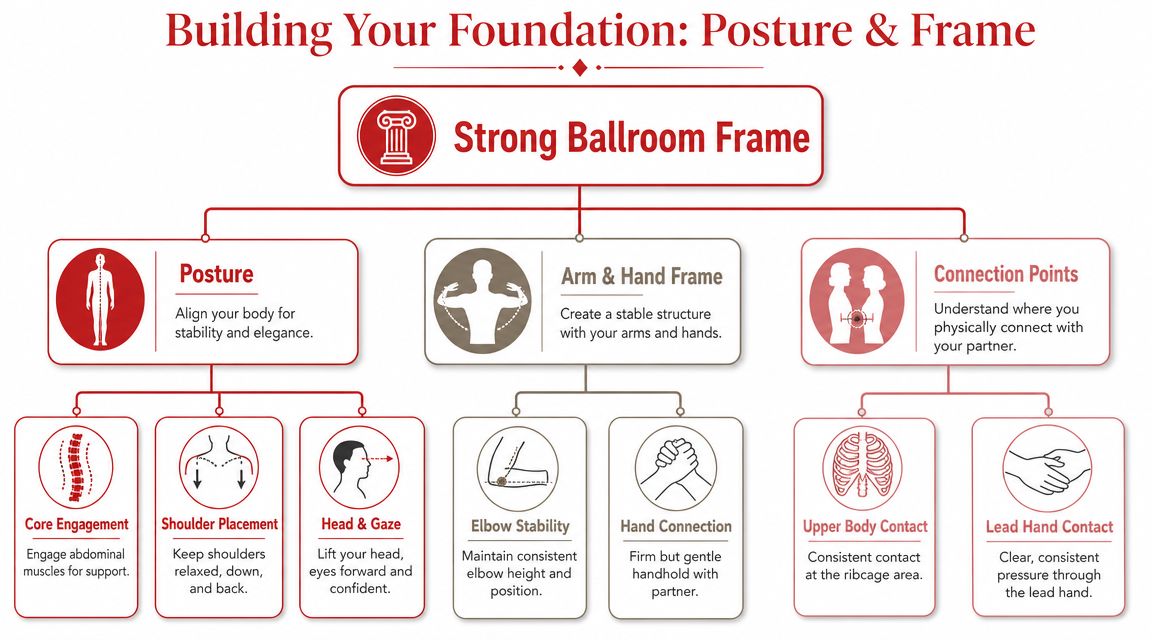
Before your partner can understand any signal, your body needs a structure that can carry it. In ballroom, that structure is your posture and frame. Without it, even a correct pattern feels unreliable.
The leader is expected to communicate through the torso and frame, not by pushing or pulling with the arms. One ballroom instruction source states that leading with the hands and arms is a misconception, and movement should begin from the torso or core, with the arms acting as extensions for connection, as described in this ballroom leading and following reference.
Start with your standing position
If your weight sits back in your heels, your lead will lag. If your chest caves in, your partner loses the front of your movement. If your shoulders creep upward, your arms tense and your connection gets noisy.
Build your base this way:
- Lift through the spine: Stand tall without becoming rigid. Think upward, not backward.
- Engage the center: Your abdominal area should feel active enough to support movement, never clenched.
- Relax the shoulders: Down and wide is the goal. Tension in the neck always travels into the arms.
- Keep the head poised: Your eyes should look where you're going, not down at your feet.
Many students first feel a real difference as the dance starts getting easier, before they even learn a new figure.
Shape the frame without freezing it
A ballroom frame should feel present, not stiff. The common teaching image of holding a large beach ball helps because it gives the right balance of width and tone. Your elbows stay lifted enough to create structure, but the joints remain alive.
In closed hold, your arms aren't there to drag your partner around. They create a channel for information. Your body moves first, and the frame carries that movement.
If your partner feels your hands more than your center, your frame is leaking information.
What leaders often get wrong
The most common mistake is trying to increase clarity by increasing force. That never works for long. Strong leading isn't muscular. It's organized.
Watch for these habits:
- Bent posture under pressure: This makes every signal feel smaller than you intended.
- Elbows dropping during turns: The frame collapses and the follower loses consistency.
- Overactive hands: Fingers start giving instructions the body never confirmed.
- Disconnected core: The feet move, but the torso arrives late.
For dancers who want technical feedback on these mechanics, structured dance technique classes at Danza Academy can help isolate posture, frame stability, and movement quality.
Mastering Connection and Clear Signals
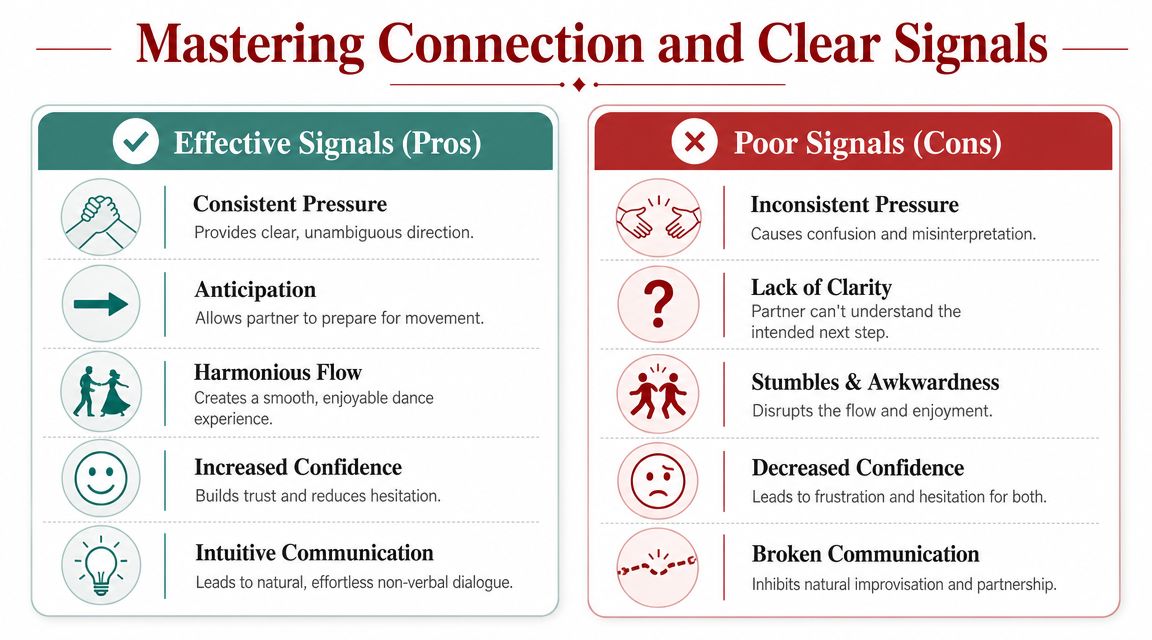
Once the frame is in place, leading becomes a live exchange. This is the part dancers often describe as “feel,” but feel isn't mysterious. It comes from pressure, direction, timing, and consistency.
Modern ballroom no longer requires a gender-based pairing for who leads and who follows. Contemporary ballroom guidance notes that the leader role was traditionally assigned to the man, but the skill itself is now understood as role-based, with the leader responsible for keeping time, maintaining balance, and communicating intended figures clearly through the body and frame, as explained in this overview of leader and follower roles in ballroom.
Lead the movement you want
A follower reads what your body is doing. She doesn't read your thoughts. If you want travel, your center must travel. If you want rotation, your torso must begin rotating. If you want a pause, your body has to settle and mean it.
Cause and effect matters here:
| Your action | What your partner reads |
|---|---|
| Clean weight change | Direction is changing |
| Torso rotation | Turn is coming |
| Stable presence with no drift | Hold or settle |
| Early preparation | Time to respond comfortably |
A delayed lead forces the follower to guess. An early, readable lead gives her space to move with confidence.
Use pressure, not force
Connection is not squeezing, yanking, or hanging on your partner. It's a consistent tone between two bodies. In some dances that connection feels more compact. In others it feels more elastic. But it should never feel random.
Here's what tends to work in practice:
- Initiate from your center: Let the torso begin the action.
- Maintain clear tone in the arms: Enough presence to communicate, never so much that the arms dominate.
- Keep pressure consistent: Sudden changes create confusion.
- Finish one message before starting the next: Mixed signals create defensive following.
A follower can respond beautifully to small information if it arrives in the right order.
The video below is useful for seeing how subtle a readable lead can be in real movement.
Timing makes the signal feel intelligent
Many leaders move on the beat but signal too late. Your partner then has to rush to catch up, and the dance feels heavy. The lead should arrive just before the action is required. That small moment of preparation is what makes the dance feel smooth rather than abrupt.
Good leading feels like an invitation delivered early, not an instruction delivered at the last second.
If your partner is repeatedly late, don't assume she missed the cue. First ask whether you gave it in time.
Navigating with Smart Footwork and Alignment
A leader isn't only responsible for the pattern. He also acts as the driver of the partnership. That means managing direction, spacing, and safety while keeping the dance comfortable.
On a crowded floor, this becomes obvious fast. The dancers who seem advanced aren't always using harder figures. Often, they're just making better decisions about where and how to move.
Floorcraft starts with looking ahead
If you stare at your partner the entire time, you'll eventually steer both of you into traffic. You need soft awareness beyond the partnership. In traveling dances especially, your eyes should scan the lane ahead and the space to each side.
Use a simple decision process:
- See the available path
- Choose the figure that fits the space
- Adjust size before the collision risk appears
- Protect your partner's line of movement
That last point matters. A strong leader doesn't sacrifice the follower's comfort to finish a favorite pattern.
Alignment prevents most avoidable collisions
Stepped-on toes and awkward body contact usually come from poor alignment, not bad luck. If your feet go one way while your torso points another, your partner receives conflicting information. If the distance between you changes every count, she has to keep re-solving the partnership.
A few habits clean this up quickly:
- Move your center and feet in agreement: Don't let the body lag behind the step.
- Respect the shared track: Your foot placement should create room for your partner's movement.
- Control size: Smaller, organized steps beat oversized ones every time on a social floor.
- Keep relative position consistent: Don't drift too far in or away unless the figure asks for it.
Comfort is part of technique
Leaders sometimes treat navigation as a separate skill from connection. It isn't. If your partner feels crowded, cut off, or rushed, your lead quality drops even if the pattern was technically correct.
The cleanest lead on paper still fails if it places your partner in the wrong spot on the floor.
Smart footwork makes the dance feel effortless because it removes emergencies. Your partner can then focus on following the conversation instead of recovering from your steering.
Essential Drills to Hone Your Leading Skills
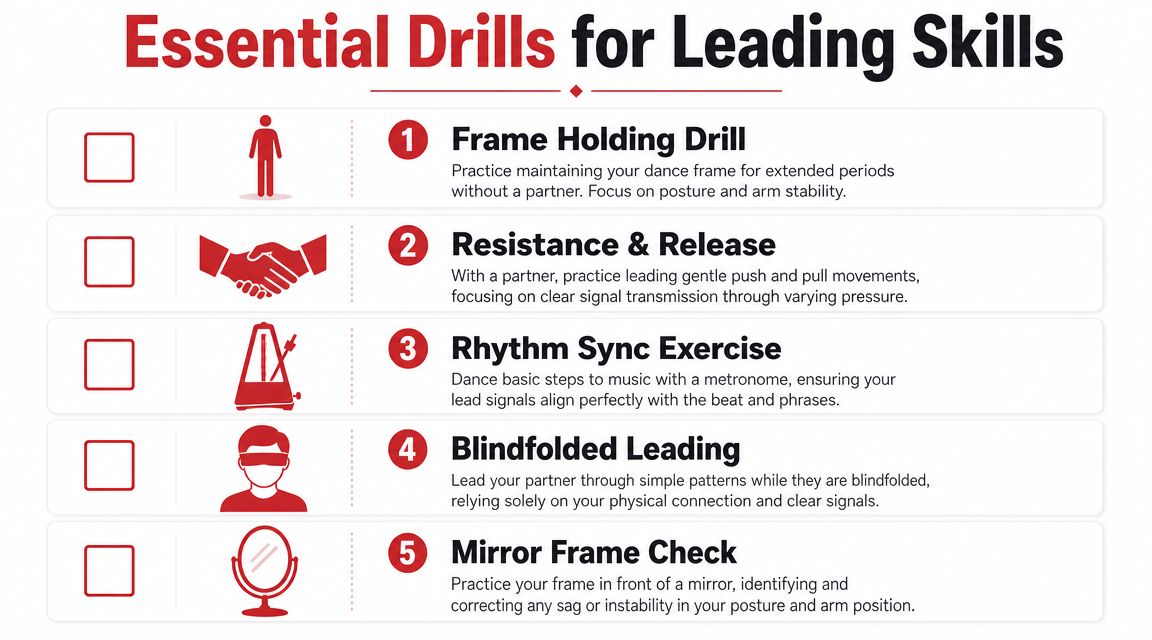
Technique only becomes reliable when your body can produce it under pressure. That's why drills matter. You're not just repeating movements. You're teaching your nervous system what clear leadership feels like.
Advanced partner-dance coaching recommends that leaders “test drive” a partner's skill level within the first 30 seconds of social dancing, starting with basics and only increasing complexity if the follower shows readiness, as described in this advanced leadership coaching guide.
Solo drills that sharpen your body language
You can improve your lead even without a partner. In fact, some of the best corrections start there.
Try these regularly:
- Mirror frame hold: Stand in dance position and check whether one elbow drops, one shoulder lifts, or the ribcage shifts.
- Walk to music with intent: Don't just step in time. Let each step begin from the body and arrive with balance.
- Quarter-turn torso drill: Rotate from the center while keeping the arms quiet. This teaches the body to lead and the limbs to follow.
- Pause and settle exercise: Practice stopping cleanly without collapsing. Many leaders are unclear because they never finish a movement.
Partner drills that improve communication
Once you add a partner, your goal changes. Now you're checking whether your message is readable.
A productive sequence looks like this:
- Dance only basic steps.
- Change direction with small body actions.
- Add a simple turn.
- Return to basics if the connection gets noisy.
That progression teaches an important truth. Complexity doesn't prove leadership. Clarity does.
Start with a conversation your partner can hear. Then make it richer.
One useful sensitivity drill is to lead a very simple pattern with reduced visual dependence. Keep it safe and controlled. The point isn't to be dramatic. The point is to make the body signal clean enough that the movement can be understood through connection alone.
Calibrate before you decorate
This is one of the biggest differences between social leaders who are enjoyable and social leaders who are exhausting. The enjoyable leader doesn't unload everything he knows in the opening moments of a dance. He checks the partnership first.
Use this practical calibration model:
| Early sign | What to do next |
|---|---|
| Timing feels solid | Add one new layer |
| Frame stays steady | Expand range slightly |
| Turns feel rushed | Simplify immediately |
| Connection fades | Rebuild basics first |
For guided practice, private dance lessons give you a setting where an instructor can spot whether the issue is timing, body initiation, frame collapse, or partner mismatch.
From Steps to Artistry Your Next Move
The shift from awkward leading to confident leading usually doesn't happen when you learn more patterns. It happens when your partner can understand you without effort. That's the true milestone.
Once your posture supports the movement, your frame stays reliable, and your footwork stops creating emergencies, the dance opens up. You stop thinking, “What comes next?” and start thinking, “What does this music need?” That's where artistry begins. Not in fancy figures, but in choices made with control.
Musical interpretation plays a big role here. If you want to deepen that side of your dancing, this guide on musicality in dance is a useful next read.
The hard truth is that leading is difficult to self-diagnose. You may feel clear while your partner feels rushed. You may think your frame is stable while it collapses every time you rotate. That gap between what you intend and what you communicate is where most dancers stall.
A strong coach closes that gap quickly. Real-time feedback can correct the angle of your frame, the timing of your preparation, and the pressure in your connection faster than trial and error ever will. That's why dancers improve fastest when they stop practicing guesses and start practicing informed corrections.
If you're ready to turn these ideas into something you can actually feel on the floor, the next step is simple.
Book a free complimentary lesson with Danza Academy of Social Dance through the contact page. You'll get direct feedback on your frame, connection, timing, and lead clarity in a real partner setting, so you can stop forcing the dance and start communicating it.