
You've probably seen a couple glide across the floor and thought, “That looks amazing, but I'd never remember all those steps.” That reaction is common. Foxtrot has a polished look, and from the outside it can seem like one of those dances you either already know or never will.
The good news is that beginners usually struggle for very normal reasons. They rush the music, stare at their feet, or assume they need a long routine before they can enjoy a full song. None of that is true. Foxtrot becomes much easier when you learn it in the right order: rhythm first, then a small set of steps, then how to use those steps with a real partner on a real floor.
That's why this guide approaches foxtrot lessons for beginners a little differently. You'll learn the foundation, but you'll also learn how to keep moving when the room is crowded, when your memory blanks, or when another couple cuts into your path. Those are the moments that decide whether dancing feels stressful or fun.
Your Journey to the Dance Floor Starts Here
A new student walks into the studio, smiles politely, then says the same thing I hear all the time: “I have two left feet.” A few minutes later, once the music starts and we strip everything down to a walk, that same student realizes dance isn't a mystery. It's a skill. And skills can be learned.
Foxtrot is one of the friendliest places to begin because it feels close to something you already know. Walking. Not marching, not bouncing, not trying to hit dramatic shapes. Just moving with control, with a partner, and with a little bit of style.
Why beginners often connect with Foxtrot
People usually relax when they discover that Foxtrot doesn't ask for flashy movement right away. It asks for steadiness. You learn how to travel, how to listen to the music, and how to stay organized with another person.
That's especially helpful if you're starting ballroom as an adult. You don't need previous dance experience to understand a smooth walk and a consistent rhythm.
You don't have to look advanced to start dancing well. You have to get comfortable with the basics.
Many beginners also come in with a very specific fear. They're not worried about the first few steps. They're worried about what happens after that. What if they forget? What if they bump into someone? What if their partner does something unexpected?
Those are the right questions. Real confidence doesn't come from memorizing more patterns. It comes from understanding a small number of useful ideas so well that you can recover smoothly.
What learning feels like at first
Early Foxtrot practice often feels uneven. One round feels easy, then the next one feels tangled. That's normal. Your brain is learning timing, direction, posture, and partner awareness all at once.
Try to measure progress in small wins:
- You hear the count sooner. The rhythm starts making sense before your feet catch up.
- You stop rushing. Your body begins to trust the slower pace.
- You recover faster. Instead of freezing after a mistake, you keep going.
- You move more comfortably with a partner. The dance starts to feel shared, not mechanical.
If that sounds modest, good. Dance improvement is often quiet at first. Then one day you realize you're no longer trying to survive the song. You're enjoying it.
Finding the Foxtrot Rhythm and Timing
Foxtrot starts in the ears before it reaches the feet. According to DanceSport Club's Foxtrot overview, Foxtrot is a slow ballroom dance built around long walking movements and short quick steps, and beginners commonly learn it with the count slow, slow, quick, quick. That count gives the dance its smooth, gliding quality.
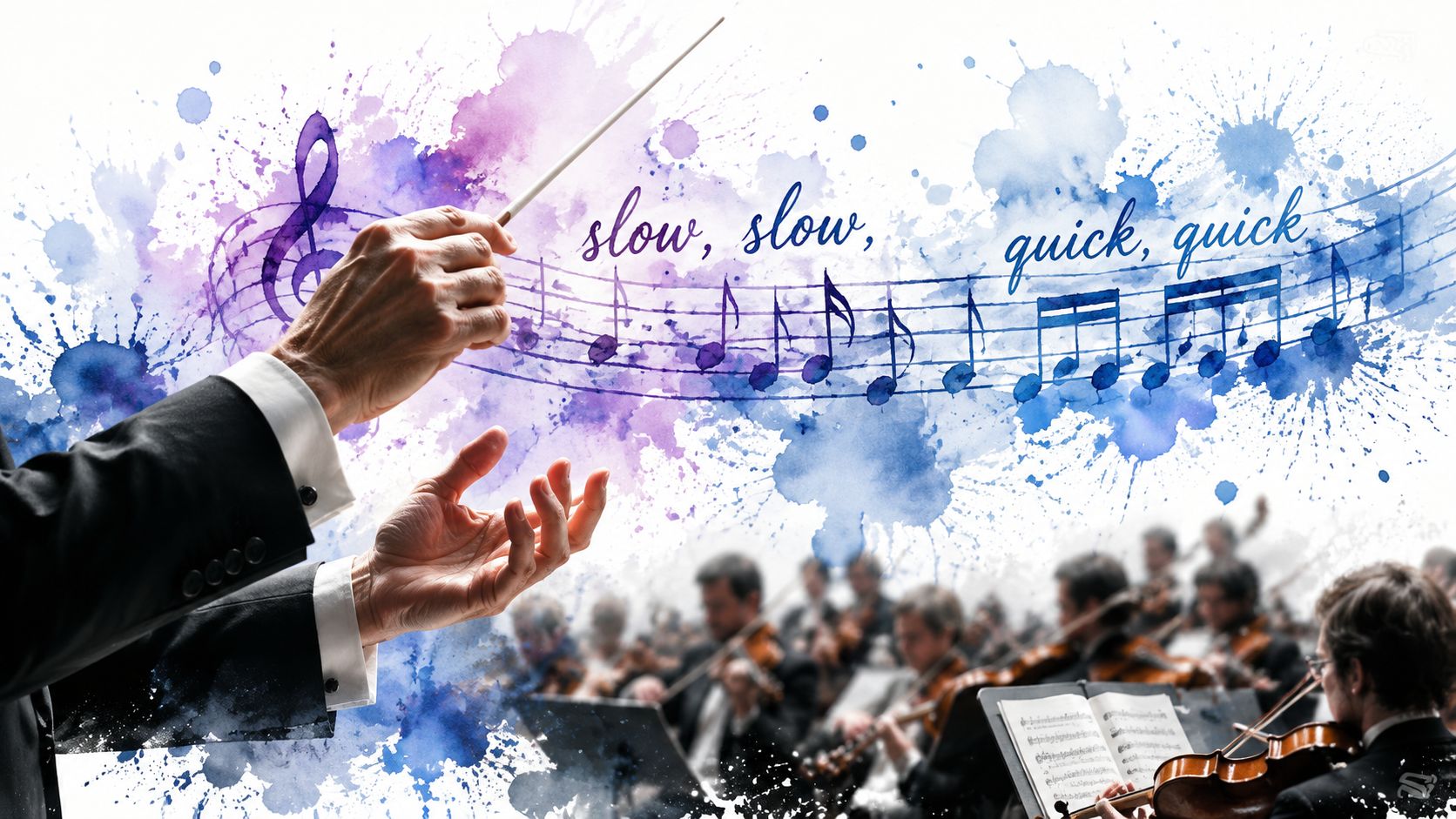
What slow and quick actually mean
Think of slow as taking more time, like a relaxed walk across a room. Think of quick as a shorter, brisker action that keeps you moving without hurrying your upper body.
That difference matters. Beginners often hear “quick” and tense up. But Foxtrot quicks aren't frantic. They are shorter in duration than the slows.
Try saying the rhythm out loud while walking:
- Slow for one step
- Slow for the next
- Quick
- Quick
Your voice should stay calm and even. If your speaking speeds up at the quicks, your feet probably will too.
A simple practice drill without a partner
Before you try full footwork, stand in place and clap the pattern. Then switch to shifting your weight from foot to foot. That helps your body connect sound and movement.
If you want a steady pulse to practice with, an online metronome can make your timing more consistent. It's especially useful if you tend to stretch the slows too much or squeeze the quicks together.
For dancers who struggle to hear where the beat lands in a song, Danza Academy also has a practical guide on how to find the beat in music. Use that kind of listening practice before dance practice, not only during it.
Practical rule: If you can clap the rhythm calmly, you're much closer to dancing it calmly.
What beginners usually get wrong
A lot of first-timers confuse smoothness with slowness. Smooth doesn't mean sleepy. It means controlled. Your body keeps moving through the count instead of stopping after every step.
The easiest way to feel that is to imagine gliding through the slows, then letting the quicks gather your feet underneath you. That image keeps your movement connected instead of choppy.
Learning the Foundational Foxtrot Steps
Most foxtrot lessons for beginners should begin with the forward basic in closed hold. Dancing4Beginners explains that the leader walks forward-left, forward-right, then side-close, while the follower mirrors backward-right, backward-left, then side-close. The rhythm stays slow, slow, quick, quick, which gives beginners a reliable starting pattern for timing and partner coordination.
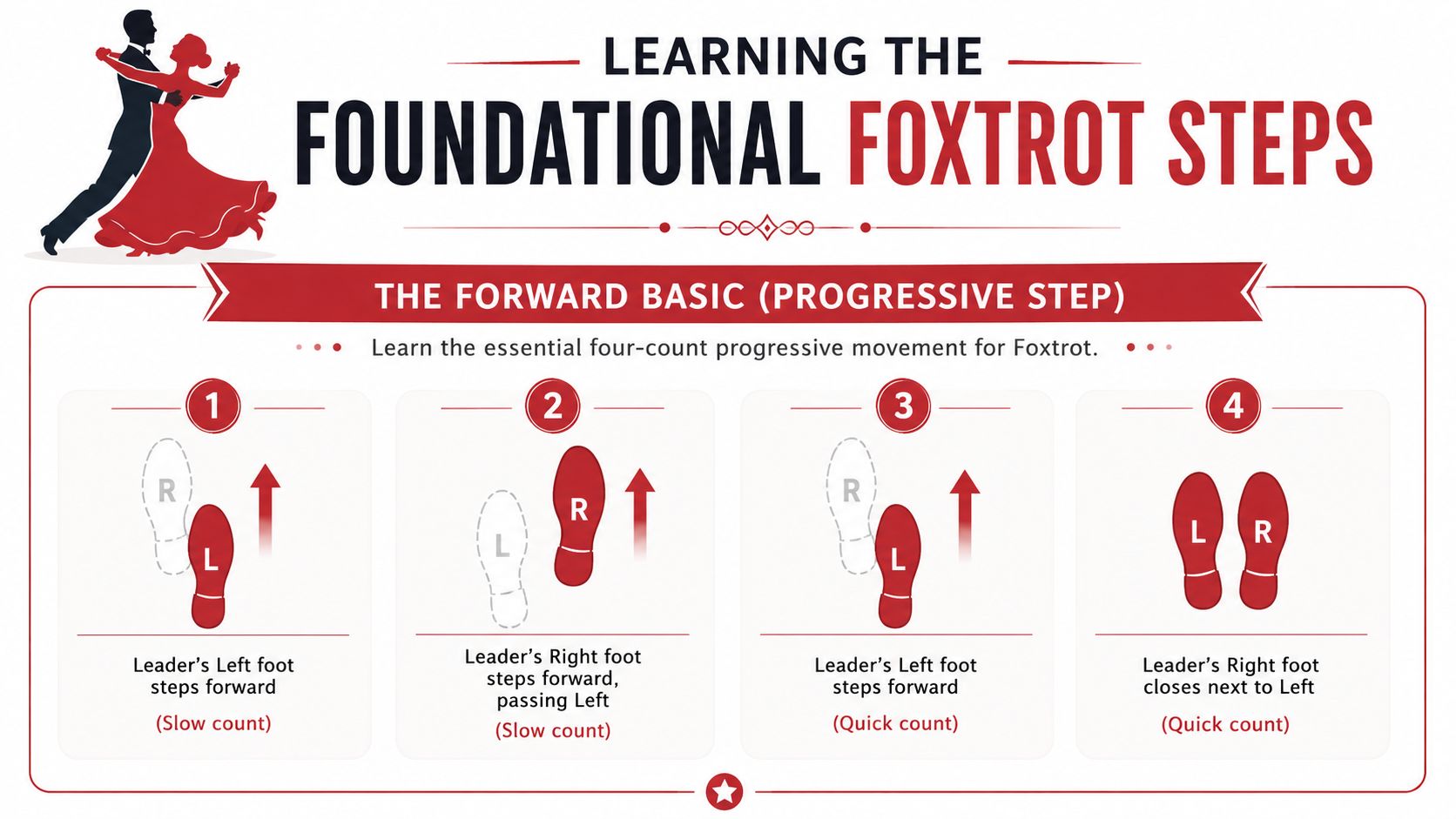
The forward basic for leaders and followers
Start by practicing this without worrying about style. Aim for clean weight changes and clear direction.
Leader pattern
- First slow: Step forward with the left foot.
- Second slow: Step forward with the right foot.
- First quick: Step to the side with the left foot.
- Second quick: Close the right foot to the left foot.
Follower pattern
- First slow: Step back with the right foot.
- Second slow: Step back with the left foot.
- First quick: Step to the side with the right foot.
- Second quick: Close the left foot to the right foot.
The side-close at the end is where many beginners rush. Don't treat it like an afterthought. Those last two quicks organize your body and make the next measure feel possible.
How to practice the basic without tangling your feet
Use a narrow track. Foxtrot isn't a giant step contest. If your feet cross awkwardly or you feel pulled off balance, your stride is probably too long.
A better first goal is this:
- Keep your steps natural. Walk-sized is enough.
- Finish each weight transfer. Don't move the next foot before the previous leg has taken your weight.
- Stay level through the body. Avoid bobbing up and down.
- Let the feet pass cleanly. Especially on the second slow.
If you're learning alone, mark a line on the floor with tape or imagine one running across the room. Travel along that line so your movement stays organized.
When the feet are small and clear, the dance feels easier. When the feet are big and dramatic, beginners usually lose timing.
A beginner box step option
Some teachers also use a box step early on because it helps dancers understand direction and weight transfer in a contained shape. It's a useful home practice tool, especially if you don't have much space.
For leaders, think of the box as moving forward, side, close, then back, side, close. Followers reverse that path. Keep the same calm timing you practiced earlier, and don't worry if the box feels less flowing than the progressive basic at first. It's there to help you organize your feet.
The key difference is simple. The forward basic travels more naturally down the floor. The box step helps you learn control in a smaller area. Both can support a beginner, but the forward basic is often the move that makes Foxtrot feel like Foxtrot.
One combination that works right away
If you want a practical solo drill, try this sequence:
- Forward basic once
- Pause and reset your posture
- Repeat the same pattern
- Say the rhythm aloud the whole time
That repetition teaches more than constantly switching steps. New dancers improve faster when they can feel the same action becoming easier.
Perfecting Your Posture Frame and Connection
Your feet can know the pattern and the dance can still feel uncomfortable. Usually the issue isn't the step. It's the way the two bodies are organized together.

Start with posture
Good ballroom posture isn't stiff military posture. It's active, lifted, and comfortable enough that you can breathe.
Think of three simple ideas:
- Stand tall through the spine. Don't lean from the waist.
- Keep the chest open. Not puffed, just available.
- Let the knees stay soft. Locked legs make you feel wooden.
When beginners collapse through the chest, they usually pull their partner off balance too. When they overcorrect and go rigid, the dance feels forced. The sweet spot is toned but mobile.
For dancers who want guided technique work beyond just memorizing patterns, structured technique dance classes can help isolate these habits in a way social practice often can't.
Build a frame that can communicate
Frame is the shape you and your partner maintain together. It gives the lead-follow conversation somewhere to travel.
In a standard ballroom hold, the leader places the right hand on the follower's back, the follower places the left hand on the leader's upper arm or shoulder area, and the joined hands stay comfortably lifted. The elbows shouldn't droop, and the shoulders shouldn't creep upward.
A useful image is to think of the arms as the edges of a picture frame. They create structure, but they don't squeeze.
Here's a short visual example of partnered smoothness in action:
Connection is not pushing
This is the part many beginners misunderstand. Leaders don't drag with the arms, and followers don't guess. The information starts in the body and travels through the frame.
If the leader wants to move forward, the body initiates first. The arms stay responsive, not bossy. If the follower keeps a live connection through the frame, the message arrives more clearly.
A light connection is not a weak connection. It's a clear one.
Try this exercise with a partner. Stand in frame and shift weight side to side without taking steps. Notice whether you can feel each other change weight. If you can, the connection is beginning to work. If not, someone is probably holding too loosely or bracing too hard.
Common partner mistakes
Beginners often improve quickly when they stop doing these three things:
- Looking down all the time: Your balance and communication both suffer.
- Gripping with the hands: Tight fingers don't create better lead.
- Breaking the frame during steps: If the arms collapse on every weight change, the partnership feels unreliable.
Think of posture as your base, frame as your structure, and connection as the conversation. When all three support each other, even a simple Foxtrot basic feels elegant.
From Basic Steps to Social Dancing
Your first social Foxtrot often feels very different from practice. The music keeps going. Other couples drift into your path. No one pauses to tell you what comes next. A pattern that felt easy in class can suddenly feel much harder in a busy room.
That does not mean you are not ready. It means social dancing asks for one more skill. You need to use your steps in traffic.
A lot of beginners spend all their energy memorizing figures. Social dancing rewards something else just as much. It rewards floorcraft, the ability to choose the right amount of movement, protect your partner's space, and keep the dance calm even when the room is crowded. As shown in this YouTube lesson on Foxtrot floorcraft and social movement, the dancers who look comfortable are usually making smart choices, not showing the longest list of patterns.
Add variety without losing control
A new figure belongs in your social dancing only if it fits into the dance like an easy sentence in a conversation. An underarm turn can work well for that. It adds interest, but it should still feel connected to the basic you already know.
Use a simple test before you keep any new move:
- Can we enter it from the basic with the same steady timing?
- Can we leave it and return to the basic without hesitation?
If both answers are yes, the figure is useful right now. If not, set it aside and come back to it later. Beginners gain confidence faster when they have a few reliable options they can use on the floor.
How to handle a crowded floor
Crowded floors change the size and shape of your dancing. Foxtrot still travels, but it needs to travel wisely.
Try these adjustments:
- Shorten your steps: Smaller steps give you time to react.
- Turn a little earlier: A gentle curve often solves a traffic problem before it becomes a collision.
- Keep a clear shared path: Your partnership should keep moving in one readable direction.
- Choose redirection over freezing: A soft side step or turn usually feels better than an abrupt stop.
This is one of the biggest differences between practicing and social dancing. In practice, you finish the pattern you planned. On a social floor, you finish the moment well.
What to do when your mind goes blank
Every beginner has this moment. You are dancing, the song continues, and the next figure disappears.
Go back to home base.
- Reestablish your frame.
- Dance one clear basic.
- Breathe and listen to the music.
- Repeat until you feel settled again.
That reset works because the basic is more than a beginner exercise. It is your home position, the step pattern you can return to whenever the floor gets busy or your memory slips. Other dancers usually will not notice that you simplified. They will notice calm timing and steady movement.
If you forget the extra pattern, keep the partnership comfortable and the rhythm clear.
Beginner-friendly Foxtrot songs
Practice music should help you hear the slow and quick timing without feeling rushed. Songs with an easy groove make it much simpler to work on control, redirection, and recovery.
| Song Title | Artist | Tempo (Approx. BPM) |
|---|---|---|
| The Way You Look Tonight | Frank Sinatra | Moderate |
| Fly Me to the Moon | Frank Sinatra | Moderate |
| Cheek to Cheek | Ella Fitzgerald and Louis Armstrong | Moderate |
| Moondance | Van Morrison | Moderate |
| Sway | Michael Bublé | Moderate-fast |
If you want a clearer picture of what happens outside the studio, this guide to how social dancing works in real settings gives helpful context for the kind of floor you are preparing to join.
One practical option for learning these skills in person is Danza Academy of Social Dance, which offers Ballroom and social dance instruction, including Foxtrot, in a studio setting.
Take Your First Step with Danza Academy
By this point, you've got a more useful picture of Foxtrot than most beginners start with. You know that rhythm comes first, that the basic step should feel like organized walking, that posture and frame shape the partnership, and that social dancing depends on recovery and navigation just as much as memorization.
That's a strong start. It's also the point where live feedback makes the biggest difference. A teacher can spot the small things you can't easily catch on your own, like a drifting shoulder, a rushed quick, or a frame that collapses in motion. Those details are hard to diagnose from reading alone.

A first lesson also removes a lot of guesswork. You don't have to wonder whether you're practicing the right thing. You can ask questions, get corrections in real time, and feel what smooth partner movement is supposed to be like.
If you've been waiting until you felt “ready,” this is ready. Not perfect. Ready. The next step is simple: book a complimentary first lesson through the contact page and turn the ideas you've just learned into actual movement.
A complimentary first lesson at Danza Academy of Social Dance is a simple, low-pressure way to start. If you want help with timing, partner connection, or using your Foxtrot on a real social floor, book your free lesson and get personal guidance from the very beginning.