Group ballroom classes generally cost $3–$25 per session, while private lessons typically run $50–$150 per hour, and competitive or wedding packages require significantly larger budgets. Your actual cost depends on how often you train, whether the price is per person or couple, and what result you expect.
You may be comparing studio websites late at night, finding one class for a few dollars and another private lesson that costs more than dinner for two. That spread feels confusing until you separate lesson format, instructor level, location, and outcome. A casual social dancer and a couple preparing a choreographed first dance shouldn't build the same budget.
What Learning Ballroom Dance Actually Costs
You find a studio offering a cheap intro special, then another quoting far more for one lesson, and suddenly the question is no longer “Can I afford one class?” It's “What will it cost to get comfortable dancing, or to be ready for the thing I care about?” That is the number beginners should focus on.
A single lesson price is useful, but it is not the full budget. Ballroom dance costs are shaped by format, frequency, timeline, and goal. If you want to sample Waltz, Salsa, or Swing and see what feels fun, a low-cost group class is often enough. If you want clean technique, fast progress, or a reliable first-dance routine, the total cost rises because you need more focused instruction and fewer wasted sessions.
According to CostHelper's ballroom dance pricing guide, one-hour group ballroom classes in the United States commonly run about $3–$25 per session, with social clubs often around $3–$10. Community centers and colleges are usually near the lower end. Professional or competitive-level group instruction is often closer to $15–$25 per hour. The same guide places private instruction at about $50–$200 per couple per lesson, depending on the teacher and local market.
Here's the part many studios do not explain clearly enough. The sticker price does not always match the learning outcome.
A quoted rate may cover a 30-, 45-, or 60-minute lesson. It may be priced per person or per couple. It may include group classes, practice parties, video review, or choreography, or none of those. An introductory package can look cheap until you divide the total by the number of included sessions and notice that those sessions are not all the same type.
CostHelper also cites a package at about $430 for 12 included sessions, which works out to roughly $35.83 per included session. That sounds straightforward, but it mixes private lessons, group classes, and practice parties. Comparing that package directly with a standard private-lesson rate will give you the wrong answer.
My advice is simple. Budget for the result, not the teaser price.
If your goal is confidence at social dances, start with the most affordable format that gets you consistent floor time. If your goal has a deadline, especially a wedding or showcase, ask exactly what is included, how long each lesson lasts, and how many lessons students usually need to reach that result. That is how you avoid hidden costs and spend on progress instead of packaging.
Group Class Pricing Explained
Group classes offer the most affordable way to begin, but the venue strongly affects both price and experience. Social clubs may charge approximately $3–$10 per one-hour session, while the broader U.S. range reaches $3–$25, according to CostHelper's pricing estimate. Other consumer guidance places group drop-ins at roughly $10–$40 per session, depending on the market and class format (Udansa's wedding dance cost guide).
| Venue type | Price range per session | Best for |
|---|---|---|
| Social club | $3–$10 | Testing ballroom casually and meeting dancers |
| Community center or college | Generally among the lowest rates | Beginners seeking structured, economical practice |
| Professional studio | Often toward the upper part of the $3–$25 range | Students wanting consistent teaching and progression |
| Competitive-level group instruction | $15–$25 | Dancers seeking more technical training |
The lowest price isn't automatically the best bargain. A low-cost class may offer limited feedback, a changing syllabus, or less convenient scheduling. A professional studio may cost more because the instructor plans a progression, demonstrates technique clearly, and keeps the class organized around a defined level.
Drop-ins and packages serve different students
A drop-in works well when you're exploring styles or have an unpredictable schedule. You pay for the class you attend and avoid a larger commitment. Multi-session packages can make sense when you know you'll attend consistently, but ask whether the package expires and whether missed sessions can be made up.
Group classes also provide something private lessons don't naturally reproduce: partner rotation. Dancing with different people teaches you to respond to varied timing, frame, height, balance, and communication. That practice matters if your goal is social dancing rather than performing a routine only with one familiar partner.
If you want a structured way to compare formats and schedules, review Danza Academy's group dance classes. Look for the class level, style, duration, partner policy, and whether practice time is included before comparing prices.
A group class is usually my first recommendation for a budget-conscious beginner who wants to explore. Choose private instruction sooner if you have a wedding deadline, need individual correction, or feel uncomfortable learning in a larger room.
Private Versus Group Lessons Compared
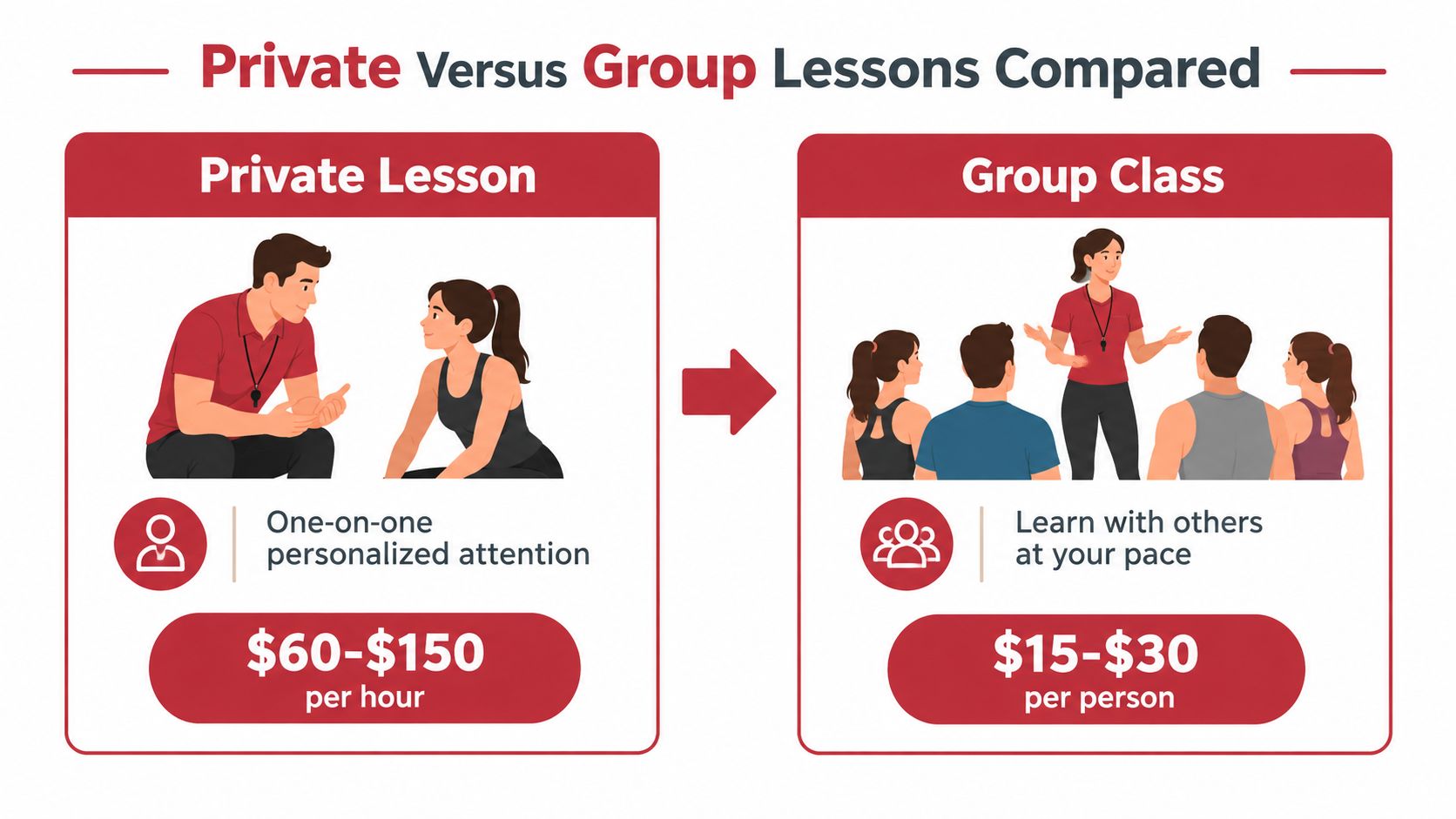
You sign up for one cheap class, then realize you still need repetition, correction, and enough floor time to feel comfortable dancing with another human being. That is the comparison here. Private and group lessons do not just carry different price tags. They produce different kinds of progress, and the true cost of learning depends on which gaps you need to close.
Private lessons give you concentrated feedback. Group classes give you volume, variety, and a room full of moving examples. If you only compare the sticker price, you miss the bigger budgeting question: how many sessions will it take in each format to reach your goal?
Studios commonly price private instruction by the lesson and may also offer small semi-private formats, where a few students share the teacher's attention and split the cost more efficiently. That middle option often deserves more attention than it gets. It can lower the per-person spend without turning the lesson into a general class.
What private instruction buys you
Private lessons buy precision. Your teacher can stop a habit the moment it shows up, fix posture and timing before they settle in, and adjust the pace to your body, not the average student in the room. That matters if you are preparing for a wedding, returning after a long break, or tired of practicing the same mistake.
It also changes the math. A higher-priced lesson can still be the better deal if it saves weeks of confusion. One clear correction at the right time often beats several lower-cost classes where no one has time to address your specific problem.
If you want to see how a studio presents one-to-one coaching, review private dance lessons at Danza Academy. And if you want a familiar comparison from another service business, this personal trainer cost guide makes the same basic point. Personalized instruction costs more because the session is built around one client's needs.
What group classes buy you
Group classes buy usable repetition. You dance with different partners, adjust to different timing and energy, and learn to keep going even when the floor is busy or imperfect. For social dancers, that is not a side benefit. It is part of the skill.
Neither format wins on its own. Choose private lessons when you need faster correction, a deadline, or a lesson built around you. Choose group classes when you need affordable practice and social confidence. The strongest budget for many beginners is a mix of both.
The video below gives newcomers another visual reference for the difference between learning environments and lesson approaches.
What Drives Lesson Price Differences
A cheap lesson can cost more in the long run if it buys you the wrong kind of help. Price differences usually come down to instructor level, geography, and lesson duration, and each one changes the true cost of learning, not just the number on the booking page.
Instructor experience changes the service
A newer social instructor and a seasoned competitive coach may both teach Waltz or Foxtrot, but the product is different. One is teaching usable fundamentals. The other may be correcting fine technical habits, building choreography, or preparing a student for performance and competition. That deeper skill set costs more, and it should.
It also is not the right purchase for every beginner. If your goal is to get comfortable at parties, dance at a wedding, or stop feeling stiff on the floor, you do not need top-tier coaching from day one. Pay for advanced expertise only when your goal requires it. Otherwise, you can burn through your budget on precision you will not use yet.
Geography affects the advertised rate
Location changes rates fast. Analysts at Superprof's U.S. ballroom lesson marketplace report an average U.S. ballroom lesson price of $54 per hour, while a Jacksonville listing averages $73 per lesson. That is a difference of $19, or approximately 35%.
Use that as a reminder, not a universal benchmark. Philadelphia and Exton students should compare local studios carefully instead of assuming a national marketplace average will match a local studio's pricing. Rent, demand, floor space, amenities, and instructor reputation all shape the rate. Marketplace listings can also reflect independent tutor pricing, which is not always the same as a studio's full program cost.
Lesson duration changes the math
Beginners often get tripped up here.
A 30-minute lesson, 45-minute lesson, and 60-minute lesson are not interchangeable just because each one counts as “a lesson.” A shorter session may look affordable, but the per-minute cost can be higher, and you may spend part of that time warming up, reviewing last week, or switching partners. That leaves less time for real progress.
Ask direct questions before you buy. How long is each lesson, exactly? Is the quoted price for one person or a couple? Does it include supervised practice time, studio parties, or floor fees? Intro offers can help you test the fit, but they do not tell you what the full learning process will cost. Get the total in writing before you commit.
Realistic Budget Scenarios for Different Goals
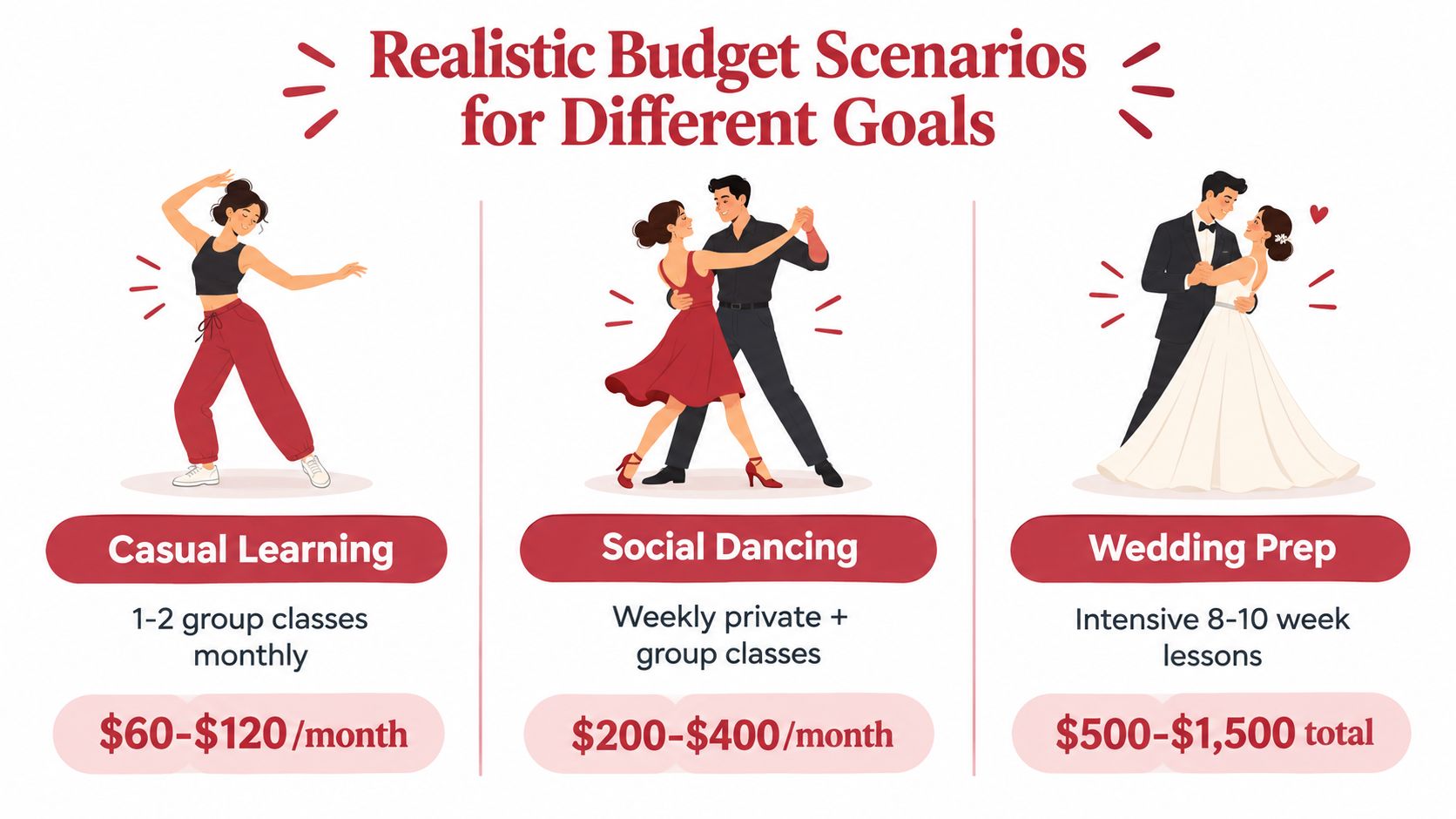
A useful budget starts with the outcome. “I want to dance” can mean learning a few social patterns, becoming comfortable at parties, or performing a choreographed first dance in front of wedding guests. Those goals require different combinations of instruction and practice.
Casual learning
A casual beginner can start with group classes and attend according to schedule. The experience may be inexpensive enough to explore several styles before choosing a favorite. Your likely outcome is familiarity with rhythm, basic patterns, and the feel of moving with a partner, not polished performance.
The infographic below offers a simple way to visualize how different goals change the budget.
Social dancing
A student taking four weekly private lessons may spend roughly $200–$800 per month before packages, travel, events, or competition expenses, based on CostHelper's private-lesson range. Combining group classes with occasional private coaching can make the budget more efficient: use private time to solve a specific problem, then use group practice to repeat and adapt the skill.
The realistic outcome is greater comfort with lead-and-follow, transitions, and social situations. Progress depends on practice between lessons, not just the amount paid.
Wedding preparation
Wedding instruction is usually sold as a package, and lesson quantity, choreography, instructor experience, and location drive the total. One published comparison estimates couples may spend about $300–$1,000 overall. Basic packages of 3–5 lessons are listed at $300–$500, standard packages of 6–8 lessons at $500–$700, and premium packages of 10 or more lessons at $700–$1,000 (this wedding dance package comparison).
Start earlier than you think if you want a routine that looks natural rather than memorized under pressure. Ask whether choreography, music editing, practice videos, and revisions are included. A lower package price may not cover the additions that matter most to your wedding plan.
How to Compare Value Beyond the Price Tag
A cheap lesson can be poor value if it leaves you confused. An expensive lesson can also be wasteful if it includes services you don't need. Compare the learning experience and the outcome, not just the number printed beside “per hour.”
Private ballroom instruction in available U.S. pricing data sits around $75–$100 per hour, but the total budget changes with duration, frequency, package discounts, choreography, practice, and whether the quoted rate is per person or couple (this consumer review of private ballroom tutoring).
Ask what the price includes
Before enrolling, get clear answers to these questions:
- Partner practice: Does a group class rotate partners, and can a solo student participate comfortably?
- Practice access: Are practice parties, open floor time, or workshops included?
- Wedding choreography: Does the package include music editing, routine design, and revisions?
- Progress structure: Will the instructor explain what you should achieve after each stage?
- Policies: Are registration, cancellation, expiration, and rescheduling rules written down?
- Materials: Do you receive practice videos, written notes, or music to use at home?
A package should make the path clearer, not hide the arithmetic. Divide the total by the included lessons, then separate instructional time from social events or practice sessions. That calculation won't tell you everything, but it prevents a bundled offer from looking cheaper than it is.
Match value to your outcome
For social dancing, partner rotation and regular repetition may matter more than private correction every week. For a wedding, personalized choreography and reliable timing may justify private instruction. For competition, technical feedback and coaching experience become central.
Use this guide to choosing a dance studio before signing a contract. My strongest advice is simple: tell the studio your goal, deadline, experience, and budget at the first conversation. A responsible teacher should explain which format supports that goal instead of pushing the largest package automatically.
Smart Budgeting Tips for Aspiring Dancers
You don't need an unlimited budget to learn ballroom dancing. You need a plan that protects your practice time and prevents surprise charges.
Start with an introduction: Use an introductory lesson to judge teaching style, studio atmosphere, and scheduling before committing to a larger package. Superprof reports that 95% of listed teachers offered a first lesson free, although marketplace offers don't represent every studio.
Mix formats deliberately: Pair private correction with group repetition when both serve your goal. Don't pay for private time to practice material you could repeat effectively in a group.
Ask about the full bill: Confirm lesson duration, couple versus individual pricing, package expiration, cancellation rules, registration, and any required membership before paying.
Budget for the surrounding costs: Dance shoes, travel, event tickets, showcases, workshops, and competition expenses can sit outside tuition. Wedding couples should also account for music editing or extra choreography if those services aren't included.
Practice between appointments: Write down the steps, use any permitted practice video, and schedule repetition at home. Better practice can reduce wasted lessons and make each paid session more productive.
Couples planning a wedding may also find broader cost-saving ideas in this guide to planning an affordable Australian wedding. The principle applies anywhere: decide which details create the experience you want, then spend intentionally on those details.
Start Your Dance Journey Today
The most accurate answer to “how much do ballroom dance lessons cost” comes from matching a real goal with a real lesson format. Group classes can keep exploration accessible. Private lessons can make a deadline manageable. A thoughtful combination can give you both personal correction and social practice.
Danza Academy of Social Dance has over 40 years of teaching experience and offers private lessons, group classes, and wedding dance preparation in Center City Philadelphia and Exton, PA. Its instructors work with beginners through advanced dancers, and students can participate without bringing a partner.
You don't have to solve every pricing question before taking the first step. Use a complimentary lesson to discuss your goals, experience, schedule, and budget, then decide whether group classes, private coaching, or wedding preparation fits your situation.
Book your free complimentary lesson with Danza Academy of Social Dance to experience the teaching style, explore your options, and get a clear recommendation for your ballroom goal. Whether you're learning for confidence, connection, a wedding, or pure enjoyment, start with a conversation and leave with a practical path forward.