
A survey of newlyweds found that 63% wished they had taken dance lessons before their wedding, and starting 3 to 6 months ahead gives you time to prepare without rushing. The right wedding dance isn't the most complicated routine. It's the one that fits your song, bodies, clothing, confidence, and actual reception space.
That distinction changes how you should plan. Couples often begin by asking how many lessons they need, then choose choreography before checking whether a full turn fits the floor or whether a formal gown allows a long traveling step. A better process starts with decisions. Choose a workable song, assess the physical and venue constraints, then build a routine that looks deliberate because it was designed for you.
Wedding dance lessons can teach timing, posture, musicality, connection, and floorcraft, but they should also solve practical problems. A simple slow dance may be ideal for one couple, while another may prefer a compact waltz, a relaxed rumba, or a choreographed routine with no dips or lifts. The goal is not to perform like professionals. The goal is to move together comfortably when the room is watching.
Why Most Couples Wish They Started Earlier
The first dance has not always been a staged performance. At 17th- and 18th-century aristocratic balls, a host or honored guest traditionally opened the evening's dancing before other attendees joined. By the 19th century, particularly in England, the bride and groom increasingly became the couple expected to dance first at wedding celebrations. The gesture shifted from signaling rank and opening a formal ball to presenting the newlyweds as partners, a history described in the development of the wedding first dance.
That older meaning still matters. Your first dance is a public moment, but it began as a social signal rather than a theatrical production. Even Emily Post's 1922 guide, Etiquette recommended that newlyweds wait until guests had begun dancing and treat their initial dance as a private or symbolic moment instead of a staged show. Modern couples can keep that intimacy while adding preparation that makes the moment feel secure.
What preparation actually changes
A survey of 1,000 newlywed couples found that 63% wished they had taken dance lessons before their wedding. Among respondents who did take lessons, 95% felt more confident and 80% reported reduced pre-wedding stress, according to the survey reported by Ballroom Dance in NYC.
Those figures don't mean every couple needs an elaborate routine. They show that preparation solves more than footwork. It gives you a shared plan for entering the floor, starting on the music, recovering after a missed step, and finishing without awkwardly wondering what happens next.
Couples who start early also have room to change direction. A song may feel perfect in the car but too fast once you try to move to it. A dramatic dip may look attractive in a video but feel unstable in formal shoes. Early instruction lets you replace those elements before they become wedding-week problems.
Practical rule: Build confidence by removing avoidable decisions before the reception, not by adding complexity for its own sake.
The tradition has evolved from opening a formal gathering to expressing partnership in front of family and friends. Lessons work best when they preserve that meaning. Your routine should give you enough structure to feel prepared, while leaving space to look at each other, breathe, and enjoy the moment.
Choosing Your Song and Dance Style
Choose the song before choosing the choreography. The music determines the rhythm, phrasing, emotional tone, and amount of travel available to your routine. A song you both love will also make home practice less tedious, which matters more than selecting a track because it seems technically fashionable.
Music preferences are broadening. A 2025 survey of more than 900 married people found that country music represented 23% of first-dance selections in the contemporary period, compared with 6% during the 1960s. The finding, reported by The Black Tux's first-dance song survey, supports a practical conclusion: don't assume a first dance must use a classic ballad or traditional waltz.
Match movement to the music
Listen to the song several times with different questions in mind:
- Can you identify a steady pulse? You should be able to tap or count along without forcing the timing.
- Does the structure give you natural changes? A purely musical opening, chorus, or final phrase can provide clean moments for an entrance, turn, or ending.
- Does the emotional tone fit your relationship? Technical suitability won't rescue a song that feels disconnected from you.
- Can the arrangement be shortened if needed? A complete recording may be longer than you want to dance in front of your guests.
A slow romantic ballad may suit a simple waltz, rumba, or relaxed social-dance pattern. An upbeat country track may work with country two-step or a compact swing-inspired routine. Latin music can support salsa, bachata, or another rhythm-based approach, but the teacher should select movements that match your experience rather than forcing advanced figures into the song.
Don't choose a dance style from a label alone. Two songs in the same genre can have very different phrasing and accents. Your instructor should test the song with basic movement, then adjust the style to your comfort, clothing, and floor.
For couples who want music that reflects their identity and relationship, a curated guide can help you find inclusive wedding songs without assuming that every couple follows the same gender roles or traditional format. You can also use Danza Academy's guide to the best wedding dance songs as a starting point, then narrow the choice by testing songs on your feet.
The best selection gives you emotional connection and practical freedom. If the chorus makes you want to move but the tempo leaves you scrambling, change the choreography or choose another song. A familiar, manageable song will usually produce a more convincing dance than an impressive track you can't comfortably interpret.
Private Lessons vs Group Classes for Couples
Once the song is chosen, the learning format affects how quickly your routine becomes usable. Private lessons put the instructor's attention on your partnership, while group classes give you repetition in a social setting and exposure to different partners and movement styles.
Neither option is automatically right for every couple. The decision depends on whether your main need is customized choreography, general comfort, social practice, or a flexible introduction to partner dancing.
Compare the learning environments
| Format | Best For | Pace | Social Element |
|---|---|---|---|
| Private lessons | Couples with a specific song, venue concern, or personalized routine | Adjusted to the couple's progress | Focused attention on the partners |
| Group classes | Couples who want a supportive introduction and broader practice | Set by the class progression | Practice with other dancers and a shared class |
Private instruction is especially useful when one partner has more experience, when your height difference affects hand positions, or when one of you needs extra time with timing and balance. The teacher can shorten a pattern, change the entry, or replace a dip immediately instead of waiting for the whole class to move on.
It also makes sense when the wedding date is close or when the couple wants choreography built around a particular song. Every minute can address the actual first dance, including how you enter the floor, where you face, and how you finish.
Group classes offer a different advantage. They can reduce the pressure of being watched by wedding guests because you become accustomed to learning in a room with other people. Rotating partners can also help you improve responsiveness, frame, and rhythm, although that practice won't automatically produce a routine for your chosen song.
Choose based on the problem you need to solve
Use private lessons when the question is, “How do we make this exact dance work for us?” Choose group classes when the question is, “How do we become more comfortable moving with a partner?” Many couples benefit from combining the formats, using group classes for general confidence and private instruction for the wedding routine.
Before booking, ask whether the teacher will work with your song, whether you can practice in the clothing and footwear you expect to wear, and how the instructor handles mobility or balance concerns. Danza Academy's overview of group versus private dance classes can help you compare the formats before committing.
The most efficient path is the one that addresses your actual risk. If your concern is forgetting choreography, private repetition may matter most. If your concern is feeling exposed, a welcoming group environment may be a useful first step. Don't choose solely by class label or price. Choose the setting that helps you practice the movement you'll perform.
Building Your Lesson Timeline and Practice Schedule
A wedding dance becomes easier to manage when you divide it into decisions instead of treating it as one large performance. Starting 3 to 6 months before the wedding gives you time to select the song, test basic movement, adapt the routine, and rehearse without turning every practice into an emergency.
Keep the routine proportionate to your goal. Research indicates that approximately 70% of couples prefer simple first-dance routines, which generally last about 1.5 to 3 minutes, and couples often feel prepared with roughly 4 to 6 hours of total practice. Those findings are reported in guidance on easy first-dance choreography. They support a short, repeatable routine rather than a long sequence filled with movements you haven't absorbed.
Use the calendar to reduce pressure
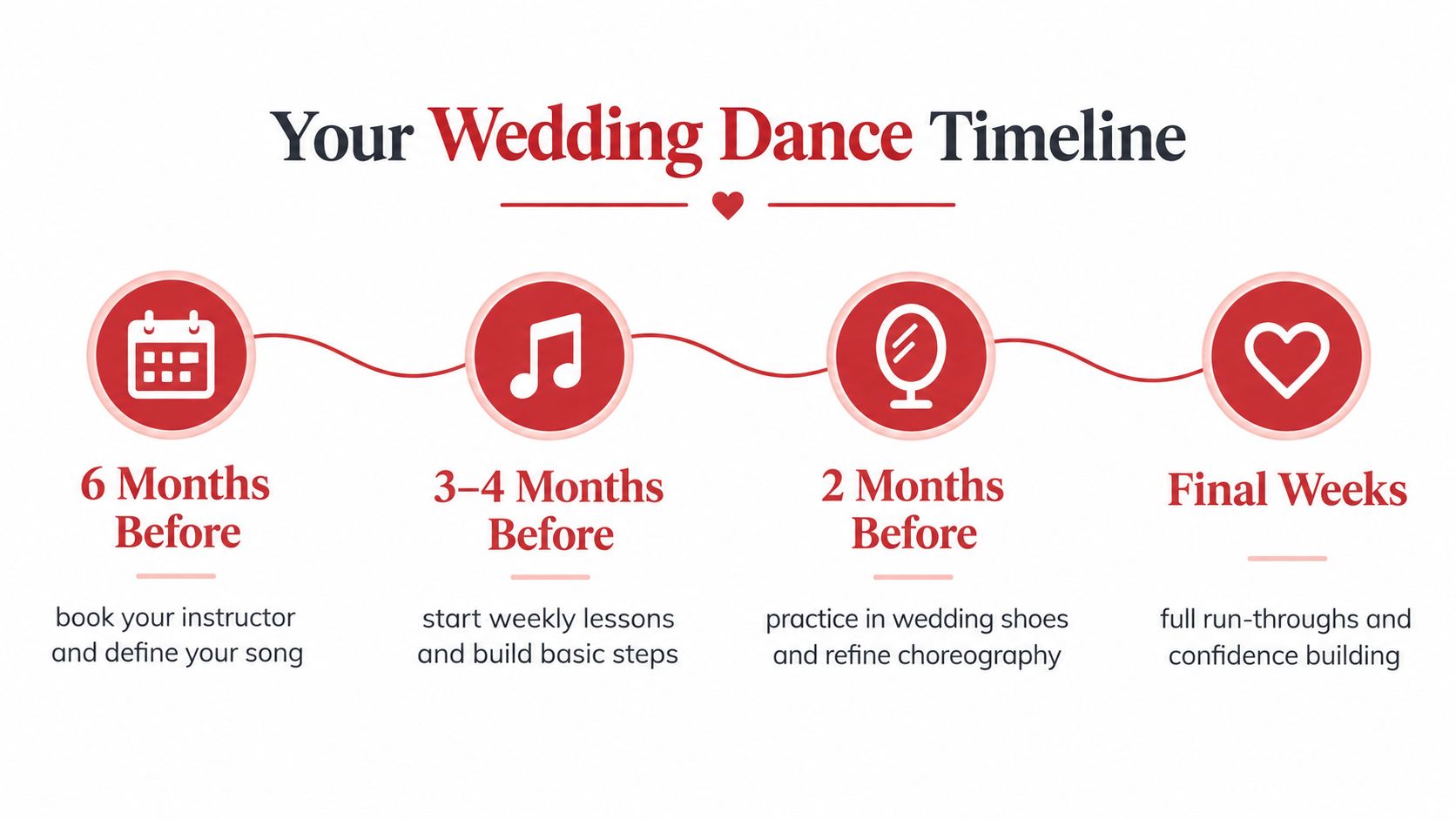
Six months before: Book an introductory consultation or lesson, bring your song options, and describe the venue, clothing, and comfort level you expect. The first session should reveal whether the song suits your movement and whether your original idea needs simplifying.
Three to four months before: Begin regular lessons and learn the foundation. Focus on posture, weight changes, connection, rhythm, and a small number of figures that can be repeated confidently. Don't add decorative choreography before the basic movement feels reliable.
Two months before: Add transitions and rehearse in wedding shoes or a comparable pair. If a dress, jacket, or formal shoe changes your balance, this is the point to adjust the routine, not the week of the wedding.
Final weeks: Practice complete run-throughs, including the start and finish. Confirm the edited song, floor access, DJ cues, and any restrictions on dips, lifts, or traveling patterns.
Make home practice specific
Home practice doesn't need to become another wedding obligation. Use focused sessions that each have one purpose:
- First practice: Walk the basic rhythm and say the timing aloud.
- Next practice: Repeat the transitions without music, then add the song.
- Later practice: Run the full routine and note where either partner loses confidence.
- Final practice: Rehearse in comparable shoes and clothing, then stop before fatigue affects your balance.
Use this guide to remembering dance choreography for methods such as breaking the routine into sections, attaching movements to musical phrases, and practicing transitions separately. The aim isn't to memorize a long list of names. It's to recognize what comes next from the music and from your partner's connection.
Practice principle: Repeat the moments that cause hesitation, not only the sections you already enjoy.
A routine is ready when you can recover calmly. If one partner misses a step, the other should know how to keep the movement simple and continue. That ability matters more than executing every decorative detail.
Overcoming Challenges and Adapting Your Dance
A routine that looks comfortable in a studio may become difficult at the reception. A fitted gown can restrict leg movement, a jacket can limit arm range, and heels can alter balance. A crowded, uneven, or unfamiliar floor can also make traveling patterns unsafe.
A first dance gains more from a routine that fits the conditions than from added choreography. Clothing, physical abilities, the selected song, and the venue may make standard figures impractical. Compact social-dance patterns, stationary choreography, and no-dip options provide workable alternatives, as discussed in this practical wedding first-dance guide.
Design around the constraint
A restrictive dress: Reduce large leg extensions, wide lunges, and fast directional changes. Weight shifts, close turns, upper-body styling, and small rotational patterns allow the fabric to move without pulling against it.
Limited mobility: Build the routine around stable, comfortable movement. Stationary choreography can still follow musical accents through changes of shape, turns within a safe range, or expressive arm styling. Partner roles can be arranged around each person's abilities rather than assuming that one person must always lead conventionally.
A height difference: Adjust hand positions, frame, and turning distance instead of copying a routine designed for another couple. A teacher can select figures that preserve connection without pulling either partner off balance.
Unfamiliar footwear: Account for the heel, sole, and support level when selecting steps. Footwear affects stride length, weight transfer, and confidence, so the routine should suit the shoes each partner will wear. If the shoes create instability, revise the movement rather than forcing the original version.
A crowded floor: Replace wide traveling patterns with compact turns or a contained social-dance sequence. Keep a smaller version of the routine ready in case guests move closer than expected.
A dance that looks intentional and comfortable will outshine a difficult routine performed with hesitation.
Song length affects stamina and nerves. If anxiety or fatigue is a concern, many instructors suggest shortening the music to roughly 2 to 2.5 minutes, as outlined in this practical wedding first-dance guide. The edited song should still have a clear beginning and ending, and the DJ or band should know exactly which version to play.
Check physical risk before adding a dip, lift, fast spin, or floor-traveling figure. Both partners should be able to enter and exit the movement safely in the expected clothing and on the actual surface. Uncertainty is a clear reason to choose a simpler finish.
The venue surface deserves the same attention as the choreography. Wood or tile generally supports controlled movement, while grass, gravel, carpet, and uneven patios may call for a temporary floor. A smooth, level, hard surface makes footwork more predictable and gives turns a consistent base.
Early adaptation makes the routine more personal, not less impressive. The dance reflects how you move together under real conditions, rather than how a video couple moved in an ideal studio.
Final Logistics and Your Big Day Plan
The final preparation is partly a dance task and partly an event-management task. Confirm the usable floor, the music file, the DJ cue, the lighting, and the point at which you'll enter. Your instructor needs to know whether the floor is centered, bordered by tables, or shared with guests immediately after the first dance.
Venue planning guidance recommends allowing approximately 0.5 square meters per dancer and sizing the floor for roughly one-third of guests dancing simultaneously. Under that calculation, a 120-person wedding needs about 20 square meters of dance floor, as outlined in this wedding venue layout guide. Your first dance may use less space, but the wider reception plan can affect how freely you travel.
Confirm the details before the reception
Ask the venue these questions:
- Surface: Is the floor smooth, level, and hard enough for controlled footwork?
- Usable area: Are chairs, tables, decorations, or speakers reducing the advertised floor size?
- Access: Where will you wait, and how will you reach the center?
- Music: Will the DJ or band play the edited version from the correct cue?
- Timing: Will dinner, speeches, or guest dancing follow immediately?
- Safety: Are dips, lifts, bare outdoor surfaces, or slippery areas restricted?
In the final week, avoid trying to rebuild the choreography. Run it comfortably, review the opening and ending, and practice the recovery plan for a missed step. Conserving energy is part of preparation. You want enough attention left for your partner and the people around you.
Coordinate related transport early as well. If guests or members of the wedding party need reliable travel between the ceremony, reception, and accommodation, a wedding transportation service can help keep the schedule organized. A late arrival can compress the reception timeline and leave less room for a calm first-dance setup.
Your final routine should have three versions in your mind: the full plan, the compact plan, and the recovery plan. The full plan uses the choreography you practiced. The compact plan keeps you mostly in place if the floor is crowded. The recovery plan returns to a comfortable basic step if either partner loses the sequence.
Danza Academy of Social Dance offers private wedding dance lessons, custom choreography, and supportive instruction for couples preparing a first dance that fits their song, skill level, clothing, and venue. Book the free complimentary lesson to test the teaching approach, identify your practical constraints, and create a clear plan, then visit Danza Academy of Social Dance to learn more about its Ballroom, Latin, and social dance programs.