You arrive at a crowded salsa social, hear the band lock into its groove, and take the first basic with confidence. Then your partner shifts in a way you didn't expect. Your feet continue on one timing, their weight changes suggest another, and the music seems to move away from both of you. The problem may not be your step pattern. It may be that you're dancing salsa on 2 vs salsa on 1 without sharing the same rhythmic starting point.
That choice affects more than whether you break on count 1 or count 2. It influences which musical layer you hear, how you organize weight changes, how clearly you communicate through the frame, and how naturally you fit into a social or performance setting. Neither timing is universally superior. Each makes certain musical and movement relationships easier to perceive.
Introduction to Salsa on 2 and Salsa on 1
A beginner may find salsa on 1 physically clear because movement starts with the strong beginning of the musical bar. Salsa on 2 can direct attention toward percussion, while its later break initially makes familiar patterns feel displaced. These reactions reflect a change in musical reference, not a change in the underlying basic. As listening develops, timing choice also affects how dancers shape phrases, answer accents, and coordinate weight changes with a partner.
Salsa on 1 is commonly associated with LA-style salsa, while salsa on 2 is commonly associated with New York-style salsa. Historical accounts connect on 2 with mambo and Cuban son traditions in New York's Puerto Rican and Nuyorican communities. On 1 follows historical paths associated with Puerto Rico and later Los Angeles dance-club culture, as discussed in the Dance Dojo's history of New York-style salsa and an academic discussion of salsa timing traditions.
| Feature | Salsa on 1 | Salsa on 2 |
|---|---|---|
| Directional break | Counts 1 and 5 | Counts 2 and 6 |
| Common style association | LA-style salsa | New York-style salsa or mambo on 2 |
| Primary musical reference | Strong downbeat and melodic emphasis | Percussion, clave, and tumbao accents |
| Initial learning experience | Often more direct for beginners | Often requires more deliberate timing awareness |
| Social setting | Common entry point in many beginner environments | Strong presence in New York-style and advanced social-dance communities |
| Core step structure | Counts 1, 2, 3, hold 4, then 5, 6, 7, hold 8 | The same structure, re-phased around the break |
The practical question is which timing supports a dancer's current goal. On 1 may clarify the bar's opening and melodic phrasing, while on 2 may make interlocking percussion and delayed rhythmic responses easier to organize. In partner work, either choice can communicate well when both dancers share the same timing and understand how the break shapes the phrase. A dancer's preference may change as musical listening, social experience, and performance demands develop.
Understanding Timing and Count Differences
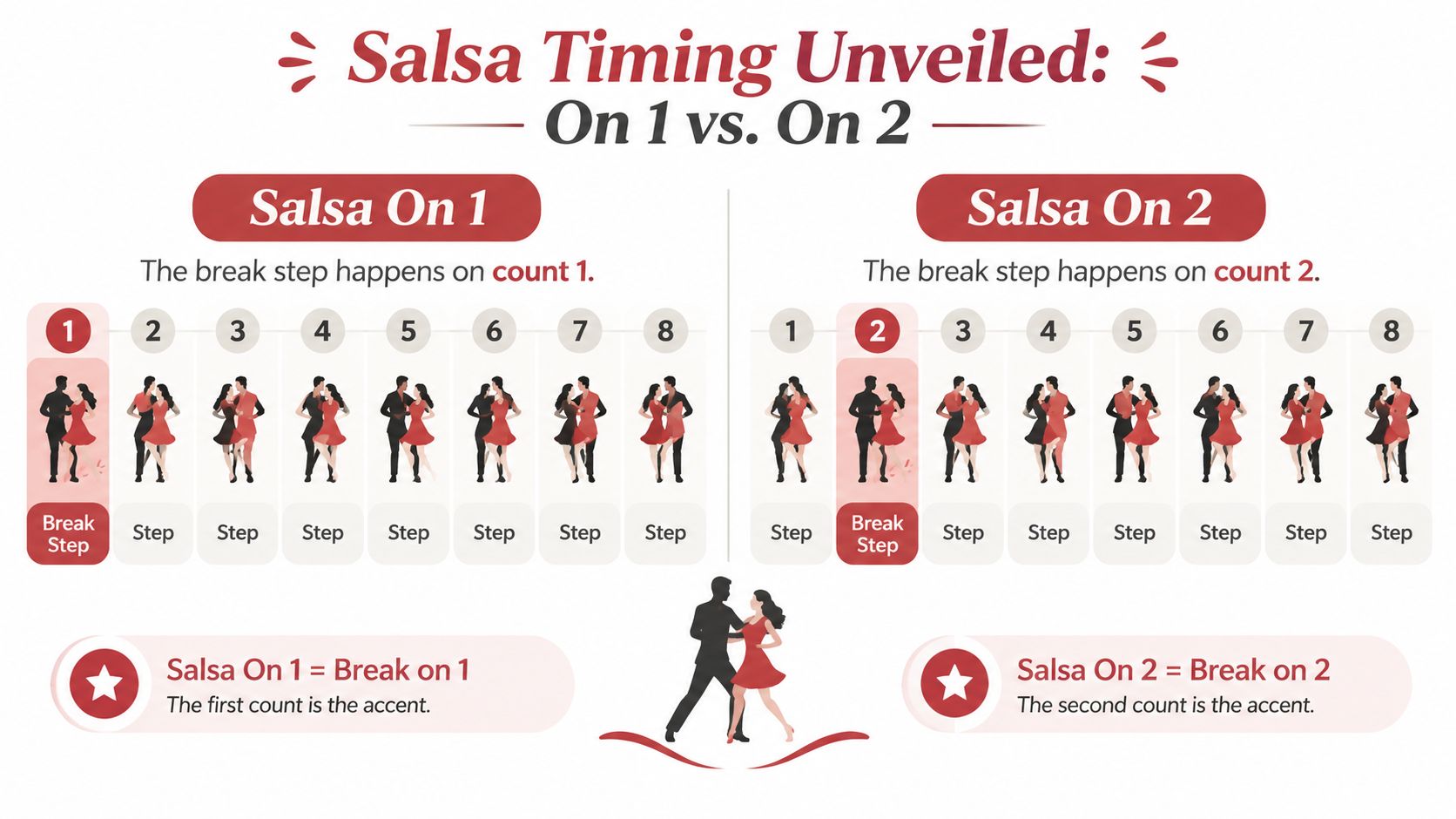
A dancer can perform the same basic sequence yet communicate a different musical priority by changing the timing anchor. Both styles use an eight-count phrase: steps occur on 1, 2, 3 and 5, 6, 7, with a pause or hold on 4 and 8 (Your Dance Studio's beginner comparison). The footwork framework remains consistent. The directional break changes position within the phrase.
One phrase, two timing anchors
In on 1, the break occurs on count 1 and returns on count 5. This placement gives the dancer an immediate reference at the start of the phrase, which can support clear alignment with a song's opening pulse or melodic gesture.
In on 2, the break shifts to counts 2 and 6. The dancer follows the same count grouping, but the directional change arrives one beat later, creating a different relationship with the phrase's internal accents. The Dance Dojo explanation of on-1 and on-2 timing documents this distinction.
| Count | On 1 | On 2 |
|---|---|---|
| 1 | Break | Step or preparation |
| 2 | Step | Break |
| 3 | Step | Step |
| 4 | Hold | Hold or transition |
| 5 | Break | Step or preparation |
| 6 | Step | Break |
| 7 | Step | Step |
| 8 | Hold | Hold or transition |
The one-beat shift affects more than a count exercise. On 1 places the directional action at the downbeat, while on 2 can direct attention toward the offbeat and percussion-led movement within the same cycle. That choice influences how a dancer phrases a turn, delays a response, or matches a partner's weight change.
Practical rule: Keep the step pattern. Change the count carrying the directional break, then reorganize the surrounding movement around that anchor.
A steady pulse makes the distinction easier to test. Use the Vocuno metronome, first marking the beat without steps, then adding the basic. Dancers who confuse pulse with melody can consult Danza Academy's guide to how to find the beat in music before practicing either timing.
The embedded demonstration offers another listening reference for timing and percussion.
Exploring Musical Phrasing and Rhythm Alignment
Timing becomes musically meaningful when you stop hearing salsa as a single beat stream. The melody, bass, clave, and conga pattern occupy different layers, and dancers can choose a break placement that makes one layer more prominent in their movement.
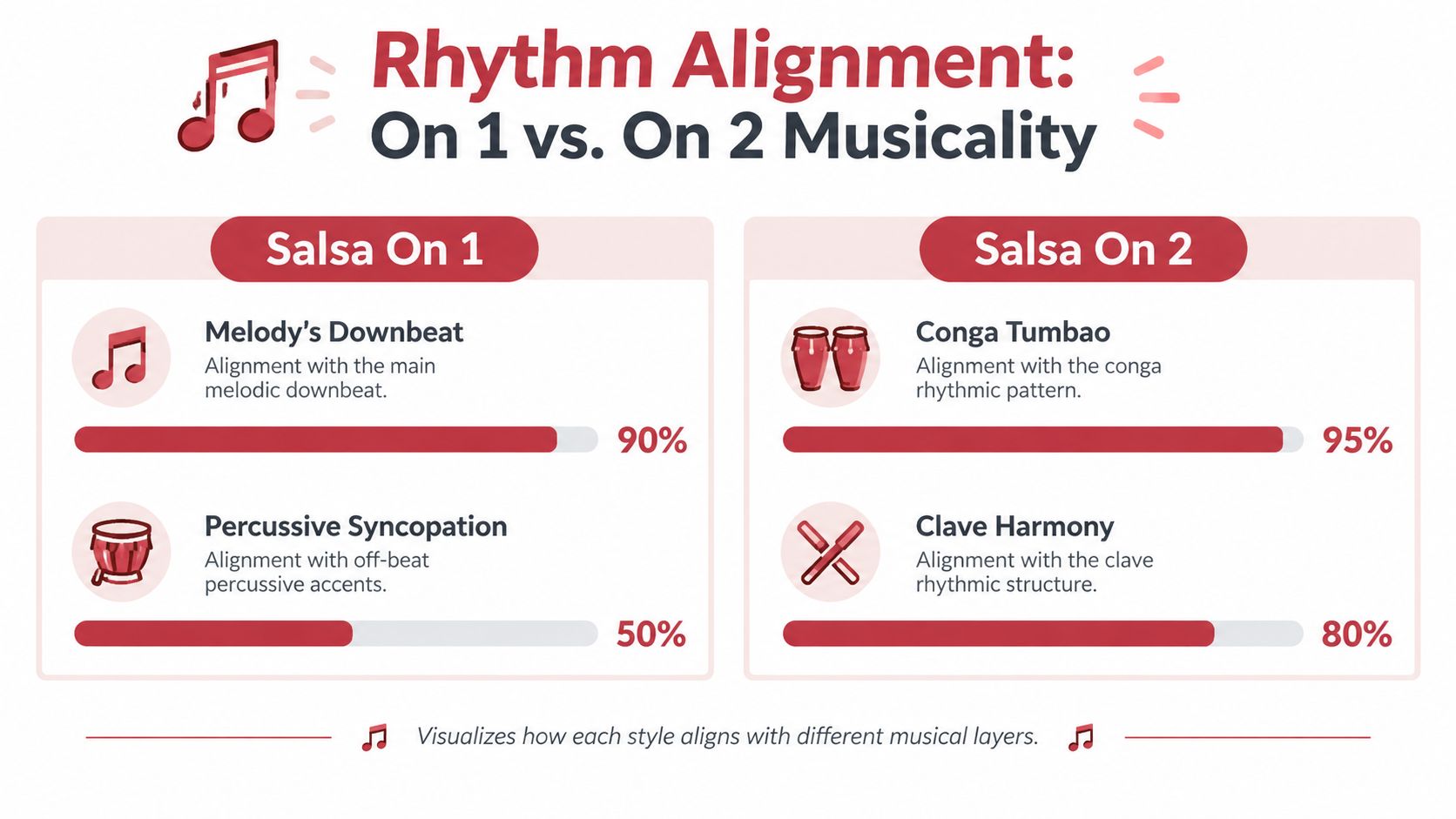
On 1 is commonly associated with the stronger downbeat feel of the music. That makes it a practical reference for dancers who naturally organize movement around the beginning of the bar or follow the melodic line. On 2, by contrast, is often associated with salsa's percussion-driven groove, particularly the clave and tumbao accents (Dance Dojo's comparison of timing approaches).
Why percussion changes the experience
Technical explanations describe on 2 as fitting the rhythm of the Son clave and the Conga tumbao. Tumbao is often described through accents around 8&-2 and 4&-6, which gives on 2 a particularly useful framework for dancers who want their weight changes to converse with the percussion rather than follow the melody (the technical explanation of clave and tumbao alignment).
That doesn't make on 1 less musical. It means the dancer may privilege a different layer. A break on 1 can make a vocalist's phrase or the orchestra's downbeat feel immediate. A break on 2 can make the conga's response and syncopated motion feel more present in the body.
Try listening before dancing. First, tap the strongest regular pulse. Then listen for the conga's response and the recurring clave pattern. Finally, notice whether your body wants to change direction at the bar's opening or after that opening has already passed.
- Melody-led listening: If you naturally follow the singer or horn line, on 1 may provide a clearer first reference.
- Percussion-led listening: If the conga and clave draw your attention, on 2 may give your movement a more satisfying anchor.
- Phrase-led listening: If you hear larger musical sentences, experiment with both timings and notice which one helps you finish a phrase without rushing.
The distinction is best understood as a change in musical interpretation, not a ranking of sophistication. A deeper exploration of that listening process appears in Danza Academy's guide to what musicality means in dance.
Navigating Partner Connection and Technique
Partner connection depends on shared timing as much as on frame, direction, and elasticity. When both dancers use on 1 or both use on 2, weight changes tend to arrive together. With different timings, identical physical signals can be interpreted at different points in the phrase, affecting not only coordination but also how the pair responds to musical accents.
Make the directional break clear before adding styling or turns. In on 1, the lead changes direction on count 1 and returns on count 5. In on 2, those actions occur on counts 2 and 6. The lead should organize the body early rather than pull harder. Clear preparation lets the intended break arrive on its chosen count while preserving the follower's ability to respond.
A practical connection drill
Stand with a partner in a comfortable frame and practice the basic without turns.
- Mark the pulse first. Keep the torso calm and identify the counts aloud.
- Place the weight change. For on 1, direct the break through count 1. For on 2, wait for count 2 before directing the same type of action.
- Keep pressure moderate. Compression should communicate direction, not force a step.
- Protect the holds. Counts 4 and 8 remain pauses in the basic structure. Avoid filling them with nervous extra movement.
- Switch roles mentally. Followers should read the lead's body while staying attentive to the music, rather than predicting the action from the beat alone.
Both timings retain the same basic step structure: steps on 1, 2, 3 and 5, 6, 7, with holds on 4 and 8. The technical difference is the point at which the body reverses direction, which changes how partners share the start of a phrase and settle its pause.
A mismatch can feel like a frame problem because the dancers disagree about when weight should transfer. A follower waiting for count 2 may feel late, while a lead initiating on count 1 may sense resistance. Reduce the pattern, agree on one timing, and use visible counting before asking the frame to convey subtler information.
Connection also has a musical dimension. A well-timed lead gives the follower room to complete a phrase, while premature pressure can interrupt that phrasing even when the pattern remains technically correct.
In social dancing, do not treat a different timing as evidence of inexperience. Ask, observe, and adapt when the setting permits. Recognizing both approaches helps a dancer preserve connection and respond to a partner's phrasing without turning the dance into a correction exercise.
Comparing Social and Performance Contexts
A dancer may feel fully at ease with one timing in class, then encounter a different expectation on the social floor. The choice between on 1 and on 2 therefore reflects more than individual preference. It also reflects teaching lineages, local conventions, and the musical details a community treats as most important.
Both styles have developed into established forms, but their historical paths differ. On 1 is more closely associated with Puerto Rican rhythmic history, while on 2 has a longer relationship with Cuban-derived son and mambo before its development in New York, as noted earlier. Eddie Torres played a major role in formalizing and popularizing New York-style on 2 from the 1960s through the 1980s. His contribution was teaching and spreading the method, not inventing dancing on 2 itself.
Social floors
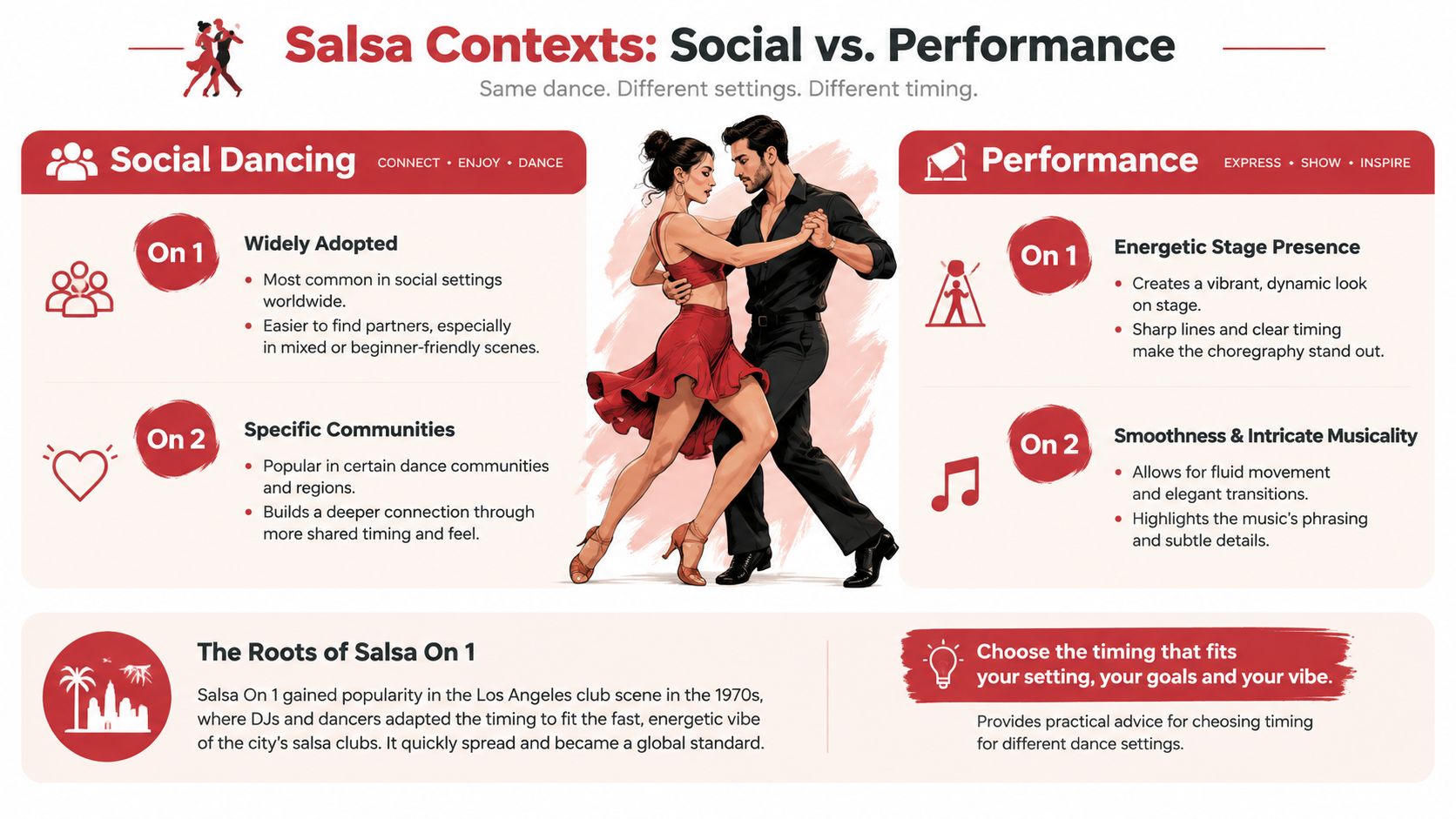
On 1 can provide a practical entry point in beginner-oriented social settings. Its relationship with the downbeat gives new dancers a direct reference for the first directional action, while its association with LA-style salsa makes it familiar in many clubs and classes. That familiarity can reduce negotiation between partners, allowing attention to shift toward weight transfer, phrasing, and floor awareness.
On 2 can be especially rewarding in communities shaped by New York mambo culture. The delayed break creates room to hear and answer percussion, sustain a phrase, or leave space before the next movement. Partners who share that timing can make the dance feel conversational because their pauses and directional changes align with the same rhythmic layer.
Partner availability often follows these local histories. One city may offer many on-1 partners, while another may have a concentrated on-2 network. The difference reflects teaching lineages, events, and floor expectations rather than a ranking of technical quality. A dancer choosing a social class should therefore assess the room's convention before treating either timing as a universal default.
Performance spaces
Performance changes the decision because choreography controls the timing environment. A team can select on 1 for a direct relationship with the bar's opening, or on 2 for phrasing that gives percussion and syncopation greater visible influence. That decision affects accents, pauses, directional lines, and the clarity of group synchronization.
On 1 can make sharp accents and collective hits easy for an audience to read. On 2 can support longer rhythmic ideas, suspended pauses, and movement that appears to answer the percussion rather than mark the downbeat alone. The timing alone does not determine performance quality. Choreography must make its rhythmic logic visible through spacing, texture, and coordinated emphasis.
Choosing for the room
| Situation | More practical starting point | Reasoning |
|---|---|---|
| First social classes | On 1 in many settings | The downbeat offers a direct entry reference |
| New York-style mambo community | On 2 | The local convention and percussion focus support shared timing |
| Choreographed team | Either, chosen collectively | Group clarity matters more than individual preference |
| Musicality-focused practice | Both | Comparing them reveals different musical layers |
| Mixed social floor | Adaptability | Partner communication matters more than defending one timing |
The most useful long-term skill is context awareness. Learn both approaches well enough to recognize a partner's timing, hear which musical layer it emphasizes, and decide whether to match, ask, or adapt. In social dance, that flexibility protects the partnership. In performance, it helps a group turn timing into a deliberate interpretive choice.
Pros and Cons for Learners
Beginners often want a simple answer because the first weeks of salsa already contain unfamiliar posture, weight transfer, partner connection, and musical listening. The choice becomes easier when you treat each timing as a different learning environment rather than a permanent identity.
On 1 usually offers a more direct first relationship with the bar's opening. That can reduce the mental distance between hearing the beat and changing direction. It may also make early partner drills feel clearer when classmates share the same entry point.
On 2 asks the learner to delay the break by one beat. That delay can feel awkward at first, especially if the dancer's body automatically responds to the strongest downbeat. Once the dancer hears the percussion layer more clearly, however, the same delay can become a source of control and expressive detail.
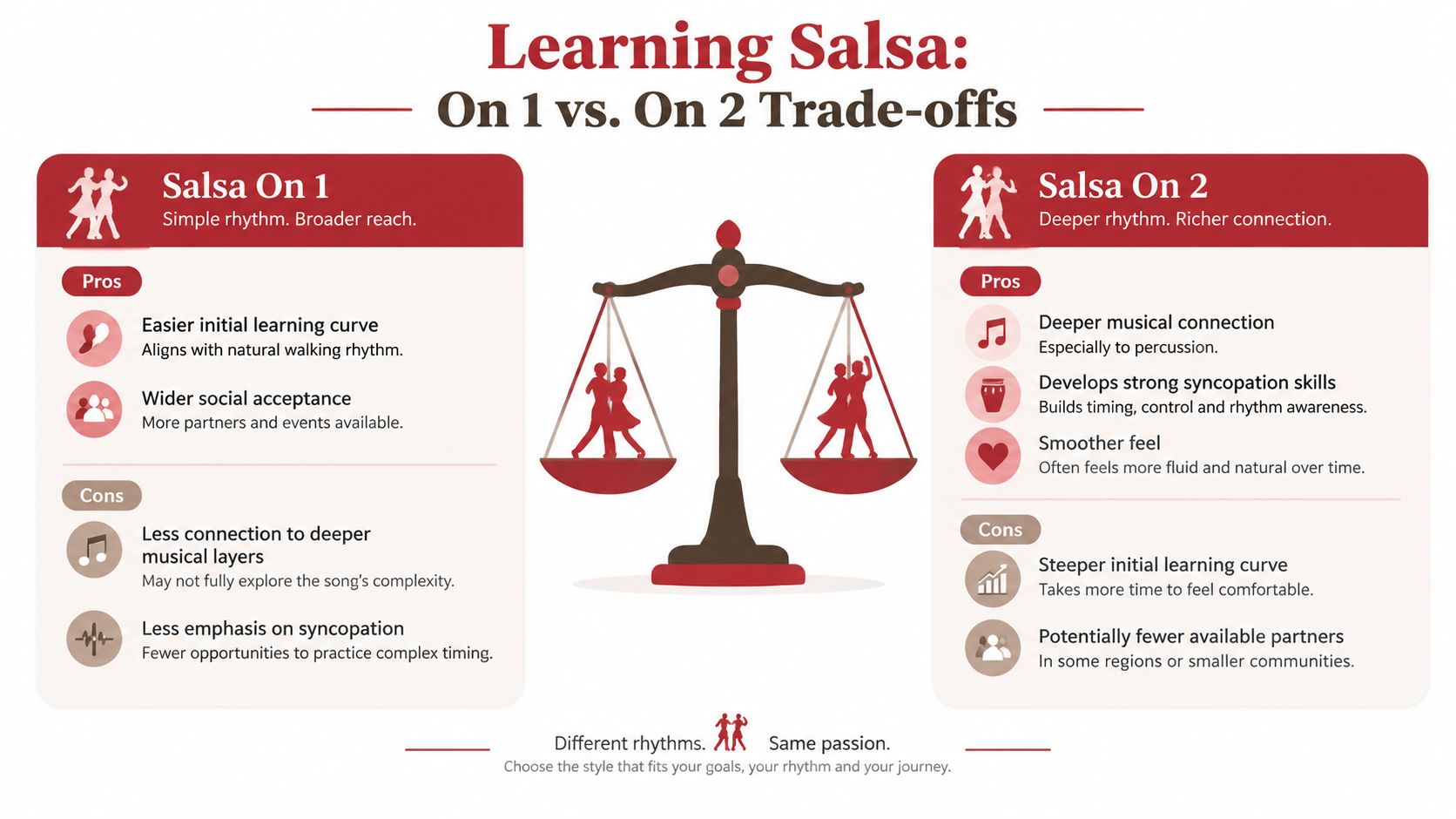
What each timing develops
| Learner priority | On 1 may support | On 2 may support |
|---|---|---|
| First-step confidence | A clear downbeat reference | Deliberate beat selection |
| Social integration | Easier participation where on 1 dominates | Connection with on-2 communities |
| Musical listening | Melody and bar-opening awareness | Percussion and syncopation awareness |
| Partner work | Direct early weight-change practice | Precise delayed communication |
| Performance phrasing | Sharp accents and direct lines | Smoothness and layered rhythmic detail |
These are tendencies, not guarantees. A learner can develop musicality on 1, and a learner can become technically precise on 2. The timing provides a set of listening priorities, but the teacher and practice method determine how fully those priorities become skills.
Recent academic writing challenges the familiar claim that on 2 is “more musical.” Research published in 2026 emphasizes that on-1 and on-2 timing involve different starting points within the bar and different relationships with larger rhythmic phrasing, while a 2019 musicology paper frames the difference as a shift in the beats where break steps align, not a different basic pattern (Oxford Academic's discussion of rhythmic structure). Both timings can therefore be musically valid while highlighting different layers of the same song.
A better learner question: Which musical layer do you want your body to notice first?
The trade-off is adaptability
Choosing on 1 may help you join a broad range of beginner classes, but staying only with the most familiar timing can limit your ability to interpret a percussion-heavy phrase. Choosing on 2 may sharpen your rhythmic awareness, but practicing without enough compatible partners can make social application harder in some regions.
The strongest pathway may be sequential rather than exclusive. Learn one timing well enough to protect your balance and connection, then study the other as a translation system. That approach turns the difference into a transferable skill. You'll be able to hear where a partner is breaking, preserve your frame, and make a deliberate decision instead of reacting with uncertainty.
Recommendations for Style Selection and Next Steps
Choose on 1 first if your immediate goal is social confidence, your local classes primarily teach LA-style salsa, or you want a direct relationship with the musical downbeat. Choose on 2 first if New York mambo interests you, percussion consistently captures your attention, or your preferred community already dances on 2.
Your first month of practice should have a narrow target. Keep the basic small, protect the holds on counts 4 and 8, and record yourself listening for whether the directional break arrives on 1 or 2. Add partner drills only after your solo timing is stable enough that you can maintain it without staring at your feet.
Match the pathway to your goal
- For social dancers: Start with the timing most common in your local classes, then learn to recognize the alternative at socials.
- For musicality seekers: Practice the same basic on both timings while listening separately to melody, clave, and conga.
- For performers: Select the timing that serves the choreography's accents and use group rehearsal to make every break consistent.
- For returning dancers: Rebuild weight transfer before adding turns. Timing problems become harder to diagnose once complex patterns hide the basic.
Private instruction can help when you keep switching counts, while group classes offer repeated practice with different partners. Danza Academy's salsa dance classes for adults are one option for learners who want structured guidance across social and Latin dance styles.
Don't make your decision permanent. A dancer who can comfortably move between on 1 and on 2 gains more than an additional basic. They gain a way to analyze phrasing, communicate with unfamiliar partners, and choose movement that serves the music rather than forcing every song into one habitual count.
Danza Academy of Social Dance offers personalized instruction that can help you experience both salsa on 1 and salsa on 2 through focused timing, musicality, and partner-connection practice. Book the free complimentary lesson through Danza Academy of Social Dance and arrive with your goals, whether you're seeking social confidence, deeper percussion awareness, or performance preparation.