
You're standing in the middle of the reception floor, surrounded by cameras, phones, and guests who've been waiting for this moment. Your partner is smiling, your parents are watching, and the DJ is about to press play. You may know your song perfectly, but that doesn't automatically tell you how to enter, where to place your feet, or what to do if one of you misses a step.
The practical answer to wedding first dance how to is to make the decision before you make the choreography. Choose a style that fits your comfort, select and shape a song that supports it, rehearse in manageable phases, and protect your confidence during the final week. A memorable first dance isn't a talent test. It's a short, well-prepared moment that still feels like the two of you.
What Your First Dance Really Is
A first dance carries more emotional weight than its length suggests. Couples often feel exposed standing in front of 80 to 200 guests, with family watching closely and cameras recording every turn. That pressure can make a simple sway feel difficult, while a complicated routine can become impossible if it hasn't been designed for real wedding conditions.
The tradition itself began as a public display of honor rather than a choreography showcase. The modern wedding first dance traces to European court and aristocratic ball traditions in the 16th and 17th centuries, when the guest of honor opened the dancing. Formal Renaissance-era balls commonly used a slow, stately minuet, and the custom later spread beyond royalty and high society as formal dancing became more democratic. By the early 20th century, newlyweds were increasingly opening the reception floor themselves, with the couple-centered version becoming more established after World War I and in the postwar era. This history of the first dance explains why the moment still combines etiquette, recognition, and intimacy.
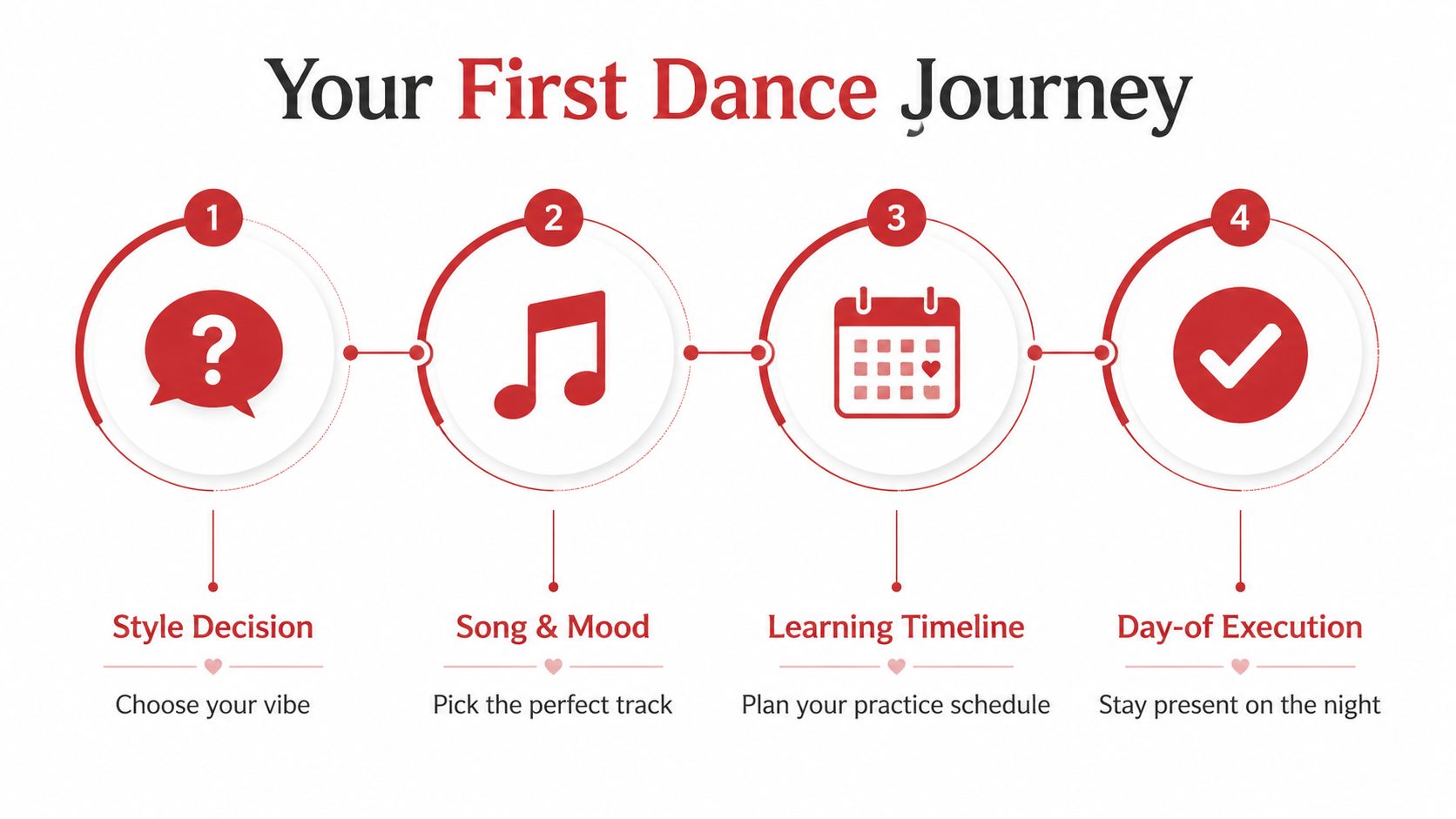
Treat it as four manageable decisions
First, choose your style. Decide whether you want natural movement, a hybrid routine, or fully choreographed performance. Your dance experience, guest mix, and floor conditions matter more than what looks impressive online.
Second, shape the song. Pick music with a usable rhythm, suitable lyrics, and a clear ending. A song edit gives you control over the energy and prevents the dance from dragging.
Third, build a rehearsal timeline. Learn the foundation before adding transitions and highlights. Short, frequent practice develops reliable movement more effectively than one exhausting session.
Finally, plan the execution. Rehearse the entrance, first connection, one transition, and ending under conditions that resemble the reception. Couples who know how the dance starts and finishes usually recover more calmly from anything in the middle.
Practical rule: Confidence comes from knowing what to do next, not from having perfect natural ability.
The first dance is both a relationship moment and a public statement. It tells your guests how you want to enter married life together, whether that means a quiet embrace, a classic ballroom pattern, or a playful routine built around your personalities. If you want visual inspiration for how couples use space, entrances, and guest positioning, you can browse Atlanta wedding galleries for examples of real reception environments.
Choosing a Style That Fits You
Start with three questions, not a YouTube search.
How comfortable are you with dancing? If you already move easily to music, a choreographed routine can give you a satisfying performance challenge. If you freeze when someone watches, a small set of repeatable patterns will serve you better than a sequence packed with tricks.
Who's watching? A large, mixed-age guest list may respond warmly to a polished routine, but it may also include relatives who value the traditional intimacy of a simple dance. The right choice should make the couple feel recognizable, not turn the reception into a talent competition.
What's the floor like? A spacious ballroom supports traveling foxtrot patterns and broad turns. A crowded restaurant floor calls for compact rumba or waltz-based movement, with careful spacing and fewer directional changes.
Zola's 2025 wedding report says 21% of couples are incorporating a choreographed first dance in 2025. Zola's 2025 wedding data reflects the growing visibility of choreographed moments, while The Knot's 2025 Real Engagements & Weddings Survey says first dances and parent dances remain popular. Those facts don't mean every couple needs a routine. They mean you have permission to personalize the format.
| Style Tier | Best For | Choreography Level | Floor Feel |
|---|---|---|---|
| Fully choreographed | Confident couples who want a performance moment | Detailed sequence with planned highlights | Polished, theatrical, and musical |
| Hybrid | Most couples who want structure without losing spontaneity | Basic pattern, transitions, and one featured variation | Natural with clear direction |
| Natural sway | Minimalists, nervous couples, or pairs with limited preparation time | Light guidance and a dependable opening and ending | Intimate, relaxed, and compact |
Ballroom vocabulary helps clarify what those labels mean. A waltz gives you a flowing rise-and-fall quality and works well for romantic, spacious music. A foxtrot creates smooth walking patterns and suits couples who want elegant travel without sharp visual effects. A rumba stays grounded and expressive, making it useful when the floor is tight or the song has a slow, emotional pulse.
Choose fully choreographed only when you'll enjoy practicing it. Choose hybrid when you want the safety of structure and room to breathe. Choose natural sway when being present matters more to you than displaying steps. The best first dance is the one you can perform while still looking at your partner.
Picking and Shaping the Song
Song selection should begin with movement, not a playlist title. A usable first-dance track needs a beat you can find, lyrics you can stand behind, and enough musical structure to tell your body what happens next.
Tempo gives you an early filter. For this planning approach, test songs from roughly 80 to 130 BPM, depending on the style. A waltz generally needs a slower pulse with a clear three-count feel. A foxtrot works better at a moderate walking pace, while rumba can handle a slightly quicker, grounded rhythm. You don't need to identify the exact BPM before testing a song. Play it and walk or sway together. If you rush, stop, or lose the beat, the track is already giving you useful information.
Use your ears, feet, and judgment
Read the lyrics aloud. Romantic production can hide words that don't belong at a wedding. If a line would make your grandmother uncomfortable, edit the song or choose another one. A beautiful melody can't rescue lyrics that undermine the moment.
Aim for a 90-second to 2-minute usable window. The original recording may be longer, but your first dance only needs enough time to establish the relationship, show your chosen movement, and finish with intention. You can explore wedding dance song ideas after you've identified your preferred mood and dance style.
A clean edit usually follows this order:
- Trim the intro: Start close to the first strong musical phrase so the entrance doesn't consume the dance.
- Cut a verse: Remove repetition while preserving the emotional arc.
- Fade on a phrase: End after a musical resolution, not halfway through a vocal line.
- Confirm the cue: Give the DJ or band the exact edited file and verify how it will start.
Before committing, run a shortlist test. Dance to each edited version in socks on a 10-by-10 patch of carpet. That small space exposes problems quickly. If the song makes you collide, lose balance, or search for the next movement, the floor will feel even less forgiving in formal clothing.
Don't choose a song because it looks impressive in a video. Choose one that makes your shoulders drop, gives your feet a steady invitation, and lets you finish before your energy fades.
Building Your Rehearsal Timeline
A first dance lesson timeline works best when you start instruction 6 to 12 weeks before the wedding, with the final month focused on refinement rather than learning new material. This wedding dance lesson timeline supports that schedule. Three months is also a practical starting point for selecting and editing the song, learning the base movement, adding choreography, and rehearsing in realistic conditions, as outlined in this first-dance choreography guidance.
Keep sessions short. 15 to 20 minutes, three times weekly gives busy couples enough repetition to build muscle memory without turning practice into an argument. Move through four phases:
Foundation
Learn the basic hold, posture, weight shifts, and primary step. Don't add a dip or turn until both partners can complete the foundation without stopping. Your readiness benchmark is completing two full passes without verbal cueing.
Shaping
Add transitions and match movement to musical phrases. Decide who leads each change and where the couple should face. This phase should make the routine feel connected rather than assembled from unrelated steps.
Polishing
Refine the entrance, eye contact, featured variation, and ending. Practice recovering from a missed step by returning to the anchor movement instead of showing panic.
Dress rehearsal
Use wedding shoes and clothing with a similar shape to the outfit. Test the floor if possible, especially if it's polished, uneven, crowded, or smaller than the studio floor. Couples who want a practical schedule for the entire celebration can find a wedding day timeline template and place the dance rehearsal, sound check, and reception entrance in the same planning document.
| Week Range | Focus Phase | Private Lessons | Home Practice per Week |
|---|---|---|---|
| 6 to 12 weeks before | Foundation | Establish the base and hold | 15 to 20 minutes, three times weekly |
| Middle preparation period | Shaping | Add transitions and musical phrasing | 15 to 20 minutes, three times weekly |
| Final month | Polishing | Correct posture, timing, entrance, and ending | Short, frequent review sessions |
| Final week | Dress rehearsal | Refine only, no new choreography | Light practice in wedding shoes |
Private coaching accelerates learning because an instructor can correct the frame, timing, and lead-follow connection immediately. It still plateaus without repetition. At-home practice builds automaticity, but couples often drift from the intended timing without outside feedback. Use both formats.
The most common mistake is cramming during the final week. Stop adding new moves seven days before the wedding. From that point forward, protect recall, comfort, and musical flow.
Private Lessons and Group Practice
A private lesson should solve your specific problems. A typical session begins with a warm-up review, then introduces one or two new elements. The instructor watches the frame, posture, weight transfer, and connection, troubleshoots the points where you hesitate, and assigns a focused homework task. A session usually lasts 45 to 60 minutes, but the value comes from targeted correction rather than constant movement.
If your partner pulls during a turn, the instructor can isolate the lead and follow. If one person keeps stepping early, the teacher can slow the rhythm and rebuild the timing. If the dip looks unstable, the instructor can replace it with a safer ending that still suits the song.
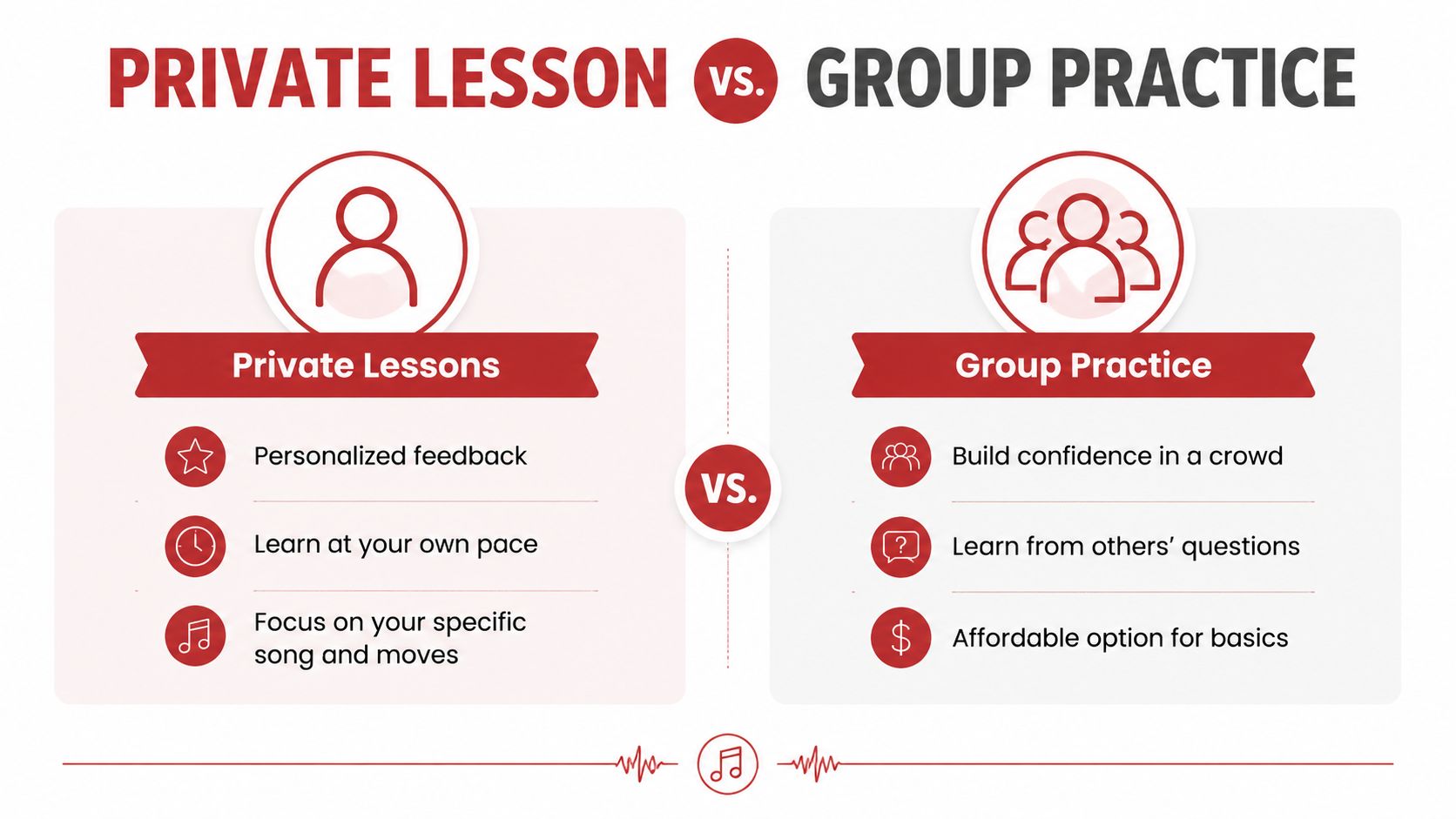
What group practice adds
A group session provides a different kind of training. Other dancers create visual distraction, a simulated audience, and changing traffic patterns. You also experience how the same movement feels when the available floor is wider, narrower, or interrupted by other couples.
Use group practice as a controlled stress test, especially near the wedding. It exposes habits that don't appear when you drill alone, such as staring at the floor, shrinking the steps, speeding up under observation, or losing the starting position after an entrance.
A hybrid schedule is the most sensible option for couples who want personalized choreography without avoiding performance conditions. Use regular private lessons for the routine, then include one group practice in the final two weeks to test your composure and floor awareness. Danza Academy's private dance lessons for adults are one option for couples who want individual instruction built around their song and ability.
Learn floorcraft before the reception
Wedding floors rarely behave like empty studio floors. Tables may sit close to the dance area, photographers may move around the perimeter, and guests may lean into the space for a better view. Practice keeping your steps compact enough to adjust without abandoning the routine.
Choose an anchor move you can return to after a mistake. If a turn goes wrong, reconnect in closed position, find the beat, and continue. Your partner doesn't need to know anything went wrong unless you announce it with your face.
Repeated exposure also changes how nerves feel. An instructor can cue you through the opening, remind you to breathe, and create deliberate interruptions so you practice recovering. The goal isn't to eliminate adrenaline. It's to teach your body that adrenaline doesn't require a stop.
Managing Nerves and Week-Of Prep
The final 72 hours often create more anxiety than the reception itself. Couples start questioning the song, the shoes, the dip, and every move they've already learned. Treat this period as confidence protection, not a last-minute opportunity to rebuild the dance.
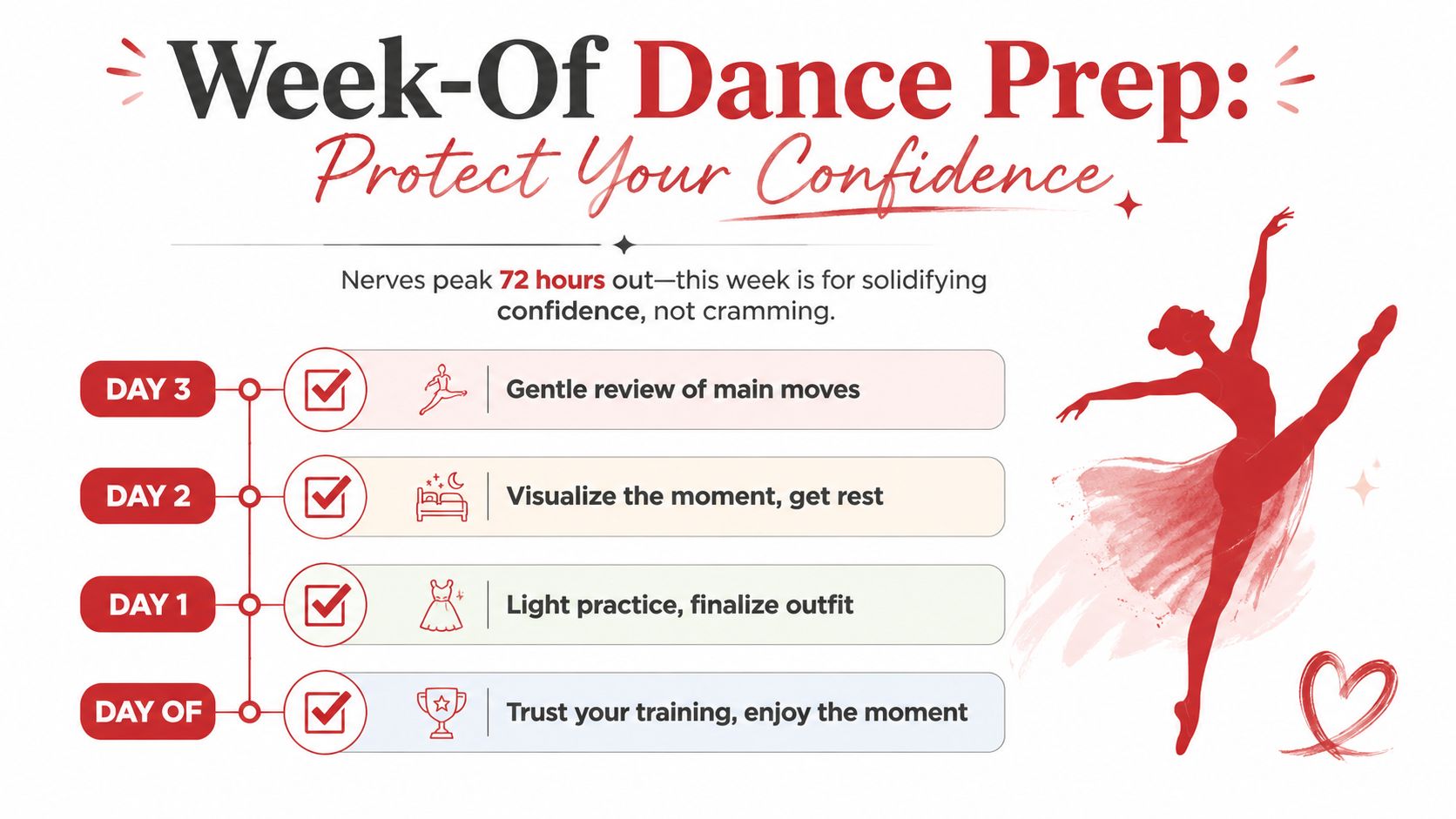
Use a simple week-of checklist
- Monday: Take the final lesson or review a rehearsal video. Correct only issues that affect safety, timing, or the ending.
- Tuesday: Practice in your wedding shoes and complete two full passes. Don't test unfamiliar footwear.
- Wednesday: Take the day off. Rest your legs and stop mentally replaying the routine.
- Friday: Complete a sound check with the DJ or band. Confirm the edited file, starting cue, volume, and fade.
- Rehearsal-day morning: Warm up lightly and review the anchor movement. Add nothing new.
Wear shoes that are already broken in. Test the venue floor if you can, especially if the surface is slick or the dance area is smaller than expected. Have water and a small snack 90 minutes before the reception so you're not dancing dehydrated or distracted by hunger.
Your mental cues should be physical and specific. Pick a focal point beyond your partner for the entrance, exhale fully on the first beat, and look at a guest instead of staring at the floor. Keep your shoulders down. Let your partner's hand and the music provide the next instruction.
Tradition itself isn't universally accepted anymore. YouGov's 2021 to 2026 tracker continues to measure whether the first dance should be preserved or dropped, while The Knot's 2025 survey still reports that first dances remain popular. The YouGov wedding traditions tracker makes the broader point clear: guests may hold different opinions, so brevity, comfort, and inclusivity matter.
A slightly imperfect dance you remember with affection is better than a flawless routine you spend the entire song trying to survive.
Try a Complimentary Lesson at Danza Academy
You don't need to commit to a full package before you know what your first dance should look like. A complimentary introductory lesson can give you an honest assessment of your comfort level, a short custom routine preview matched to your song, and realistic guidance on how many lessons you'll need.
Danza Academy of Social Dance works with couples across ability levels, from complete beginners who want a simple sway to partners pursuing a fully choreographed ballroom routine. The lesson can also expose practical issues early, including an unsuitable tempo, an unstable dip, or choreography that won't fit your venue.
Use the first dance lessons near you resource to explore the next step, then bring song ideas, your wedding shoes, and a short list of moves you've seen and liked. Even starting 8 to 10 weeks out can give you enough time to develop genuine confidence when you practice consistently.
Danza Academy of Social Dance offers personalized wedding dance preparation, from natural movement to custom ballroom choreography, with instruction built around your song, floor, and comfort level. Visit Danza Academy of Social Dance to book the free complimentary lesson and leave with a clear, practical plan for your first dance.