
You're standing at the edge of a salsa floor, watching couples move through turns as if they've been doing it forever. You want to join them, but your feet feel unfamiliar, the music sounds fast, and you're not sure whether you should step forward, back, or wait for the next beat. That hesitation is normal. Every confident social dancer once had to find the first step.
The practical way to learn salsa dancing isn't to memorize a huge catalogue of patterns. It's to build a skill stack in the right order: rhythm and timing, footwork and body movement, partner connection, then musicality and style. Each layer solves a different problem, and skipping one usually creates frustration later.
Starting From Zero With Salsa Dancing
Salsa is a relatively modern social dance shaped by several musical and cultural milestones. Son cubano formed much of its musical base in Cuba during the 1920s and 1930s, mambo influenced New York Latin dance culture in the 1940s and 1950s, and the word salsa gained wider recognition during the 1960s. Its global expansion accelerated in the 1970s and beyond, eventually leading to congresses, schools, media, and online learning communities around the world. You can read more about this blended history in this overview of salsa's development.
That history matters because salsa isn't one rigid tradition. It combines Caribbean, African, and urban Latin influences, so regional scenes may emphasize different timing, styling, and partnerwork. The two labels beginners hear most often are LA On1 and NY On2, but you don't need to settle every style question before learning your first basic.
Build the layers in order
- Rhythm and timing come first. Salsa is commonly taught in an eight-beat phrase, and learning where the pauses fall lets you move to music even when you're practicing alone.
- Footwork and body movement make the rhythm visible. You'll learn to transfer weight cleanly, keep your feet underneath you, and bend your knees instead of forcing artificial hip motion.
- Partner connection turns solo steps into conversation. Leading and following depend on balance, direction, and weight placement, not just hand signals.
- Musicality and style make dancing enjoyable rather than mechanical. You'll learn to hear accents, respond to instruments, and choose movement that fits the music.
Instructor's rule: A small vocabulary danced on time is more useful than a large vocabulary danced with uncertainty.
Research also supports the value of regular salsa practice beyond recreation. An NIH-indexed study tracked weekly practice over two years, with averages of 4.6 ± 1.2 hours per week for women and 6.4 ± 1.7 hours per week for men, compared with an initial mean of four hours per week among the studied pairs. Another controlled study included 121 young participants, with 93 completing analysis and a 77.7% completion rate, while a separate study reported a 38-second improvement in a 400-meter walk among dancers compared with a 10-second improvement in a health-education group. These findings are summarized in the NIH-indexed salsa dance research.
With consistent practice, many adults can reach enjoyable social dancing within 3 to 6 months, particularly when they practice 3 to 4 times per week rather than attending only one weekly class. A practical benchmark is that 7 to 10 moves can be enough for an enjoyable social dance, so your early goal should be comfort and timing, not an impressive move list.
Locking In the Rhythm and Basic Step
Start with the count before you worry about where your feet go. Salsa uses an eight-beat phrase, but dancers step on six counts: 1, 2, 3, pause, 5, 6, 7, pause. The pauses on 4 and 8 aren't empty space. They give the pattern its breathing room and help you avoid rushing.

Learn the forward-back basic
For a standard beginner On1 basic, the leader moves through this sequence:
- Count 1: Step forward with the left foot.
- Count 2: Replace weight onto the right foot.
- Count 3: Step back into place with the left foot.
- Count 4: Pause.
- Count 5: Step back with the right foot.
- Count 6: Replace weight onto the left foot.
- Count 7: Step forward into place with the right foot.
- Count 8: Pause.
The follower mirrors the pattern with the opposite feet. The important detail isn't the size of the step. It's the weight transfer. If you reach too far, your body arrives late and the next step becomes a recovery. Keep your feet close to hip width, soften the knees during the pauses, and let the body respond to the feet.
Practice away from music first. Count out loud while tapping the rhythm on a table, then walk the pattern slowly without trying to look stylish. After that, use a slow salsa track and keep counting until the pauses feel predictable. If you lose the beat, stop moving, find count 1 again, and restart. Continuing with the wrong count only teaches your body the wrong habit.
Use a short daily drill
A five-minute routine is enough to establish the first layer:
- Two minutes of counting: Say “1-2-3, pause, 5-6-7, pause” while clapping or tapping.
- Three minutes of stepping: Perform the basic in place, concentrating on clean weight changes and quiet feet.
The salsa timing guide from The Dance Dojo explains the six-step structure and the pauses that organize the phrase. Practice consistently, and the count will begin to feel like a physical pattern instead of a calculation.
Building Your First Core Moves
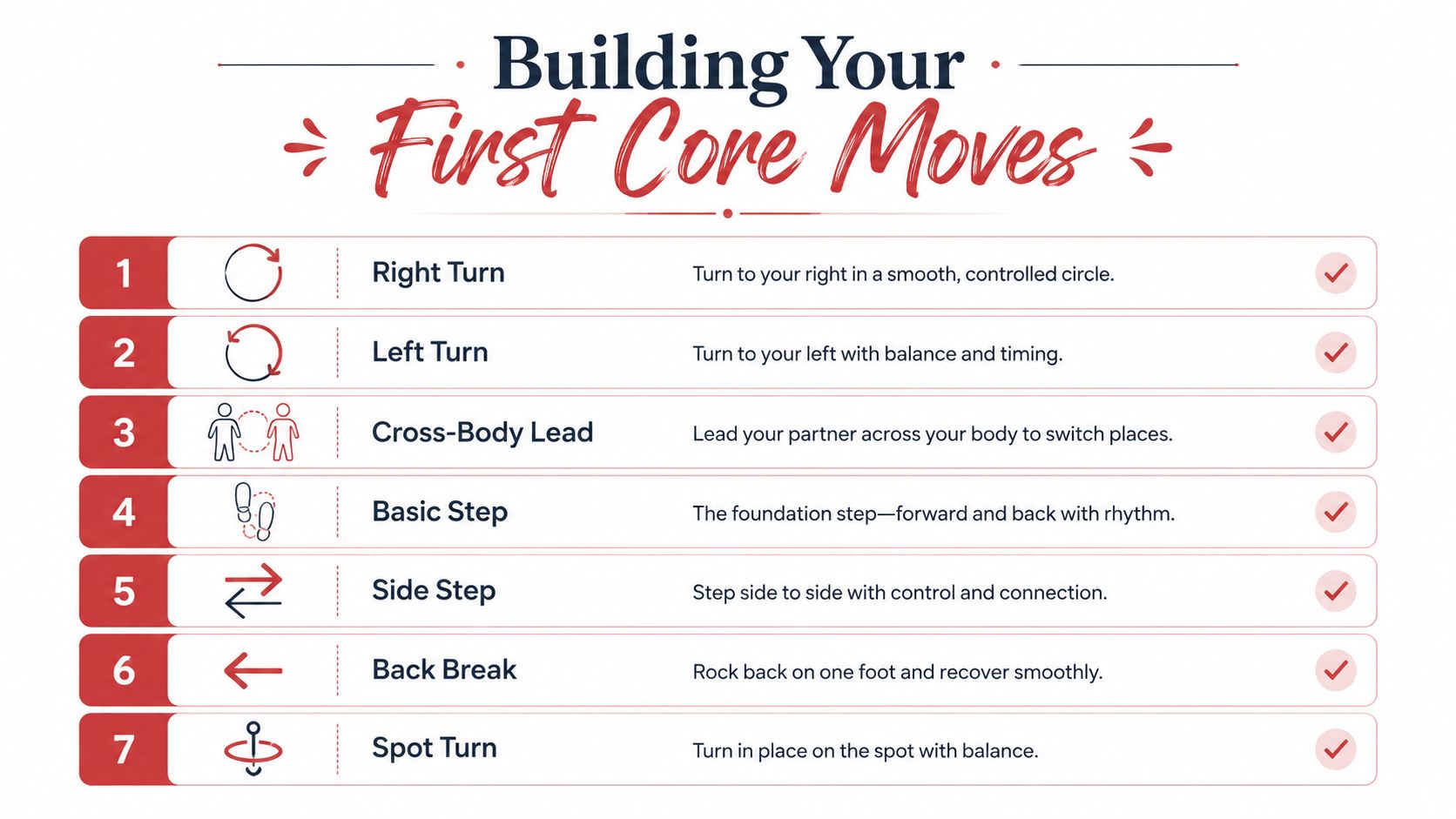
Your first target is a usable vocabulary of 7 to 10 moves, not a warehouse of combinations. Most beginner patterns are recombinations of the basic step, a directional change, and a turn. Once you understand that, each new figure feels like a variation rather than a completely new dance.
The essential move set
- Right turn: The leader guides a clockwise turn over 2-3-4 while maintaining the rhythm. The follower steps through the turn and returns to the basic. Eye contact helps keep the invitation clear and prevents the turn from feeling abrupt.
- Left turn: The dancer rotates counterclockwise while continuing the same weight-transfer pattern. Keep the steps small and finish balanced before starting another figure.
- Cross-body lead: The leader creates a pathway for the follower to travel across the line, then returns to the basic. The key cue is a clear shoulder signal and directional body movement, not pulling with the arms.
- Basic inside turn: The follower turns inward while the leader maintains a stable frame and gives room to rotate. The follower should finish the turn on balance rather than chasing the next step.
- Open break: Both partners create a small separation before reconnecting. Controlled hand tension gives information, but the arms shouldn't become rigid.
- Side step: Move laterally while keeping the rhythm and torso relaxed. This develops spatial awareness without adding a complicated pattern.
- Spot turn: Rotate in place while keeping the weight centered over the supporting foot. Spot turns teach control and prepare you for faster combinations.
Practice the turns alone in socks on a carpet, counting every step and finishing on the correct beat. Keep your arms relaxed until your feet can complete the movement reliably. Filming yourself is useful because timing errors, leaning, and oversized steps are easier to spot on video than they feel in the moment.
Useful test: If you can lead or follow these movements through a full song without losing the count, you're ready to try a social floor.
The partner version still depends on weight transfer. A follower can often respond to the direction of the leader's changing weight before processing a detailed hand signal, which is why stable feet and a clear center matter so much. The guide to salsa leading and following signals offers further detail on that connection principle.
Choosing Your Timing Style and Learning Musicality
Beginners often stall by trying to learn every salsa timing style at once. Start with the core rhythm, become comfortable with the basic, then choose one timing focus for your early training. On1 breaks on beat 1, while On2 shifts the break to beat 2. Both use the same eight-beat musical phrase and many of the same figures, but they create a different sensation in the body.
On1 often feels direct and energetic, with the first directional change arriving on count 1. On2, associated with New York style and mambo, asks you to listen more carefully to the phrase and can feel smoother and more grounded. Neither timing is universally correct. Your local social scene, preferred teachers, and musical goals should influence the choice.
A useful test is to attend one local social dance night before committing. Watch the classes, observe the dancing, and notice which timing dominates the room. That won't make the decision for you, but it will reduce the chance of practicing a style you rarely encounter locally. The On1, On2, and On3 timing explanation breaks down how the break beat changes across named variants.
On1 vs On2 beginner decision snapshot
| Factor | On1, LA-style | On2, NY-style / Mambo |
|---|---|---|
| Break beat | Beat 1 | Beat 2 |
| Physical feel | Direct and energetic | Smooth and flowing |
| Early focus | Clear directional changes | Precision and rhythmic detail |
| Good starting context | Scenes and classes centered on On1 | Scenes and classes centered on On2 |
| Main beginner risk | Rushing turns | Losing the break count |
Musicality doesn't begin with complicated theory. It begins with listening. Spend five minutes with a salsa track and count the phrase, clap on the 2 and 6, and notice when the singer changes sections. Try a call-and-response drill by stepping during one musical phrase and freezing during the next. Tap your foot to the tumbao, then use a freeze-on-2 exercise to sharpen your awareness of the break.
For a practical explanation of how dancers respond to rhythm and phrasing, read what musicality means in dance. The goal isn't to identify every instrument immediately. It's to make deliberate choices instead of moving through the song on autopilot.
Group Classes, Private Lessons, and Solo Practice
No single training format solves every beginner problem. Group classes provide repetition with different partners, private lessons deliver precise feedback, and solo practice turns instruction into muscle memory. The strongest learning routine uses each format for what it does well.
Choose the right tool for the problem
Group classes give you a curriculum, a shared learning environment, and opportunities to rotate partners. They're useful for learning how different bodies respond to the same lead or follow. The trade-off is that a teacher may not have time to correct every individual, and the pace has to accommodate the group.
Private lessons are valuable when you keep repeating the same mistake, feel stuck between levels, or need focused preparation for a wedding dance. A private instructor can adjust the exercise to your balance, timing, and goals, though the format costs more and doesn't provide the same partner rotation. You can compare that approach with private dance lessons for adults when deciding how much individual feedback you need.
Solo practice costs nothing and should happen between lessons. Stand in front of a mirror for 15 minutes, drill the basic, practice footwork without arms, and listen to salsa while tapping the beat. Solo work won't teach the complete physical conversation of partnerwork, but it can prepare your rhythm, balance, turns, and confidence before you enter a class.
Practice rule: Use class time to receive information, then use home practice to make that information automatic.
A workable weekly split
For a beginner, a strong default is two group classes per week plus 15 minutes of daily solo practice. Add a private lesson when you need diagnosis rather than more material. If you're comparing dance training with other movement-based hobbies, this guide to pole studios in Detroit is a useful example of how specialized instruction can vary by format and setting.
Look for four instructor habits:
- Clear counting: The teacher explains the rhythm before layering on arms or patterns.
- Partner rotation: Students work with more than one person when the class format allows it.
- Gentle correction: The instructor fixes errors without embarrassing beginners.
- Social follow-through: The teacher stays connected to the social dancing community after class.
A good instructor won't merely demonstrate a sequence and move on. They'll explain what the movement should feel like, identify the cause of the error, and give you a drill you can repeat without supervision.
An 8 to 12 Week Beginner Practice Plan
A realistic roadmap needs milestones, not motivational slogans. The following plan assumes two 60-minute group classes per week and 15 minutes of daily solo practice. Treat the time frame as a guide, not a deadline. If the count still feels unstable, repeating a block will help more than adding complicated patterns.
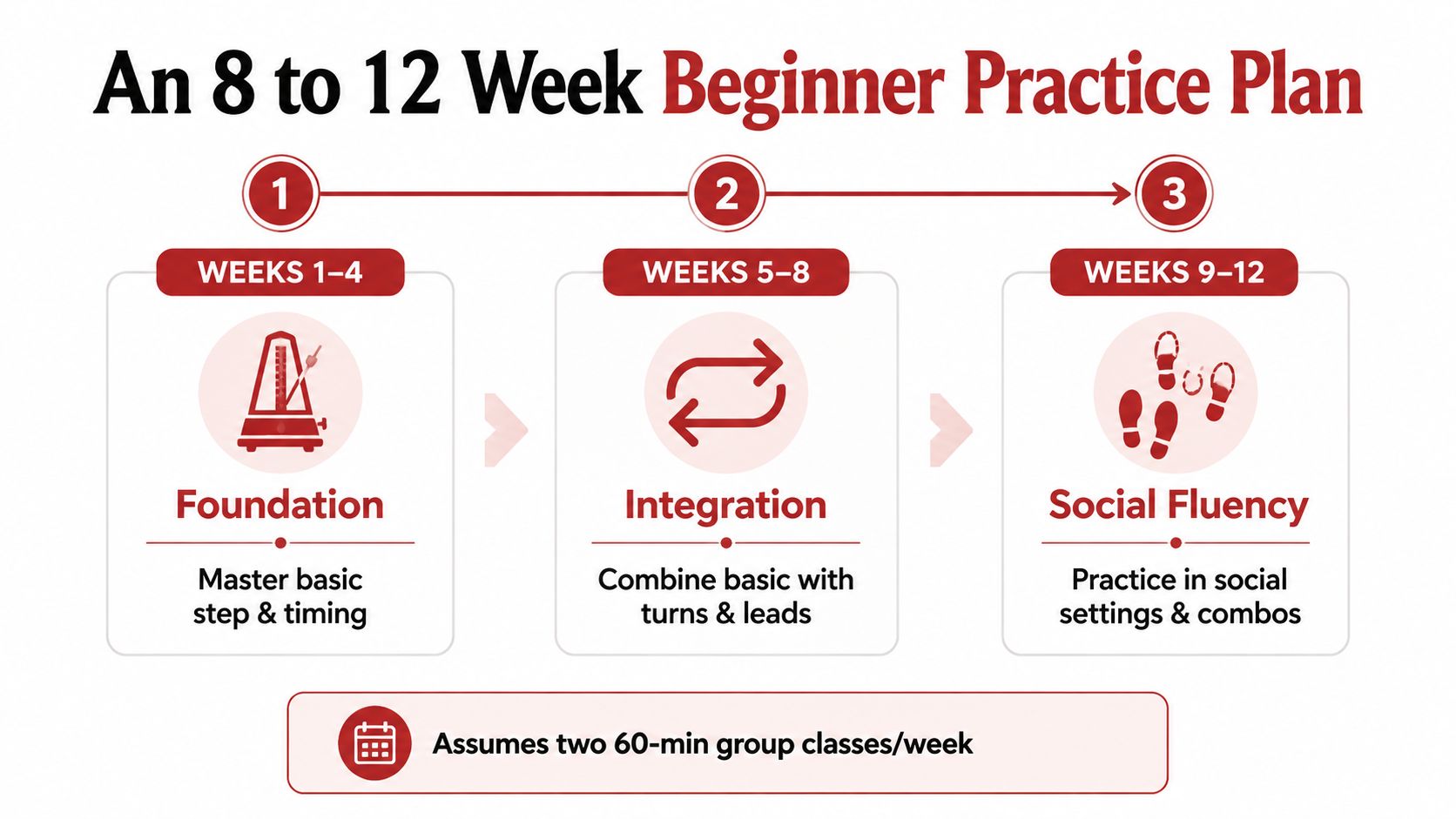
Weeks 1 to 4, foundation
Focus on the basic step, clean weight transfer, posture, and your chosen On1 or On2 break. Count aloud during solo practice, then reduce the volume gradually as your body begins to recognize the phrase. Your milestone is dancing the basic smoothly across the floor without reaching, wobbling, or restarting after every phrase.
Weeks 5 to 8, integration
Add the right turn, cross-body lead, and one or two partner patterns from class. Practice each movement first without arms, then with the appropriate hand or shoulder cue. Your milestone is completing a full song without losing timing, even if you repeat the same few figures.
Weeks 9 to 12, social fluency
Add musicality drills, an inside turn, and your first social dance outing. Don't wait until you feel flawless. The purpose of a social is to learn how your timing and connection hold up with unfamiliar partners. Your milestone is completing three full dances with strangers, adjusting the complexity to your actual comfort.
Use this printable checklist:
- Count the rhythm for five minutes.
- Drill the basic step.
- Practice one turn or directional change.
- Attend the scheduled group classes.
- Review one correction from class.
- Listen for a musical accent or phrase change.
- Record each social dance outing and note what felt stable.
A missed milestone usually points to timing or weight transfer, not a lack of move vocabulary. Repeat the block until the basic feels dependable, then progress.
Next Steps and Booking Your First Lesson
Once the basic, turns, connection, and musicality begin working together, your practice should move beyond the living room. Attend social dance nights and use simple patterns with rotating partners. A successful evening isn't measured by how many figures you perform. It's measured by whether you stay present, keep time, communicate clearly, and make your partner feel comfortable.
Weekend workshops can provide concentrated feedback when you want to improve a specific skill such as turns, shines, partner connection, or musicality. If you're preparing for a wedding, choreography creates a structured project that can develop over 3 to 6 months, giving you time to learn the sequence, refine transitions, and perform without relying on improvisation. You can also cross-train with bachata or cumbia to develop body movement, rhythm awareness, and confidence in social settings.
To find a suitable local starting point, browse salsa dancing studios and lesson options. Book a complimentary intro lesson or trial group class within the next seven days if you can. A specific appointment turns a good intention into the first repetition.
Prepare for the first lesson
- Arrive early: Give yourself time to meet the instructor and settle in.
- Wear comfortable shoes: Smooth soles make pivoting easier than heavy athletic tread.
- Choose clothes that allow movement: You should be able to bend your knees and move your shoulders freely.
- Hydrate: Bring water, especially if you're not used to sustained movement.
- Communicate concerns: Tell the instructor about injuries, pain, or movement limitations before class begins.
You don't need a partner, natural rhythm, or a polished wardrobe to start. You need a clear count, patient repetition, and a teacher who can help you build the stack one layer at a time.
Danza Academy of Social Dance offers salsa instruction through private lessons and group classes, with guidance focused on fundamental steps, rhythm, partner connection, and musicality. Visit Danza Academy of Social Dance to book the free complimentary lesson, arrive with your questions, and take the first practical step toward dancing socially with confidence.