You're probably in one of two places right now. You want to start dancing, but you don't know which studio fits, or you've been putting it off because the whole process feels harder than it should. Most beginners aren't worried about the dancing itself. They're worried about walking into the wrong room, feeling behind, or signing up for something that doesn't match why they wanted to dance in the first place.
That hesitation is normal. Colorado Springs gives you real options, which is good news, but it also means you need a better filter than “closest studio” or “best-looking website.” Some classes are built for wedding prep. Some are built for social connection. Some are ideal for a solo adult who wants confidence before ever stepping onto a social floor.
A lot of local content still assumes you're showing up as part of a couple. That leaves out a big part of the market. While many dance resources are geared towards couples, there has been a significant 35% rise in solo adults signing up for dance classes nationwide, driven by a desire for social reconnection, according to local Groupon trend context for Colorado Springs dance classes. If you're looking on your own, you're not the exception. You're part of a growing group of adults who want a clear on-ramp.
Start Your Dance Journey in Colorado Springs
A newcomer usually starts with one simple goal. They want to feel comfortable moving to music without feeling awkward. For one person, that means finally trying salsa after years of saying “maybe someday.” For another, it means not dreading a wedding dance. For a solo student, it often means something even more practical. They want enough confidence to say yes to a social night, a beginner class, or a community event without feeling lost.
Colorado Springs is a strong place to begin because the local scene isn't limited to one style or one type of student. You'll find wedding-focused instruction, social partner classes, and community groups with a more casual atmosphere. That variety matters because beginners don't all need the same thing.
If you're completely new, start by narrowing your first goal to one of these:
- Social confidence: You want to meet people, move comfortably, and stop overthinking every step.
- Skill building: You like structure and want a clear learning path.
- Event prep: You've got a wedding, party, cruise, or reunion coming up.
- Creative challenge: You already love music and want a technical hobby.
Practical rule: Your first class should match your reason for starting, not the dance style you think sounds the most impressive.
That's especially true for solo dancers. Couples often have a built-in reason to commit. Singles usually need a studio or class format that lowers the social barrier. If a beginner-friendly environment matters to you, it helps to review guidance designed for adult dance lessons for beginners before you book anything.
What solo dancers should look for first
If you're coming alone, don't make the mistake of judging a studio only by whether it teaches partner dance. Judge it by whether beginners can enter without friction. That means classes where partner rotation is handled well, instructors explain fundamentals clearly, and nobody acts like you should already know the room etiquette.
Some of the best beginner experiences happen when the first objective is small. Learn how to keep time. Learn where to place your weight. Learn how to take a basic lead or follow cue without freezing. That's how confidence starts. Not with flashy patterns, but with simple wins.
Finding Your Rhythm with Different Dance Styles
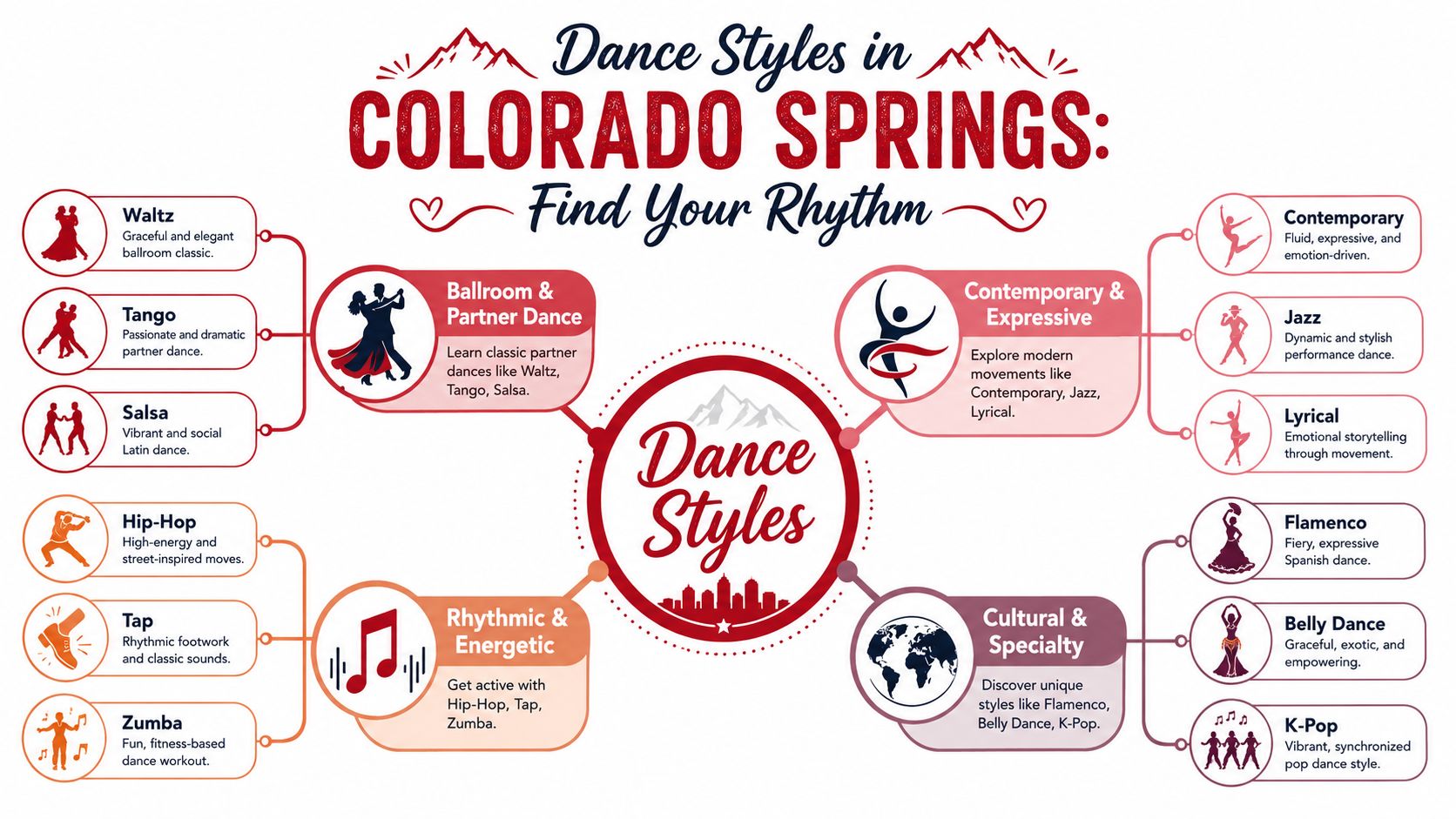
Colorado Springs offers more than one lane. The Colorado Springs dance scene is diverse, featuring studios like Dance Colorado and community groups like Waggin' Wheeler's Square Dancing, offering everything from classic Ballroom and Club Salsa to year-round square dance lessons, as noted by Dance Colorado's local dance community overview.
That variety is useful only if you know how each style feels in real life.
Ballroom styles for structure and polish
Ballroom is a smart starting point if you like order, posture, and technique that builds week by week. In local offerings, that usually means dances such as Waltz, Foxtrot, and Tango. These styles teach you how to travel with a partner, hold frame, and stay composed even when you're unsure of the next figure.
Waltz tends to feel smooth and flowing. Foxtrot feels more conversational and versatile. Tango asks for sharper intention and cleaner timing. Beginners often think ballroom is “formal,” but its core value is that it teaches control. If you want to stop feeling clumsy, that structure helps.
Latin styles for rhythm and energy
Latin styles often attract adults who want a social atmosphere with more bounce, musical play, and visible personality. Around Colorado Springs, you'll commonly see Salsa, Rumba, and Club Salsa in studio and community options. Some wedding-focused providers also include styles such as Bolero or social Latin variations in their packages.
These dances don't all feel the same. Salsa is quick, alert, and social. Rumba slows things down and forces you to hear the beat more carefully. Bolero sits in a space many beginners find surprisingly useful because it teaches smooth motion with expressive timing.
If you've ever heard music and wanted to move instead of count, Latin may be your better entry point.
Good teachers don't start Latin beginners with flashy combinations. They start with timing, weight transfer, and enough repetition that the rhythm stops feeling foreign.
Social styles for connection and ease
Some students don't care what category the dance falls into. They want a room where people are friendly and the barrier to entry is lower. Social styles are often the answer. In Colorado Springs, that can mean Swing, East Coast Swing, Country Western, or square dance communities.
Swing works well for adults who want upbeat music and a looser feel. Country partner styles often appeal to people who want practical dance-floor utility at local events. Square dancing is worth more attention than it gets. It can be a strong fit for people who want movement, group interaction, and less pressure around couple-based identity.
Specialized choices for a better personality match
Some students should skip the “most popular” route and choose based on temperament.
| If you want this | Start with |
|---|---|
| Elegant movement and classic partnering | Waltz or Foxtrot |
| Fast social energy | Salsa or Swing |
| Relaxed community feel | Country Western or square dance |
| Sharper lines and dramatic presence | Tango |
| Better musical awareness | Rumba |
A lot of progress comes down to whether the music makes sense to your body. If you want to improve that skill early, learning more about musicality in dance will help you choose a style that clicks faster.
Private Lessons vs Group Classes What Fits You Best
Most beginners ask the wrong question. They ask which option is better. The better question is which format solves your actual problem.
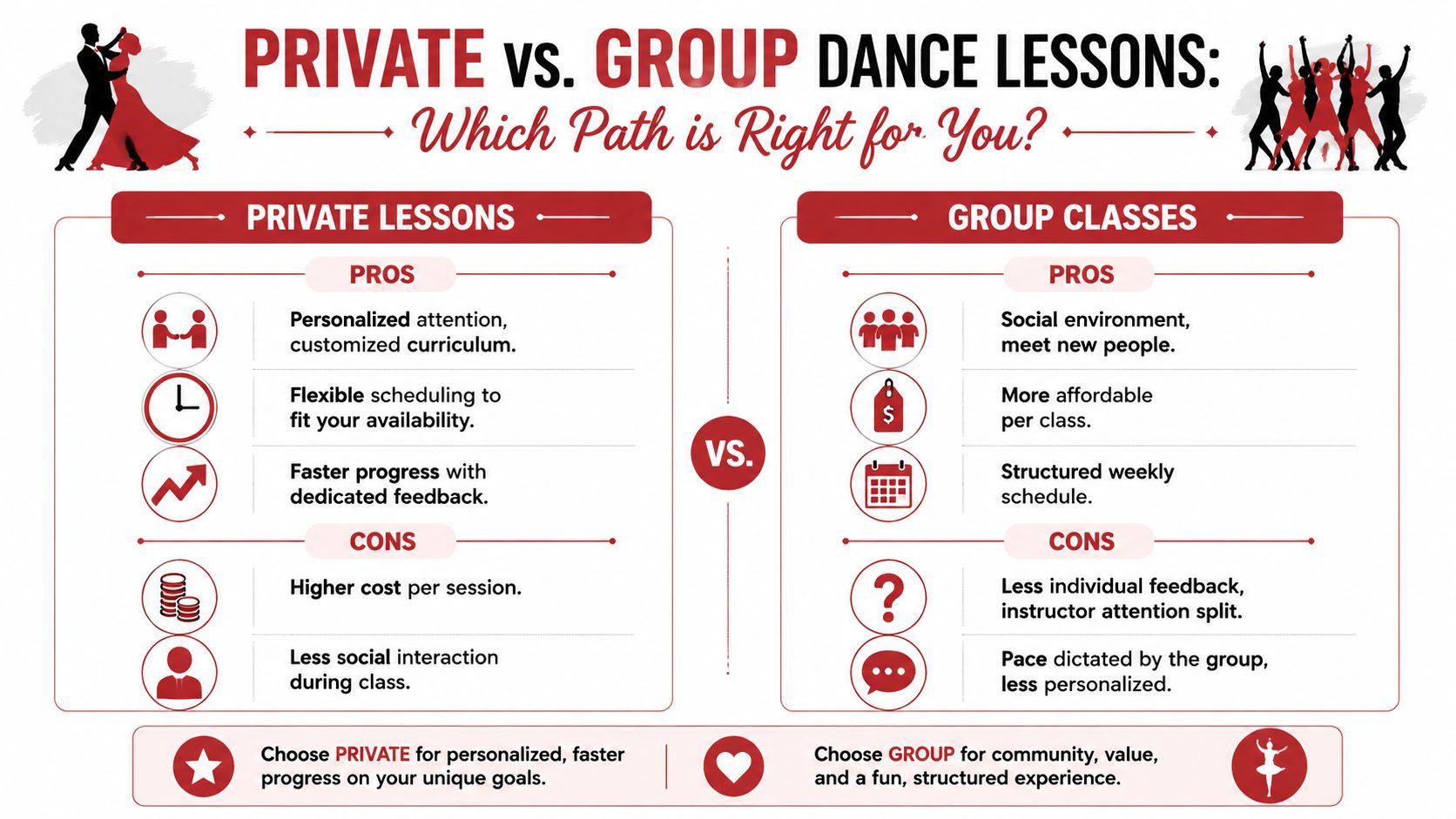
If your problem is “I need to get comfortable and meet people,” group classes usually make more sense. If your problem is “I need fast progress and personal feedback,” private lessons usually win. Neither format is universally better. They produce different results.
When private lessons are the right call
Private lessons work best when precision matters. Wedding couples are the obvious example, but they're not the only one. Solo adults also benefit when they want to fix hesitation, improve partnering faster, or get over the fear of “holding everyone back.”
A private lesson lets the instructor adapt in real time. If your timing is fine but your frame collapses, the whole lesson can shift toward that. If you're a follow who anticipates, or a lead who overuses force, you'll get correction immediately. Group classes rarely offer that depth.
Private lessons are often the smarter choice for:
- Event deadlines: Weddings, galas, reunions, and cruise socials.
- Fast confidence building: You want fewer guesses and more direct feedback.
- Technique cleanup: Posture, timing, connection, and floorcraft need work.
- Schedule flexibility: You can't always attend a set weekly class.
For adults who want a more personalized learning path, it helps to understand how private dance lessons for adults differ from a general class environment.
Where group classes shine
Group classes do something private lessons can't fully replace. They teach you how to function in a real social setting. You hear counts from across the room, adapt to different partners, recover when you miss something, and realize everyone else is learning too.
That matters more than many beginners expect. A solo dancer who only takes private lessons may improve technically but still feel nervous in a social room. A student who only takes group classes may feel socially comfortable but plateau sooner because nobody is correcting small habits consistently.
Coach's note: Group classes are often the best first step for students who are more afraid of the room than the dancing.
A simple way to decide
Here's the trade-off in plain terms:
| Format | Best for | Main limitation |
|---|---|---|
| Private lessons | Speed, personalization, event prep | Higher cost and less built-in social exposure |
| Group classes | Affordability, repetition, social comfort | Less individual feedback |
| Workshops | Quick immersion and variety | Not always enough for steady habit-building |
Workshops sit in the middle. They can be excellent for sampling a style or getting an intensive burst of practice, but they usually work best when paired with something more consistent.
If you're torn, the practical answer is often hybrid. Start with a private lesson if you're anxious or goal-driven. Start with a group class if you want low pressure and community. Add the other format once you know what you're missing.
A Realistic Look at Costs and Commitments
Beginners often overestimate how expensive dance is, then underestimate the commitment needed to improve. The local market in Colorado Springs is fairly readable once you know what pricing models to expect.
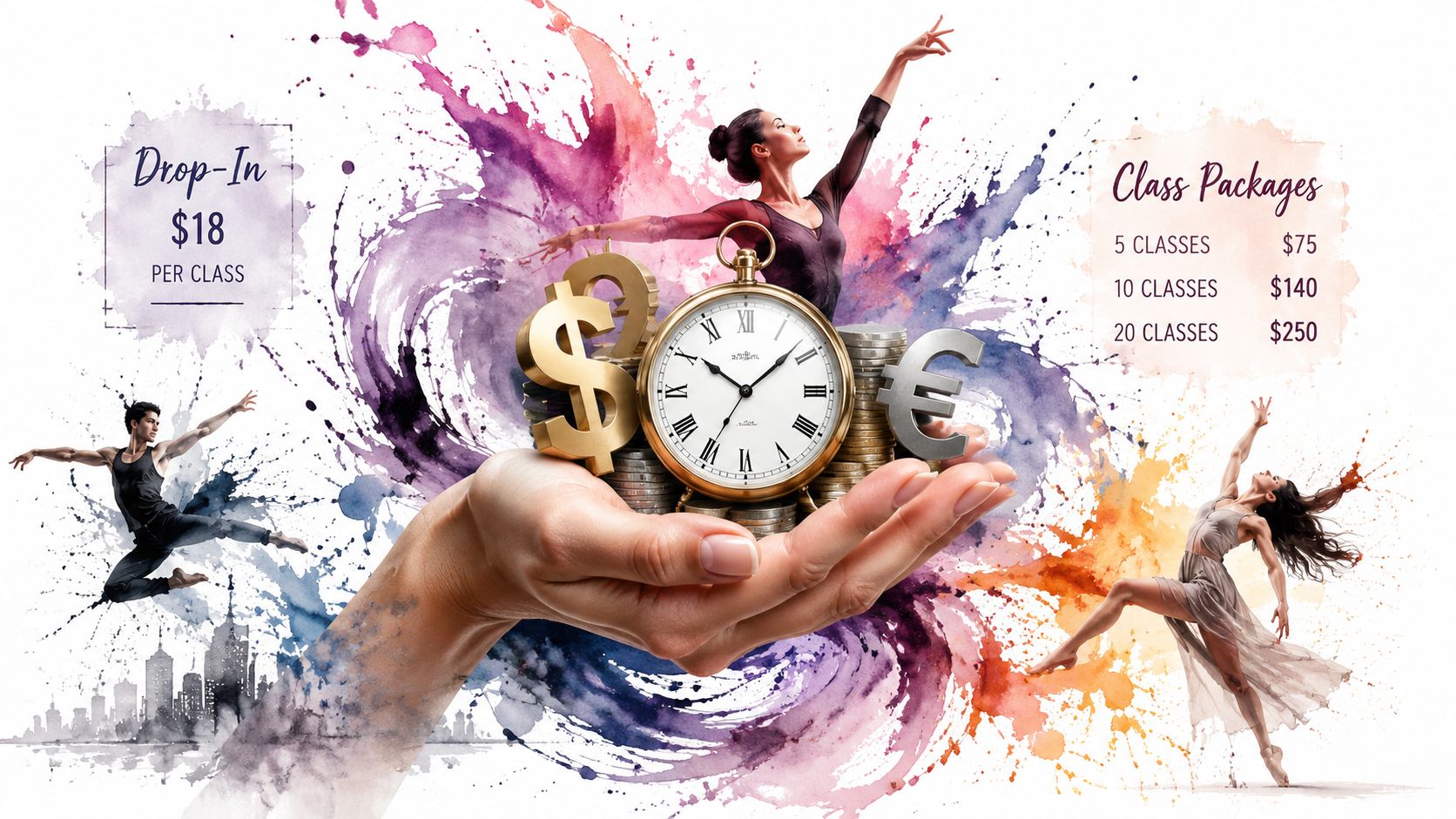
In Colorado Springs, expect an average drop-in rate for partnership dance classes of around $15 per session. Many studios also offer introductory specials, such as two 45-minute private lessons for about $129, as a way for new students to get started, based on Colorado Springs wedding dance lesson market pricing.
What those numbers mean in practice
A drop-in class is usually the easiest entry if you're still exploring. You're paying for access, not a long-term commitment. That's ideal if you're comparing teaching styles, trying out a genre, or easing into dance after a long break.
Introductory private packages are different. They're designed to lower the barrier to starting one-on-one instruction. That can be useful if you need more than casual exposure. It can also be misleading if you assume the intro package represents the full long-term cost of training. Usually, it doesn't. It represents the first step.
Time matters as much as price
The bigger mistake isn't overspending. It's buying a format that doesn't match your actual availability.
If you can only attend inconsistently, don't sign up for something that depends on weekly continuity unless you're sure you can follow through. If you need external accountability, a recurring class may help more than occasional private sessions. The right plan is the one you'll keep.
A few practical budgeting questions help:
- Are you exploring or committing? Exploration favors drop-ins and trial formats.
- Do you need speed or consistency? Speed favors private lessons. Habit favors scheduled classes.
- Will you practice outside class? Students who practice between lessons usually get more value from every paid session.
Some studios also use memberships, packages, or reward-style systems to encourage repeat visits. If you're comparing how businesses structure retention and customer perks more broadly, it can be useful to view loyalty platform costs and see how recurring engagement programs are typically framed. That won't tell you which dance studio is best, but it gives you a useful lens for evaluating whether a studio's pricing model feels straightforward or overly complicated.
Vetting Studios and Instructors Like a Pro
By the time most adults start comparing studios, they've already narrowed the dance style. That's only half the decision. The studio itself will shape your progress more than the style name on the schedule.
A polished website doesn't tell you whether the teaching is clear. A long class list doesn't tell you whether beginners are handled well. And a studio can be popular with wedding couples while still being a poor fit for solo adults who need a better social runway.
What to check before you commit
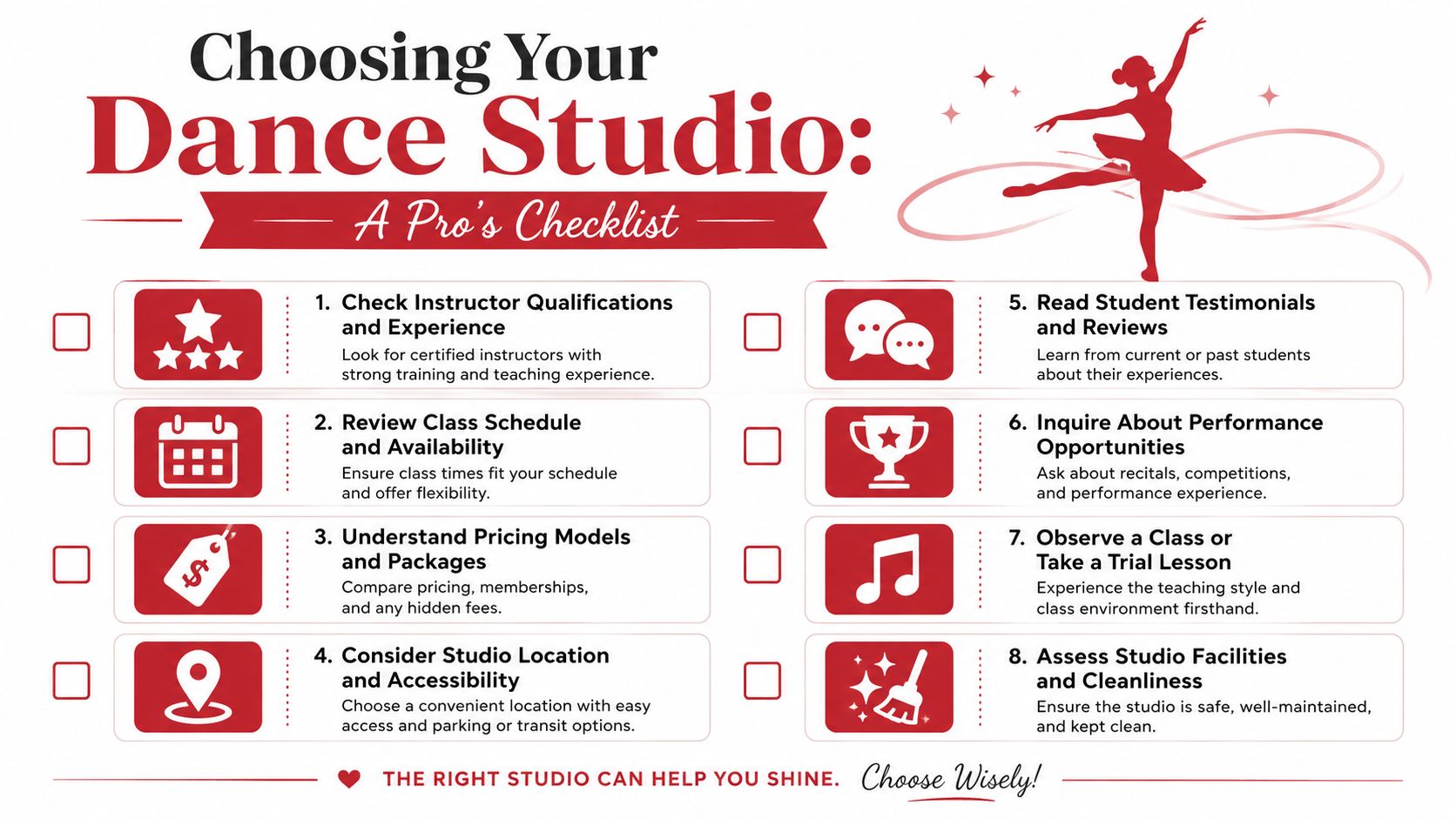
Use a practical screen, not an emotional one.
- Teaching style: Does the instructor explain clearly, or mostly demonstrate and move on?
- Beginner handling: Are new students welcomed, or left to figure it out on their own?
- Partner policy: If you're solo, does the room rotate partners smoothly and respectfully?
- Atmosphere: Is the room tense, cliquish, and performance-heavy, or calm and teachable?
- Progress path: Can the studio explain what happens after your first class?
- Cleanliness and logistics: Floors, spacing, parking, and front-desk organization matter more than people admit.
A good instructor does more than know steps. They know how to sequence information so a beginner can absorb it without shutting down.
Watch for these red flags
Some problems show up immediately if you know what to look for.
| Green flag | Red flag |
|---|---|
| Clear beginner onboarding | Assumes you already know basic terms |
| Transparent pricing | Vague packages and pressure to buy fast |
| Friendly partner rotation | Solo dancers feel stranded |
| Simple scheduling | Confusing class calendar |
| Direct answers | Sales talk instead of instruction |
Don't judge a studio by its most advanced dancers. Judge it by how it treats the newest person in the room.
Why the booking process tells you a lot
The easiest signal of a customer-focused studio often appears before you ever enter the room. Studios that simplify their trial booking process can see sign-ups increase by up to 3.2x. An effortless, 24/7 online booking form with minimal fields is a sign of a customer-focused studio, according to analysis of dance studio trial booking systems.
That matters because the booking process reflects how the business thinks. If the inquiry form is clunky, repetitive, or hard to access, there's a decent chance the student experience will feel the same. Studios that remove friction usually understand beginners better.
The strongest move you can make is simple. Don't choose based on branding alone. Observe a class, ask direct questions, or take a trial lesson. You'll learn more in one visit than in an hour of scrolling reviews.
Your First Class What to Wear and What to Bring
The first class goes better when you stop trying to dress like a dancer and start dressing like a beginner who wants to move comfortably. Wear clothes that let you raise your arms, turn, and take a full step without adjusting every few seconds. For most adults, that means comfortable fitted or semi-fitted clothing, not anything oversized or restrictive.
Shoes matter, but they don't need to be fancy on day one. Start with clean shoes that stay secure on your feet and let you move without fighting the floor. Avoid anything with heavy tread if possible. If a studio has a specific floor policy, follow it. Good studios will tell you what works before class.
What to bring and what to leave at home
Bring only what helps you focus:
- Water: Not because the class is always intense, but because dry studios and nerves catch up fast.
- A light layer: Some rooms feel cool before warm-up and warm later.
- A notebook or phone note: Useful if you tend to forget terminology or practice points.
- An open mind: You'll learn faster if you expect to be imperfect.
Leave behind the idea that you need to impress anyone. Nobody sensible expects a beginner to look polished.
The question solo dancers ask most
A lot of adults still hesitate because they think partner dance requires arriving with a partner. In many beginner settings, it doesn't. What matters more is whether the class is run in a way that includes solo students comfortably. If that's your concern, ask before booking. A good studio will answer directly.
Your first class isn't a performance. It's a test drive.
That's one reason taking advantage of a free trial lesson is a highly effective way to find a studio you'll stick with long-term. It gives you a true taste of the class experience without any initial financial commitment, preserving the perceived value of the instruction, as explained in this guide to why free trial dance lessons work.
If you've been waiting until you feel “ready,” this is the part to let go of. Readiness usually comes after the first class, not before it.
If you want a welcoming place to start, Danza Academy of Social Dance offers a free complimentary lesson so you can experience the teaching style before committing. Whether you're coming in solo, preparing for a special event, or ready to build real confidence on the dance floor, you can book your first visit through the Danza Academy contact page.