
You've probably already chosen a venue, talked through the music, sorted the guest list, and made peace with the fact that every small wedding decision somehow turns into five more. Then the first dance comes up, and one of you gets excited while the other says some version of, “I don't dance.”
That's normal.
Most couples don't need a show routine. They need a plan that makes them feel comfortable, connected, and steady in front of the people they love. A good first dance choreographer doesn't turn your wedding into a recital. They shape a moment that fits your song, your personalities, and your actual comfort level.
Why a First Dance Choreographer Is Your Best Investment
You've picked the song. One of you can already hear the moment in your head. The other is hoping a slow sway will be enough to get through it.
That gap is exactly why couples hire a first dance choreographer.
A wedding dance is not about proving you can perform. It is about feeling steady, connected, and comfortable in a very public moment. Good choreography gives you a plan that fits the two people in front of us, not a stock routine copied from a video. If one partner is confident and the other feels like a complete beginner, we build around that from the first lesson.
It helps couples who do not see themselves as dancers
The couples who benefit most are often the ones who start by saying, “We have no idea what we're doing,” or, “One of us does not dance.” That is common. It is also workable.
A choreographer adjusts the dance to your comfort level, your song, your clothing, and the kind of attention you want on the day. Sometimes that means a fuller routine with clear musical moments. Sometimes it means a polished entrance, a few clean turns, and an ending that feels natural. Both can work well.
What matters is that the dance feels like you.
You are paying for judgment, not just steps
Online tutorials can teach patterns. They cannot watch how the two of you move together and make smart changes on the spot.
That coaching saves time and stress in ways couples often do not expect:
- The dance matches your real ability level: We can simplify footwork, shorten travel, or repeat phrases so the dance feels secure under pressure.
- Both partners get a role that suits them: The stronger dancer does not have to drag the other through the song, and the less experienced partner does not get set up to fail.
- The routine fits the setting: Floor size, dress shape, shoes, and even how close guests will stand all affect what should go into the choreography.
- Mistakes stop looking like disasters: You learn where to reconnect, how to keep timing, and how to finish with confidence even if a moment goes off track.
- Practice gets clearer: Instead of running the whole song over and over, you know which sections need attention and which details can wait.
That is the part couples usually value most after the wedding. They did not just memorize moves. They knew what to do, why it worked, and how to recover if nerves showed up.
The process should feel collaborative
A good first dance is built with you, not assigned to you.
At Danza Academy, we shape the choreography around your personalities first. Some couples want romantic and classic. Some want playful. Some want clean basics because being relaxed matters more than doing a dip. We also pay attention to the uneven pairing that shows up all the time in wedding lessons. One partner learns fast, the other needs more repetition. That does not mean the dance has to look uneven. It means the choreographer has to teach with care.
You can get a sense of that teaching approach by looking at our wedding dance teachers at Danza Academy.
It adds something good to the wedding process
Wedding planning can turn into a list of decisions, invoices, and deadlines. Dance lessons give you time to do something together that is active, focused, and fun. There is value in that on its own.
By the time the music starts at your reception, you are not guessing. You have practiced how to stand together, how to start, where to look, and how to move through the song in a way that feels comfortable. For many couples, that peace of mind is the best return on the investment.
Finding the Right Choreographer for You
Not every instructor is the right fit for every couple. Some choreographers teach performance-heavy routines. Some focus on social basics. Some are excellent with experienced dancers but struggle to pace lessons for beginners. The right choice depends less on style labels and more on how they teach.
You're looking for someone who can read the room quickly. If one partner is hesitant, they should notice that. If your song choice is beautiful but too long, they should say so. If your venue won't support sweeping movement, they should build around that instead of forcing a template.
What to look for first
A choreographer should be able to do more than demonstrate well. They should be able to translate movement into something learnable.
A few things matter immediately:
- Beginner-friendly teaching: Ask how they work with couples who've never danced before.
- Range of styles: A broader background helps them match your music and personality instead of pushing one default approach.
- Song editing help: This matters more than many couples realize.
- Clear communication: You should leave a consultation feeling less confused, not more.
- Supportive pacing: Good coaching lowers pressure. It doesn't increase it.
If you're comparing studios, it helps to review the actual instructors and teaching background, not just polished marketing photos. You can get a practical sense of that by looking at Danza Academy's wedding dance teachers, especially if you want to see how a studio presents its wedding coaching team.
Questions worth asking before you book
Some questions reveal more than “How much do lessons cost?”
Ask things like:
How do you tailor routines for complete beginners?
You want a real answer, not “Don't worry, it'll be easy.”Can you help us choose and edit our song?
Song structure shapes everything else.How do you handle mixed comfort levels?
This matters when one partner is eager and the other is reluctant.Will you choreograph for our venue and clothing limitations?
A ballroom routine built for a large floor may not fit a tight reception space.What should we practice between lessons?
Strong instructors give focused homework, not vague encouragement.
Practical rule: Choose the choreographer who makes the dance feel manageable, not the one who makes it sound impressive.
Watch for a mismatch
A few signs should make you pause:
| Green flag | Red flag |
|---|---|
| They ask about your comfort level | They jump straight into flashy moves |
| They discuss music editing early | They leave song length undecided |
| They simplify without apology | They treat simple as “less than” |
| They ask about shoes, dress, and floor | They teach as if every wedding has the same setup |
A studio can have strong credentials and still be wrong for your particular wedding. That's why chemistry matters. You need someone who listens, adjusts, and knows when to push and when to keep it simple.
Designing a First Dance That Is Uniquely Yours
The strongest wedding dances don't all look alike. One couple wants elegant and classic. Another wants soft and understated. Another wants a little humor and surprise. A thoughtful first dance choreographer starts there, with who you are, not with a stock routine.
A couple might come in with a song they love but no idea what style fits it. Another might know they want a Waltz feel, but they're open to changing the music if it helps the dance feel more natural. Good choreography usually grows from a few practical decisions made in the right order.
Start with the feeling, not the move list
The creative process works better when the first question isn't “What tricks can we do?” It's “How do you want this to feel?”
That answer changes everything.
A romantic couple might suit a smooth Foxtrot or a gentle Rumba. A playful pair may feel more like Swing. If the music has a clean rise and fall, a Waltz can feel timeless. If the two of you don't want anything too formal, the choreography can stay grounded, simple, and relaxed while still looking intentional.
Song choice matters so much that it's worth browsing ideas before your first lesson. If you're still deciding, a curated list of best wedding dance songs can help you hear what kind of movement different songs naturally invite.
The non-dancer should never feel trapped
Many couples grow tense at this stage. One partner says, “I'll do lessons if we keep it simple.” That's not resistance. That's useful information.
Expert dance educators emphasize that a successful first dance for a couple with mixed skill levels hinges on a low-pressure process that prioritizes confidence and simple, repeatable patterns over forced complexity, as explained in this guidance on making a non-dancing partner comfortable for a wedding first dance.
That approach works because wedding dancing is different from studio dancing. You'll be in formalwear, under attention, and carrying emotion. Complexity can look impressive in rehearsal and fall apart under pressure. Simplicity often looks better because it lets you breathe, connect, and recover naturally if something slips.
Your first dance should feel like the two of you, not like two people pretending to be somebody else for three minutes.
A choreographer who understands that won't try to “fix” the less experienced partner by piling on steps. They'll build sections that repeat, choose transitions that are easy to remember, and give each person a clear job in the partnership.
Here's a visual example of the kind of polished, accessible result many couples aim for:
Personal doesn't have to mean complicated
Some of the most personal choices are small:
- Turning toward each other instead of out to the room
- Using one signature dip or turn instead of several
- Building the ending around a lyric you both love
- Choosing an entrance that feels calm instead of theatrical
Those details are what make the dance yours. A polished result usually comes from editing well, not adding more.
Your Rehearsal Timeline and Practice Tips
Timing changes how the whole process feels. Start early enough, and lessons feel steady. Wait too long, and every rehearsal starts to feel urgent.
Industry guidance commonly points couples toward a three-month planning window, with many studios recommending lessons begin at least three months before the wedding. Professional coaches also recommend keeping the routine between 2:00 and 2:30 minutes, with guidance in this first-dance lesson advice on song length and preparation explaining that this range helps hold attention and reduces fatigue.
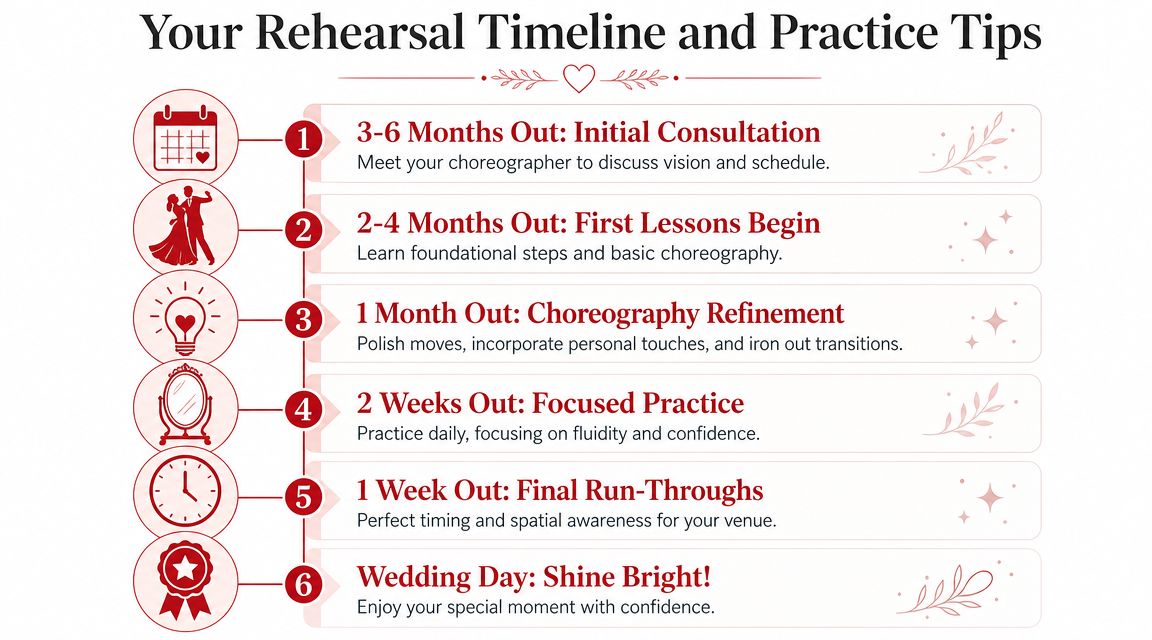
What a smart timeline looks like
That timeline doesn't mean every couple needs the same number of lessons. It means you need enough room to learn, forget, revisit, clean up, and perform without panic.
A practical rhythm often looks like this:
- Early phase: choose the song, confirm the edit, and learn the core frame or foundational movement.
- Middle phase: build the main choreography in chunks that repeat.
- Later phase: clean entrances, exits, timing, and transitions.
- Final stretch: rehearse in realistic conditions.
The order matters. If you build choreography before locking the song, you waste time. If you add too many details before the couple remembers the structure, confidence drops.
What to do between lessons
Home practice doesn't need to be long to be useful. It needs to be focused.
The same expert guidance notes that many couples practice at home for 20 to 30 minutes a few times a week, and that over-choreographing too early makes recovery harder when nerves hit. That's why your practice should center on memory, spacing, and calm repetition, not constant adding.
A strong at-home routine usually includes:
Run the full dance once without stopping
This shows where memory breaks down.Isolate the weak section
Don't keep restarting from the top.Practice with counts, then music
Counts make timing clearer. Music tests recall.End with one clean full run
Finish on success, even if it's not perfect.
Coach's note: Couples improve faster when they repeat a few clean patterns than when they chase more choreography every week.
Rehearse under real conditions
A wedding dance often falls apart for practical reasons, not artistic ones. Shoes slide differently. A dress changes range of motion. The floor feels smaller once tables and guests are in place.
That's why we tell couples to pressure-test the routine before the wedding:
| Practice detail | Why it matters |
|---|---|
| Wedding shoes or similar footwear | Balance, turning speed, and confidence change quickly |
| Full song run-throughs | Stamina and memory need to work together |
| Video review | You catch spacing and timing issues you won't feel live |
| Small-space rehearsal | Most wedding floors are tighter than they look |
| Entrance and ending practice | These are the moments guests notice most |
If memory is your biggest worry, focused repetition helps more than “doing it more intensely.” A useful next step is learning how to remember dance choreography with sectioning, musical cues, and cleaner rehearsal habits.
Nailing the Logistics on Your Wedding Day
By wedding day, the choreography should already be done. What matters now is execution under real conditions. Under these circumstances, small logistical mistakes can make a simple dance feel shaky.
Start with the music cue. Make sure the DJ, band, or coordinator knows exactly which version of the song to play, where it starts, and whether there's a fade or a hard ending. If your routine uses a specific opening pose or pause, tell them that too. Don't rely on someone figuring it out in the moment.
Dress, floor, and spacing change the dance
A key part of choreography that often gets missed is adapting to physical constraints. Professional coaches note in this NBC-featured discussion of wedding dance spacing and attire limits that sleeves, bodices, and skirts can restrict movement, and couples need spatial awareness so they're not “playing bumper cars.”
That applies even to very simple dances.
If the dress has structure through the shoulders or torso, certain turns may feel smaller. If the skirt is full, your foot placement needs to stay cleaner. If the floor is crowded or compact, the dance should travel less. None of that means your choreography is wrong. It means smart couples adapt.
A short day-of checklist helps
Use something concrete:
- Test the floor early: Even a brief walk-through tells you whether it's slick, sticky, or tighter than expected.
- Run key moments, not the whole routine repeatedly: Save energy. Rehearse the entrance, one transition, and the ending.
- Bustle or manage the dress correctly: If there's a train or added volume, know who's helping before the dance starts.
- Stand where the camera can see you well: If you care about the photos and video, face matters.
For couples thinking beyond the dance itself, it also helps to understand how movement, timing, and room setup affect your pictures. This guide to mastering wedding photography is useful because it shows how positioning and planning shape what gets captured.
Calm couples almost always look more polished than over-rehearsed couples who are fighting the room.
Frequently Asked Questions About Wedding Dance Lessons
A lot of couples walk into their first lesson with the same look. One of you is excited, the other is worried about being the person with "no rhythm." We see that all the time at Danza Academy, and it is very workable. Good wedding dance lessons are not about turning you into performers. They are about building a dance that fits your music, your personalities, and the version of confidence you can carry onto the floor.
How much should we budget for wedding dance lessons
Lesson pricing varies by studio, city, and how customized you want the dance to be. A simple first dance with a few polished transitions usually costs less than a fully custom-designed routine with music edits, styling details, and multiple rounds of revision.
A better way to budget is to match the plan to your real goal.
If you want to feel comfortable, connected, and prepared, you may only need a small package and a clear practice plan. If one partner is anxious, the song has tricky phrasing, or you want a dance with more personality, it often makes sense to invest in more coaching so the routine feels natural instead of rushed.
What if we have absolutely no rhythm
Usually that means one of three things. You are not used to counting music, you have never danced together, or one of you gets tense the second attention is involved.
All of those can be taught around. We break music into clear landmarks, give you steps that repeat in a way that makes sense, and build in recovery points so a small mistake does not turn into panic. For many couples, the goal is not to dance "big." The goal is to feel steady and connected.
If one partner is the self-described non-dancer, we do not force them into material that fights their instincts. We shape the choreography around what they can do confidently, then add details that make the whole dance look polished.
Can we combine parts of different songs into a medley
Yes, and it can be a lot of fun when it reflects who you are as a couple. A medley works best when the music cuts are chosen early, because every transition changes timing, energy, and memory load.
That trade-off matters.
A medley can create a bigger moment, but it also asks more of you in rehearsal. If one of you is already nervous, we may suggest keeping the footwork simple and letting the music change provide the surprise. If you both love performing, a medley gives us more room to show different sides of your personality.
If you are sorting out the rest of the wedding budget too, this guide with essential wedding vendor tipping insights is useful for another planning detail couples often leave until late.
How many lessons do we need
The answer depends on your starting point and the kind of dance you want. Couples who want a short, clean first dance usually need fewer lessons than couples asking for custom choreography, lifts, dips, or a medley.
Time matters as much as lesson count. Weekly lessons with practice in between usually work better than cramming, because your body needs repetition and a little space to absorb what you learned. We would rather see you do a simple dance with confidence than a complicated one you do not trust yet.
Do we need a fancy dance style
No. Guests respond to comfort, connection, and clear movement more than dance terminology. A well-structured routine built from easy patterns can look elegant, romantic, playful, or relaxed, depending on who you are.
That is why collaboration matters. The right choreographer does not hand every couple the same template. We help you choose a style and level of difficulty that feels like you, whether that means classic and understated or lighthearted and a little unexpected.
What if one of us is much more nervous than the other
That is common, and it should shape the lesson plan from the start. The nervous partner usually does better with smaller pieces, more repetition, and a role that feels secure. The more confident partner often needs guidance too, especially on leading calmly, staying patient, and not trying to fix everything mid-dance.
We treat that difference as part of the choreography process, not a problem to hide. When both partners feel understood, the dance gets better fast.
If you are still unsure what would suit your song, comfort level, or timeline, the easiest next step is to talk it through in person. At Danza Academy of Social Dance, you can book a free complimentary lesson through the contact page. It is a simple way to ask questions, meet an instructor, and find out what kind of first dance will feel like you.