You're likely here because Latin dance has been on your mind for some time. Perhaps you watched a couple glide through salsa at a party, saw a wedding first dance that felt alive instead of staged, or caught yourself thinking that group classes might be more fun than another hour on a treadmill. You want in, but you also want someone to tell you what happens in a latin dance class before you walk through the door.
That hesitation is normal. Beginners worry about rhythm, partners, coordination, and whether they'll stand out. In practice, most new students are dealing with the same mix of curiosity and nerves, and the first class is designed for exactly that stage.
A good class doesn't expect you to know anything. It gives you a structure, a few clear wins, and enough guidance to feel the music without getting buried in technique. Over time, dancing becomes more than a one-time activity. It can fit childhood, college, adulthood, wedding season, healthy aging, and even competitive goals.
Welcome to the World of Latin Dance
A lot of people start the same way. They love the music, they admire the confidence dancers seem to have, but they assume they've missed the window to begin. Then they finally try one class and realize the room is full of regular people learning one step at a time.
That shift matters. Dancing changes how people relate to themselves and to others. A 2012 study on Latin dance participation found significant increases in self-efficacy and social connectedness among middle school students after five weeks, which is one reason partner dance works so well for reducing isolation and building trust in a group setting.
For adults, that shows up in practical ways. You get better at reading non-verbal cues. You learn to work with a partner instead of forcing your way through movement. You start feeling more comfortable taking up space.
The first breakthrough usually isn't a perfect turn. It's the moment a student stops apologizing for being new.
Why beginners stick with it
Some hobbies ask you to perform alone. Latin dance gives you a room, music, structure, and community right away. That makes it easier to keep showing up, especially when you're busy or a little self-conscious.
Here's what tends to help most:
- Clear basics first: Good instruction starts with rhythm, foot placement, and posture before flashy combinations.
- Social learning: Rotating partners in class helps you adapt and loosens the fear of “getting it wrong.”
- Visible progress: Even one class can make the music feel less mysterious.
A hobby that grows with you
Latin dance also works at different life stages. Kids can build coordination and confidence. Adults can use it for fitness, social connection, or pure fun. Engaged couples can turn it into a first dance they actually enjoy. Experienced students can keep training for stronger technique, better musicality, and competition.
That range is what makes a latin dance class worth trying. You don't need to decide your entire dance future before lesson one. You just need a place to start.
Exploring the Rhythms of Latin Dance
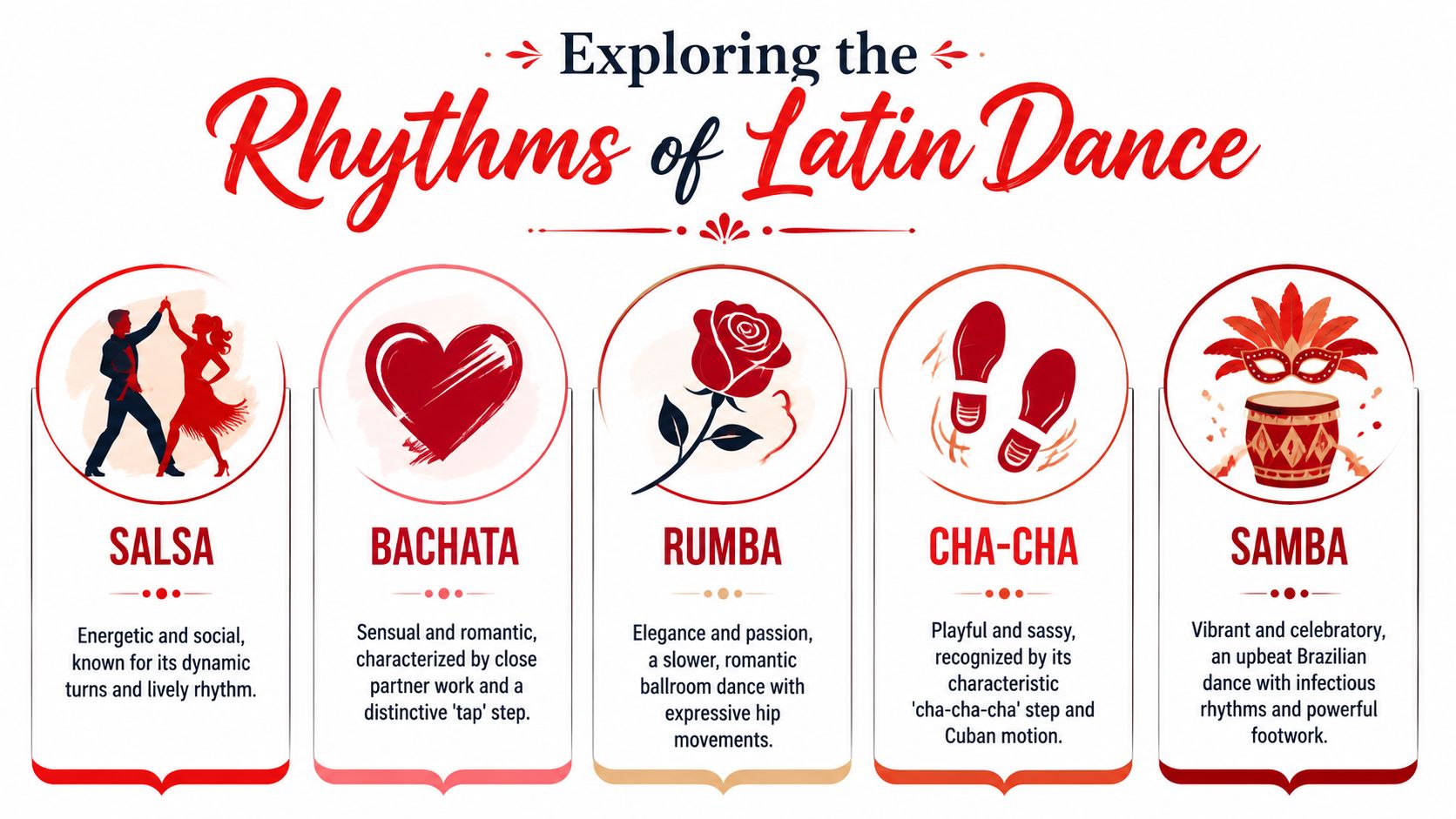
The easiest way to choose your first style is to think less about labels and more about personality. Each Latin dance has a different pulse, mood, and kind of movement. Some people walk into their first class convinced they want salsa, then fall in love with cha-cha. Others want something romantic and discover they prefer the grounded feeling of rumba.
Salsa
Salsa is usually the gateway dance for a reason. It feels social right away. The music has momentum, the basic step is approachable, and even simple patterns look exciting once you understand timing.
Students who enjoy salsa usually like movement that feels lively and interactive. If you want turns, partner changes, and a dance you'll see often at parties and socials, salsa is a strong place to begin.
Bachata
Bachata has a more intimate, relaxed feel. The movement is often smaller, the partner connection is more obvious, and the rhythm gives beginners a chance to settle into the music without feeling rushed.
This style suits people who want something smooth and expressive. It's also a helpful choice for students who feel overwhelmed by fast footwork and want to develop comfort with partner movement first.
Practical rule: Don't choose your first style based on what looks hardest. Choose the one whose music makes you want to move.
Rumba
Rumba slows the room down. It asks for patience, balance, and control. Beginners sometimes think slow means easy, but rumba exposes weight changes and posture very clearly, which is exactly why it's so useful.
If you like expressive dancing and want to understand body action in a deeper way, rumba gives you that foundation. It also builds habits that carry over into other Latin styles.
Cha-Cha
Cha-cha is playful. It has sharp rhythm, compact steps, and a lot of personality. The syncopation gives it bounce, and the timing rewards attention to detail.
Students who enjoy precision often do well here. Cha-cha is excellent for learning how musical accents shape movement, and it teaches you not to rush.
Samba
Samba feels festive and athletic. It has bounce, drive, and a strong sense of celebration. It's demanding, but it's also incredibly rewarding once the rhythm starts making sense in your body.
For students who love upbeat music and don't mind working for their coordination, samba can be a lot of fun. It tends to appeal to people who want energy on the floor.
Which Latin dance style is right for you
| Dance Style | Energy Level | Feeling & Vibe | Common Music |
|---|---|---|---|
| Salsa | High | Social, vibrant, fast-moving | Lively Latin club music |
| Bachata | Moderate | Romantic, relaxed, connected | Guitar-driven Latin music |
| Rumba | Moderate to low | Expressive, grounded, controlled | Slower romantic Latin music |
| Cha-Cha | Moderate | Playful, rhythmic, cheeky | Syncopated Latin dance music |
| Samba | High | Festive, driving, celebratory | Upbeat Brazilian rhythms |
How to choose without overthinking
If you're unsure, use simple criteria:
- Pick salsa if you want the broadest social use.
- Pick bachata if connection matters more to you than speed.
- Pick rumba if you want technique and control.
- Pick cha-cha if rhythm details excite you.
- Pick samba if you want bounce and high energy.
The good news is that your first choice doesn't lock you in. Many dancers start with one style and branch out once their timing and confidence improve.
Finding Your Perfect Class Format
The right format can make the difference between “that was interesting” and “I'm coming back next week.” People often assume dance learning is one-size-fits-all, but it isn't. A busy parent, a shy beginner, an engaged couple, and a teen interested in performance usually need different setups.

Group classes for social momentum
Group classes work well when you want energy, repetition, and community. You learn alongside other beginners, hear the same counts repeatedly, and get the benefit of seeing common mistakes corrected in real time.
This format is especially useful if your goal is social dancing rather than a polished routine. If you're comparing options, this guide on how to choose a dance studio can help you evaluate teaching style, class structure, and atmosphere.
Group classes are a strong fit for:
- New adult students: You'll get used to timing and partner rotation without pressure.
- Students on a schedule: Weekly classes create consistency.
- People seeking community: The social side becomes part of the habit.
Private lessons for focused progress
Private instruction is better when you want direct feedback. An instructor can adjust posture, timing, foot placement, and frame on the spot. That usually leads to cleaner movement and fewer bad habits.
Private lessons make sense for students who feel nervous in groups, have irregular schedules, or want faster progress. They're also ideal when one issue keeps repeating and needs personal attention.
In partner dance, general advice helps. Specific correction changes everything.
Wedding dance preparation
Wedding couples often need a different kind of plan. They're not looking for endless patterns. They want a routine that fits their song, their comfort level, their clothing, and the size of their dance floor.
That demand is growing. Search interest in “Latin wedding dance lessons” rose 22% year over year in 2025, and 28% of couples chose Latin-infused first dances, according to the cited wedding trend data. The trade-off is simple: group classes build general skill, while wedding lessons focus on a short-term, personalized result.
Kids programs and family pathways
Kids need classes that build rhythm, listening, and confidence without overloading them with jargon. The best youth instruction keeps structure tight and movement joyful. Parents often underestimate how useful dance is for posture, coordination, and comfort performing in front of others.
A family that starts with one child's class often discovers a longer path. Parents try beginner sessions. Siblings join. A wedding or special event creates another reason to train. That's how dance becomes part of family life instead of a single course.
One practical option in the Philadelphia area is Danza Academy of Social Dance, which offers group classes, private lessons, wedding preparation, kids' programs, and competitive training in Center City and Exton.
What to Expect in Your First Lesson
Most first lessons are calmer than people expect. You won't walk in and be thrown into advanced partner work. A good beginner session builds confidence in layers, starting with the basics your body needs before any turn or combination makes sense.
The first few minutes
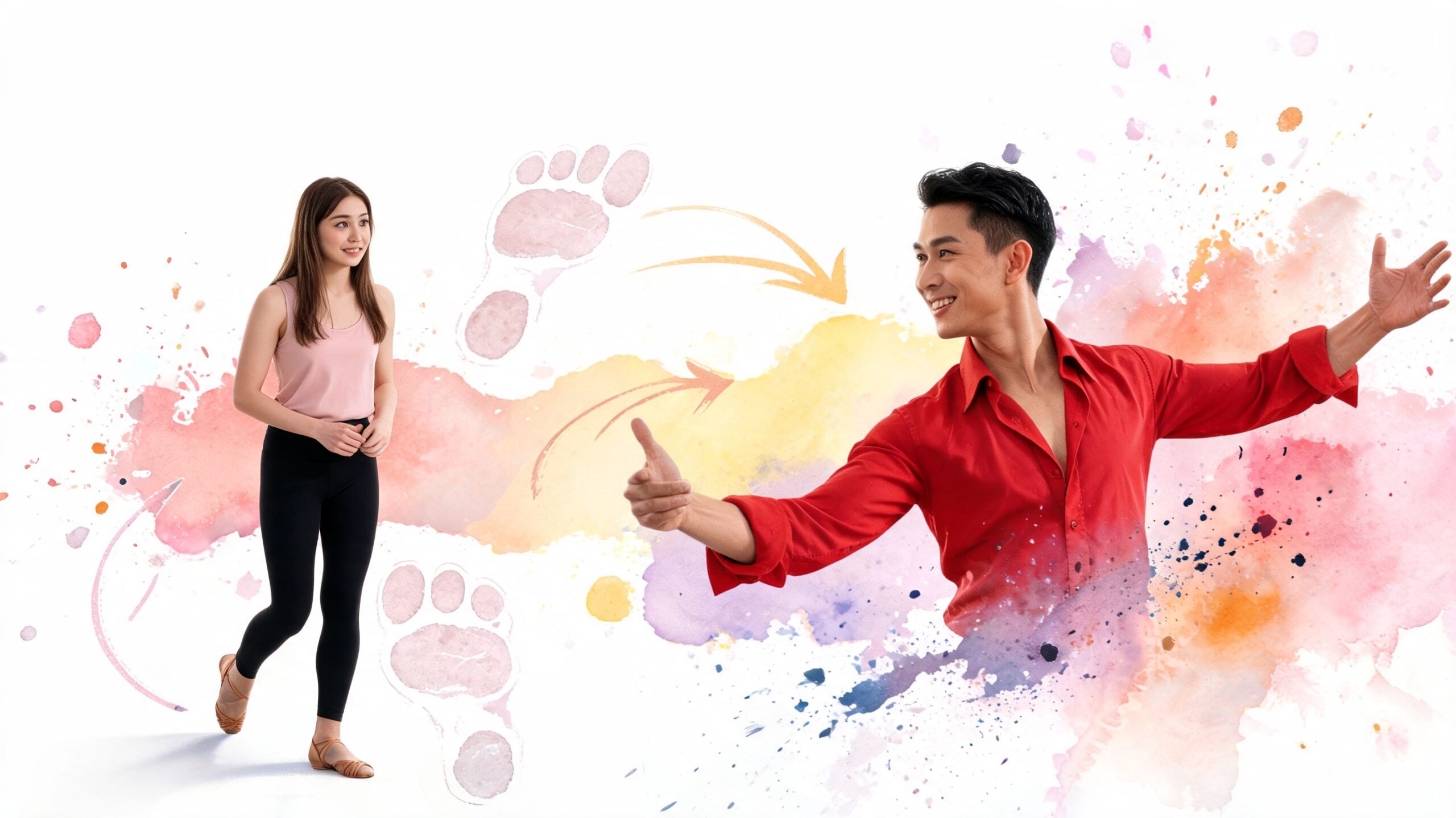
You'll usually begin by getting oriented to the room, meeting the instructor, and loosening up with a simple warm-up. That warm-up isn't about fitness boot camp energy. It's there to wake up your feet, knees, hips, and core so rhythm feels easier to organize.
Then comes the first real task. You learn a basic step pattern by yourself before adding a partner. That matters because beginners need to hear the count and feel the weight change in their own body first.
If you want a closer look at what that experience feels like, this beginner dance lesson overview gives a practical preview.
Learning the basic without panic
At this stage, the instructor usually keeps the combination short. Think basic forward and back steps, side movement, or a small rhythm pattern that repeats until it feels familiar. The goal isn't memorizing a long sequence. The goal is to stop freezing when the music starts.
Common beginner experiences include:
- Missing the count at first: Normal. It takes repetition before the rhythm settles in.
- Looking at your feet: Also normal. That fades as the pattern becomes automatic.
- Feeling better by the end than the beginning: This is usually the turning point.
Your first technique concept
One of the first real technical ideas you may hear is Cuban Motion. A technical explanation of Cuban Motion describes it as the rhythmic body action created by correct weight transfer and knee action, not forced hip movement, and notes that it often takes 8 to 12 weeks of practice to start feeling natural.
That's important because beginners often make the same mistake. They try to “look Latin” by moving the hips independently. That doesn't work. Proper action comes from the floor up.
When your feet and knees do the right job, the body starts to look like dance instead of effort.
Partnering for the first time
After solo practice, you'll usually try the step with a partner. Nerves might spike at this point, but the fun begins here too. Partnering teaches timing, attention, and shared movement in a way solo drills can't.
Don't expect instant smoothness. Expect small wins. Staying on time for a few measures, finishing a basic pattern together, and recognizing the music more clearly are all excellent first-day results.
From Beginner Steps to Confident Dancer
Progress in dance isn't linear. One week you feel sharp, the next week a basic turn feels clumsy again. That's normal. Skill builds in layers, and each layer depends on what came before it.
The beginner stage
At the beginning, students focus on three things: rhythm, weight transfer, and orientation in space. You're learning where the step goes, when it happens, and how to stay balanced enough to do it again without resetting every second.
This stage can feel repetitive, but repetition is what makes social dancing possible. The goal isn't variety yet. It's reliability.
The intermediate shift
Intermediate dancing starts when you stop thinking only about yourself. Now you have to notice another person's timing, maintain a clearer frame, and respond instead of guessing. That's when lead and follow become real skills rather than vague ideas.
A useful support for older adults working on steadiness outside the studio is this guide to best balance exercises for Boston seniors. Balance training and dance technique complement each other well, especially when students want more control during turns and directional changes.
The advanced layer
At higher levels, connection becomes much more precise. A technical discussion of the lead-follow tension framework describes advanced dancers using 3 to 5 pounds of pressure through the frame and adjusting that connection 4 to 8 times within one 8-count phrase to communicate turns and transitions cleanly.
That sounds technical, and it is. But the practical meaning is simple. Advanced dancers don't shove or guess. They create clear, responsive communication through posture, timing, and calibrated resistance.
Smooth dancing is rarely about bigger movement. It's usually about clearer information.
What works and what doesn't
Students improve faster when they accept a few realities:
- What works: Regular attendance, simple drills, listening to the music outside class, and taking correction without ego.
- What doesn't: Collecting complicated patterns before basics are stable.
- Also doesn't work: Trying to dance “harder” instead of dancing more clearly.
Confidence comes from competence. The flashy part arrives later, and it looks better when the basics are solid.
More Than a Workout The Benefits of Latin Dance
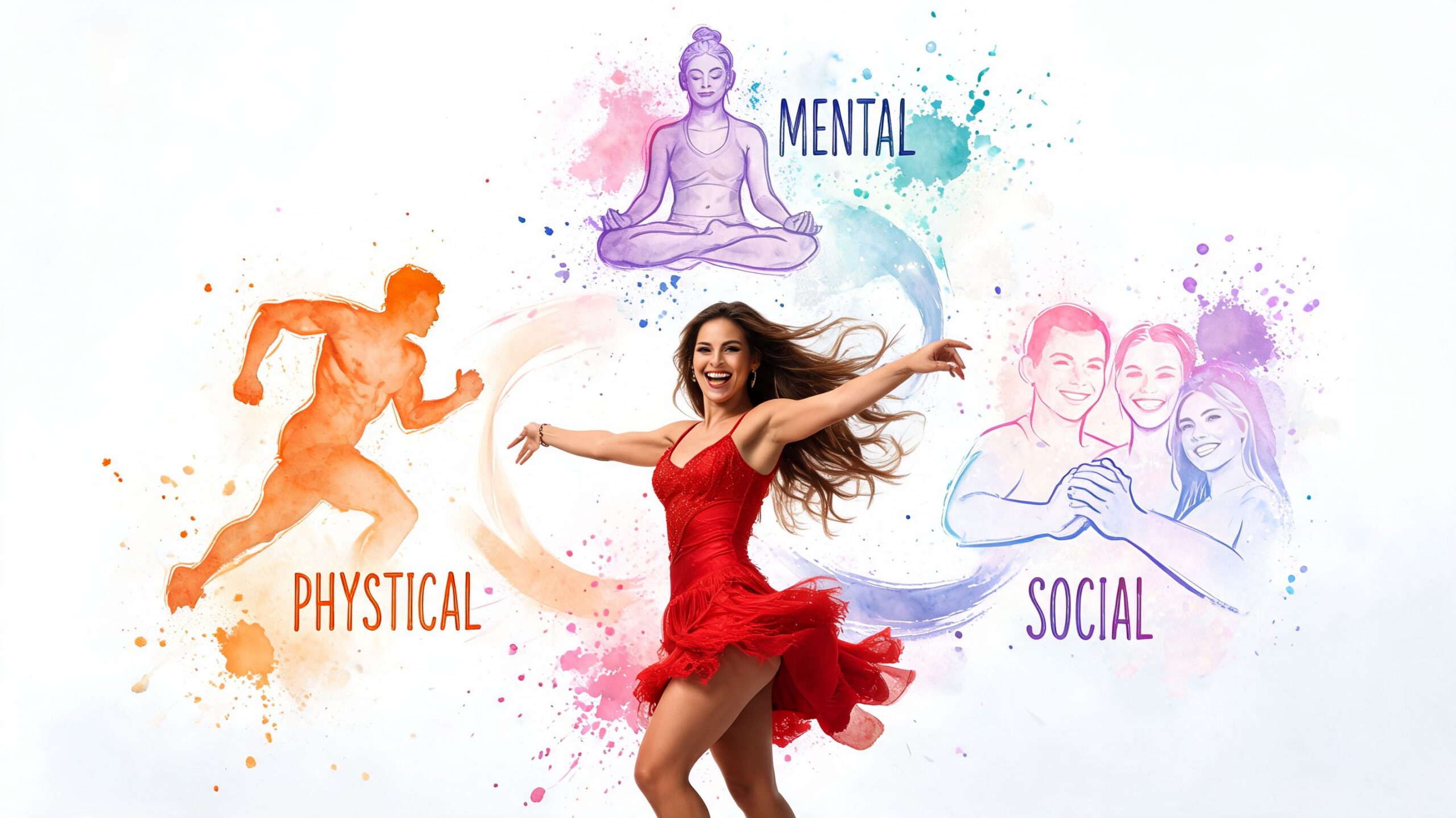
A latin dance class can absolutely challenge your body, but treating it as exercise alone misses the bigger picture. The strongest long-term students usually stay because dancing combines physical training, social contact, and mental engagement in one place.
Physical benefits
A 2024 report summarizing an Applied Sciences study on Latin dance and musculoskeletal health described 30 participants with a median age of 66 in one-hour Latin dance sessions. Wearable sensors showed that the ankles and knees absorbed much of the impact, especially at faster tempos, supporting joint loading and muscle engagement in ways that can help counter age-related physical decline. The same report notes that classes can burn 300 to 600 calories per hour, depending on intensity.
That combination is one reason dance appeals to people who don't enjoy conventional workouts. You're training coordination, lower-body strength, posture, and stamina while dealing with music and movement instead of staring at a screen.
Social benefits
Partner dancing teaches social skills in a very direct way. You have to pay attention, respect space, communicate through touch and timing, and recover gracefully when something goes wrong. In group settings, students also build familiarity over time, which makes it easier to keep showing up.
Many adults need exactly that kind of low-pressure social structure. If you're interested in how this side of dance develops over time, this article on the benefits of social dancing is a helpful companion.
Mental benefits
Dance asks your brain to do several jobs at once. You listen, count, move, adjust, remember, and respond. That makes class mentally engaging in a way many fitness routines aren't.
The payoff goes beyond class. Students often report better confidence, lower stress, and a stronger sense of presence in social settings.
Here's the trade-off in plain terms:
- Gym workouts may be simpler to measure.
- Dance classes often feel easier to sustain because the activity itself is enjoyable.
- Partner dance adds accountability because other people expect to see you there.
That last point matters. People are more likely to continue a habit when it also gives them connection.
Start Your Dance Journey at Danza Academy
Starting is the hardest part for most people. Not because the dancing is impossible, but because walking into something new takes a decision. Once that first lesson is on the calendar, the process gets much easier.
Danza Academy has been teaching for over 40 years, with studios in Center City Philadelphia and Exton, PA. That matters because beginners need more than enthusiasm from an instructor. They need structure, patience, and corrections that make sense. Adults trying something new, parents looking for a productive activity for their kids, couples preparing for a wedding, and experienced dancers refining technique all need different kinds of guidance.
Why the first lesson matters
The best first lesson doesn't try to impress you with complexity. It helps you relax, understand the rhythm, and leave feeling like dance is something you can learn. That's the standard you should expect from any studio you consider.
For many students, the right next step is a low-pressure introduction instead of a big commitment. That's why the complimentary first lesson is useful. You get to experience the teaching style, the environment, and the pace before deciding what format fits your goals.
Who this works for
A first class makes sense if you're any of the following:
- A complete beginner: You don't need prior experience or a partner.
- An engaged couple: You can start building a first dance that feels natural instead of awkward.
- A parent: You can explore a structured activity that builds confidence and coordination.
- A returning dancer: You can rebuild fundamentals and sharpen technique.
If you've been waiting until you felt more coordinated, more confident, or more “ready,” it's better to start before any of that arrives. Readiness usually comes after the first class, not before it.
Frequently Asked Questions About Latin Dance
Do I need to bring a partner
No. Most beginners don't come in with a partner, and a well-run class is built to accommodate that. If you do have a significant other who wants to join, that's great too.
What should I wear to my first class
Wear clothes you can move in comfortably. Choose shoes that let you step and pivot without feeling stuck. You don't need performancewear, sequins, or specialty dance shoes for day one.
How long will it take to feel comfortable
That depends on consistency, the style you choose, and whether you're taking group classes, private lessons, or both. Most students feel more settled once they've repeated the same basics enough times that they no longer have to think through every count.
Comfort usually arrives in stages. First you recognize the rhythm. Then you trust your feet. Then you begin enjoying the music while moving instead of managing every step.
Am I too old, too shy, or too uncoordinated
No. Those are three of the most common concerns, and none of them disqualify you. Good teaching meets you where you are.
If you're shy, class gives you a structure so you're not forced to invent social confidence from scratch. If you feel uncoordinated, basics and repetition fix more than people expect. If you're older, dance can still be an excellent fit because it trains balance, rhythm, and controlled movement in a practical setting.
Should I choose one style or try several
Start with one. Beginners make faster progress when they build one rhythm cleanly before jumping between too many styles. Once your timing improves, adding another dance gets much easier.
What if I mess up in class
You will, and so will everyone else. That's not failure. That's how dance class works. The students who progress are not the ones who never miss a step. They're the ones who keep moving after they do.
If you're ready to try a latin dance class for yourself, book a complimentary first lesson with Danza Academy of Social Dance. It's a simple, no-pressure way to experience the studio, meet the instructors, and find the right path for your goals, whether you're starting from zero, preparing for a wedding, enrolling a child, or returning to dance after time away. You can schedule your free lesson through the Danza Academy contact page.