
You might be here because you've watched a couple glide across a floor and thought, “I wish I could do that,” and then immediately followed it with, “But I’d probably be terrible.”
That thought is more common than you think.
Confidence isn't typically the initial motivator for those starting latin ballroom dancing lessons. They start because something about the music, the movement, or the connection keeps pulling at them. Maybe it was a wedding where everyone else seemed relaxed on the dance floor. Maybe it was a social night out where Salsa and Cha Cha looked fun instead of intimidating. Maybe you just want a hobby that feels alive.
Latin dance has a way of waking people up. It’s rhythmic, expressive, and social. It gives you structure without making you feel boxed in. And even when you’re learning technique, it still feels human. You’re not just memorizing steps. You’re learning how to listen, respond, and move with intention.
If you’re nervous, that’s okay. New students often worry about having no rhythm, no partner, or two left feet. Those worries usually fade once the first lesson begins and the mystery disappears. Dance becomes much simpler when someone breaks it down clearly and lets you build one small success at a time.
Step Onto the Dance Floor An Introduction
A lot of beginners arrive with the same private hope. They want to feel comfortable enough to join in instead of standing at the edge of the room.
Maybe that’s you.
You hear Latin music and feel the beat, but when you picture yourself taking lessons, your brain jumps straight to the hard part. You imagine fast feet, dramatic turns, and experienced dancers who somehow know exactly what to do. From the outside, it can look like everyone else got handed a secret map.
They didn’t. They learned step by step.
Latin ballroom dancing lessons are exciting because they combine music, movement, and partnership in a way that feels personal. One dance might feel playful. Another might feel bold. Another might feel like a quiet conversation between two people. That range is part of the appeal. There’s room for your personality in it.
The other surprise for many first-timers is how welcoming the dance world can be. Good instruction doesn’t throw you into the deep end. It gives you rhythm first, then balance, then timing, then connection. One piece starts making sense, and then the next one does too.
You do not need to arrive looking like a dancer. You arrive, and then you become one.
If you’ve been curious for a while, this is the right place to begin. The world of Latin dance is much less mysterious than it looks, and once you understand how the dances feel, what happens in a first lesson, and how the learning process works, it becomes a lot easier to take that first step.
Exploring the Rhythms of Latin Dance
A new student often expects Latin dance to feel like five completely different worlds. In practice, it feels more like learning five ways to have a conversation through music. Each dance has its own tone, pace, and body action, but they all teach the same core skills: hearing the beat, changing weight with control, and connecting your movement to a partner.
International Latin ballroom follows a clear format. It includes five standardized dances performed in competition: Cha Cha, Samba, Rumba, Paso Doble, and Jive. That structure was formalized around 1950 and is used widely in competitions around the world, according to Vibe DanceSport’s overview of International Latin.
For beginners, that structure is reassuring. You are not walking into a mystery. You are learning a family of dances with recognizable personalities.
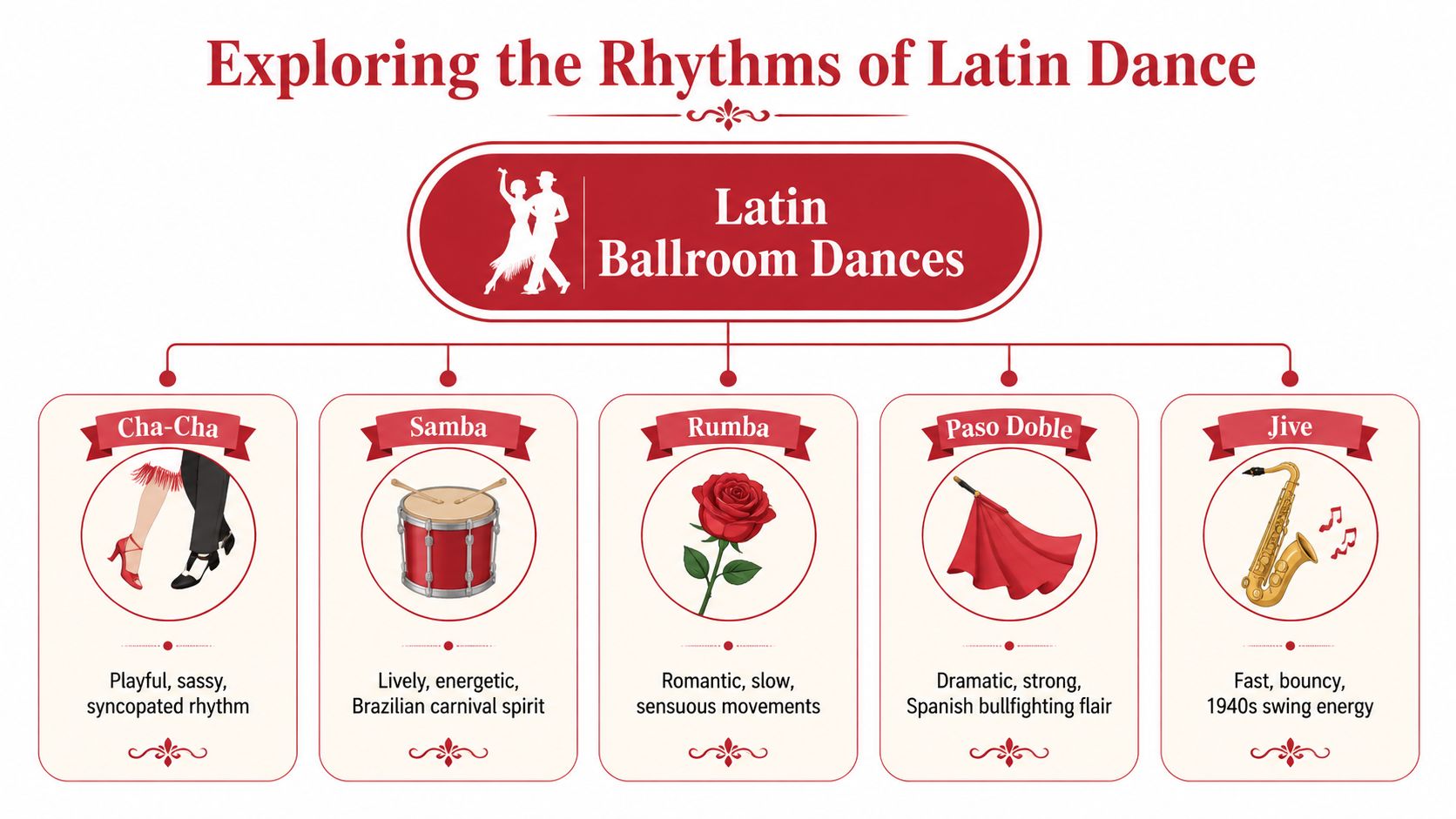
Cha Cha
Cha Cha is often the first dance that makes a beginner smile.
It feels playful, sharp, and a little mischievous. In International Style, the music is in 4/4 time, and many students learn the basic rhythm as 2-3-4&1, as noted earlier. That count gives the dance its signature little sparkle. You hear the beat, then you answer it with quick, tidy steps.
Cha Cha works like a light conversation with someone who keeps you on your toes. There is back-and-forth in the rhythm. There is also clarity. Many beginners enjoy it because the timing is easy to hear, which makes it easier to trust your feet.
Samba
Samba brings a completely different feeling. It is buoyant, traveling, and full of lift.
Its roots connect to Brazilian carnival traditions, and that festive spirit still comes through. The movement has a soft rebound quality that can surprise first-timers. Students sometimes see Samba and assume it is loose and spontaneous. In reality, it's more interesting. Samba asks for control inside the bounce, the same way a basketball returns cleanly because of how you release it.
Once that rebound starts to feel natural, Samba becomes joyful instead of confusing.
Rumba
Rumba slows the room down.
That slower speed is helpful, but it also asks more from you. In Rumba, you can feel every transfer of weight, every pause, and every moment of hesitation. Beginners often discover that this is the dance where connection stops being an abstract idea and starts feeling real.
Rumba works like a quiet conversation between two people who are listening. One person moves. The other responds. The space between those actions matters. That is why Rumba teaches so much about timing, balance, and partner awareness. It is less about rushing to the next step and more about staying present in the one you are on.
Paso Doble
Paso Doble is bold from the first measure. It draws on the look and attitude of Spanish bullfighting and developed into a theatrical ballroom form in the early twentieth century.
The feeling is proud, direct, and dramatic. The shapes are stronger, the posture is more pronounced, and the movement has a deliberate attack. Students who feel shy in daily life sometimes enjoy Paso Doble for exactly that reason. It gives them a clear character to step into.
If Rumba feels intimate, Paso Doble feels public. You are not whispering through this dance. You are declaring something.
Jive
Jive closes the Latin group with energy and wit. It grew out of American swing and jitterbug influences and brings a bright, athletic quality to the floor.
This dance is fast, but fast does not mean unmanageable. Good teaching breaks Jive into clear basics: rock action, light footwork, and a springy rhythm through the legs and torso. New dancers usually relax once they realize they are not expected to kick wildly or move at full speed on day one.
Jive feels like the moment at a party when everyone stops overthinking and starts having fun.
At a glance comparison
| Dance | Feeling / Mood | Tempo | Best for |
|---|---|---|---|
| Cha Cha | Playful, flirty, sharp | Moderate, with clear syncopation | Beginners who want strong rhythm cues |
| Samba | Festive, rolling, buoyant | Lively | Students who enjoy energetic movement |
| Rumba | Romantic, controlled, expressive | Slower | Dancers who want to develop balance and connection |
| Paso Doble | Dramatic, bold, theatrical | March-like and strong | People who enjoy character and posture |
| Jive | Bouncy, upbeat, high-energy | Fast | Students who love athletic, cheerful dancing |
Where social Latin fits in
Alongside ballroom Latin, many studios also teach social dances such as Salsa, Bachata, and Merengue. They are popular for parties, weddings, nights out, and community dance events. Some students start with ballroom technique and later add social styles. Others do the reverse.
That overlap helps beginners. Skills carry across more than people expect. Learning to hear a clear beat in Cha Cha can help with Salsa timing. Learning partner awareness in Rumba can make social dancing feel less awkward and more natural.
A good rule of thumb: choose your first dance by the music that makes you want to move.
That choice matters because dance is not only about memorizing steps. It is about building a relationship with rhythm, with your own body, and with the person across from you. When the music clicks first, confidence usually follows faster.
What to Expect in Your First Dance Lesson
Your first lesson usually feels most unfamiliar before it starts. Once you’re in the room, the process is much calmer than people expect.
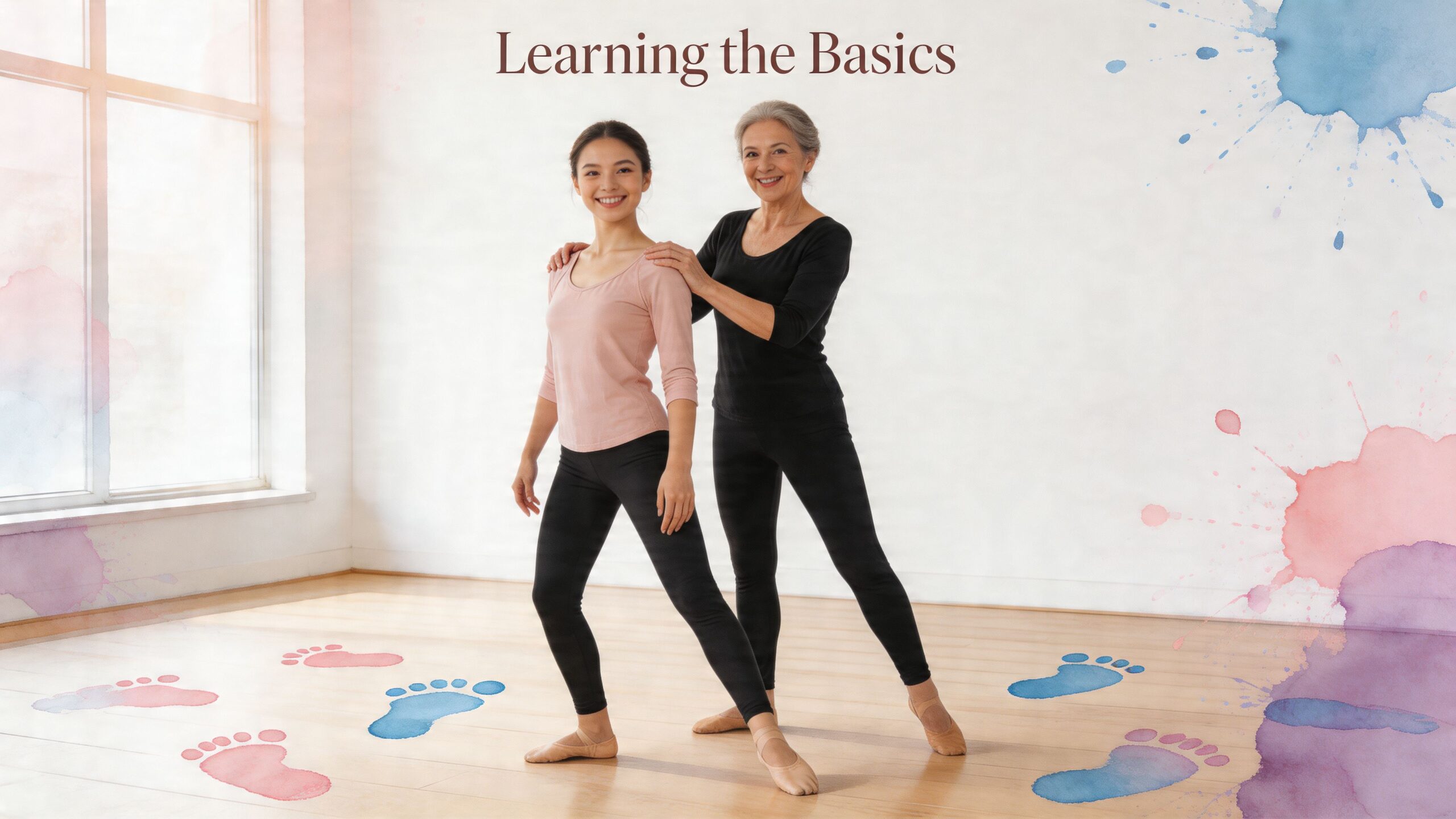
You walk in, meet your instructor, and get a sense of the space. There may be mirrors, music playing softly, and other students at different levels. That can feel a little exposing at first, but beginners usually relax once they realize no one is expecting perfection. People are there to learn.
The first few minutes
A good first lesson begins straightforwardly. You may start with posture, standing balance, and basic rhythm. Instead of launching into a full routine, your instructor might have you shift weight from one foot to the other and match that movement to the beat.
That’s more important than it sounds.
Beginners often think dance starts with fancy foot patterns. It usually starts with learning where your weight is, when it changes, and how the music tells you to move. If your teacher starts with a dance like Rumba or Cha Cha, that’s often because those dances reveal timing in a clear way.
Here’s the emotional arc many students go through in that first class:
- At the door: “I feel awkward.”
- After the first few counts: “Okay, I can follow this.”
- After repeating the basic: “I didn’t expect that to feel this good.”
- At the end: “I want to try that again.”
Why teachers talk about Cuban Motion
One of the first technical ideas you may hear is Cuban Motion. That phrase can sound advanced, but the basic idea is teachable. In Latin dancing, the hip action comes from how you use your legs and transfer weight, not from forcing your hips side to side.
A verified expert source explains that Cuban Motion is created by straightening the knee of the standing leg, and that focused drills can improve frame stability and connection by 15 to 20% after 10 lessons in that training context, as shown in this technique video reference.
That doesn’t mean your first class becomes a biomechanics lecture. It means your instructor may give you a simple cue like, “Straighten the standing leg and let the body respond.”
The feeling is less “wiggle your hips” and more “let the movement travel upward from the floor.”
That one correction often clears up a lot of beginner confusion.
A short visual example can help if you like seeing movement in action before trying it yourself:
What success looks like in lesson one
A successful first lesson isn’t about doing everything right. It’s about leaving with a few things that make sense in your body.
You might leave knowing how to find the beat, how to take a basic step without rushing, and how to stand with more intention. You may also notice something less obvious. You feel less self-conscious because your brain had a job to do.
That’s one reason people love latin ballroom dancing lessons. They pull your attention into the present. You stop overthinking and start listening.
Preparing for Your Dance Journey
Most first-lesson nerves come from practical questions. What do I wear? Do I need special shoes? Am I going to break some studio rule I don’t know about?
The good news is that preparation is simple.
What to wear
Choose clothes you can move in without tugging at them every few seconds. If you can comfortably walk, turn, and lift your arms, you’re probably dressed well enough for class.
A few solid beginner choices:
- For tops: Breathable shirts or fitted layers help you move without feeling restricted.
- For bottoms: Stretch pants, leggings, or lightweight trousers usually work better than stiff denim.
- For layers: Bring something easy to remove if you warm up quickly once music starts.
If you’re someone who likes a physical routine before activity, this guide on how to warm up effectively offers useful ideas about preparing joints and muscles before movement. You won’t warm up for dance exactly the same way you would for lifting, but the general principle is helpful: a prepared body feels safer and responds faster.
The right footwear
Shoes matter more than clothes.
For a beginner class, look for something secure on your foot with a sole that lets you move smoothly. Many new dancers do fine in clean shoes that aren’t sticky and don’t have heavy tread. You want enough grip to feel stable, but not so much that turning feels like your foot is glued to the floor.
You usually don’t need performance shoes on day one. If you stick with lessons, your instructor can tell you when it makes sense to buy practice shoes or a dance-specific pair.
Students often ask for a full prep checklist before their first private lesson. This article on preparing for your first private dance class covers the basics in a practical way.
Studio etiquette
Dance studios are social spaces, but the etiquette is refreshingly straightforward.
- Arrive a little early: You’ll settle in faster and start class less flustered.
- Practice good hygiene: Dance is a shared activity. Freshness is kindness.
- Stay open to feedback: Corrections aren’t criticism. They’re how progress happens.
- Be courteous with partners: A clear, respectful attitude makes everyone more comfortable.
- Keep comparisons in check: Someone else’s experience says very little about your pace.
Most people in a dance room remember what it felt like to be new. You do not need to earn your place before you start.
That mindset helps more than any outfit ever will.
Choosing Your Path Private vs Group Lessons
Students often ask which format is better. The honest answer is that it depends on what kind of learner you are and what you want from dance.
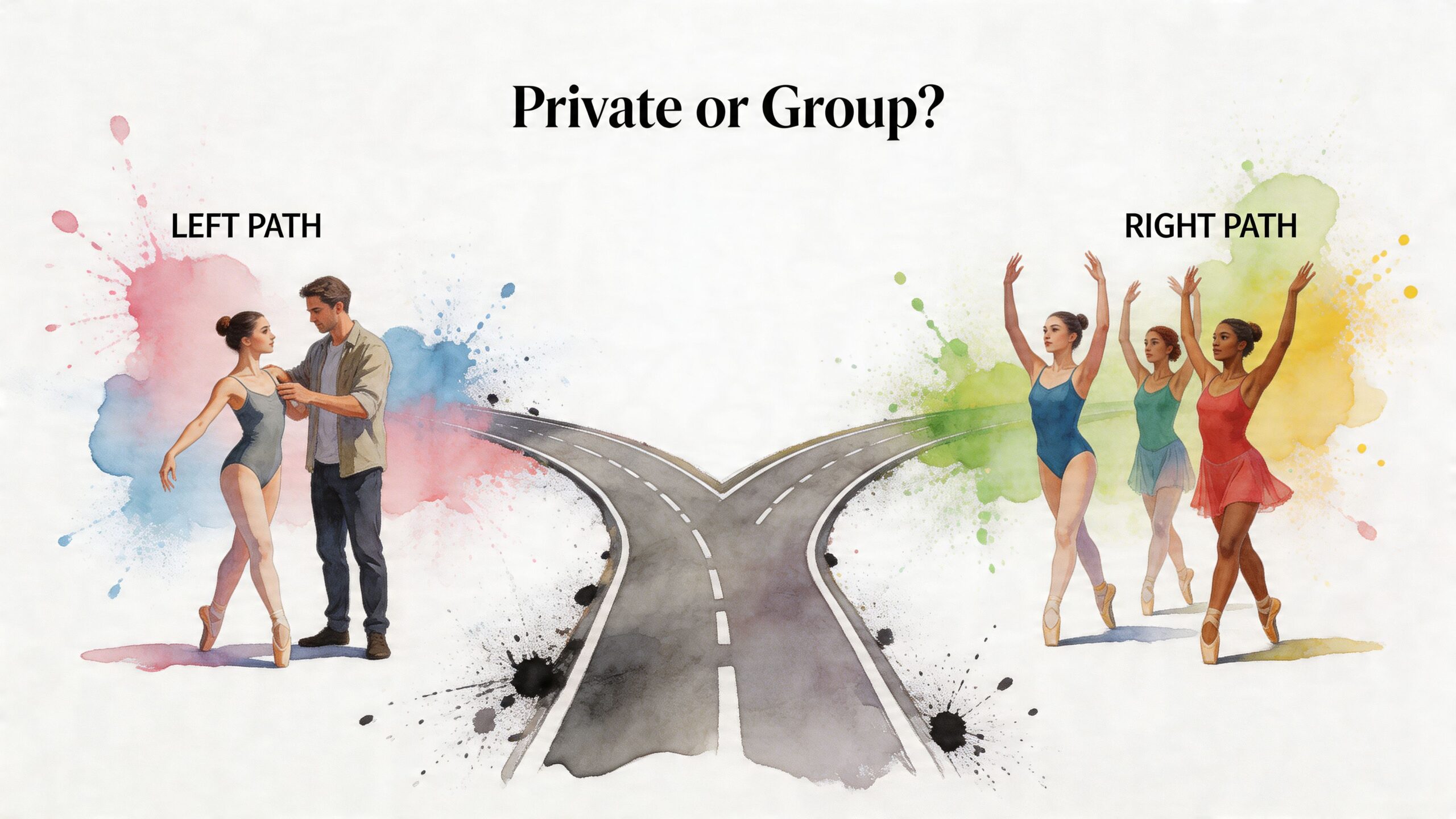
A simple analogy helps. Group classes are like a university lecture. Private lessons are like one-on-one tutoring. Both work. They just solve different problems.
Group classes
Group lessons give you energy and repetition. You learn alongside other people, hear common questions answered in real time, and get used to dancing in a shared room.
They’re especially useful if you want:
- Social comfort: Dancing around others becomes normal very quickly.
- Variety: You may experience different partners and different movement styles.
- Routine: A recurring class can make practice part of your week.
Group settings also help people loosen up. If you’ve been worried about looking awkward, it can be reassuring to see that everyone is learning something.
Private lessons
Private lessons focus tightly on you. Your timing, your posture, your goals, your specific sticking points.
This format is often ideal for students who want to prepare for a wedding dance, move faster, or work through technical issues with more detail. Verified guidance on advanced Latin technique notes that partner frame compression and body drift rely on elastic torso tension rather than arm pulling, and that this kind of lead-follow communication is best refined through personalized coaching, as described in this technical overview.
That idea matters even for beginners. New dancers often try to “hold on” with their arms. A private lesson lets a teacher correct that quickly and help you feel real connection through the body.
Good partner connection feels more like carrying a shared tray together than dragging someone across a room.
That’s the feeling many students are looking for, even if they don’t yet have words for it.
How the learning path develops
Latin training often follows a progression such as Bronze, Silver, and Gold. In simple terms:
- Bronze: Basic figures, timing, posture, and clean weight changes
- Silver: More refined technique, stronger rhythm detail, more coordinated body action
- Gold: Greater complexity, control, and expressive freedom
You don’t need to worry about those labels right away. They’re just a map. They show that dance develops in layers, not all at once.
If you’re still weighing your options, this guide on group vs private dance classes can help you match the format to your goals. For students comparing local options, Danza Academy of Social Dance offers both formats along with Ballroom, Latin, social, wedding, and kids programs.
The Many Benefits of Learning to Dance
You walk into class after a long day carrying work stress in your shoulders and a little nervous energy in your chest. An hour later, you leave warmer, looser, and more connected to yourself and the people around you. That shift is one of the reasons people keep coming back to latin ballroom dancing lessons.
Yes, you learn patterns and timing. You also learn how to feel steady in your body, how to listen, and how to enjoy being present with music instead of thinking about everything else on your list.
A workout with a purpose
Latin dance asks your whole body to participate. Your feet place the rhythm, your core helps you stay organized, and your upper body learns to stay alive without getting tense. It works like carrying groceries up a few flights of stairs while keeping a cup of water from spilling. You are active, but you also need balance and control.
Over time, students often notice the benefits outside the studio. Standing taller becomes easier. Turning corners feels more coordinated. Even everyday movement can feel less stiff because your body has practiced changing weight cleanly and recovering balance.
For adults who dislike repetitive exercise, dance gives the body a job and gives the mind a reason to stay engaged.
Confidence that grows one small success at a time
Confidence in dance usually arrives gradually.
A beginner gets through a full song without freezing. A couple starts to relax instead of apologizing to each other. A student who once avoided parties says yes to a social dance because they trust their basics.
That kind of confidence matters because it is built in public. You practice staying calm while learning something new, while being seen, and while making mistakes without treating them like disasters. That skill carries into weddings, work events, date nights, and any room where you want to feel more at ease.
Stress relief that keeps your mind in the room
Dance gives your attention a clear place to go. You hear the beat, shift your weight, and respond to what is happening now. For many adults, that feels like a reset button.
Rhythm works a lot like walking with a friend. If one person rushes ahead or drifts behind, the walk feels awkward. Once both people settle into the same pace, everything gets easier. Partner dancing creates that same relief. The body and the music start cooperating, and your mind gets a break from overthinking.
A social skill that feels natural
One of the kindest things about learning to dance is that it gives people a shared activity instead of forcing conversation from scratch. You do not have to be brilliant at small talk. The music gives both people something to do together.
That is especially helpful for new students who want connection but feel rusty socially. In class, everyone is learning. Everyone misses a step sometimes. That creates a more forgiving atmosphere than many social settings.
If you want to see how that experience feels in a real studio setting, Latin dance classes in Philadelphia for beginners and social dancers can give you a clear picture of what regular practice looks like.
A hobby that can grow with you
Some students want a fun night out. Others want a reliable weekly practice, a stronger connection with a partner, or a long-term creative outlet. Dance has room for all of that.
As noted earlier, the ballroom world also extends into major festivals and competitions for dancers who want to pursue it seriously. But social dancing is already a rich goal on its own. Being able to step onto a floor, hear the music, connect with a partner, and enjoy the moment is a meaningful achievement.
A key benefit is the person you become along the way. Someone more comfortable in their body. Someone more willing to connect. Someone who hears music and feels invited instead of intimidated.
Your Invitation to the Dance Floor at Danza Academy
At some point, reading about dance stops being useful and trying it becomes the thing that matters.
If you’ve made it this far, you probably don’t need more convincing that latin ballroom dancing lessons can help you feel more confident, more connected, and more comfortable in your body. What you may need is an easy first step.
That’s where a complimentary lesson helps. It gives you a real experience of the studio, the teaching style, and the feeling of moving to music without pressure to already know anything. For adults in the Philadelphia area, Latin dance classes in Philadelphia can be a practical starting point if you want to explore local options.
Danza Academy has over 40 years of teaching experience and serves students in Center City Philadelphia and Exton, PA. The studio works with beginners, social dancers, couples, kids, and students with bigger performance goals. No partner is required, and if you do have a significant other, they’re welcome too.
If you’ve been waiting until you felt ready, this is your reminder that readiness often comes after the first lesson, not before it.
Book the complimentary lesson and let the first step be small, simple, and real.
Frequently Asked Questions About Latin Dancing
Do I need a partner to start?
No. You can absolutely begin without one.
That’s one of the biggest misconceptions about ballroom and Latin classes. Many adults delay lessons because they think they need to arrive as a pair. In reality, studios often teach singles, couples, and rotating group formats. Learning without a regular partner can even help because you become more adaptable and pay closer attention to lead and follow skills.
If you are coming with a spouse or friend, that can be wonderful too. You’ll share the learning process together.
How long does it take to feel comfortable on a social dance floor?
It depends on how often you practice, how relaxed you are with new situations, and what “comfortable” means to you.
For most beginners, comfort comes in stages. First you recognize the beat. Then you can do a basic without freezing. Then you can recover after a mistake without panicking. That last part matters more than people realize.
Social confidence usually grows before technical mastery does. You do not need to know everything before you can enjoy dancing with other people.
What if I have no rhythm?
Those who say this can already hear rhythm. They just haven’t connected what they hear to what their body does yet.
That’s teachable.
A good instructor won’t start by giving you complicated choreography. They’ll help you find the beat, count it, step it, and repeat it enough that the timing starts to feel natural. Rhythm is often less about talent than repetition and listening.
Am I too old to start?
No.
Adults begin dance lessons at many different life stages. Some start because of a wedding. Some start after retirement. Some start because they finally have time for themselves again. Dance can be adapted to many goals, whether you want fitness, fun, social confidence, or a new skill.
What matters more than age is pacing. Clear instruction and appropriate challenges make a huge difference.
Are latin ballroom dancing lessons only for serious competitors?
Not at all.
Competitive ballroom is one branch of the dance world, not the whole tree. Many students take lessons because they want to enjoy parties, move better, or share an activity with someone they care about. The same technique that supports high-level dancing also helps social dancers feel more balanced and comfortable.
You don’t need to choose between “casual” and “real.” Social dancing is real dancing.
What if I feel awkward or embarrassed?
You probably will for a few minutes. That’s normal.
Awkwardness is often just unfamiliarity in its first form. The body is trying something new, and your attention is very high. Once you have a clear task, such as stepping on count or changing weight at the right moment, that embarrassment usually softens.
Most dance rooms are full of people who remember exactly what that first lesson felt like. You’re not behind. You’re beginning.
Can kids learn Latin dance too?
Yes, and there’s a growing need for structured youth programs. Verified guidance notes that there is rising demand for Latin ballroom programs adapted for kids, while relatively few studios provide a clear curriculum. It also notes that for ages 5 to 12, simplifying hip action and emphasizing fun, coordination-building exercises can support meaningful confidence gains, as described in this overview on kids dance program needs.
For children, the goal usually isn’t “mini adult technique.” It’s rhythm, coordination, posture, listening, and confidence. Kids learn best when movement feels playful and achievable.
What should I practice at home between lessons?
Keep it simple.
A short practice session is usually more helpful than a long, frustrated one. Work on a basic step, count out loud, and pay attention to weight changes. If your teacher gave you one correction, use that as your focus rather than trying to remember everything at once.
Consistency matters more than intensity for beginners.
Is Latin dance only about steps?
No, and that’s one reason people fall in love with it.
The steps matter, but the feeling underneath them matters more. Rhythm gives the body a pattern. Connection gives the dance meaning. Once students understand that, they stop trying to “get through” the dance and start dancing it.
Take the next step with Danza Academy of Social Dance by booking a free complimentary lesson through their contact page. If you’ve been waiting for the right moment to start, this is a simple, no-pressure way to walk in, meet an instructor, and feel what dancing is like for yourself.