
You’re probably here because swing dancing looks fun from the outside, but stepping onto the floor yourself feels like a different story. Maybe you’ve watched couples spin and laugh at a social dance, or seen a class online and thought, “I’d love to do that, but I have no rhythm, no partner, and no idea where to start.”
That’s a normal place to begin.
Beginner swing dance lessons work best when they remove mystery. You don’t need a dance background. You don’t need special talent. You don’t even need to arrive feeling confident. You just need a clear first step, a teacher who breaks things down effectively, and a class environment where mistakes are expected.
Your First Step Onto the Swing Dance Floor
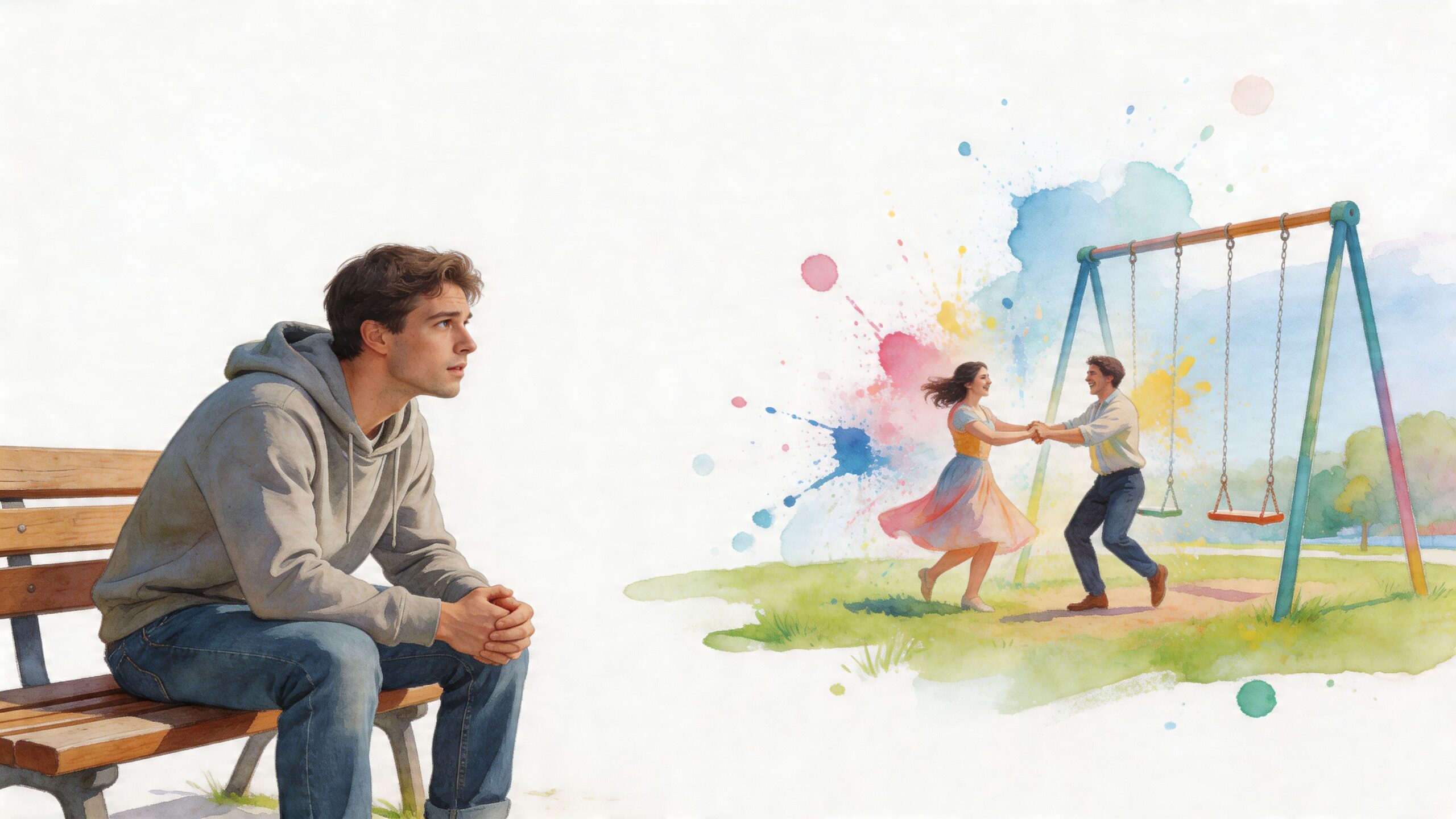
You arrive a few minutes early, hear upbeat music from the studio, and pause at the door for a second. One question usually shows up right there. "What if I walk in alone and everyone else already knows more than I do?"
That moment is common, especially for adults trying something new after a long break from dance, sports, or any kind of class. The good news is simple. A beginner swing lesson is built for that exact starting point.
Why swing feels easier than people expect
Swing often surprises first-time students because the beginning is more organized than it looks from the outside. You are not memorizing a long routine. You are learning a small rhythm pattern, then matching your weight changes to that rhythm, one piece at a time.
East Coast Swing is a common starting style in beginner programs because its basic pattern is clear and repeatable. Many students describe it as easier to hear in the music once a teacher counts it out and lets them practice slowly. It works like learning a simple clap pattern before trying a full song. First you find the beat. Then your feet have somewhere to go.
That structure also makes swing adaptable. If you are active already, you can add more energy as you improve. If you are returning to movement after time away, you can keep the steps smaller, take breaks, and still learn the same skill. Good beginner instruction meets you where your body is today, not where you think it should be.
Practical rule: Your first class is an introduction to rhythm, balance, and partner connection.
You don't need a partner to start
This worry stops a lot of people before they ever try a class. Partner dance sounds like something you are supposed to arrive ready for, with another person and a plan.
Beginner swing classes usually work differently. Many welcome solo students, rotate partners during class, or give you a chance to practice the footwork on your own first. That means showing up alone is not a problem to solve. It is a normal way to begin.
If learning alone feels especially intimidating, a one-on-one lesson can make the first step feel much smaller. This guide on how to prepare for your first private dance class helps explain what that experience is like and how to make it comfortable from the start.
What beginners usually discover in the first hour
The first win is rarely "I nailed every step."
It is usually something quieter and more important. You realize the dance is made of learnable parts. A rock step. A triple step. A change of weight. A little more comfort with the music than you had 20 minutes earlier.
That shift matters. Once swing stops feeling like a talent other people were born with, it becomes a skill you can practice at your own pace. Whether you come in fit, stiff, nervous, curious, solo, or all of the above, your first step onto the floor still counts.
Demystifying Your First Swing Dance Class
Walking into your first class gets easier when you know what the hour will look like. Most anxiety comes from uncertainty, not from the dancing itself.
A beginner class is usually simple, structured, and much less intimidating than people imagine.
What to wear and what to bring
Keep it practical. You want clothes that let you move without fussing with them.
A good starting point:
- Wear comfortable clothing: A top and pants or leggings that let you lift your arms and shift your weight easily.
- Choose shoes that stay on securely: You want something stable and comfortable. Avoid shoes that grip the floor too aggressively or shoes that slip off.
- Bring water: Dancing is active, and even beginners warm up quickly.
- Leave the extras behind: You don’t need special dance gear for your first lesson.
If you’re preparing for a one-on-one session, this guide on how to prepare for your first private dance class can help you feel even more ready.
What the class usually feels like
Most beginner swing dance lessons follow a rhythm of their own.
You walk in, meet the instructor, and settle into a short warm-up. Then the teacher introduces one basic idea at a time. It may be a pulse, a weight shift, or a first version of the basic step. After that, you practice slowly, then with music, then with a little more confidence than you had ten minutes earlier.
Here’s the kind of flow many beginners experience:
A welcome and quick orientation
You learn where to stand, how the class rotates, and what role you’ll try first if the class uses leader and follower roles.A basic movement drill
This helps you feel the beat before adding partner work.A simple pattern
Usually one pattern is enough for a first class. The point is clarity, not quantity.Practice with music
The dance begins to feel real.
Rotating partners often helps beginners learn faster because each person gives you a slightly different feel. You stop memorizing one person and start understanding the dance.
What if you feel awkward
You probably will, briefly. Everyone does.
The trick is to expect that awkward stage instead of treating it like failure. Early swing classes are full of small corrections. Which foot starts. How big the step should be. Where your hands go. How to stand close enough to communicate without feeling stiff. None of that means you’re bad at dancing. It means you’re learning.
The students who progress fastest aren’t the ones who look smooth right away. They’re the ones who stay relaxed enough to keep trying.
Mastering Foundational Swing Dance Techniques
You walk onto the floor, the music starts, and your first thought is often, “How am I supposed to move this fast?” Here is the reassuring part. Beginner swing does not start with flashy turns or big kicks. It starts with a small set of repeatable skills your body can learn one layer at a time.
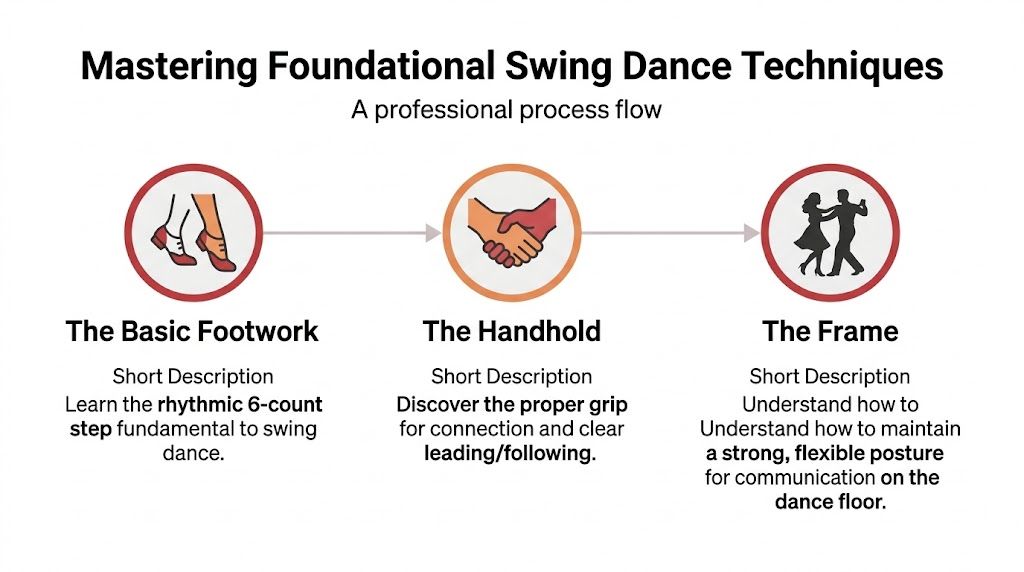
Focus on three pieces first. Rhythm, footwork, and connection. If those make sense, the rest of swing starts to feel much less mysterious.
The rhythm that holds everything together
A common beginner pattern in East Coast Swing is rock step, triple-step, triple-step. You can treat that 6-count rhythm like a loop in the music. Once you feel where the loop begins and ends, the dance stops feeling random.
Many new students step too big at first. That is a normal teacher observation, not a sign that you lack coordination. Big steps usually create a chain reaction. Your weight lands late, your balance tips, and the beat starts to feel harder to catch.
Small steps fix more than people expect.
Small steps keep you under control. Control helps you stay on time. Staying on time makes the dance feel easier.
If you are learning on your own, practice the rhythm before you worry about style. Try this at home:
- Stand tall with your feet under your hips: Keep each step close to where you started.
- Say the count out loud: “Rock step, triple-step, triple-step” gives your body a clear pattern to follow.
- Practice without music first: Slow repetition builds timing faster than rushing.
If fast music makes you nervous, cut the tempo in half and keep the pattern the same. Swing still works when practiced slowly.
The basic footwork without the jargon overload
Beginners often assume footwork means memorizing a complicated pattern. In reality, the first job is simpler. Move your weight clearly from one foot to the other.
That idea solves a lot of confusion.
On the rock step, you shift your weight back and then return. On the triple-steps, you take three small steps over two beats. The feet stay light and close to the floor. You are not trying to travel across the room. You are teaching your body to change weight cleanly and on time.
A good comparison is walking down a hallway in socks. If your steps are quiet and controlled, you are close to the right feel. If you are stomping or reaching, make everything smaller.
For a broader overview of styles, class structure, and what to expect as you progress, you can explore swing dance lessons and styles.
A short visual demo can help once you’ve read the idea in words:
If you have knee concerns, low stamina, or you are returning to movement after a long break, keep your version compact. The basic still counts. You can reduce the depth of the rock step, shorten the triple-steps, or pause between repetitions. Good swing timing does not require athletic intensity.
That matters for solo learners too. You do not need to arrive already fit or already graceful. You need a version of the basic that feels stable in your body.
The handhold and frame that make partner dancing work
Connection is the part many beginners worry about most, especially if you are coming alone and have never done partner dance before. People often ask, “What if I squeeze too hard?” or “What if I miss the signal?” Those are beginner questions, and they have beginner-friendly answers.
Connection works like a conversation through the body. The goal is to make your movement clear enough that your partner can feel it without force. Your handhold stays light. Your arms have gentle tone. Your posture stays upright so signals can travel cleanly from one person to the other.
Frame works like carrying a large tray. It has structure, but you are not locking your elbows or bracing your shoulders. Too loose, and the message disappears. Too stiff, and every movement feels heavy.
Here is a simple way to check your frame:
| Element | What it should feel like | What beginners often do instead |
|---|---|---|
| Handhold | Light and responsive | Clutching too tightly |
| Arms | Gently active | Letting them go limp or tensing up |
| Posture | Upright and balanced | Leaning in, slouching, or pulling away |
If partner dancing feels intimidating, start by practicing only one job at a time. First keep the rhythm. Then keep your steps small. Then add a light hand connection. Breaking it into parts makes the whole dance feel much more approachable.
That is how foundation work helps. It gives you a simple base you can return to, whether you are learning with a partner, rotating in class, or showing up on your own for the first time.
Navigating Common Beginner Mistakes with Confidence
Most beginner mistakes are not signs that you “can’t dance.” They’re signs that your body is sorting out several new skills at once.
That’s why I rarely call them problems. I call them milestones.
Looking down at your feet
This happens because your brain wants visual confirmation. You’re learning new foot patterns, so of course you want to check whether they’re correct.
The issue is that looking down pulls your posture forward and disconnects you from both the music and your partner.
Try this instead:
- Pick a spot at eye level on the wall: Keep your gaze there while practicing the basic.
- Go slower than you think you need to: Speed creates panic. Slow practice creates memory.
- Use your ears more than your eyes: Let the beat guide you.
Spaghetti arms and overly strong arms
Beginners tend to land at one of two extremes. Either the arms go completely floppy, or they get tense and try to force the dance.
Neither works well.
Loose arms blur your signals. Overly strong arms feel pushy and make turns harder. Good connection lives in the middle. Your arms should feel available, toned, and calm.
If your partner can’t tell what you mean, don’t add strength. Add clarity.
A useful drill is to stand with a partner or even practice alone and hold your arms in dance position for a short period while stepping in place. You’re teaching your upper body to stay organized while your lower body moves.
Stiff posture and held breath
This one surprises people. They think posture means “stand as rigidly as possible.”
It doesn’t.
Good dance posture is upright but flexible. If you hold your breath, lift your shoulders, or lock your knees, you’ll feel clunky no matter how well you know the pattern. A lot of movement problems start as tension problems.
Try this reset between repetitions:
- Exhale fully
- Drop your shoulders
- Soften your knees
- Start again smaller
Anticipating instead of listening
New dancers often try to guess what comes next. Leaders rush the lead. Followers jump into the move before it’s offered. Both habits come from the same place. You want to get it “right.”
But swing works better when you respond to what’s happening now, not what you hope is about to happen.
That’s why patient practice beats hurried practice every time. When you stop trying to be early, your timing usually improves on its own.
Social Swing Etiquette for a Great Experience
You finish class, the music starts, and people begin stepping onto the floor. If you came alone, that moment can feel bigger than the lesson itself. Your brain may jump straight to the social questions. Who do I ask? Where do I stand? What if I slow someone down?
Those worries are common, especially for adults who are learning without a built-in partner or coming back to movement after a long break. The good news is that social swing has simple rules, and they are meant to make the room feel easier to enter, not harder.
How to enter social dancing if you learned alone
Many beginners start swing by themselves. That is normal in group classes, and good studios expect it. You do not need to arrive with a partner, a perfect basic, or a big social personality.
A helpful first goal is small. Stay for one song after class. Ask for one dance. Then decide if you want another.
That approach works because social dancing is a skill, just like rhythm or turns. The first few dances are not a test. They are your practice round in real conditions.
If you are learning alone, these habits make the transition smoother:
- Join a beginner-friendly class that rotates partners: Rotation helps you meet people quickly and learn that every dancer feels a little different.
- Tell yourself one clear plan before class ends: “I’m staying for one song” is easier to follow than “I should be more social.”
- Practice either role if your studio allows it: This builds empathy and helps the whole dance feel less mysterious.
- Ask instructors which socials are best for beginners: Some events are calmer, slower, and easier for a first night out.
If you know you need more individual support before social dancing feels comfortable, this comparison of group classes vs private dance lessons and how to choose can help you pick the setting that fits your pace, confidence level, and body.
How to ask someone to dance
Keep the invitation short and friendly. “Would you like to dance?” is enough.
New students often worry they need to explain that they are beginners. You usually do not. A polite ask, a relaxed tone, and a smile are clear. If you want, you can add “I’m still learning,” but only if it helps you settle your nerves.
Sometimes the answer will be no. That is part of social dancing, and it is rarely personal. The person may be resting, looking for a specific partner, sitting out that song, or managing pain, fatigue, or dizziness.
The best response is simple. “No problem, maybe later.”
Then move on. No apology. No pressure. No awkward speech.
Floor craft and partner rotation
Good etiquette is mostly awareness. A social floor works like traffic at low speed. Everyone has more fun when each dancer notices space, keeps movement sized to the room, and avoids sudden choices.
Here are the habits that make a floor feel safe and welcoming:
| Social habit | Why it matters |
|---|---|
| Rotate partners in class | You learn adaptability and become easier to dance with socially |
| Keep steps and turns controlled | Smaller movement helps prevent collisions |
| Ask clearly and accept any answer kindly | People feel respected and safer saying yes or no |
| Thank your partner after each dance | It closes the interaction warmly and simply |
| Step off the floor if you need a break | Rest is normal, especially if you are building stamina |
That last point matters more than many beginners realize. You do not need athlete-level endurance to belong at a swing social. Dance one song, rest one song, and return when your breathing settles. Many students with limited mobility, lower stamina, or old injuries do best when they pace themselves that way.
Social swing is one shared song, not a performance review.
If you are introverted, anxious, or walking in alone, let that idea carry some weight for you. Your job is not to impress the room. Your job is to be respectful, present, and open to one good dance at a time.
Choosing Your Ideal Lesson Format Group vs Private
Some students do best in a room full of people. Others learn faster when an instructor can stop, adjust, and answer every question in real time. Neither choice is better across the board. It depends on how you learn and what you want from dancing.
If you want a deeper comparison, this guide on group vs private dance classes and how to choose is a helpful next read.
Group Classes vs. Private Lessons Which is Right for You?
| Feature | Group Classes | Private Lessons |
|---|---|---|
| Learning pace | Shared pace with the class | Tailored to your speed |
| Feedback | General corrections plus partner experience | Direct, personalized coaching |
| Social environment | Great for meeting people and rotating partners | More focused and one-on-one |
| Scheduling | Set class times | More flexibility |
| Best for | Building basics and confidence in a community setting | Fast progress, specific goals, or extra support |
Group classes are often a great starting place for beginner swing dance lessons because they normalize the learning process. You see other people figuring it out too.
Private lessons are especially useful if you want more individual attention, feel nervous in groups, or want adjustments for your comfort, mobility, or pace.
Take the Lead Your Swing Dance Journey Starts Here
Swing dancing becomes much more approachable once you stop treating it like a talent test. It’s a learnable skill. You build it step by step. First the rhythm, then the footwork, then the connection, then the confidence to enjoy a full song without overthinking every count.
That’s why so many adults end up loving it. You don’t have to arrive polished. You arrive curious, and the skill grows from there.

If you’ve been waiting until you felt less nervous, more coordinated, or more “ready,” you can stop waiting. Beginner classes are built for beginners. That includes people learning alone, people returning to movement after a long break, and people who want a version of swing that fits their current fitness level instead of fighting it.
Danza Academy of Social Dance has helped beginners learn with confidence for 40+ years, with studios in Center City Philadelphia and Exton, PA. If you want a friendly first experience without pressure, the best next move is to try the studio for yourself and book your free complimentary first lesson.
If you’re ready to stop watching from the sidelines and start dancing, Danza Academy of Social Dance offers a free complimentary lesson so you can experience the teaching style, atmosphere, and support for yourself. It’s a simple, no-pressure way to begin. Book your first lesson and take that first step onto the floor.