
You may already know a few steps.
Maybe you’ve taken a Salsa class, practiced a wedding dance in the kitchen, or watched your child repeat a routine at home. The steps are there, but the dancing still feels awkward, wobbly, rushed, or disconnected. You can do the pattern, yet it doesn’t look or feel the way you hoped.
That gap is usually technique.
Technique isn’t something reserved for professionals in rehearsal studios. It’s the skill that helps everyday dancers move with balance, control, comfort, and confidence. It’s what makes a Waltz feel smooth instead of bouncy. It’s what helps a social dancer stay on time in Salsa. It’s what gives a first dance that calm, elegant look guests remember.
When people hear “technique dance classes,” they often picture strict drills and intimidating correction. A good class feels very different. It gives you tools your body can use. You learn how to stand, transfer weight, use your frame, place your feet, and move with the music so the dance starts making sense.
Beyond the Steps The Foundation of Great Dancing
A lot of dancers hit the same frustrating point. They learn more patterns, but their dancing doesn’t improve in the way they expected.
They know where the feet go, but turns feel unstable. They can get through a Foxtrot or Salsa basic, but they don’t feel comfortable enough to relax. They watch another dancer use the same steps and wonder why it looks effortless there and effortful here.
That difference is the how behind the what.
What technique really means
Technique is not a fancy word for perfection.
It means learning the body mechanics that support dancing well. In plain language, that includes things like:
- Posture: how you stack your head, ribs, hips, and feet
- Balance: how you stay centered when you step, turn, or change direction
- Weight transfer: how you fully move from one foot to the other
- Control: how you stop rushing, wobbling, or collapsing through movement
- Connection: how partners communicate through frame and timing
If dance steps are the vocabulary, technique is the grammar. Without grammar, people may still understand a sentence, but it sounds choppy and unclear. Dance works the same way.
Why dancers often miss it at first
Beginners usually focus on memorizing. That’s normal.
Your brain is busy trying to remember left foot, right foot, turn here, pause there. At that stage, technique can seem invisible because it isn’t the headline. But once the basic pattern is familiar, technique becomes the reason one dancer looks grounded and another looks uncertain.
Good technique doesn’t make dancing stiff. It removes the extra effort that makes dancing feel stiff.
That’s also why the room matters. Space, floor quality, mirrors, and instruction style all affect how clearly you can feel these details in your body. If you’re curious about that side of training, this look at a professional dance studio matters for training helps explain why environment changes the learning experience.
Technique gives shape to movement. It turns “I got through it” into “I danced it.”
Why Technique is Your Most Important Dance Partner
If choreography is the furniture in a house, technique is the foundation under it.
The furniture may look exciting first. New steps are fun. Dips, turns, styling, and dramatic shapes catch attention. But if the foundation underneath is shaky, every part of the dance feels harder than it should.
A strong base changes everything
In social styles, poor technique usually shows up in familiar ways:
- In Foxtrot, dancers rush through slow timing because they never learned controlled weight transfer.
- In Rumba, they try to create expression with the arms while the body underneath is unstable.
- In Tango, they force sharpness with tension instead of using clear body organization.
- In partner dancing, one person leads with the hands and the other guesses what comes next.
Those aren’t talent problems. They’re foundation problems.
Technique helps you move more efficiently. Instead of muscling through every figure, you learn how to organize your body so the movement works with you. That matters for comfort, for clarity, and for the look of the dance.
Why judges value it so highly
Even if you never plan to compete, it’s useful to know how the dance world measures quality.
In competitive dance adjudication, technique classes make up at least 50% of an individual routine’s score according to Impact Dance Adjudicators. That doesn’t mean social dancers need to think like judges. It means technique is widely treated as the benchmark for clean, effective movement.
When experts evaluate dancing, they don’t only ask, “Did the dancer do the steps?” They ask:
- Was the movement placed well
- Was the balance secure
- Did the body stay organized
- Was the action efficient and clear
- Did the technique support the artistic choice
That same logic helps on an ordinary dance floor.
The practical payoff for everyday dancers
Technique gives you a better return on your time than only learning more material.
A dancer with fewer patterns and stronger technique often looks better, feels calmer, and adapts faster than a dancer with many patterns and weak fundamentals. That’s because technique travels. Once you learn how to stand, transfer, rotate, and connect properly, those skills help across styles.
Practical rule: If a new step keeps falling apart, don’t assume you need more choreography. You may need better mechanics.
Technique is also one of the clearest paths to safer dancing. Better alignment, better preparation, and better control reduce the unnecessary strain that comes from forcing movement.
So yes, technique is important in competition. But its real power is broader than that. It helps social dancers enjoy the floor more, helps couples feel connected, and helps students build dancing that lasts.
Unlock Your Potential How Technique Benefits Every Dancer
Technique becomes easier to appreciate when you connect it to a real goal.
Not a vague idea of “improving.” A real goal, like feeling comfortable at a party, enjoying your first dance, helping your child grow in confidence, or polishing a competitive routine.
The social dancer who wants to stop feeling self-conscious
A social dancer often says, “I know a few moves, but I freeze when the music starts.”
Technique helps because it replaces guessing with reliable habits. You start to feel your weight settle into the floor. You hear the timing more clearly. You stop overthinking your arms because your posture and rhythm are doing more of the work.
That’s when confidence starts to look natural. Not flashy. Comfortable.
For dancers who care about moving well and staying healthy, general movement resources on preventing sports injuries can also be useful alongside studio instruction, especially when they reinforce warm-up habits and body awareness.
The engaged couple who wants a first dance that feels graceful
Wedding couples rarely need dozens of complicated patterns.
They need a dance that feels steady, connected, and relaxed under pressure. Technique helps with the details guests notice without knowing the terms. A smoother transition. A cleaner turn. A better frame. Less staring at your feet. More ability to stay present with each other.
That’s why a simple routine with sound technique often looks more elegant than an ambitious routine built on panic.
The child who needs structure, coordination, and self-belief
Kids benefit from technique in a different way.
They learn how to listen, repeat, organize movement, and become aware of their bodies in space. They begin to understand that progress comes from practice, not magic. That lesson carries beyond dance.
A technique class also gives children a stable framework. Instead of just copying shapes, they learn how movement works. That builds coordination and discipline, but it also builds pride. A child can feel the difference between “I tried to copy it” and “I know how to do it.”
A short demonstration can make these ideas easier to picture:
The serious dancer who wants polish, not just difficulty
For advanced students, technique is where good dancing separates from impressive dancing.
A harder routine doesn’t automatically read as better. Clear foot pressure, body timing, balance, and movement quality usually matter more than adding one more trick or one more shape.
That’s one reason structured training matters so much. In a university assessment, 95% of senior-level dance majors in the highest ballet level and 100% in modern met or exceeded technique and performance expectations, according to California State University, Fullerton. Different dance settings have different goals, but the lesson is useful across styles. Consistent, structured technique work builds reliable skill.
Strong technique doesn’t limit expression. It gives expression something sturdy to stand on.
Whether your goal is fun, confidence, elegance, or performance quality, technique dance classes help you get there with less confusion and more control.
Inside a Technique Class What to Expect
Many people avoid technique classes because they don’t know what happens inside one.
They worry it will be too advanced, too strict, or too full of terminology. A well-run class is much more practical than that. It usually follows a clear progression so your body can prepare, learn, repeat, and absorb.
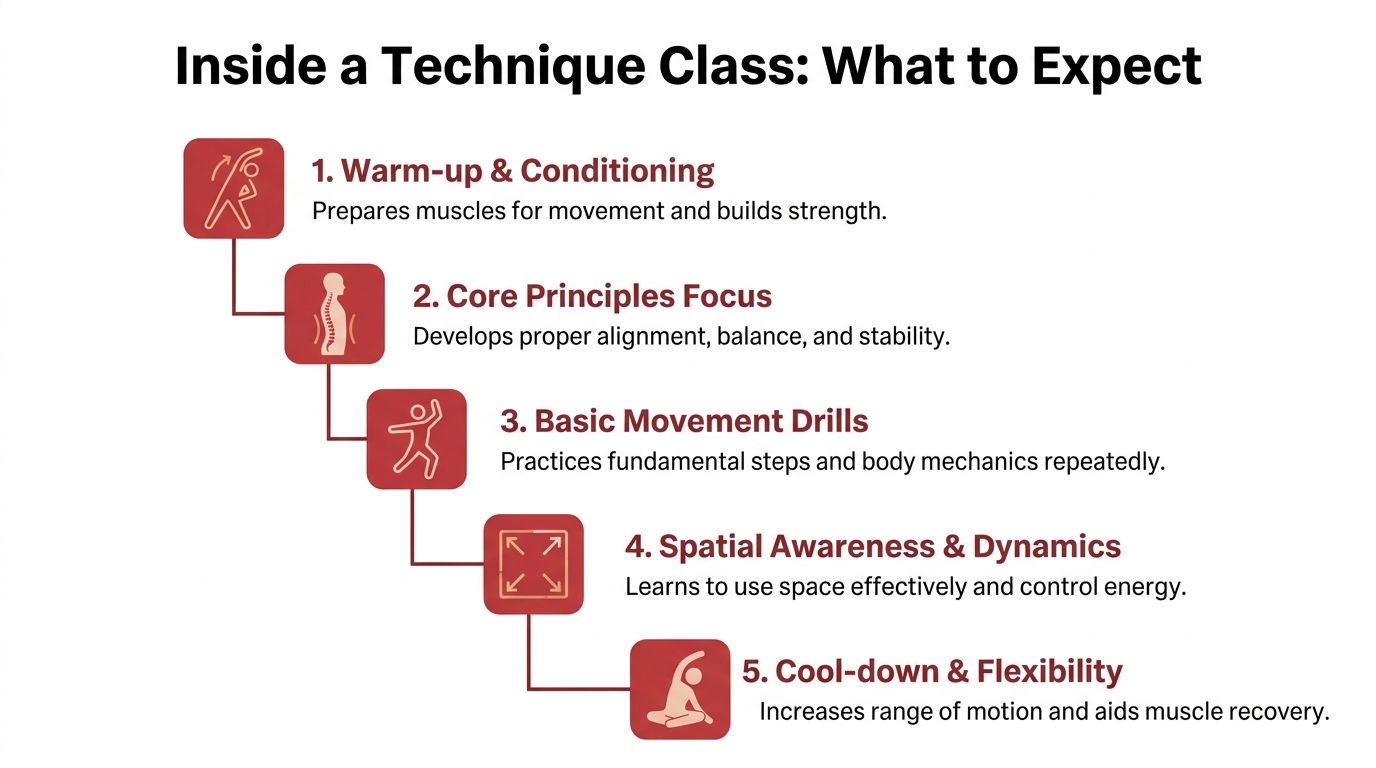
Warm-up comes first for a reason
The beginning of class should prepare the body for movement, not just fill time.
Effective technique classes use dynamic warm-ups and training principles drawn from sports science. According to Dance Masterclass, dynamic warm-ups can reduce acute injury risk by 20% to 30%, and progressive overload helps create lasting neural adaptations for skill growth.
In plain English, that means your body learns better when the work builds gradually and intelligently.
A warm-up may include:
- Gentle mobility work: circles for ankles, hips, shoulders, and spine
- Rhythm-based activation: simple stepping patterns to wake up timing
- Balance preparation: standing on one leg, changing weight, finding center
- Light conditioning: exercises that switch on the muscles you’ll need later
Then the class narrows the focus
After the warm-up, the teacher usually isolates one or two ideas instead of throwing everything at you.
That might be posture in Waltz, grounded footwork in Salsa, ribcage control in Rumba, or frame and connection in partner work. With these specifics, technique starts to feel surprisingly logical. You’re not being told to “dance better.” You’re being shown a specific physical task.
A skilled teacher may use different approaches depending on the room. Some students learn best by imitation. Others need tactile imagery, counts, or a mechanical explanation. If you’re interested in how instructors adapt to learners, this guide to types of teaching styles offers a useful overview.
A helpful mindset: You do not need to master everything in one class. You need to notice one correction and apply it clearly.
Repetition is where progress happens
The middle of class often includes short drills.
These are not punishment. They are where the body gets enough repetition to stop guessing. You may repeat a walk, a rock step, a rise and fall action, a frame exercise, or a turning preparation several times with coaching in between.
That repetition is what makes dance feel more familiar later in social settings.
Class usually ends with integration
Toward the end, many teachers blend the technical idea back into actual dancing.
You might practice a short pattern, move with a partner, or use the concept with music. This is the moment where the class clicks. The drill stops being abstract because you can feel the result in a real dance context.
If you want a broader sense of studio culture and how classes are typically structured, this overview of what to expect from a top dance academy in Philadelphia can help you walk in feeling prepared.
Technique in Action Sample Drills for Popular Styles
Technique gets less intimidating when you can see what it looks like in practice.
Most drills are simple. The challenge isn’t complexity. The challenge is doing a basic action with control, timing, and consistency.
Sample Technique Drills by Dance Style
| Dance Style | Technique Focus | Sample Drill Description |
|---|---|---|
| Salsa | Weight transfer and timing | Step in place over the basic rhythm and fully settle weight into each foot before changing. This teaches cleaner timing and reduces the habit of skimming across the floor. |
| Waltz | Rise and fall with balance | Practice a slow measure moving forward and side with attention to soft knees, lifted posture, and smooth elevation. The goal is a floating look, not a bounce. |
| Tango | Body separation and direction | Walk basic Tango steps while keeping the torso organized and the direction clear. Add small rotational actions from the upper body without twisting the hips out of control. |
What each drill is really teaching
A Salsa weight transfer drill may feel too easy at first.
But many timing problems come from incomplete weight changes. If you never arrive fully on the standing leg, the next step starts late, your rhythm gets muddy, and your partner feels uncertainty in the lead or follow.
Waltz drills work the same way. People often think the dance should rise because they lift upward. In reality, the smoother look comes from coordinated foot use, leg action, and body control. A simple drill exposes whether you’re floating or bobbing.
Tango is another good example. Dancers often chase the style first. They want the sharp head line or dramatic look. But without control through the torso and clear intention in the walk, the style becomes decoration sitting on top of confusion.
How to practice without overcomplicating it
If you try these ideas on your own, keep the session narrow.
- Choose one focus: Don’t practice frame, footwork, timing, and styling all at once.
- Go slowly first: Slow practice reveals habits that fast dancing hides.
- Use a mirror carefully: Check posture and placement, then look away so you don’t become mirror-dependent.
- Stop at clean, not tired: Technique work should sharpen awareness, not turn sloppy from fatigue.
A drill is just a magnifying glass. It helps you see one piece of the dance clearly enough to improve it. That’s why technique dance classes often feel so productive. They strip away the noise and let you work on what actually matters.
Finding Your Fit How to Choose the Right Class
The right class is the one that matches your current body, your current goals, and your current confidence level.
That sounds obvious, but many dancers place themselves badly. Beginners join a class that moves too fast. Experienced dancers stay in a class that no longer challenges them. Adults compare themselves to younger movers and assume they’re behind when they’re in a different season of learning.
Start with the goal, not the label
“Beginner,” “intermediate,” and “advanced” can be useful, but they don’t tell the whole story.
Ask yourself a few better questions:
- Do I want social confidence?
- Am I preparing for a wedding?
- Do I learn best with repetition or fast variety?
- Do I want group energy or one-on-one attention?
- Do I need a pace that respects an older or previously injured body?
Your answers matter more than your ego.
Adults often need a different approach
This is especially important for adults over forty.
A significant gap exists in dance content for adults over 40 in social styles, with much of the available material focusing on youth or competitive dancers rather than age-related considerations and social fitness goals, as noted by Dance to Unite. That gap leaves many adults feeling like they have to choose between being ignored or being pushed too hard.
They don’t.
An adult-focused class should respect mobility differences, balance changes, recovery needs, and real-life goals. Some adults want performance polish. Others want to enjoy a party, move for fitness, or dance comfortably at a wedding or event. All of those are valid.
The right class should challenge you without making you feel like you need to survive it.
Group or private
This is where format matters.
Group classes are helpful if you want repetition, social energy, and broad exposure to style and rhythm. Private lessons are useful if you want personalized pacing, specific correction, or help with a focused goal like a first dance or rapid improvement in one area.
If you’re deciding between formats, this comparison of group vs private dance classes which is right for you can help you sort out what fits your learning style.
One practical option to consider is Danza Academy of Social Dance, which offers private lessons, group classes, wedding dance preparation, kids’ programs, and social styles such as Salsa, Waltz, Tango, Swing, and ballroom-based partner dancing.
The best class fit should make you feel seen, not sorted into a box.
Take the First Step to Confident Dancing Today
Technique isn’t an extra layer you add once you become an advanced dancer.
It’s the skill that makes dancing feel better from the beginning. It helps the social dancer relax. It helps the wedding couple look connected. It helps kids build coordination and discipline. It helps serious dancers clean up what choreography alone can’t fix.
That’s why technique dance classes matter so much. They don’t take the joy out of dance. They remove the confusion that gets in the way of joy.
If you’ve been waiting to feel more natural on the floor, more elegant in your first dance, or more secure in your movement, this is a good place to start. You do not need perfect rhythm, ideal flexibility, or previous experience. You need guidance, practice, and a class that teaches the why behind the how.
Book the complimentary first lesson and let your body feel the difference for itself. That first lesson isn’t just a trial. It’s your first clear step toward dancing with more ease, more control, and more confidence.
You can book your free complimentary lesson on the contact page at https://danzaacademy.com/contact.
A complimentary first lesson at Danza Academy of Social Dance gives you a simple, low-pressure way to begin. If you want to build confidence for social dancing, prepare for a wedding, help your child start strong, or sharpen your technique with expert guidance, book your free lesson here: https://danzaacademy.com/contact