
Finding the beat in music is really just about latching onto that steady, repeating pulse at the heart of a song. Think of it as the music’s heartbeat—that consistent thump-thump-thump that makes you want to tap your foot. It's a core rhythm your brain is already wired to understand, even if you don't feel like a "natural" right now.
Everyone Has Rhythm—You Just Need to Unlock It

If you've ever told yourself, "I just wasn't born with rhythm," it's time to throw that idea out the window. The ability to feel a beat isn't some rare talent reserved for a lucky few; it’s a fundamental human skill, and it seems to be hardwired into our brains from day one.
And that’s not just a pep talk—it's backed by science. A fascinating 2023 study tested newborns with steady drum rhythms versus jittery, random ones. The babies' brains lit up with clear beat-perceiving responses only for the steady, predictable patterns. This suggests that beat perception is an innate cognitive mechanism we have from birth.
What this really means is that learning how to find the beat in music isn't about gaining a new skill from scratch. It's about reconnecting with an ability you already have.
Your Natural Rhythmic Foundation
Just think about your own heartbeat or the steady rhythm of your breathing. Our bodies are governed by these internal clocks, which helps our brains instinctively look for patterns in the world around us. Music is just an external pattern that clicks with this internal wiring.
At Danza Academy, our entire teaching philosophy is built on this very principle. We don't try to hammer a foreign concept into your head; we guide you in rediscovering and sharpening what's already there.
The key is to move past the intimidation. Once you truly get that the foundation is already in place, you can start building real, lasting confidence on the dance floor.
From Feeling Awkward to Feeling the Music
So many beginners feel awkward because they get stuck in their heads, trying to logically "solve" the rhythm puzzle. But the first real step is to just listen and let your body respond naturally, without judgment.
This shift in mindset is a game-changer for anyone learning to dance, whether it's a simple Foxtrot or a complex Salsa. For those just starting out, exploring the pros of group dance lessons for beginners can be an amazing way to build this confidence in a fun, supportive space.
Ready to unlock the rhythm you were born with? The fastest way forward is with hands-on guidance. We invite you to book a free complimentary lesson at Danza Academy to find your beat with an expert instructor. Schedule your free lesson here: https://danzaacademy.com/contact.
How to Actively Listen for the Musical Pulse
Moving from just hearing music to actively listening is your first real step. It’s like tuning an old radio—you’re not just letting static wash over you; you're dialing in to find that one clear signal. In music, that signal is the song’s heartbeat, its pulse.
The pulse is that steady, repeating undercurrent giving a song its backbone. It’s the part that gets your foot tapping or your head nodding without you even thinking about it. To find it, you just need to train your ears to lock onto the most consistent sounds.
Pinpointing the Song's Heartbeat
Start by listening low. The lowest-pitched instruments, like the bass drum and bass guitar, are almost always your best friends here. In most pop, rock, or electronic music, the bass drum hits on the main beats, giving you a clear, thumping guide.
Ever notice that classic "boom-chick" pattern in a Country song? That "boom" is the bass drum, and that's your pulse right there. In a fiery Salsa track, it's often the driving beat of the conga drum that lays down that same steady foundation.
Don't try to hear everything at once. Pick one instrument—the kick drum, a repeating bass note, or even a steady hand clap—and just follow it. That single thread will lead you straight to the song's core beat.
Once you think you've got it, put it to the test. Tap your foot or clap your hands along with that sound. If you can keep a steady, even tap going through a verse and chorus without feeling rushed or like you're falling behind, you've nailed it. You've found the pulse.
Identifying the Powerful Downbeat
Now, within that steady pulse, you’ll notice one beat feels stronger, more important than the others. That's the downbeat. It’s the "one" count that anchors every musical phrase and signals the start of a new cycle. For any dancer, finding the "one" is everything, since most patterns and steps kick off right on that beat.
Listen for the emphasis in the music. The downbeat is often marked with a cymbal crash, a slightly heavier bass drum hit, or the very first note of a new line of lyrics. It feels like a point of arrival, the start of a new musical sentence. In a simple 4/4 pop song, for example, you’ll count "ONE-two-three-four, ONE-two-three-four," with that "ONE" always feeling like home base.
To help you tune your ear, it's useful to know which instruments are most likely carrying the rhythm in different styles of music.
Key Rhythmic Elements to Listen For
| Musical Element | What to Listen For | Common in Dance Styles |
|---|---|---|
| Kick Drum | The deep "thump" or "boom" sound | Pop, Rock, Hip-Hop, EDM, Country |
| Bass Guitar | The low, repeating notes that follow the drums | Funk, R&B, Jazz, Rock |
| Snare Drum | The sharp "crack" sound, often on beats 2 & 4 | Most popular music, especially Rock and Pop |
| Congas/Bongos | The driving, foundational hand drum patterns | Salsa, Mambo, Cha-Cha, Latin music |
| Piano/Guitar | A repeating chord progression or rhythmic riff | Blues, Swing, Tango, Folk |
Focusing on these elements will give you a clear roadmap to finding the beat in almost any song you hear.
This focus on listening works because our brains are naturally wired for it. A neuroscience study revealed that our brains track auditory beats far more effectively than tactile ones. When participants listened to a rhythm, their brainwaves literally locked onto the beat, allowing them to tap with incredible precision. But when they only felt the rhythm as vibrations, their brains couldn't build a clear picture of the beat, and their timing got sloppy.
Feeling a bit lost? Don't worry. This is a skill you build with practice, not something you master overnight. If you're struggling to translate what you hear into how you should move, getting some expert guidance can make all the difference. At Danza Academy, we specialize in breaking these concepts down into simple, physical exercises that just click.
The best way to get started is by booking our free complimentary lesson. Let our expert instructors help you turn listening into confident, natural movement. Book your free lesson at https://danzaacademy.com/contact.
Mastering the Art of Counting Music
Feeling the pulse is a huge first step, but counting it is what gives you real power and control on the dance floor. Counting turns that vague feeling into a clear, predictable roadmap for your feet. Think of it as the secret language that connects your movements directly to the song’s structure.
The best part? You don’t need a music theory degree for this. Most of the music you’ll hear at parties or weddings—from Swing and Salsa to Foxtrot and pop—is built on a surprisingly simple and repetitive framework.
Understanding Time Signatures Simply
The most common time signature you'll ever come across is 4/4 time. All this means is that there are four beats in every measure of music. If you can count "1, 2, 3, 4" over and over again, with each number landing squarely on a beat, you've got it. You're counting in 4/4 time.
Another popular one, especially for dances like the Waltz, is 3/4 time. You can probably guess this one: it has three beats per measure. This creates that classic rhythmic feel of "1, 2, 3, 1, 2, 3," which gives the Waltz its signature rising and falling motion.
For now, just focus on 4/4 time. It covers the vast majority of music you’ll be dancing to. Go ahead and try it with a pop song. First, find the pulse, then start counting "1-2-3-4" out loud. You'll quickly hear how the song naturally organizes itself into these little groups of four.
The whole process is a simple flow: you listen intently, find the pattern, and then let your body feel the rhythm.
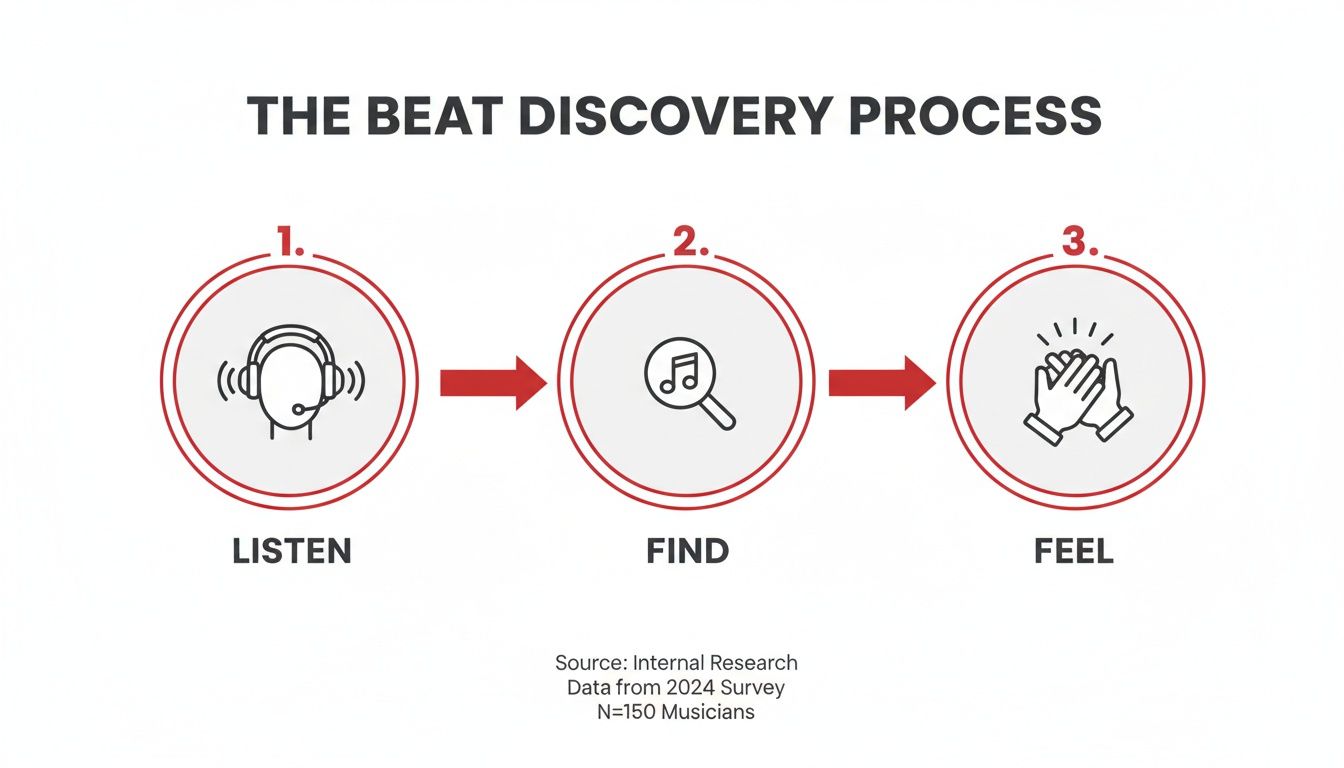
As you can see, finding the beat is an active journey that travels from your ears to your mind and finally into your body.
Why Dancers Count to Eight
Here's a little inside secret: while musicians often count in fours, dancers almost always count in sets of eight. What's the reason for the difference? It’s because a typical musical phrase—a complete musical thought, kind of like a sentence in a song—usually lasts for two measures of 4/4 time. By counting to eight (1-2-3-4-5-6-7-8), we align our dance steps with these longer musical ideas.
This eight-count structure is the absolute foundation of most dance choreography you'll learn. Your basic Salsa step, for instance, takes a full eight counts to complete its pattern. When you count to eight, you’re doing more than just tracking beats; you're syncing up with the song's natural flow and learning how to anticipate what's coming next.
Key Takeaway: Your main goal is to find the '1' of each eight-count phrase. That '1' is the downbeat, your anchor. It’s often highlighted by a new chord, a cymbal crash, or the start of a new line of vocals. If you can nail the '1', you'll always start your dance patterns right on time.
Introducing the 'And' Count for Finer Rhythms
Once you're comfortable counting the main beats, you can add another layer of detail. Some dances, like the Cha-Cha, have steps that land between the main beats. This is where the 'and' count becomes your best friend.
To get the hang of this, you just subdivide the beat. Instead of counting "1, 2, 3, 4," you'll count "1 and 2 and 3 and 4 and." The numbers still land on the main beats, but the 'ands' fall exactly halfway between them. That classic Cha-Cha rhythm, for example, is often counted "two, three, cha-cha-cha," which lines up rhythmically with "2, 3, 4-and-1."
This might sound a little complex at first, but it’s really just a way to add more texture and detail to your timing. Feeling a bit overwhelmed by all this counting? That's completely normal. This is where getting some hands-on instruction can make all the difference, turning these abstract concepts into confident, natural movement.
At Danza Academy, we specialize in making these ideas click. Experience it for yourself by booking our free complimentary lesson on our contact page. Our expert instructors will guide you from counting in your head to truly dancing with your heart.
Connecting Your Body to the Beat
Alright, this is where the real magic happens—the moment you take what you've heard and turn it into movement. You've been training your ears, you've learned to count, and now it's time to let that rhythm sink into your body and onto the dance floor.
The goal here isn't to nail complex choreography right away. It's about something much more fundamental: making the pulse of the music a part of you. When you start to physically feel the beat, the music stops being something you listen to and starts being something that guides you from within.
At Danza Academy, we've seen it time and again. The biggest hurdle for new dancers is simply getting out of their own heads. That’s why we always start with simple, repeatable movements to build that crucial muscle memory.
Simple Drills to Embody the Pulse
Forget fancy footwork for a second. Let's start with the most basic physical reaction to music: shifting your weight. Stand with your feet about shoulder-width apart and put on a song with a nice, clear beat.
As you count out that familiar "1, 2, 3, 4," just gently shift your weight from one foot to the other on every single count.
- On count 1: Shift your weight to your left foot.
- On count 2: Shift your weight to your right foot.
- On count 3: Shift back to your left.
- On count 4: Shift back to your right.
That’s it. Don't overthink it. Just feel the easy sway of your body lining up with the music's heartbeat. This super simple drill is incredibly powerful because it teaches your body what the beat feels like, forging a direct connection between hearing and moving.
From Weight Shifts to Foundational Steps
Once that side-to-side sway feels natural, you can start layering in some real dance steps—the kind that form the foundation of countless styles. You'll be surprised how many popular moves are built on this simple weight-shifting idea.
The basic Salsa step, for example, is just this same principle, but moving forward and back. The classic "rock step" in Swing dancing? Another perfect example—a simple, two-beat weight transfer that anchors the entire dance. If you want to see how this works in practice, we put together a list of 10 easy dance moves anyone can learn that all spring from these core concepts.
This mind-body connection isn't just a feeling; it's a skill you can train. Research from UC Press actually compared musicians and dancers on their rhythmic abilities. While musicians were a bit better at tapping out a beat with their fingers, dancers were just as good at syncing their entire body to the rhythm. Both groups totally blew the non-specialists out of the water.
This shows that dancing isn't just something you do after you hear the beat—it's an active process that actually sharpens your ability to connect with the music on a much deeper level.
When you feel that connection click for the first time, it's a genuine breakthrough. It's the moment you stop thinking about the beat and start being the beat.
Finding the Beat for Your First Dance
Your first dance is one of the most intimate moments of your wedding day. It’s more than just a series of steps; it's about feeling truly connected to your song and each other. That incredible connection starts with understanding the music's unique rhythm.
Many of today's popular wedding songs, especially modern ballads or acoustic tracks, have subtle beats that can be tricky to pin down. Unlike a high-energy pop song with a pounding drum, the rhythm might be carried by a gentle guitar strum or a soft piano melody. It’s there, you just have to know how to listen for it.
A Practical Guide for Your Special Song
The first step to confidently finding the beat in your chosen song is to just listen together—no pressure to dance yet. Put the song on and simply tap your hands on your knees to the most consistent, repeating sound you can identify. This simple act of active listening helps your body internalize the tempo before you even stand up.
Next, try to zero in on the downbeat, which is the "1" count of each measure. Listen for the moment a new line of lyrics begins or when the chorus hits with more emotional punch. That's usually where the strongest beat lands, and it gives you a reliable anchor point to start your dance.
So many couples get hung up on complex choreography, but the truth is, the most beautiful first dances are built on a simple, shared connection to the music. When you both feel the same pulse, every movement becomes more confident and synchronized.
Understanding the song's phrasing is also a game-changer. Music is often structured in sets of eight counts. Try counting along in eights and notice how the energy builds and softens over those counts. This will help you anticipate changes in the song and move together with a natural, flowing grace that looks and feels incredible.
Turning Stress into a Joyful Experience
Preparing for your first dance should be a fun part of your wedding journey, not another source of anxiety. If you're feeling a little lost on how to find the beat in music for your specific song, professional guidance can make all the difference. To feel completely prepared, check out our guide on how to prepare for your first private dance class.
Once you're comfortable connecting with the rhythm, you can have fun exploring different first dance song ideas to find the perfect track that speaks to you as a couple.
At Danza Academy, we specialize in helping couples transform wedding dance stress into a joyful process of connection. The best way to start is with our free complimentary lesson—a no-pressure opportunity to work with an expert instructor on your chosen song. Book your lesson now at https://danzaacademy.com/contact and let's create a beautiful moment together.
Still Have Questions About Finding the Beat?
It's completely normal to hit a few mental blocks, even when you know all the right techniques. Sometimes things just don't click right away. Let's tackle some of the most common hurdles we see new dancers face when they're trying to lock into the music.
"What if I Just Have No Rhythm?"
This is the number one thing we hear from new students, and I can tell you with confidence: it’s almost certainly not true. Your brain is already wired to recognize rhythm—you do it every day without thinking.
That feeling of having "no rhythm" isn't about what you can or can't hear. It's usually just a disconnect between what your ears are hearing and what your body is doing. It’s a coordination challenge, not a perception one.
So, forget about "dancing" for a minute. Start small. Just focus on the simple listening and tapping exercises we talked about earlier. Building that first mind-body connection is the real secret to unlocking the rhythmic ability you already have.
How Can I Practice Finding the Beat by Myself?
The best thing you can do is weave it into your daily life. Make a habit of listening actively whenever you can—in the car, while cooking, or out for a walk.
Here’s a simple routine:
- Pick a song: Find something with a really clear, steady drum beat. Pop and classic rock are great for this.
- Tap along: Try to clap or tap your foot to the most obvious, consistent thump you hear. That’s usually the bass drum.
- Count it out: Once you feel that pulse, start counting out loud along with your taps: "1-2-3-4, 1-2-3-4."
A few minutes of this every day will train your ear way faster than one long, frustrating session once a week. Consistency beats intensity every time.
Remember, the goal isn't perfection; it's progress. Every time you correctly identify a beat, you are strengthening the neural pathways that make this skill feel more automatic and natural over time.
Does the Type of Music Really Matter When I'm Learning?
Oh, absolutely. It matters a lot! When you're just starting out, you want to set yourself up for easy wins.
Choose music where the beat is strong, clear, and impossible to ignore. Pop, disco, and a lot of classic rock songs are perfect because the drums are right up front in the mix. You want to save the tricky stuff—like intricate jazz, atmospheric classical music, or complex Latin rhythms—for later. Stick with the easy-to-follow stuff until you feel confident in your basic listening skills.
Why Do Dancers Count to Eight, Not Four?
Great question. While most of the music you hear is in 4/4 time (meaning four beats per measure), dance choreography is built around longer musical phrases. Think of a phrase as a complete musical sentence. Most of the time, these phrases last for two of those four-beat measures.
So, dancers count in sets of eight (1-2-3-4-5-6-7-8) to line up their movements with the song's bigger structure. It makes it so much easier to remember choreography, stay synced up with a partner, and feel what's coming next in the music. It’s a simple hack that helps you dance with the music, not just on top of it.
Ready to put all this into practice? The quickest way to build real confidence is with an expert who can give you personalized feedback and help you connect these ideas to your own body. At Danza Academy, we specialize in making rhythm feel simple and intuitive.
Your first step is on us.
Book Your Free Complimentary Lesson Today and let us show you how to find the beat and start moving with confidence.